Rising Adoption of Hydrogen Fuel Cell Vehicles Drives Reciprocating Hydrogen Compressor Market Growth
According to our latest study, "Reciprocating Hydrogen Compressor Market Size and Forecast (2021–2034), Global and Regional Share, Trend, and Growth Opportunity Analysis – by Type, End User, and Geography," the market was valued at US$ 893.88 million in 2025 and is expected to reach US$ 1555.23 million by 2034; it is estimated to record a CAGR of 6.3% during 2026–2034. The report includes prospects owing to the current reciprocating hydrogen compressor market trends and their foreseeable impact during the forecast period.
Governments worldwide are prioritizing the development of cleaner and more sustainable industrial solutions, including in the automotive sector, driven by rising concerns over resource depletion, environmental degradation, air pollution, and increasing greenhouse gas emissions. This shift in policy direction and public awareness has accelerated demand for hydrogen fuel cell vehicles, which supports the need for high-pressure hydrogen handling and compression systems, including reciprocating hydrogen compressors. Growing government investments in hydrogen refueling infrastructure and consumer purchase incentives are enabling original equipment manufacturers (OEMs) to expand their revenue potential and strengthen their geographic reach. India launched the National Green Hydrogen Mission in January 2023 with an estimated investment of US$2,000 million to develop its hydrogen ecosystem.
Reciprocating Hydrogen Compressor Market Analysis — by Geography
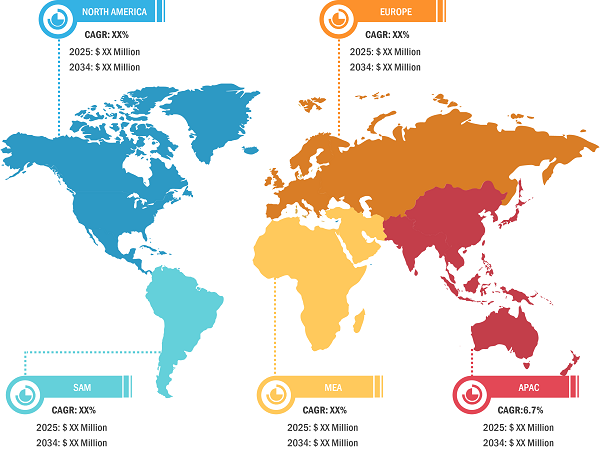
Reciprocating Hydrogen Compressor Market Size, Trends & Demand by 2034
Download Free SampleReciprocating Hydrogen Compressor Market Size and Forecast (2021 - 2034), Global and Regional Share, Trend, and Growth Opportunity Analysis Report Coverage: By Type (Lubricated and Oil-free), End User (Power Plants, Oil and Gas, Food and Beverages, Petrochemical and Chemical, Hydrogen Fueling Stations, Hydrogen Storage (Tube Trailers), and Others), and Geography (North America, Europe, Asia Pacific, Middle East and Africa, and South and Central America)
Source: The Insight Partners Analysis
Hydrogen fuel cell electric vehicles (FCEVs) provide several advantages compared to conventional internal combustion engine (ICE) vehicles, including higher efficiency and longer driving ranges. On average, FCEVs deliver nearly 63 miles per gallon gasoline equivalent (MPGge), compared to approximately 29 MPGge for ICE vehicles, with hybrid configurations improving efficiency by ~3.2%. FCEVs are capable of traveling nearly 300 miles on a single refueling, while the Honda Clarity achieves up to 366 miles, among the highest ranges for zero-emission vehicles in the US. As a result of these performance benefits, the adoption of hydrogen vehicles is steadily increasing. According to a May 2024 study by Springer Nature, South Korea leads in fuel cell vehicle adoption with approximately 19,270 units across passenger cars, buses, and trucks, followed by the US with ~12,283 units. Continued policy support, along with technological advancements from key industry players, is strengthening hydrogen infrastructure development and driving reciprocating hydrogen compressor market growth.
The report includes the reciprocating hydrogen compressor market forecast by type, and end user. In terms of type, the market is bifurcated into oil-free and lubricated. By end user , the market is segmented into power plants, oil and gas, food and beverages, chemical and petrochemical, automotive and refueling stations, hydrogen storage, and others.
The scope of the reciprocating hydrogen compressor market report focuses on North America (the US, Canada, and Mexico), Europe (Russia, the UK, Germany, France, Italy, and the Rest of Europe), Asia Pacific (South Korea, China, India, Japan, Australia, and the Rest of Asia Pacific), the Middle East and Africa (South Africa, Saudi Arabia, the UAE, and the Rest of Middle East and Africa), and South and Central America (Brazil, Argentina, and the Rest of South and Central America).
The reciprocating hydrogen compressor market in the Asia Pacific is segmented into Australia, China, Japan, India, South Korea, and the Rest of APAC. These countries together represent a diverse mix of both mature and developing hydrogen markets, shaped by varying levels of industrial development, energy transition targets, and renewable energy integration. China leads the region, supported by its large-scale hydrogen production capacity, strong policy framework, and rapid expansion of hydrogen infrastructure across transportation and industrial applications, driving strong demand for reciprocating hydrogen compressors. Japan and South Korea are early adopters, focusing primarily on hydrogen fuel cell technologies and import-dependent hydrogen supply chains, supported by their advanced automotive and electronics industries.
India is steadily developing its hydrogen ecosystem through initiatives such as the National Green Hydrogen Mission, aimed at reducing fossil fuel dependence and strengthening domestic production capabilities. Australia has emerged as a key exporter of green hydrogen, benefiting from abundant renewable energy resources and a strong focus on large-scale hydrogen project development. The Rest of APAC, including several Southeast Asian economies, remains in the early stages of hydrogen adoption but is expected to grow steadily, driven by rising investments, supportive policy frameworks, and increasing focus on decarbonization in power and industrial sectors. Overall, the region offers strong long-term potential for hydrogen infrastructure expansion, cross-border hydrogen trade, and rising deployment of reciprocating hydrogen compressor systems.
Global Reciprocating Hydrogen Compressor Market Analysis: Competitive Landscape and Key Developments
The global reciprocating hydrogen compressor market report highlights the factors driving market growth and the key developments of prominent players. Atlas Copco AB; Fluitron, Inc.; Gardner Denver Nash, LLC; Burckhardt Compression AG; HAUG Sauer Kompressoren AG; Howden Group; NEUMAN & ESSER GROUP; Hydro-Pac, Inc.; Lenhardt & Wagner GmbH; PDC Machines Inc.; Sundyne; and Ariel Corporation are among the key players profiled in the reciprocating hydrogen compressor market report. Other players were also studied and analyzed to get a holistic view of the market and its ecosystem. Market players focus on new product launches, expansion, diversification, and acquisition strategies to capitalize on prevailing business opportunities.
- In March 2026, Kawasaki Heavy Industries, Ltd. announced it has constructed a facility at Harima Works (Kako-gun, Hyogo Prefecture) to demonstrate its KM Comp-H2 centrifugal hydrogen compressor for hydrogen liquefaction plants and started demonstrations using 100% pure hydrogen gas from January 2026. This activity stems from the Green Innovation Fund Project “Development of Large-scale High-efficiency Equipment for Hydrogen Liquefiers” sponsored by the New Energy and Industrial Technology Development Organization (NEDO) and is the world’s first trial aimed at hydrogen liquefaction plants.
- In December 2025, KAJI TECHNOLOGY CORPORATION. (hereinafter referred to as ‘the Company’) will introduce high-pressure hydrogen compressors to the Korean market through collaboration with KOREA GASGEN Co., Ltd.
Contact Us
Phone: +1-646-491-9876
Email Id: sales@theinsightpartners.com