
3D Magnetic Sensor Market Size, Growth & Trends by 2034
Coverage: by Type (Rotary 3D Magnetic Sensor, Linear 3D Magnetic Sensor); Application (Automobile, Industrial, Consumer Electronics, Others) , and Geography (North America, Europe, Asia Pacific, and South and Central America)
- Status : Data Released
- Report Code : TIPRE00007876
- Category : Electronics and Semiconductor
- No. of Pages : 150
- Available Report Formats :


- Last update date : July 15, 2026


2025 Market Size
US$ 5.79 Bn
Base year value
2034 Forecast
US$ 11.12 Bn
Projected by 2034
CAGR 2026-2034
7.51 %
Growth rate
Addressable Market
US$ 76.16 Bn
(2026-2034)
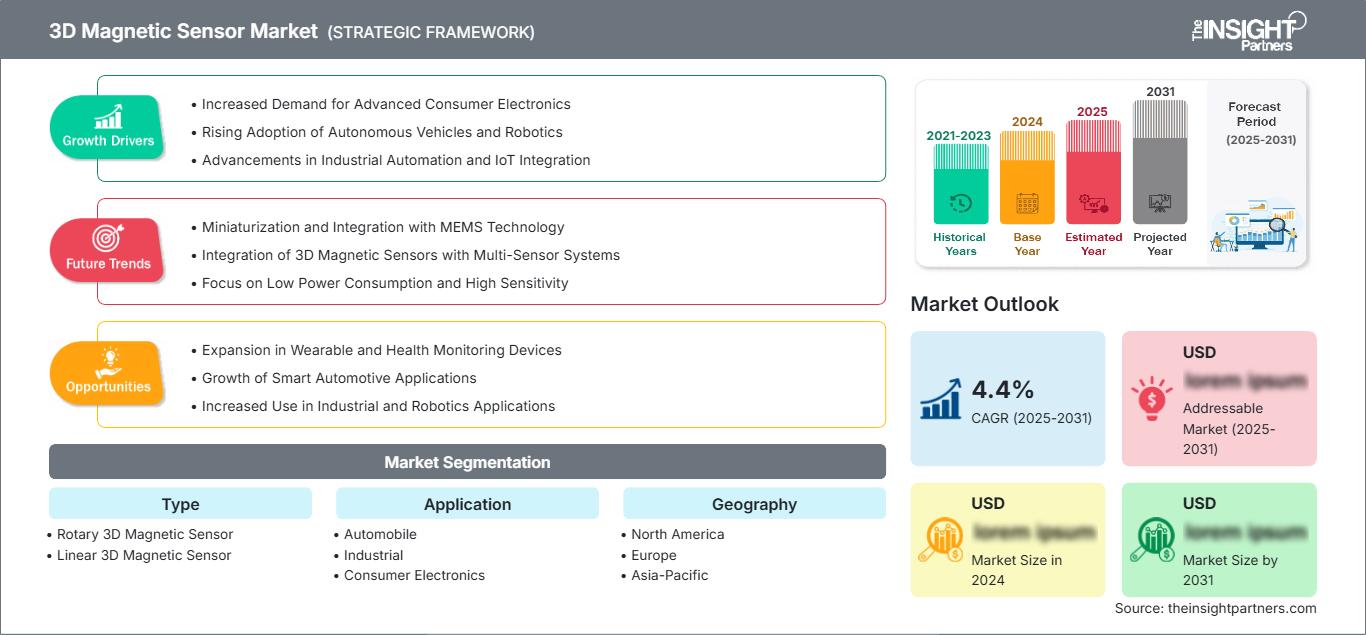
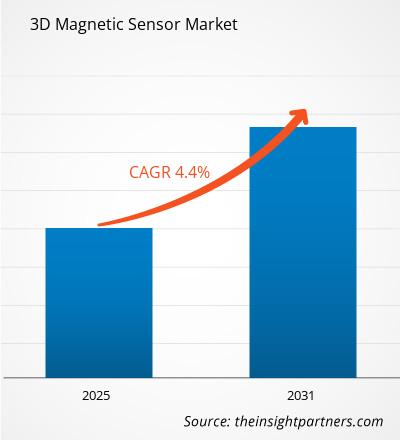
The 3D Magnetic Sensor Market was valued at US$ 5.79 Billion in 2025 and is projected to reach US$ 11.12 Billion by 2034, expanding at a CAGR of 7.51% during 2026–2034. The 3D Magnetic Sensor Market is advancing as rotary and linear sensing move deeper into automobiles, industrial automation, and consumer electronics that require contactless position, angle, and displacement measurement.
North America is expected to grow at a CAGR range of 6.8–7.2% during 2026–2034, supported by automotive electrification, factory automation, and defense-grade position sensing. The region benefits from established semiconductor design ecosystems, functional-safety engineering, and demand for compact multi-axis sensors in steer-by-wire, robotics, smart appliances, and medical-adjacent equipment where robustness and low power consumption are critical.
3D Magnetic Sensor Market Assessment and Insights
- North America: 27–31% share in 2025, growing at a CAGR of 6.8–7.2% during 2026–2034, supported by EV platforms, industrial robotics, and local sensor design depth.
- US: 76–80% share of North America in 2025, growing at a CAGR of 6.9–7.3% during 2026–2034, driven by automotive electronics and automation.
- Europe: 22–26% share in 2025, growing at a CAGR of 6.4–6.8% during 2026–2034, with Germany, France, and the UK leading automotive and industrial adoption.
- Asia Pacific: 34–38% share in 2025, growing at a CAGR of 8.1–8.5% during 2026–2034, led by China, Japan, South Korea, and India.
- Largest Segment: Rotary 3D Magnetic Sensor holds 58–62% market share in 2025, growing at a CAGR of 7.1–7.5% during 2026–2034.
- High Growth Segment: Linear 3D Magnetic Sensor holds 38–42% market share in 2025, growing at a CAGR of 8.0–8.4% during 2026–2034.
- Key companies analyzed in detail: Allegro MicroSystems, Inc., Infineon Technologies AG, TDK Corporation, Melexis NV, Alps Alpine Co., Ltd., Baumer Holding AG, Honeywell International Inc., Elmos Semiconductor SE, TE Connectivity plc, ams-OSRAM AG
Source: The Insight Partners' analysis based on proprietary research, government publications, company annual reports, investor presentations, industry databases, and expert interviews.
The 3D Magnetic Sensor market report has shifted from single-axis Hall switches toward integrated three-axis Hall, TMR, and advanced magnetic position ICs with embedded diagnostics. Automotive suppliers increasingly prefer programmable sensors that reduce magnet count, simplify mechanical tolerances, and support ISO 26262 design paths. Production dynamics now emphasize wafer-level accuracy, calibration, electromagnetic immunity, and packaging that can withstand temperature, vibration, and stray-field exposure across compact mechatronic assemblies.
Future expansion will be concentrated in Asia Pacific electronics manufacturing, European vehicle safety platforms, and North American robotics and electrification programs. Investment is moving toward low-power sensor fusion, resolver replacement, and integrated diagnostics for software-defined vehicles. Regulatory pressure around vehicle safety, energy efficiency, and industrial machine reliability will continue widening the 3D Magnetic Sensor Market scope beyond conventional position sensing.
3D Magnetic Sensor Market Report Scope
| Report Attribute | Details |
|---|---|
| Market size in 2025 | US$ 5.79 Billion |
| Market Size by 2034 | US$ 11.12 Billion |
| Global CAGR (2026 - 2034) | 7.51% |
| Historical Data | 2021-2024 |
| Forecast period | 2026-2034 |
3D Magnetic Sensor Market Analysis
Demand is driven by vehicles, industrial actuators, consumer devices, and smart machines that need precise contactless measurement in confined mechanical spaces. The 3D Magnetic Sensor Market size reflects rising sensor content in pedals, gear selectors, steering systems, brushless motors, joysticks, appliance controls, and robotic joints. Value creation spans magnetic IC design, magnet selection, calibration software, packaging, validation, and long-term customer qualification.
The competitive landscape is concentrated among analog and mixed-signal specialists with automotive-grade manufacturing depth. Infineon Technologies AG, Melexis NV, Allegro MicroSystems, Inc., TDK Corporation, and ams-OSRAM AG compete on accuracy, diagnostics, and application engineering, while Honeywell International Inc., TE Connectivity plc, Elmos Semiconductor SE, Baumer Holding AG, and Alps Alpine Co., Ltd. strengthen industrial and interface-specific positioning.
● REPORT CUSTOMIZATION
Tailor This Report To Align With Your Specific Business Requirements
This report can be customized to align precisely with your business objectives, scope, and target markets. Customization options include tailored segmentation, geography, competitive analysis, and strategic insights to support informed decision-making.
Customize This Report →WHAT YOU CAN ADJUST
- ● Segmentations
- ● Geography
- ● Competitive Analysis
- ● Language Preferences
3D Magnetic Sensor Market: Strategic Insights
Regional Insights
North America 3D Magnetic Sensor Market
North America accounts for 27–31% share in 2025 and is projected to grow at a CAGR of 6.8–7.2% during 2026–2034. Adoption is tied to electric vehicle controls, steer-by-wire validation, industrial robots, and automated equipment requiring durable contactless feedback. Functional-safety requirements encourage suppliers to offer diagnostic-rich products that reduce system-level risk.
The regional supply chain benefits from semiconductor design centers, automotive electronics engineering, aerospace testing, and medical device manufacturing. The 3D Magnetic Sensor Market share is reinforced by high-value applications rather than only unit volume. Customers prioritize long product lifecycles, temperature stability, and electromagnetic robustness, especially in motor control, cockpit interfaces, and industrial safety systems.
U.S. 3D Magnetic Sensor Market
The U.S. accounts for 76-80% of North American demand in 2025 and is expected to see a CAGR of 6.9-7.3%. The growth is attributed to electric mobility, warehouse automation, aerospace controls, and the development of user interfaces for consumer devices. In-house engineering personnel are favoring the use of a multi-axis magnetic sensor due to redundancy in motion sensing and mechanical space saving.
Customers of Allegro Microsystems Inc., Honeywell International Inc., TE Connectivity plc, and ams-OSRAM AG are in the automotive, industrial, and electronics segments. Applications range from accelerator pedals and rotary encoders to battery disconnects, robotic grippers, and smart-home controls. Suppliers whose products incorporate IC features together with design software will have a competitive edge over others.
Europe 3D Magnetic Sensor Market
In Europe, market share is between 22-26% for 2025 and is forecast to increase at a CAGR of 6.4-6.8%. Germany holds a leadership position due to advanced solutions in vehicle electronics, electric powertrains, industrial drives, and automation products. OEMs and Tier 1 companies from Germany focus on stray-field immunity, calibration repeatability, and documentation for steering, braking, and actuator systems.
UK markets are enabled by engineering capabilities in motorsports, aerospace systems, medical devices, and advanced manufacturing. French markets include automotive electronics, industrial robotics, and aerospace electronics, where the application emphasis is on miniaturized magnetic sensing with reduced mechanical wear. The European 3D Magnetic Sensor Market trends center on reliability, traceability, and efficient energy management.
Italy and Spain provide additional demand via industrial machinery, two-wheeler electronics, consumer appliances, and automotive parts manufacturing. Growth is consistent rather than explosive because the qualification process is lengthy, yet design wins can last for a long time. European customers start to benchmark magnetic sensing against optical and inductive solutions from a lifecycle cost perspective.
APAC 3D Magnetic Sensor Market
Asia Pacific accounts for 34–38% share in 2025 and is forecast to grow at a CAGR of 8.1–8.5%. China leads regional demand through EV production, consumer electronics assembly, industrial automation, and domestic semiconductor localization.
Japan and South Korea promote the use of high-quality sensors in robotics, automotive electronics, video game hardware, and appliances. India is rising in two-wheeled vehicle electrification, industrial automation, and the encouragement of electronics production.
Australia remains small yet significant in mining automation, defense electronics, and industrial monitoring. Electronics policies, battery supply, and factory digitization increase the region's relevance for 3D Magnetic Sensor Market expansion.
Middle East & Africa 3D Magnetic Sensor Market
The Middle East & Africa market is projected to grow at a CAGR of 5.8–6.2%. Saudi Arabia leads demand through industrial modernization, smart infrastructure, energy automation, and localized manufacturing ambitions.
Adoption in logistics automation, aerospace ventures, intelligent buildings, and security applications is being promoted in the UAE. In South Africa, contributions come from mining automation, industrial automation, and automotive components.
Demand in the Rest of MEA remains project-driven and involves importing sensors that are integrated into machinery, consumer durables, and energy infrastructure. Growth will depend on distribution and service.
Segmentation Analysis
Type
The type segment is expected to grow at a CAGR of 7.4–7.8% during 2026–2034. Rotary designs dominate because steering, pedals, knobs, valves, BLDC motors, and encoders need accurate angular feedback. Linear designs are gaining momentum in long-stroke actuators, level sensing, robotics, and human-machine interfaces where contactless displacement measurement reduces wear and improves sealing.
- Rotary 3D Magnetic Sensor: This sub-segment leads adoption because angular measurement is central to pedals, steering, knobs, valves, motor feedback, and encoders across automotive, industrial, and consumer platforms.
- Linear 3D Magnetic Sensor: This sub-segment is strategically important for long-stroke measurement, joystick travel, robotic actuators, level detection, and sealed mechanisms where optical sensing is less reliable.
Application
The application segment is projected to grow at a CAGR of 7.5–7.9% during 2026–2034. Automobile demand remains largest as EVs, safety systems, and cockpit controls expand sensor content. Industrial automation adds high-reliability motion feedback, while consumer electronics uses magnetic sensing for compact interfaces, gaming peripherals, foldables, and wearables requiring low power and durability.
- Automobile: Demand is led by pedals, gear selectors, steering angle, throttle, valve position, e-motors, battery systems, and comfort controls that require functional safety and durable sensing.
- Industrial: Adoption is tied to robotics, drives, valves, factory automation, machine tools, and predictive maintenance, where sealed contactless feedback improves lifecycle reliability.
- Consumer Electronics: Usage is expanding in gaming devices, AR/VR accessories, foldables, wearables, appliances, and smart controls, where compact multi-axis sensing improves responsiveness and power efficiency.
Opportunity Snapshot
| Application | Revenue Contribution | Trend Tag | Adoption Stage |
| Automobile | High | EV Controls | Mature |
| Industrial | Medium | Robotic Motion | Scaling |
| Consumer Electronics | Medium | Gaming Input | Scaling |
| Others | Low | Medical Tools | Emerging |
3D Magnetic Sensor Market Growth Drivers and Impact Analysis
Vehicle Electrification and Functional-Safety Sensing
The electric vehicle needs increased accuracy in position, orientation, and current proximity sensing for traction, pedal, charging, thermal, brake, and steering actuation. 3D magnetic sensors are appealing because they are contactless, dirt-tolerant, and can simplify mechanical designs. Further requirements come from safety regulations and x-by-wire technologies, which require redundancy, self-diagnosis, and reliable operation in the presence of stray magnetic fields. From a practical perspective, there will be more sensors per car, particularly in electric and hybrid cars, as automakers replace mechanical switches and older Hall-effect sensors with programmable multi-axis ICs that enable platform reuse.
Industrial Automation and Robotics Feedback Expansion
Factory installations now use collaborative robots, AGVs, servodrives, and intelligent valves that require tiny feedback sensors capable of functioning amid dust, oil, vibration, and temperature fluctuations. Magnetic sensors provide sealing capability and require less maintenance than mechanical sensors. Industrial users have a greater preference for reliable repeatability in their applications, which positively impacts the manufacture of premium-quality products with calibrated outputs and diagnostics. Such a factor broadens the scope for the 3D Magnetic Sensor Market analysis in the automobile industry and drives demand for rotary and linear sensors in the application sectors mentioned above.
Compact Consumer Interfaces and Low-Power Electronics
Consumer electronics companies have been incorporating magnetic sensing technology into game controllers, keyboards, VR/AR devices, wearables, foldable devices, appliances, and smart home devices. The attraction includes low power consumption, quick response, robustness, and the ability to perform motion sensing even from sealed enclosures. As products become increasingly thin and complex, multi-axis magnetic sensors can replace physical switches. This will have implications for shorter product cycles for miniature rotary and linear control mechanisms, where suppliers will compete on smaller packaging, digital interfaces, and software calibration capabilities.
3D Magnetic Sensor Market Future Trends
Resolver Replacement in Compact Motion Systems
Future designs will increasingly use magnetic ICs to replace bulkier resolver or potentiometer-based feedback in selected low- and mid-power motion systems. This trend will be strongest where designers need lower weight, easier assembly, and digital diagnostics without sacrificing angular accuracy. Automotive auxiliaries, electric bikes, industrial actuators, and small robots should be among the early adopters. Suppliers who offer magnet designs as a reference, calibration capabilities, and safety documentation will help reduce the customer’s development cycle and increase the chance of winning the design. The development will not replace resolvers in extreme-traction applications but will expand the market for 3D magnetic sensing.
Sensor Fusion with Embedded Diagnostics
The next wave of magnetic sensor technology will integrate magnetic sensing capabilities with diagnostic functions, microcontroller interfacing, and software compensation to mitigate changes in accuracy caused by temperature variations, magnet aging, and stray fields. This will facilitate the development of software-defined cars, predictive maintenance, and adaptive user interfaces. Magnetic sensors could even be fused with inertial, pressure, or current sensing to increase situational awareness. Firms that excel in analog design and firmware platforms will have an advantage as customers demand application-ready sensing modules rather than just sensor chips. This shift reinforces the importance of validation tools and long-term field data.
3D Magnetic Sensor Market Opportunities
Automotive Platform Design-Ins for EV and ADAS Electronics
An automotive platform design-in presents an appealing long-cycle business opportunity because a single validated sensor configuration can be used across all vehicle variants, geographies, and model years. Suppliers have the opportunity to pursue EV controls, brake and steering actuators, e-shifters, thermal management valves, and cockpit controls, using accurate sensors with ASIL-compatible diagnostics and flexible communication interfaces. The opportunity requires action to ensure evaluation boards, magnet simulation capabilities, safety documentation, and calibration software are in place at the beginning of the design cycle.
Localized Industrial and Consumer Electronics Supply in Asia
The localization of Asia Pacific region opens up chances for regional Application Engineering, Distribution Partnership, and Manufacturing Alignment. Regions such as China, Japan, South Korea, India, and Southeast Asia are growing in electronics, robotics, gaming peripherals, appliances, and the electric-vehicle supply chain, resulting in a need for localized application engineering. Foreign suppliers can team up with local module manufacturers, whereas local companies can try to outdo their competitors through better calibration, testing, and packaging. The chance will facilitate growth in the 3D Magnetic Sensor Market forecast, where design iteration and a reliable supply chain are required.
Recent Developments
- May 2026: TDK Corporation introduced the Micronas HAL 13xy family, a factory-programmable Hall-effect switch sensor designed for speed and direction detection in automotive and industrial applications. Leveraging TDK-Micronas’ proven 3D HAL technology, HAL 13xy features three orthogonal Hall elements (X, Y, Z) arranged in a pixel cell, providing 90° phase separation (quadrature signal) that is inherently independent of magnet pole spacing and air gap. This design enables the simultaneous measurement of two magnetic-field components, offering manufacturers maximum flexibility in sensor and magnet placement.
- July 2025: Infineon Technologies AG has launched the third generation of the XENSIV™ 3D magnetic Hall-effect sensor family, comprising three product series: TLE493D-W3B6-Bx, TLE493D-P3B6, and TLE493D-P3I8. Developed in accordance with ISO26262, the sensor family provides integrated diagnostic functions to support functional safety applications up to ASIL-B.
- April 2026: LZE GmbH strengthened its semiconductor sales network through a cooperation with Karl Kruse GmbH & Co. KG. For Karl Kruse, the partnership marks its entry into the field of magnetic field sensor technology. New partnership strengthens semiconductor distribution of magnetic field sensors.
Frequently Asked Questions

- Comprehensive Market Sizing and Forecast Analysis
- Detailed Segmentation Analysis
- In-Depth Market Dynamics Assessment
- Regional and Country-Level Insights
- Competitive Landscape and Company Benchmarking
- Strategic Business Intelligence
Recent Reports
Testimonials

The Insight Partners' SCADA System Market report is comprehensive, with valuable insights on current trends and future forecasts. The team was highly professional, responsive, and supportive throughout. We are very satisfied and highly recommend their services.
RAN KEDEM Partner, Reali Technologies LTDs
I requested a report on a very specific software market and the team produced the report in a few days. The information was very relevant and well presented. I then requested some changes and additions to the report. The team was again very responsive and I got the final report in less than a week.
JEAN-HERVE JENN Chairman, Future Analytica
We worked with The Insight Partners for an important market study and forecast. They gave us clear insights into opportunities and risks, which helped shape our plans. Their research was easy to use and based on solid data. It helped us make smart, confident decisions. We highly recommend them.
PIYUSH NAGPAL Sr. Vice President, High Beam Global
The Insight Partners delivered insightful, well-structured market research with strong domain expertise. Their team was professional and responsive throughout. The user-friendly website made accessing industry reports seamless. We highly recommend them for reliable, high-quality research services
YUKIHIKO ADACHI CEO, Deep Blue, LLC.
This is the first time I have purchased a market report from The Insight Partners.While I was unsure at first, I visited their web site and felt more comfortable to take the risk and purchase a market report.I am completely satisfied with the quality of the report and customer service. I had several questions and comments with the initial report, but after a couple of dialogs over email with their analyst I believe I have a report that I can use as input to our strategic planning process.Thank you so much for taking the extra time and making this a positive experience.I will definitely recommend your service to others and you will be my first call when we need further market data.
JOHN SUZUKI President and Chief Executive Officer, Board Director, BK Technologies
I wish to appreciate your support and the professionalism you displayed in the course of attending to my request for information regarding to infectious disease IVD market in Nigeria. I appreciate your patience, your guidance, and the fact that you were willing to offer a discount, which eventually made it possible for us to close a deal. I look forward to engaging The Insight Partners in the future, all thanks to the impression you have created in me as a result of this first encounter.
DR CHIJIOKE ONYIA MANAGING DIRECTOR, PineCrest Healthcare Ltd.Reason to Buy
- Informed Decision-Making
- Understanding Market Dynamics
- Competitive Analysis
- Identifying Emerging Markets
- Customer Insights
- Market Forecasts
- Risk Mitigation
- Boosting Operational Efficiency
- Strategic Planning
- Investment Justification
- Tracking Industry Innovations
- Aligning with Regulatory Trends





 Get Free Sample for