
3D Printed Surgical Models Market Demand, Trends & Forecast by 2034
Coverage: By Specialty (Cardiac Surgery, Gastroenterology, Endoscopy of Esophagus, Neurosurgery, Orthopedic Surgery, Reconstructive Surgery, Surgical Oncology, Transplant Surgery); End User (Hospitals, Specialty Clinics, Others) , and Geography (North America, Europe, Asia Pacific, and South and Central America)
- Status : Data Released
- Report Code : TIPRE00019697
- Category : Life Sciences
- No. of Pages : 150
- Available Report Formats :


- Last update date : July 30, 2026


2025 Market Size
US$ 3,463.11 Mn
Base year value
2034 Forecast
US$ 9,236.59 Mn
Projected by 2034
CAGR 2026-2034
11.52 %
Growth rate
Addressable Market
US$ 55,917.15 Mn
(2026-2034)
The 3d printed surgical models market was valued at US$ 3,463.11 Million in 2025 and is projected to reach US$ 9,236.59 Million by 2034, registering a CAGR of 11.52% during 2026–2034. Demand is expanding as hospitals and specialty clinics use patient-specific anatomical models to plan complex procedures, rehearse surgical approaches, improve team communication, train clinicians, and support patient education across high-risk surgical specialties.
Across North America, 3d printed surgical models market size is supported by point-of-care 3D printing programs, advanced imaging infrastructure, and wider clinical acceptance of patient-specific planning. The region is estimated to grow at a CAGR range of 10.9–11.8% during 2026–2034. FDA recognizes 3D printing’s ability to produce patient-matched devices and anatomical models from CT or MRI data, strengthening clinical workflow adoption.
3D Printed Surgical Models Market Assessment and Insights
- North America held 40–43% share in 2025 and is projected to grow at a CAGR between 2026–2034 of 10.9–11.8%, supported by hospital 3D labs, surgical planning programs, and pediatric specialty centers.
- US represented 86–89% of North America in 2025 and is expected to grow at a CAGR between 2026–2034 of 10.8–11.7%, led by academic hospitals and complex surgery programs.
- Europe accounted for 27–30% share in 2025 and is forecast to expand at a CAGR between 2026–2034 of 10.2–11.0%, with Germany, the UK, Belgium, France, and Spain leading adoption.
- Asia Pacific captured 21–24% share in 2025 and is projected to grow at a CAGR between 2026–2034 of 12.6–13.5%, driven by China, Japan, South Korea, India, and Australia.
- Largest Segment Hospitals held 72–76% market share in 2025 and is expected to grow at a CAGR range of 11.1–11.9% during 2026–2034 due to point-of-care adoption.
- High Growth Segment Surgical Oncology represented 14–18% share in 2025 and is forecast to grow at a CAGR range of 13.0–13.9% during 2026–2034 as tumor planning expands.
- Key companies analyzed in detail: Stratasys Ltd., 3D Systems, Inc., Lazarus 3D, LLC, Osteo3D, Axial3D Ltd., Onkos Surgical, Inc., Formlabs Inc., Materialise NV, 3D LifePrints Limited, and WhiteClouds.
Source: The Insight Partners' analysis based on proprietary research, government publications, company annual reports, investor presentations, industry databases, and expert interviews.
This sector has moved away from basic demonstrative models to produce highly accurate tissue-mimicking, sterilizable, and procedure-specific anatomical replicas. Surgical rehearsals, device fit testing, tumor visualization, and risk communication are being done using the models at hospitals. Factors affecting the 3d printed surgical models market include automated segmentation, online ordering through the cloud, radiology, and biomaterials mimicking bone, myocardium, vessels, cartilage, or soft tissue.
Future demand will be driven by advancements in reimbursement, 3D printing of hospital models, and the speed of conversion of DICOM data to models. On-demand printing has been gaining traction beyond early adopters, with Materialise stating 2025 trends for automation, AI, efficient workflow, oncology, and congenital heart disease. This growth will be seen more in collaboration among surgeons, radiologists, and biomedical engineers under quality system standards.
3D Printed Surgical Models Market Report Scope
| Report Attribute | Details |
|---|---|
| Market size in 2025 | US$ 3,463.11 Million |
| Market Size by 2034 | US$ 9,236.59 Million |
| Global CAGR (2026 - 2034) | 11.52% |
| Historical Data | 2021-2024 |
| Forecast period | 2026-2034 |
3D Printed Surgical Models Market Analysis
Demand is driven by complex anatomy, surgical risk reduction, resident training, patient consent, and the need to understand spatial relationships that are difficult to interpret from two-dimensional scans. 3d printed surgical models market growth is reinforced by published evidence that patient-specific models support planning, rehearsal, education, and communication across specialties.
The value chain includes medical imaging, segmentation software, radiology review, 3D design, material selection, printing, post-processing, quality checks, clinical engineering, and surgical team feedback. Supply dynamics favor providers with validated workflows, fast turnaround, tissue-mimicking materials, privacy controls, and the ability to deliver repeatable models for urgent surgical cases.
The competitive landscape combines global additive manufacturing companies and specialized medical modeling providers. 3d printed surgical models market analysis shows Stratasys Ltd., 3D Systems, Inc., Materialise NV, Formlabs Inc., Axial3D Ltd., and Lazarus 3D, LLC competing through anatomical realism, software workflows, clinical validation, and hospital partnerships.
Osteo3D, Onkos Surgical, Inc., 3D LifePrints Limited, and WhiteClouds add specialist capabilities in orthopedic, reconstructive, oncology, and educational models. Strategic positioning depends on model accuracy, clinical turnaround, regulatory documentation, specialty-specific material libraries, integration with hospital imaging systems, and evidence that models reduce uncertainty, operating time, or training gaps.
● REPORT CUSTOMIZATION
Tailor This Report To Align With Your Specific Business Requirements
This report can be customized to align precisely with your business objectives, scope, and target markets. Customization options include tailored segmentation, geography, competitive analysis, and strategic insights to support informed decision-making.
Customize This Report →WHAT YOU CAN ADJUST
- ● Segmentations
- ● Geography
- ● Competitive Analysis
- ● Language Preferences
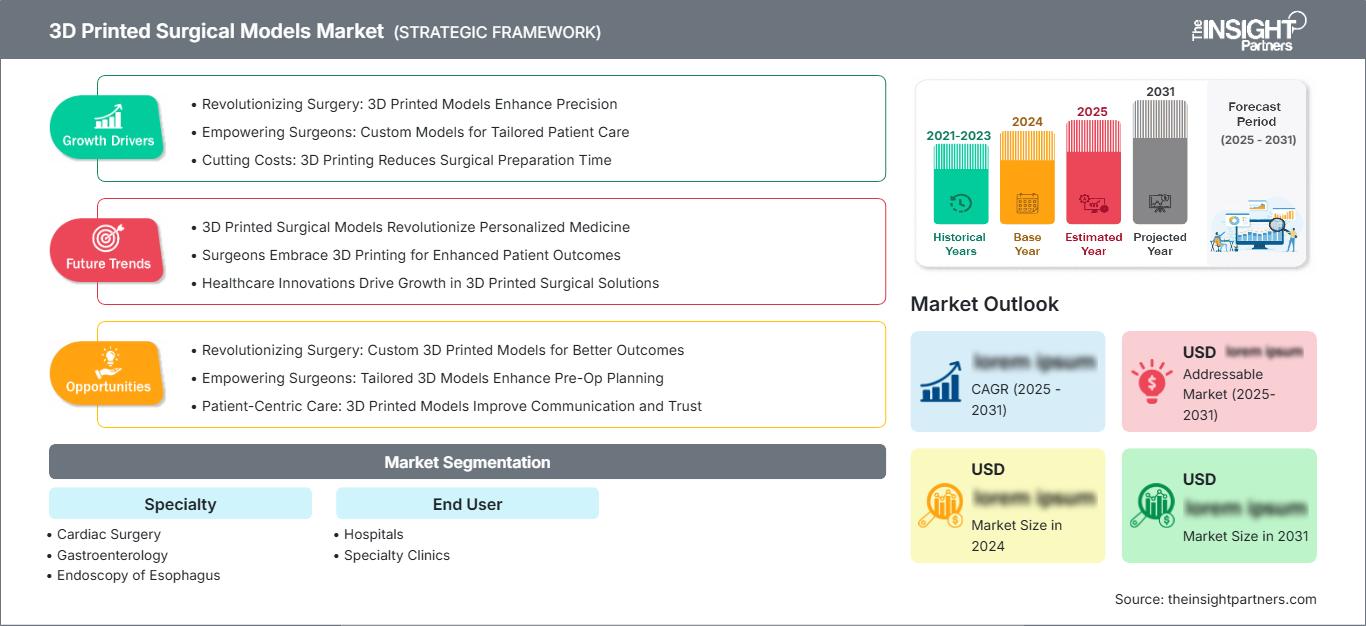
3D Printed Surgical Models Market: Strategic Insights
Regional Insights
North America 3d printed surgical models Market
North America held 40–43% share in 2025 and is projected to grow at a CAGR of 10.9–11.8% during 2026–2034. Adoption is supported by academic hospitals, pediatric centers, cancer institutes, and surgical innovation departments. Hospitals increasingly create anatomical models in-house to support cardiac, orthopedic, neurosurgical, transplant, and oncology cases where spatial understanding directly affects surgical strategy.
The 3d printed surgical models market share in North America is reinforced by FDA-regulated additive manufacturing guidance and broader infrastructure for point-of-care 3D printing. Stratasys states that hospital 3D printing can improve surgical planning by converting CT and MRI scans into patient-specific models for visualization, rehearsal, and communication.
U.S. 3d printed surgical models Market
The U.S. represented 86–89% of North America in 2025 and is expected to grow at a CAGR of 10.8–11.7% during 2026–2034. Its scale reflects high surgical volumes, tertiary hospital concentration, pediatric specialty programs, and early adoption of point-of-care additive manufacturing.
Company presence is strong through hospital labs, software platforms, and service bureaus. Stratasys Ltd., 3D Systems, Inc., Formlabs Inc., Materialise NV, Lazarus 3D, LLC, Axial3D Ltd., Onkos Surgical, Inc., and WhiteClouds support workflows spanning segmentation, printing, anatomical modeling, surgical rehearsal, and patient education. Applications concentrate on cardiovascular defects, cranial tumors, orthopedic deformity, transplant planning, and reconstruction.
Europe 3d printed surgical models Market
Europe accounted for 27–30% share in 2025 and is forecast to expand at a CAGR of 10.2–11.0% during 2026–2034. Germany is in the lead position owing to its capabilities in hospital engineering, medical devices, and surgery innovation programs. The United Kingdom, Belgium, France, and Spain encourage adoption using their health care systems and specialized hospitals.
The German market is driven by advanced capabilities in medical engineering and high utilization of 3D planning for orthopedic and reconstruction surgeries. The UK is influenced by 3D LifePrints Limited and personalized surgery at the hospital level. Belgium is a key player because of Materialise NV and its role in 3D planning, case management, and personalized surgery processes in hospitals.
France, Italy, and Spain are growing through oncology, cardiology, and reconstructive surgery programs. European adoption is evidence-based and involves evaluation of the efficiency of operating room procedures, informed consent, and clinical governance. In the Materialize 2025 hospital forum, there was a growing community of surgeons, radiologists, and clinical engineers in Europe pushing for the scaling of 3D planning.
APAC 3d printed surgical models Market
APAC held 21–24% share in 2025 and is projected to grow at a CAGR of 12.6–13.5% during 2026–2034. China leads regional volume through hospital modernization and local additive manufacturing capacity, while Japan, South Korea, India, and Australia contribute through specialty surgery and academic programs.
Industrial and policy drivers include expanding medical imaging access, lower-cost 3D printing, and public investment in surgical innovation. India shows rising use in neurosurgical and orthopedic simulation, while Australia supports clinical modeling through tertiary hospitals. Stratasys’ AIIMS Delhi case study illustrates neurosurgical training adoption in India.
Middle East & Africa 3d printed surgical models Market
The Middle East & Africa is projected to grow at a CAGR of 8.7–9.5% during 2026–2034. Saudi Arabia leads demand through tertiary hospitals, surgical modernization, and medical innovation programs. The UAE follows with premium hospital systems, medical tourism, and specialist reconstruction services.
South Africa anchors African adoption through private hospitals and university-linked biomedical engineering programs. The rest of MEA remains early-stage because surgical models require high-quality imaging, segmentation skills, and printer governance. Gulf healthcare investment supports procurement, but broader adoption depends on trained clinical engineers and sustainable reimbursement.
Segmentation Analysis
Specialty
The Specialty segment is expected to grow at a CAGR of 11.3–12.1% during 2026–2034. 3d printed surgical models market scope across specialties is driven by anatomical complexity, surgical risk, training needs, and the value of tactile rehearsal. Cardiac, neurosurgery, orthopedic, oncology, and transplant use cases carry strong demand because model-based planning can clarify critical structures and procedural sequence.
- Cardiac Surgery uses models for congenital heart disease, valve anatomy, vascular pathways, and chamber relationships, supporting preoperative rehearsal and clearer communication between surgeons, cardiologists, and families.
- Gastroenterology benefits from anatomical models when complex hepatobiliary, pancreatic, or colorectal cases require spatial understanding of tumors, vessels, ducts, and adjacent organs before intervention.
- Endoscopy of Esophagus applications include simulation, procedural training, and complex anatomy review, especially where tumor location, narrowing, or reconstruction planning affects endoscopic or surgical strategy.
- Neurosurgery uses models for tumors, vascular lesions, skull base anatomy, and complex approaches where tactile rehearsal can improve orientation around critical neural and vascular structures.
- Orthopedic Surgery represents a major use case because deformities, fractures, revisions, and tumor resections benefit from drill testing, osteotomy planning, implant sizing, and resident education.
- Reconstructive Surgery uses models for craniofacial, trauma, congenital, and soft-tissue reconstruction, helping teams pre-shape plates, evaluate symmetry, and plan anatomical restoration.
- Surgical Oncology is the fastest-growing specialty because tumor resection depends on margin visualization, organ-sparing strategy, vascular mapping, and coordination between resection and reconstruction teams.
- Transplant Surgery uses models for donor-recipient anatomy, vascular variation, and organ positioning, supporting planning in kidney, liver, and pediatric transplant cases with complex anatomical constraints.
End User
The End User segment is projected to grow at a CAGR of 11.0–11.8% during 2026–2034. Hospitals dominate because they manage complex surgeries, imaging, operating rooms, and multidisciplinary teams. Specialty clinics use models selectively, particularly in orthopedics, cranio-maxillofacial care, and procedural training, where case complexity justifies external or in-house model production.
- Hospitals hold the largest position because they use surgical models for complex planning, resident education, patient consent, device fit checks, and multidisciplinary care coordination.
- Specialty Clinics adopt models for selected high-value cases, especially orthopedic deformity, oncology reconstruction, endoscopy training, and patient education, where tactile visualization improves planning confidence.
Opportunity Snapshot
| Segment Name | Revenue Contribution | Trend Tag | Adoption Stage |
|---|---|---|---|
| Hospitals | High | Point Care | Scaling |
| Specialty Clinics | Medium | Case Rehearsal | Scaling |
3D Printed Surgical Models Market Growth Drivers and Impact Analysis
Need for Better Visualization in Complex Surgery
Complex surgery often requires surgeons to mentally convert two-dimensional CT or MRI slices into three-dimensional anatomy. Patient-specific models reduce this interpretation burden by providing a tactile reference for tumor margins, vascular branching, fracture planes, and congenital defects. Stratasys highlights that 3D printed anatomical models help clinicians plan procedures, communicate with teams and families, and train on rare anatomy. The 3d printed surgical models market benefits because hospitals can use models to identify optimal surgical approaches before entering the operating room. Real-world impact is strongest in cardiac surgery, neurosurgery, transplant surgery, and surgical oncology, where anatomical uncertainty can affect procedure time and risk.
Expansion of Point-of-Care 3D Printing Programs
Point-of-care 3D printing in hospitals is on the rise because of the need to cut down outsourcing, safeguard patient information, and hasten treatment planning for emergency cases. According to Materialise, the trend in point-of-care in 2025 will see increased uptake of point-of-care technology in congenital heart disease and oncology, while AI and automation increase efficiency in operations. FDA mentions 3D devices and models used in point-of-care as well. The market implications for such trends include growing demands for printers, segmentation software, materials, and workflow advice in hospitals.
Growing Use in Surgical Education and Simulation
Training through surgery will become one of the main forces in the industry as the need for realism is being felt in hospitals and training institutions to lessen reliance on cadavers and enhance rehearsal. Stratasys’ case study from AIIMS Delhi provides an insight into how FDM, PolyJet, and Digital Anatomy technology were used to train in neurosurgery procedures such as craniotomy and neuro-endoscopy. Lazarus 3D has soft synthetic models made from polymer that can be cut and sutured, and also customized using CT or MRI images.
3D Printed Surgical Models Market Future Trends
AI-Enabled Segmentation and Case Automation
AI-enabled segmentation will define 3d printed surgical models market trends as hospitals seek faster conversion of imaging data into surgical-grade models. Axial3D focuses on automation and segmentation techniques that help in scaling patient-specific care to medical device manufacturers and hospitals, whereas Materialise focuses on automation and artificial intelligence-driven workflows for 3D planning at the point of care. Future systems will have the ability to reduce the time taken to do manual contouring, improve model consistency, and handle a larger number of cases. The adoption of these solutions will be based on clinical validation, radiologist approval, data transfer security, and PACS integration.
Tissue-Mimicking and Imaging-Visible Models
Future simulations will progress from shape fidelity towards the real behavior of the tissue, radiopacity, and procedure simulation. Stratasys and Siemens Healthineers have created 3D printed patient-specific phantoms from RadioMatrix material and Digital Anatomy technology to mimic human anatomy for CT imaging study and algorithm creation. This allows models that can be scanned, cut, sutured, drilled, and practiced more realistically. Applications where touch and imaging behavior are important include endoscopy, neurosurgery, cardiac surgery, orthopedic drilling, and surgical oncology.
3D Printed Surgical Models Market Opportunities
Hospital-Based 3D Planning Centers
3d printed surgical models market Forecasts indicate a strong opportunity in hospital-based 3D planning centers that serve multiple specialties under one quality-managed workflow. There are also some possible applications for the use of shared segmentation groups, reliable printing, clinical engineers, and standardization of case intake portals for the use of cardiac, orthopedic, oncology, neurosurgery, and transplant teams. More than 150 people participated in the 2025 hospital 3D planning forum, according to Materialise. The commercial success of the technology will be determined by training, accuracy, documentation, reimbursement assistance, and evidence of models improving procedures.
Specialty-Specific Simulation and Training Libraries
Simulation libraries that are specific to particular specialties provide a great opportunity for printers and for providers of models. Lazarus 3D was awarded the 2025 NIH SBIR Phase I grant to develop and validate a cardiac presurgical planning simulation library for congenital heart defects via the use of 3D printing technology because there is a need for such medically oriented simulation systems. The providers will be able to generate a consistent income through the creation of patient-specific and reusable models for cardiac surgery, endoscopy, neurosurgery, orthopedic oncology, transplant, and reconstruction.
Recent Developments
- October 2025: Stratasys Ltd. published new resources on 3D-printed anatomical models for surgical planning, highlighting recent hospital data on time, cost, outcomes, point-of-care model production, and how patient-specific models support preoperative visualization, procedural rehearsal, team communication, and patient education across complex surgical specialties.
- July 2025: Materialise NV hosted the 2025 3D Planning and Printing in Hospitals Forum in Leuven, Belgium, bringing together more than 150 surgeons, radiologists, and clinical engineers. The event focused on scaling hospital 3D planning, clinical breakthroughs, point-of-care workflows, and collaborative implementation of personalized surgical solutions.
- June 2025: Axial3D Ltd. highlighted AXCEL, its AI-driven, cloud-based platform for medical device companies, in its June 2025 company update. The platform is positioned to streamline patient-specific workflows, improve scalability, and support personalized surgical planning through automated 3D data and planning capabilities.
Frequently Asked Questions

- Comprehensive Market Sizing and Forecast Analysis
- Detailed Segmentation Analysis
- In-Depth Market Dynamics Assessment
- Regional and Country-Level Insights
- Competitive Landscape and Company Benchmarking
- Strategic Business Intelligence
Recent Reports
Testimonials

The Insight Partners' SCADA System Market report is comprehensive, with valuable insights on current trends and future forecasts. The team was highly professional, responsive, and supportive throughout. We are very satisfied and highly recommend their services.
RAN KEDEM Partner, Reali Technologies LTDs
I requested a report on a very specific software market and the team produced the report in a few days. The information was very relevant and well presented. I then requested some changes and additions to the report. The team was again very responsive and I got the final report in less than a week.
JEAN-HERVE JENN Chairman, Future Analytica
We worked with The Insight Partners for an important market study and forecast. They gave us clear insights into opportunities and risks, which helped shape our plans. Their research was easy to use and based on solid data. It helped us make smart, confident decisions. We highly recommend them.
PIYUSH NAGPAL Sr. Vice President, High Beam Global
The Insight Partners delivered insightful, well-structured market research with strong domain expertise. Their team was professional and responsive throughout. The user-friendly website made accessing industry reports seamless. We highly recommend them for reliable, high-quality research services
YUKIHIKO ADACHI CEO, Deep Blue, LLC.
This is the first time I have purchased a market report from The Insight Partners.While I was unsure at first, I visited their web site and felt more comfortable to take the risk and purchase a market report.I am completely satisfied with the quality of the report and customer service. I had several questions and comments with the initial report, but after a couple of dialogs over email with their analyst I believe I have a report that I can use as input to our strategic planning process.Thank you so much for taking the extra time and making this a positive experience.I will definitely recommend your service to others and you will be my first call when we need further market data.
JOHN SUZUKI President and Chief Executive Officer, Board Director, BK Technologies
I wish to appreciate your support and the professionalism you displayed in the course of attending to my request for information regarding to infectious disease IVD market in Nigeria. I appreciate your patience, your guidance, and the fact that you were willing to offer a discount, which eventually made it possible for us to close a deal. I look forward to engaging The Insight Partners in the future, all thanks to the impression you have created in me as a result of this first encounter.
DR CHIJIOKE ONYIA MANAGING DIRECTOR, PineCrest Healthcare Ltd.Reason to Buy
- Informed Decision-Making
- Understanding Market Dynamics
- Competitive Analysis
- Identifying Emerging Markets
- Customer Insights
- Market Forecasts
- Risk Mitigation
- Boosting Operational Efficiency
- Strategic Planning
- Investment Justification
- Tracking Industry Innovations
- Aligning with Regulatory Trends





 Get Free Sample for