
4D Printing Market Share, Growth & Forecast by 2034
4D Printing Market Size and Forecasts (2021 - 2034), Global and Regional Share, Trends, and Growth Opportunity Analysis Report Coverage : By Type of Programmable Material (Programmable Carbon Fiber, Programmable Textiles, Programmable Bio-Material, Programmable Wood), End-User Industry (Medical, Aerospace, and Defense, Automotive, Other)
- Status : Data Released
- Report Code : TIPRE00039692
- Category : Electronics and Semiconductor
- No. of Pages : 150
- Available Report Formats :


- Last update date : July 16, 2026


2025 Market Size
US$ 302.34 Mn
Base year value
2034 Forecast
US$ 4,441.59 Mn
Projected by 2034
CAGR 2026-2034
34.79 %
Growth rate
Addressable Market
US$ 16,032.16 Mn
(2026-2034)
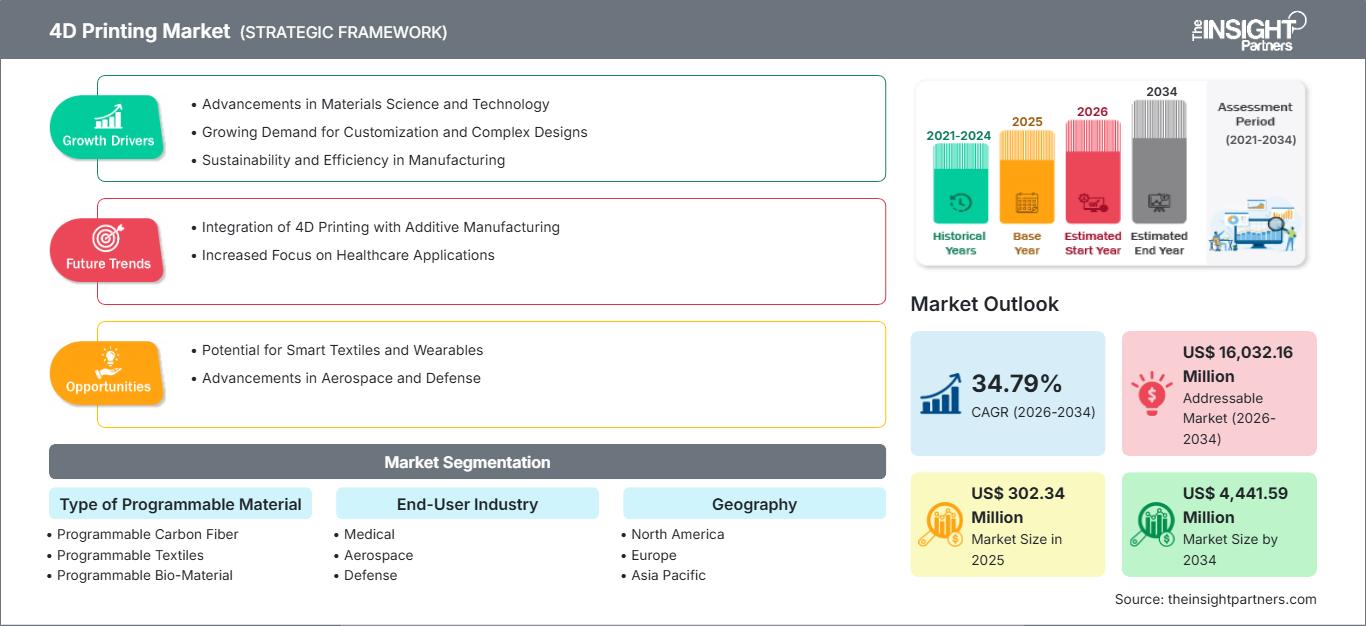
The 4D Printing Market size was valued at US$ 302.34 Million in 2025 and is projected to reach US$ 4,441.59 Million by 2034, expanding at a CAGR of 34.79% during 2026–2034. The market is advancing as programmable materials add time-dependent transformation to additive manufacturing, enabling printed structures to change shape, stiffness, function, or assembly behavior after exposure to heat, moisture, light, pressure, or biological stimuli.
North America is projected to experience a 33.8% to 34.4% CAGR rate from 2026 to 2034, owing to defense-driven material science research, aerospace lightweighting, biomedical applications, and high-end polymer development. The adoption of the region is driven by lab work between universities and industry, additive manufacturing services, and use in adaptive implants, morphing aerospace components, programmable fabrics, and shape-memory composites.
4D Printing Market Assessment and Insights
- North America: 36–40% share in 2025, growing at a CAGR of 33.8–34.4% during 2026–2034, supported by defense R&D, aerospace qualification, medical innovation, and smart-material pilot programs.
- US: 80–84% share of North America in 2025, growing at a CAGR of 34.1–34.7% during 2026–2034, driven by biomedical engineering, aerospace primes, and additive manufacturing software ecosystems.
- Europe: 24–28% share in 2025, growing at a CAGR of 32.4–33.0% during 2026–2034, with Germany, the UK, France, and Italy leading programmable material research and industrial pilots.
- Asia Pacific: 25–29% share in 2025, growing at a CAGR of 36.2–36.9% during 2026–2034, led by China, Japan, South Korea, and India across smart textiles, healthcare, electronics, and automotive applications.
- Largest Segment: Programmable Textiles hold 40–44% market share in 2025, growing at a CAGR of 34.2–34.8% during 2026–2034 due to adaptive wearables, defense fabrics, and medical compression uses.
- High Growth Segment: Medical holds 22–26% market share in 2025, growing at a CAGR of 37.0–37.8% during 2026–2034 as bio-adaptive implants, tissue scaffolds, and patient-specific devices scale.
- Key companies analyzed in detail: Organovo Holdings, Inc., BICO Group AB, Stratasys Ltd., Materialise NV, Autodesk, Inc., Hewlett Packard Enterprise Company, Desktop Metal, Inc., 3D Systems Corporation, Dassault Systèmes SE, Voxeljet AG.
Source: The Insight Partners' analysis based on proprietary research, government publications, company annual reports, investor presentations, industry databases, and expert interviews.
4D printing is a field that has advanced from a proof of concept to a niche technology, adding to traditional additive manufacturing by leveraging material programming, simulation, and stimulus response to create value in products. Technological advancement in this field is shifting from creating simple prototypes to creating shapes that can fold, unfold, expand, harden, soften, or fit themselves once the creation process is complete.
During the 4D Printing Market forecast period, forward momentum will strengthen where high-value applications justify longer validation cycles and material qualification. Asia-Pacific will grow in terms of electronics, intelligent clothing and healthcare manufacturing, whereas Europe will focus on sustainable material and industry standards. There will be regulatory interest in personalized medicine, aircraft efficiency, and robust military systems, increasing the market size through faster commercialization, particularly as labs translate programmable structures into standardized manufacturing processes.
4D Printing Market Report Scope
| Report Attribute | Details |
|---|---|
| Market size in 2025 | US$ 302.34 Million |
| Market Size by 2034 | US$ 4,441.59 Million |
| Global CAGR (2026 - 2034) | 34.79% |
| Historical Data | 2021-2024 |
| Forecast period | 2026-2034 |
4D Printing Market Analysis
4D Printing Market analysis shows that the demand is determined by industries that need adaptive technology in order to minimize the assembly process, weight, stock, or surgery. Aerospace and defense industries assess self-assembling structures, shape-morphing surfaces, and programmable composites, whereas medical sectors examine implants and scaffolds with a response to the biological environment. The focus of WHO on personalized and affordable healthcare will further drive interest in patient-specific devices, whereas IATA traffic recovery will emphasize efficiency priorities for aircraft.
Additive Manufacturing hardware, BioFabrication hardware, Materials Science technology, Simulation software, and Application Engineering make up the competitive environment. Companies such as Stratasys Ltd, Materialize NV, Autodesk Inc., Hewlett Packard Enterprise Company, Desktop Metal Inc., 3D Systems Corporation, Dassault Systèmes SE, Voxeljet AG, Organovo Holdings Inc., and BICO Group AB compete on validated workflows, software-driven design, bioprinting capabilities, and materials for industry. Investments are made in smart materials libraries and digital twins.
● REPORT CUSTOMIZATION
Tailor This Report To Align With Your Specific Business Requirements
This report can be customized to align precisely with your business objectives, scope, and target markets. Customization options include tailored segmentation, geography, competitive analysis, and strategic insights to support informed decision-making.
Customize This Report →WHAT YOU CAN ADJUST
- ● Segmentations
- ● Geography
- ● Competitive Analysis
- ● Language Preferences
4D Printing Market: Strategic Insights
Regional Insights
North America 4D Printing Market
North America accounts for 36–40% share in 2025 and is projected to grow at a CAGR of 33.8–34.4% during 2026–2034. The region benefits from additive manufacturing maturity, federally funded materials science, defense prototyping, and biomedical engineering. The regional market share is reinforced by strong university laboratories, aerospace primes, medical device developers, and software companies that support transformation modeling.
The regionally based purchasers focus on replicating behavior, fatigue tolerance, sterility, and traceability before proceeding from prototyping to full production. In North America, the emerging technology trends include adaptable stents, deployable aerospace structures, responsive fabric for military applications, and programmable carbon fiber parts. While usage remains limited, high-end applications enable suppliers to charge premium prices once they demonstrate transformation dependability.
U.S. 4D Printing Market
The U.S. represents 80–84% of North American demand in 2025 and is forecast to grow at a CAGR of 34.1–34.7%. The application is mainly active in aerospace, defense, regenerative medicine, soft robotics, and smart material technologies. Some of the companies that support the ecosystem include Organovo Holdings, Inc., Stratasys Ltd., Autodesk, Inc., 3D Systems Corporation, and Materialize NV.
U.S. consumers are experimenting with adaptive implants, tissue models, deployable space parts, and military fabric that reacts to moisture, temperature, or physical stress. The market size of 4D printing in America is driven by venture capital investment, defense research labs, FDA device development, and aircraft weight-reduction programs. The selection of suppliers is based on the precision of transformation, biocompatibility, and compatibility with additive manufacturing systems.
Europe 4D Printing Market
Europe holds 24–28% share in 2025 and is expected to grow at a CAGR of 32.4–33.0%. Germany leads regional commercialization through industrial automation, automotive engineering, technical textiles, and applied research institutes. Its materials ecosystem supports programmable composites and shape-memory polymers for adaptive tooling, lightweight components, and responsive manufacturing systems.
The UK's involvement lies in the sectors of aerospace, defense research, and biotechnology, through biomedical engineering research in universities and innovation centers focused on self-assembling structures and bio-reactive materials. France, on the other hand, brings to the table aircraft, medical equipment, and high-end textile applications, while Italy brings in applications of design-based intelligent clothing and automotive components. Adoption in Europe is systematic due to validation and conformity assessments.
Spain is advancing through research projects in smart materials, medical devices, and industrial printing. Growth potential in the European market is linked to Horizon-type projects, sustainability goals, and customer trust in the consistent behavior of materials. Material suppliers that use simulation, certification, and end-use testing will be better suited to regional business.
APAC 4D Printing Market
Asia Pacific accounts for 25–29% share in 2025 and is forecast to grow at a CAGR of 36.2–36.9%. China leads regional demand through electronics, medical devices, smart textiles, and EV-oriented materials development.
Japan and South Korea have precision manufacturing, robotics, bioengineering, and advanced polymers. India is rising through the localization of medical technology, engineers, and additive manufacturing facilities linked to the aerospace and automotive sectors.
Australia is small but significant in defense research, mining safety technology, and biomedical initiatives. Support for advanced manufacturing, health care access, and electronics localization continues to fuel market development.
Middle East & Africa 4D Printing Market
The Middle East & Africa market is projected to grow at a CAGR of 28.6–29.3%. Saudi Arabia leads demand through industrial diversification, healthcare modernization, defense localization, and smart infrastructure programs.
Adoption in the UAE is driven by services in aerospace, logistics, construction technology, and medical tourism. In South Africa, it is through mining equipment, research, and prototyping of medical devices.
Demands from the rest of MEA will be project-driven with use of imported systems in research and specialized manufacturing. This will depend on skills training and availability of materials.
Segmentation Analysis
Type of Programmable Material
The type of programmable material segment is expected to grow at a CAGR of 34.5–35.1% during 2026–2034. Adoption is driven by the need to match transformation behavior with end-use conditions, including moisture-triggered swelling, heat-driven shape recovery, load-responsive stiffness, and bio-responsive actuation. Material choice determines printability, stimulus sensitivity, durability, and qualification cost, making it the core technical decision in every 4D Printing Market project.
- Programmable Carbon Fiber: This sub-segment supports aerospace, automotive, and defense structures where lightweight strength, directional stiffness, and shape recovery can reduce mechanical assemblies and improve performance under controlled thermal or mechanical triggers.
- Programmable Textiles: This sub-segment leads adoption because smart apparel, medical compression, defense camouflage, and soft robotics benefit from flexible fabrics that respond to moisture, heat, strain, or body movement.
- Programmable Bio-Material: This sub-segment is strategically important for tissue scaffolds, drug delivery, implants, and regenerative medicine because biological environments require materials that can adapt, degrade, or reshape safely.
- Programmable Wood: This sub-segment remains early stage but relevant for sustainable design, architecture, furniture, and packaging where moisture-responsive swelling, folding, and natural fiber behavior can enable low-energy transformation.
End-User Industry
The end-user industry segment is projected to grow at a CAGR of 35.0–35.6% during 2026–2034. Demand is strongest where adaptive behavior creates measurable value, such as fewer surgical steps, lighter aircraft parts, deployable defense structures, and configurable vehicle components. End users are moving from research prototypes toward pilot applications that require repeatability, simulation evidence, safety testing, and compatibility with existing additive manufacturing infrastructure.
- Medical: Demand is led by tissue scaffolds, shape-changing implants, drug delivery systems, stents, and patient-specific devices that can respond to temperature, moisture, pH, or biological signals.
- Aerospace: Adoption is tied to lightweight morphing structures, self-deploying components, adaptive airfoils, and programmable composites that support fuel efficiency, compact storage, and reduced part counts.
- Defense: This sub-segment uses programmable materials for camouflage, field-deployable structures, smart textiles, and adaptive protective systems where environmental responsiveness can improve survivability and logistics.
- Automotive: Demand is emerging in adaptive interiors, thermal management, lightweight components, soft actuators, and self-fitting assemblies as automakers explore programmable materials for EV and mobility platforms.
Opportunity Snapshot
| End-User Industry | Revenue Contribution | Trend Tag | Adoption Stage |
| Medical | High | Adaptive Implants | Scaling |
| Aerospace | High | Morphing Parts | Scaling |
| Defense | Medium | Smart Camouflage | Emerging |
| Automotive | Medium | Adaptive Interiors | Emerging |
4D Printing Market Growth Drivers and Impact Analysis
Smart Materials Moving from Research to Application
Advances in shape-memory polymers, hydrogels, programmable carbon fiber, and bio-materials are converting laboratory demonstrations into application-specific prototypes. The real-world impact is a broader design space for products that assemble, deploy, or adapt without motors, hinges, or complex electronics. This reduces part count and may lower maintenance in aerospace, medical, and defense systems where compact storage or responsive behavior is valuable. The driver also expands the 4D Printing Market analysis beyond hardware sales because materials formulation, simulation, testing, and post-processing increasingly define supplier competitiveness and customer adoption.
Medical Personalization and Bio-Responsive Devices
Healthcare demand is rising because 4D printing can produce patient-specific devices that change form after placement, respond to body temperature, or support tissue growth over time. This is relevant for stents, scaffolds, wound care, drug delivery, and implants where static geometry may limit performance. The market impact is higher collaboration among hospitals, biofabrication firms, materials suppliers, and regulators. Commercial progress will depend on biocompatibility data, sterilization stability, controlled degradation, and clinical evidence, but successful applications can command premium pricing and long qualification cycles.
Aerospace and Defense Need Adaptive Lightweight Systems
Aerospace and defense organizations are exploring programmable structures because weight, compact deployment, and mission adaptability directly affect system performance. Morphing surfaces, self-deploying antennas, adaptive camouflage, and smart protective textiles can reduce mechanical complexity while improving operational flexibility. The market impact is strongest in prototyping and qualification programs, strengthening the 4D Printing Market share of suppliers whose performance gains justify higher material costs. As aircraft and defense platforms require traceable production data, suppliers that provide repeatable transformation behavior, environmental testing, and simulation-backed design will gain an advantage in long-cycle programs.
4D Printing Market Future Trends
Simulation-Led Design of Programmable Transformation
Future 4D printing workflows will rely more heavily on digital simulation before fabrication because transformation depends on material anisotropy, geometry, stimulus intensity, and environmental exposure. Software tools will help predict folding angles, swelling rates, stress concentrations, and fatigue behavior before parts are printed. This trend will reduce experimental cycles and improve confidence for medical, aerospace, and automotive buyers. Vendors with integrated design, print preparation, and validation platforms will be positioned to convert the 4D Printing Market growth opportunity into repeatable commercial programs.
Hybrid Biofabrication and Soft Robotics Convergence
Biofabrication and soft robotics will increasingly overlap as researchers combine hydrogels, living cells, elastomers, and stimuli-responsive polymers. Future systems may support minimally invasive implants, lab-grown tissue models, adaptive grippers, and medical training tools that change shape under fluid, temperature, or chemical triggers. This direction differs from current static medical printing because function emerges after fabrication. Companies with expertise in sterile workflows, biological materials, and controlled actuation will influence the next wave of 4D Printing Market trends.
4D Printing Market Opportunities
Validated Medical Pilots for Adaptive Implants
Medical pilots offer attractive commercialization pathways because adaptive behavior can solve specific clinical problems rather than compete only on manufacturing novelty. Suppliers can target scaffolds, stents, wound dressings, and implants that respond to temperature, hydration, or biological cues. The opportunity is action-oriented: partner with hospitals, build biocompatibility datasets, document sterilization effects, and align early with regulatory expectations. Successful pilots can expand the 4D Printing Market scope by proving that programmable transformation improves outcomes, procedure efficiency, or device fit in measurable ways.
Aerospace Qualification of Deployable Structures
Aerospace qualification creates opportunities for suppliers that can prove repeatable shape change under vibration, temperature cycling, humidity, and mechanical load. Self-deploying antennas, morphing ducts, adaptive panels, and lightweight brackets can reduce assembly complexity and improve packaging efficiency. The opportunity requires long-term testing, traceable materials, and collaboration with aircraft and space system integrators. Companies that provide simulation, coupon testing, and manufacturing documentation will be better placed to convert research contracts into recurring production demand.
Recent Developments
- March 2026: A Korean research team has developed a closed-loop 4D printing technology that enables self-actuating and recyclable structures using sulfur waste generated from petroleum refining processes.
- March 2025: The United States Patent and Trademark Office (USPTO) has published a new patent from New York-based IT multinational International Business Machines Corporation (IBM). According to IBM’s filing, these 4D printed substances move in response to external stimuli like heat, light, magnetic fields, or electricity. Therefore, they can be configured and manipulated to deliver microparticles (1-100µm in diameter) from a starting point to a target location in small, hard-to-reach areas.
- October 2025: BMF APAC and Shenzhen MultiMatter Science and Technology Co., Ltd. have introduced the microArch M150, a high-resolution photopolymer printer that supports multi-material 4D printing. Designed for scientific research and industrial prototyping, the system is intended to address persistent challenges in additive manufacturing by enabling the fabrication of functionally integrated, stimulus-responsive components.
Frequently Asked Questions

- Comprehensive Market Sizing and Forecast Analysis
- Detailed Segmentation Analysis
- In-Depth Market Dynamics Assessment
- Regional and Country-Level Insights
- Competitive Landscape and Company Benchmarking
- Strategic Business Intelligence
Recent Reports
Testimonials

The Insight Partners' SCADA System Market report is comprehensive, with valuable insights on current trends and future forecasts. The team was highly professional, responsive, and supportive throughout. We are very satisfied and highly recommend their services.
RAN KEDEM Partner, Reali Technologies LTDs
I requested a report on a very specific software market and the team produced the report in a few days. The information was very relevant and well presented. I then requested some changes and additions to the report. The team was again very responsive and I got the final report in less than a week.
JEAN-HERVE JENN Chairman, Future Analytica
We worked with The Insight Partners for an important market study and forecast. They gave us clear insights into opportunities and risks, which helped shape our plans. Their research was easy to use and based on solid data. It helped us make smart, confident decisions. We highly recommend them.
PIYUSH NAGPAL Sr. Vice President, High Beam Global
The Insight Partners delivered insightful, well-structured market research with strong domain expertise. Their team was professional and responsive throughout. The user-friendly website made accessing industry reports seamless. We highly recommend them for reliable, high-quality research services
YUKIHIKO ADACHI CEO, Deep Blue, LLC.
This is the first time I have purchased a market report from The Insight Partners.While I was unsure at first, I visited their web site and felt more comfortable to take the risk and purchase a market report.I am completely satisfied with the quality of the report and customer service. I had several questions and comments with the initial report, but after a couple of dialogs over email with their analyst I believe I have a report that I can use as input to our strategic planning process.Thank you so much for taking the extra time and making this a positive experience.I will definitely recommend your service to others and you will be my first call when we need further market data.
JOHN SUZUKI President and Chief Executive Officer, Board Director, BK Technologies
I wish to appreciate your support and the professionalism you displayed in the course of attending to my request for information regarding to infectious disease IVD market in Nigeria. I appreciate your patience, your guidance, and the fact that you were willing to offer a discount, which eventually made it possible for us to close a deal. I look forward to engaging The Insight Partners in the future, all thanks to the impression you have created in me as a result of this first encounter.
DR CHIJIOKE ONYIA MANAGING DIRECTOR, PineCrest Healthcare Ltd.Reason to Buy
- Informed Decision-Making
- Understanding Market Dynamics
- Competitive Analysis
- Identifying Emerging Markets
- Customer Insights
- Market Forecasts
- Risk Mitigation
- Boosting Operational Efficiency
- Strategic Planning
- Investment Justification
- Tracking Industry Innovations
- Aligning with Regulatory Trends





 Get Free Sample for