
5G In Defense Market Size Forecast & Growth Analysis by 2034
Coverage: By Communication Infrastructure (Small Cell, Macro Cell, Radio Access Network (RAN)); Network Type (Enhanced Mobile Broadband (eMBB), Ultra-Reliable Low-Latency Communications (URLLC), Massive Machine Type Communications (MMTC)); Chipset (Application-specific Integrated Circuit (ASIC) Chipset, Radio Frequency Integrated Circuit (RFIC) Chipset, Millimeter Wave (mmWave) Chipset); Core Network Technology (Software-Defined Networking (SDN), Network Functions Virtualization (NFV), Fog Computing (FC), Mobile Edge Computing (MEC)); Operational Frequency (Low, Medium, High); Platform (Land, Naval, Airborne) , and Geography (North America, Europe, Asia Pacific, and South and Central America)
- Status : Data Released
- Report Code : TIPRE00015982
- Category : Technology, Media and Telecommunications
- No. of Pages : 150
- Available Report Formats :


- Last update date : August 05, 2026


2025 Market Size
US$ 1.45 Bn
Base year value
2034 Forecast
US$ 6.32 Bn
Projected by 2034
CAGR 2026-2034
25.78 %
Growth rate
Addressable Market
US$ 48.67 Bn
(2026-2034)
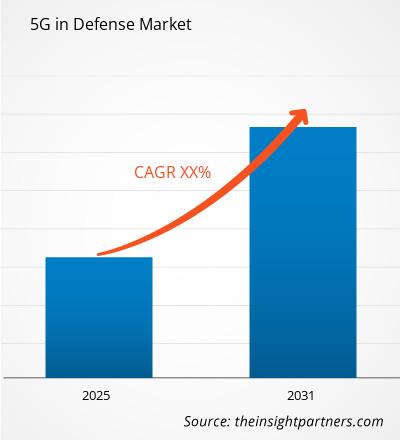
The 5G in defense market was valued at US$ 1.45 Billion in 2025 and is projected to reach US$ 6.32 Billion by 2034, expanding at a CAGR of 25.78% during 2026–2034. Increasing requirements for secure battlefield communications, real-time intelligence dissemination, autonomous defense systems, and data-intensive military operations are supporting adoption across land, naval, air, and space defense environments. Governments are also prioritizing advanced wireless infrastructure modernization programs to strengthen network-centric warfare capabilities.
Across North America, defense agencies are accelerating trials and deployments of military-grade private wireless networks, creating favorable conditions for market expansion. The 5G in defense market size is benefiting from rising investment in spectrum optimization, edge-enabled command systems, and resilient tactical communications. Regional growth is estimated to remain within a 24.5–27.5% CAGR range through 2034, supported by defense digitalization initiatives and increasing requirements for low-latency mission-critical connectivity.
5G in Defense Market Assessment and Insights
- North America: Strong military modernization spending and extensive testing of private defense networks support leadership. Share in 2025: 36–40% and CAGR between 2026–2034: 24.5–27.5%.
- US: Defense innovation programs and active participation of telecom and aerospace contractors sustain demand. Share in 2025: 78–82% of North America and CAGR between 2026–2034: 24–27%.
- Europe: NATO-led interoperability initiatives and defense communication modernization support adoption, with Germany, the UK, and France leading investments. Share in 2025: 26–30% and CAGR between 2026–2034: 24–27%.
- Asia Pacific: Military digital transformation, border surveillance upgrades, and domestic 5G ecosystem development support expansion across China, South Korea, Japan, India, and Australia. Share in 2025: 22–26% and CAGR between 2026–2034: 27–31%.
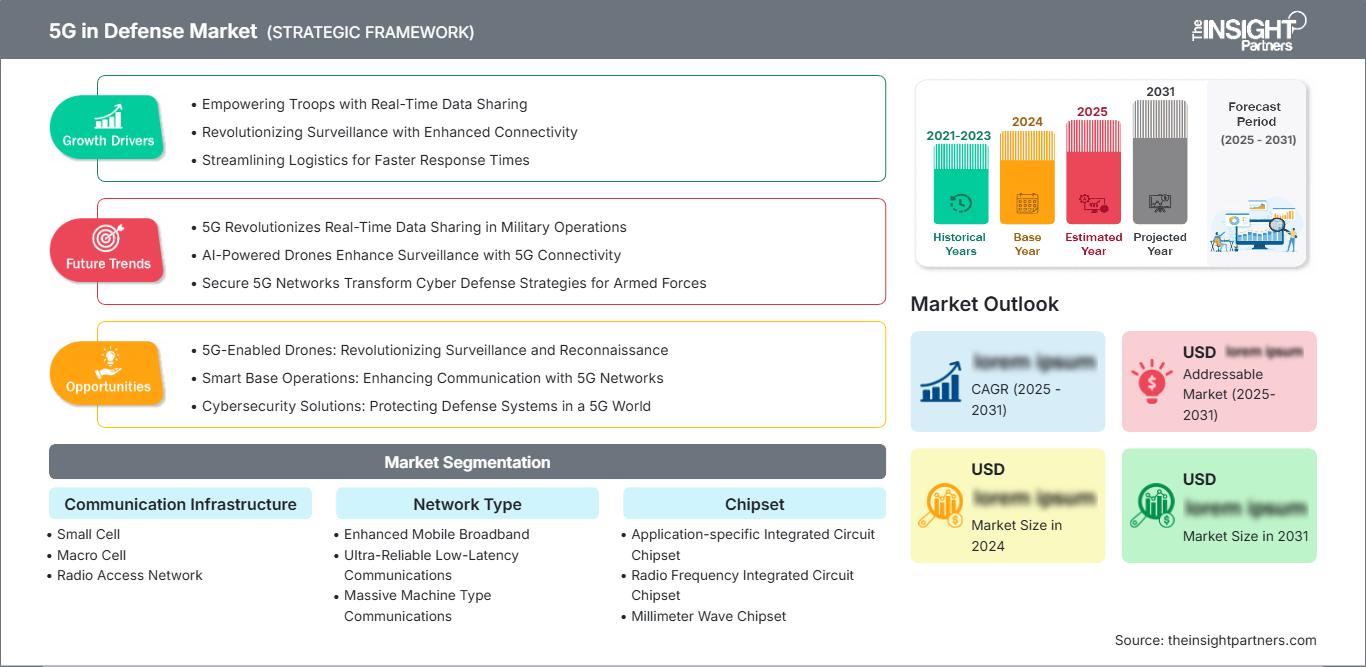
- Largest Segment: Communication Infrastructure remains dominant due to extensive deployment requirements for secure military communications. Market share in 2025: 34–38% and CAGR between 2026–2034: 24–28%.
- High Growth Segment: Mobile Edge Computing within core network technology is witnessing accelerated adoption for battlefield analytics and autonomous operations. Market share in 2025: 8–12% and CAGR between 2026–2034: 29–33%.
- Key companies analyzed in detail: Huawei Technologies Co., Ltd.; L3Harris Technologies, Inc.; NEC Corporation; Nokia Corporation; Qualcomm Technologies, Inc.; RTX Corporation; Samsung Electronics Co., Ltd.; Telefonaktiebolaget LM Ericsson; Thales S.A.; Wind River Systems, Inc.
Source: The Insight Partners' analysis based on proprietary research, government publications, company annual reports, investor presentations, industry databases, and expert interviews.
5G in defense market is reshaping communications architecture across modern defense ecosystems. Armed forces increasingly require high-bandwidth and low-latency connectivity capable of supporting unmanned systems, advanced surveillance payloads, digital command infrastructures, and multi-domain operations. Integration of edge computing, virtualization technologies, and software-defined architectures is gradually replacing traditional communication frameworks, improving operational flexibility while enabling secure transmission of rapidly expanding battlefield data volumes across geographically distributed forces.
Continued defense digitization programs across Asia Pacific, Europe, and the Middle East are expected to broaden deployment opportunities over the coming decade. Government-backed spectrum initiatives, rising investments in autonomous platforms, and demand for resilient communication networks are likely to support adoption. Regulatory support for secure private networks and increased collaboration between telecommunication providers and defense contractors are expected to strengthen long-term development prospects across both developed and emerging defense markets.
5G in Defense Market Report Scope
| Report Attribute | Details |
|---|---|
| Market size in 2025 | US$ 1.45 Billion |
| Market Size by 2034 | US$ 6.32 Billion |
| Global CAGR (2026 - 2034) | 25.78% |
| Historical Data | 2021-2024 |
| Forecast period | 2026-2034 |
5G in Defense Market Analysis
Defense organizations are increasingly prioritizing advanced connectivity platforms capable of supporting intelligence gathering, surveillance, reconnaissance, and autonomous mission execution. The 5G in defense market growth trajectory is being supported by expanding deployment of unmanned aerial vehicles, connected battlefield systems, and real-time command-and-control applications. Enhanced bandwidth availability and ultra-low latency performance allow defense operators to handle large data streams generated by sensors, radar systems, and artificial intelligence applications operating across distributed environments.
Supply chain developments are also supporting broader adoption. Semiconductor suppliers, network equipment manufacturers, cloud infrastructure providers, and defense integrators are collaborating to enhance secure communication architectures. Virtualized network infrastructure reduces dependence on hardware-intensive deployments while improving scalability. Software-defined networking, edge computing capabilities, and secure radio access technologies are becoming essential components within evolving defense communications ecosystems.
Competitive dynamics remain influenced by both defense contractors and telecommunications technology providers. The 5G in defense market analysis indicates increasing collaboration among Nokia Corporation, Telefonaktiebolaget LM Ericsson, Samsung Electronics Co., Ltd., Huawei Technologies Co., Ltd., and Qualcomm Technologies, Inc. to support specialized wireless infrastructure and network technologies. Defense-focused organizations including RTX Corporation, L3Harris Technologies, Inc., and Thales S.A. are leveraging communications expertise to address mission-critical military requirements.
Investment activity is increasingly directed toward secure private networks, advanced chipsets, edge-enabled command systems, and virtualized defense communication environments. Wind River Systems, Inc. and NEC Corporation continue supporting software-centric networking frameworks designed for mission assurance and operational resilience. Strategic positioning is increasingly dependent on cybersecurity capabilities, interoperability standards, spectrum efficiency, and the ability to support multi-domain operational concepts across complex military environments.
● REPORT CUSTOMIZATION
Tailor This Report To Align With Your Specific Business Requirements
This report can be customized to align precisely with your business objectives, scope, and target markets. Customization options include tailored segmentation, geography, competitive analysis, and strategic insights to support informed decision-making.
Customize This Report →WHAT YOU CAN ADJUST
- ● Segmentations
- ● Geography
- ● Competitive Analysis
- ● Language Preferences
5G in Defense Market: Strategic Insights
Regional Insights
North America 5G in defense market
North America accounted for approximately 36–40% 5G in defense market share in 2025 and continues to represent the largest regional market. Strong defense expenditure, advanced telecommunications infrastructure, and extensive military modernization initiatives support regional leadership. Governments across the region are investing in secure wireless communications, autonomous operational systems, and data-driven command structures. Market expansion is expected to continue at a 24.5–27.5% CAGR through 2034 as military organizations pursue enhanced network resilience and operational agility.
Regional adoption is further supported by collaboration among defense agencies, telecommunications operators, and technology developers. Investment programs focused on tactical communications, battlefield awareness solutions, and network virtualization are contributing to demand growth. Private military network deployment and integration of edge-enabled decision-making systems are becoming increasingly important. These developments are improving secure data transmission capabilities while supporting broader multi-domain operational readiness objectives across the defense sector.
U.S. 5G in defense market
The United States accounted for about 78–82% of the North American market in 2025, aided by massive modernization projects in defense and a large budget for technology procurement. The federal government is developing innovative communication architectures to facilitate intelligence activities, autonomous systems, and distributed battlefield applications. The market growth is expected to be around 24–27% CAGR during 2026-2034, driven by investments in network infrastructure.
The presence of L3Harris Technologies, Inc., RTX Corporation, Qualcomm Technologies, Inc., and Nokia Corporation is facilitating market growth. More testing of military networks based on private wireless and adoption of command solutions based on artificial intelligence are further boosting the trend. Military applications demand low-latency connectivity to enable sensor fusion and autonomous operations.
Europe 5G in defense market
Europe accounted for 26-30% of total revenue in 2025 and was expected to achieve a 24-27% CAGR through 2034. The regional demand was driven by initiatives to modernize defense communication infrastructure, the rising need for interoperability among allied forces, and investments in the security of digital communication infrastructure. Germany remained the key country within Europe owing to its industrial capability and investments in defense technology.
The UK was working towards advancing defense digitalization and next-generation military communication infrastructure. Germany possessed advanced manufacturing and telecommunications capabilities and spent on a secure defense communication system. France, Italy, and Spain were working towards making investments in defense networking infrastructure, autonomous systems connectivity, and mission-critical wireless communications systems.
APAC 5G in defense market
The Asia Pacific region accounts for around 22%-26% of worldwide revenues in 2025 and will see the highest regional growth rate, with a CAGR of 27%-31% throughout the forecast period. Countries including China, South Korea, and Japan are pursuing military digitalization initiatives, while India and Australia are improving their communications infrastructure.
Increased policy support for indigenous technology systems, along with investment in secure communication systems, is facilitating development. China is poised to be the leading regional player, while South Korea and Japan are robust innovators in this industry. Increasing surveillance and border security initiatives are helping boost regional demand.
Middle East & Africa 5G in defense market
The Middle East & Africa market is projected to expand at a 23–26% CAGR through 2034. Defense modernization efforts across Saudi Arabia and the United Arab Emirates are driving investment in secure communications infrastructure. Governments are increasingly prioritizing digital command capabilities and resilient wireless defense networks.
Saudi Arabia remains the leading regional market, supported by large defense procurement programs and technological modernization initiatives. The UAE continues investing in advanced communication technologies, while South Africa represents a key market within Africa. Expanding infrastructure development and security requirements support long-term regional adoption.
Segmentation Analysis
Communication Infrastructure
The Communication Infrastructure is projected to be the dominant segment, witnessing a 24–28% CAGR between 2026 and 2034. It is the foundation of the military wireless ecosystem owing to its ability to deliver a secure, high-throughput connection. The scope of 5G in defense market is widening further as defense companies continue their efforts to modernize radio infrastructure and communication systems.
- Small Cell: Small cell deployments support localized high-capacity coverage in military facilities, command centers, ports, and airbases. Their compact design enables efficient spectrum utilization while strengthening secure connectivity within dense operational environments.
- Macro Cell: Macro cells provide extensive geographic coverage essential for large-scale military exercises and regional operations. Defense agencies utilize these systems to maintain network continuity across expansive deployment zones and critical infrastructure assets.
- Radio Access Network: Radio access networks facilitate communication between end devices and core systems. Their strategic importance continues to increase as militaries pursue scalable, interoperable, and software-driven communications architectures for multi-domain missions.
Network Type
Network Type is expected to register a 26-30% CAGR between 2026-2034, as defense operators continue to converge their communication systems to meet their mission-driven needs. This is supported by the demand for unique connectivity solutions needed for high-bandwidth intelligence applications, as well as autonomous and machine communications.
- Enhanced Mobile Broadband: Enhanced mobile broadband supports transmission of high-resolution imagery, video surveillance, and intelligence data. Demand is rising as defense agencies increasingly depend on bandwidth-intensive applications for battlefield awareness and operational coordination.
- Ultra-Reliable Low-Latency Communications: Ultra-reliable low-latency communications enable mission-critical functions requiring immediate response times. Applications include autonomous vehicles, remote operations, tactical command systems, and high-priority defense communications where reliability is essential.
- Massive Machine Type Communications: Massive machine type communications support large numbers of interconnected sensors and devices. Their importance is growing as militaries deploy extensive surveillance, monitoring, logistics, and asset-tracking ecosystems across operational environments.
Chipset
The chipset market is estimated to grow at a CAGR of 25%-29% during 2026-2034, owing to rising requirements for processing efficiency, spectrum control, and communications. To ensure reliable networking, electronic efficiency, and performance optimization under difficult conditions, defense systems depend on custom semiconductors. Advancements in technology have improved network capacity and facilitated future military use.
- Application-specific Integrated Circuit Chipset: These chipsets provide optimized performance for specialized military applications. Their ability to deliver high processing efficiency and mission-focused functionality supports adoption across defense communication and surveillance platforms.
- Radio Frequency Integrated Circuit Chipset: Radio frequency integrated circuit chipsets enable signal transmission and reception capabilities essential for wireless defense communications. Demand remains strong due to increasing deployment of advanced radio systems and connected battlefield technologies.
- Millimeter Wave Chipset: Millimeter wave chipsets support ultra-high-speed communications and expanded network capacity. Their strategic value is increasing as military organizations evaluate advanced applications requiring substantial data throughput and low-latency performance.
Core Network Technology
Core Network Technology is estimated to grow at a 27%-31% CAGR from 2026 to 2034, the highest among segments. Network virtualization, smart orchestration, and edge computing technology are changing the landscape of defense communications systems. Increased focus on agility, cybersecurity, and distributed command remains supportive of investments in software-driven network technologies.
- Software-Defined Networking: Software-defined networking enhances flexibility by separating control and hardware functions. Defense operators leverage these capabilities to improve network management, optimize resources, and support dynamic mission requirements.
- Network Functions Virtualization: Network functions virtualization reduces hardware dependence while improving scalability and deployment efficiency. The technology is increasingly adopted to support adaptable and cost-effective military communication infrastructures.
- Fog Computing: Fog computing enables distributed processing closer to operational endpoints. This architecture helps reduce latency, improves responsiveness, and enhances decision-making capabilities within mission-critical defense environments.
- Mobile Edge Computing: Mobile edge computing delivers near-source data processing for surveillance, intelligence, and autonomous applications. Its strategic importance continues increasing as armed forces require rapid analytics and real-time operational awareness.
Opportunity Snapshot
| Segments | Revenue Contribution | Trend Tag | Adoption Stage |
| Small Cell | High | Base Coverage | Scaling |
| Macro Cell | High | Wide Area | Mature |
| Radio Access Network | High | Open RAN | Scaling |
| Enhanced Mobile Broadband | High | HD ISR | Scaling |
| Ultra-Reliable Low-Latency Communications | High | Mission Control | Scaling |
| Massive Machine Type Communications | Medium | Sensor Mesh | Emerging |
| Application-specific Integrated Circuit Chipset | High | Secure Silicon | Scaling |
| Radio Frequency Integrated Circuit Chipset | High | Spectrum Efficiency | Mature |
| Millimeter Wave Chipset | Medium | High Throughput | Emerging |
| Software-Defined Networking | High | Network Agility | Scaling |
| Network Functions Virtualization | Medium | Virtual Core | Scaling |
| Fog Computing | Medium | Distributed Processing | Emerging |
| Mobile Edge Computing | High | Edge Analytics | Scaling |
5G in Defense Market Growth Drivers and Impact Analysis
Military Digital Transformation and Network-Centric Warfare
Armed forces globally are accelerating digital transformation programs to improve situational awareness, command responsiveness, and operational effectiveness. Classic communication systems will struggle to meet modern needs for autonomous systems, AI, and real-time intelligence sharing. Next-generation wireless systems will enable flawless communication across the air, land, naval, cyber, and space domains, while increasing interoperability among military units. Defense organizations are also increasing their investment in sensors, battlefield management systems, and applications with heavy data-transfer demands. As there is increased focus on network-centric operations in military doctrine, the need for robust communication systems will grow significantly.
Expansion of Autonomous Defense Platforms
Increased use of autonomous and semi-autonomous military equipment has led to high demands for superior communication technology solutions. Drones, robotic vehicles, unmanned maritime vessels, and intelligent surveillance systems generate large volumes of data that must be transmitted securely and reliably. A superior network structure helps ensure real-time collaboration, remote-controlled operations, and the rapid distribution of intelligence. There is an increasing reliance by military commanders on autonomous systems to improve operational efficiency, reduce risk to military personnel, and enhance operational capability in difficult conditions. These demands encourage investments across the entire supply chain, from infrastructure providers and chipset makers to software vendors and system integrators.
Rising Investment in Secure Private Defense Networks
Security issues in mission-critical communications drive the increasing deployment of specialized private wireless systems on military bases. There is a need for secure, reliable connectivity to enable communication and the exchange of classified data in difficult situations. Custom-designed network architectures offer more control over performance, access, and security requirements. The modern government is actively investing in initiatives to build secure communication channels, such as virtualization technologies, edge computing, and improvements to radio network infrastructure. Such tendencies create additional business opportunities for both defense contractors and telecommunication technology providers. The use of private military networks is likely to be a key driver of industry growth during the forecast period.
5G in Defense Market Future Trends
AI-Integrated Tactical Edge Networks
The 5G in defense market trends are increasingly shaped by the convergence of artificial intelligence, edge computing, and advanced wireless communications. Military forces are supposed to employ AI-driven edge nodes that can process intelligence, surveillance, and reconnaissance information nearer to where it is acquired. This strategy helps minimize time lags and enhances decision-making agility in the mission. In the future, military architecture is set to rely on distributed systems for autonomous operations, predictive threat analysis, and flexible mission planning. An edge-enabled communication system will help enhance spectrum usage and network resilience. With increasing operational speed and situational awareness by defense establishments, AI-driven tactical edge networks are poised to be an essential component of modern military communication systems.
Expansion of Multi-Domain Connected Defense Ecosystems
There will be a need for interconnectedness in future military operations involving all the above-listed domains. Advanced communication networks will help create an integrated operational environment in which intelligence information is transferred in real time. There will be increased funding from defense agencies for inter-networking standards to enable coordinated efforts among manned platforms, unmanned vehicles, control centers, and sensors. Advancements in connectivity will lead to better synchronization of forces and greater mission efficiency. Future deployment plans will also entail mobility, software-defined, and scalable networks to meet dynamic operational situations. These trends make advanced wireless defense communication networks a key driver of multi-domain military doctrine.
5G in Defense Market Opportunities
Private Military Network Modernization Programs
Defense ministries continue allocating significant resources toward modernization of communication infrastructure, creating favorable investment conditions for technology suppliers and system integrators. The 5G in defense market Forecasts indicate expanding opportunities associated with dedicated private wireless environments across bases, testing facilities, logistics centers, and operational theaters. Organizations capable of providing secure infrastructure, virtualized network management systems, edge computing systems, and cybersecurity capabilities will be well-positioned to capitalize on changes in procurement strategies. There will be an increase in demand because the government will need sovereign communication capabilities with enhanced operational and security measures. Collaboration among telecommunications, semiconductor, and defense companies will make commercialization more promising.
Advanced Communications for Autonomous Defense Systems
Rapid expansion of autonomous defense technologies creates substantial opportunities for communication infrastructure providers and specialized technology developers. To ensure maximum effectiveness of unmanned aircraft, unmanned ground systems, unmanned maritime vehicles, and surveillance systems, these devices must have reliable and low-latency connectivity. Suppliers that can help ensure secure data communication, analytics, and networking operations will enjoy a competitive advantage. There are also opportunities in developing high-performance chipsets, virtualization software, and wireless networking technologies tailored for mission-critical applications. With military forces increasingly interested in autonomy to improve operational efficiency, investments in this sector are set to grow in the coming years.
Frequently Asked Questions

- Comprehensive Market Sizing and Forecast Analysis
- Detailed Segmentation Analysis
- In-Depth Market Dynamics Assessment
- Regional and Country-Level Insights
- Competitive Landscape and Company Benchmarking
- Strategic Business Intelligence
Recent Reports
Testimonials

The Insight Partners provided valuable market intelligence that supported our global go-to-market strategy. Their team was professional, responsive, and attentive to our feedback, providing thoughtful analysis and helpful methodological clarifications throughout the project.
Junmo Kim Chief Financial Officer (CFO), Enertech Co., Ltd.
The Insight Partners' SCADA System Market report is comprehensive, with valuable insights on current trends and future forecasts. The team was highly professional, responsive, and supportive throughout. We are very satisfied and highly recommend their services.
RAN KEDEM Partner, Reali Technologies LTDs
I requested a report on a very specific software market and the team produced the report in a few days. The information was very relevant and well presented. I then requested some changes and additions to the report. The team was again very responsive and I got the final report in less than a week.
JEAN-HERVE JENN Chairman, Future Analytica
We worked with The Insight Partners for an important market study and forecast. They gave us clear insights into opportunities and risks, which helped shape our plans. Their research was easy to use and based on solid data. It helped us make smart, confident decisions. We highly recommend them.
PIYUSH NAGPAL Sr. Vice President, High Beam Global
The Insight Partners delivered insightful, well-structured market research with strong domain expertise. Their team was professional and responsive throughout. The user-friendly website made accessing industry reports seamless. We highly recommend them for reliable, high-quality research services
YUKIHIKO ADACHI CEO, Deep Blue, LLC.
This is the first time I have purchased a market report from The Insight Partners.While I was unsure at first, I visited their web site and felt more comfortable to take the risk and purchase a market report.I am completely satisfied with the quality of the report and customer service. I had several questions and comments with the initial report, but after a couple of dialogs over email with their analyst I believe I have a report that I can use as input to our strategic planning process.Thank you so much for taking the extra time and making this a positive experience.I will definitely recommend your service to others and you will be my first call when we need further market data.
JOHN SUZUKI President and Chief Executive Officer, Board Director, BK Technologies
I wish to appreciate your support and the professionalism you displayed in the course of attending to my request for information regarding to infectious disease IVD market in Nigeria. I appreciate your patience, your guidance, and the fact that you were willing to offer a discount, which eventually made it possible for us to close a deal. I look forward to engaging The Insight Partners in the future, all thanks to the impression you have created in me as a result of this first encounter.
DR CHIJIOKE ONYIA MANAGING DIRECTOR, PineCrest Healthcare Ltd.Reason to Buy
- Informed Decision-Making
- Understanding Market Dynamics
- Competitive Analysis
- Identifying Emerging Markets
- Customer Insights
- Market Forecasts
- Risk Mitigation
- Boosting Operational Efficiency
- Strategic Planning
- Investment Justification
- Tracking Industry Innovations
- Aligning with Regulatory Trends





 Get Free Sample for