
Ambient Light Sensor Market Growth, Trends & Demand by 2034
Coverage: by Output Type (Analog, Digital); Application (Automotive, Robotics, Consumer Electronics, Medical Devices, Others), and Geography (North America, Europe, Asia Pacific, and South and Central America)
- Status : Data Released
- Report Code : TIPRE00013129
- Category : Electronics and Semiconductor
- No. of Pages : 150
- Available Report Formats :


- Last update date : July 15, 2026


2025 Market Size
US$ 1.01 Bn
Base year value
2034 Forecast
US$ 2.77 Bn
Projected by 2034
CAGR 2026-2034
11.82 %
Growth rate
Addressable Market
US$ 16.56 Bn
(2026-2034)
The Ambient Light Sensor Market was valued at US$ 1.01 Billion in 2025 and is projected to reach US$ 2.77 Billion by 2034, expanding at a CAGR of 11.82% during 2026–2034. The growth is associated with display power management, adaptive automotive lighting, digital compact sensors, and increased use of optical components for consumer devices, automotive, robotics, and medical devices applications. In North America, the component sourcing is anticipated to be improved due to alignment between sensor providers and automotive electronics, smart home control, and medical wearable devices. The Ambient Light Sensor Market size in the region is driven by a forecasted compound annual growth rate in the range of 10.8–11.6% through 2034.
Ambient Light Sensor Market Assessment and Insights
- North America accounted for 33–36% share in 2025 and is projected to grow at 10.8–11.6% CAGR between 2026–2034, supported by automotive displays, smart buildings, and medical wearables.
- US represented 76–80% of North America in 2025 and is expected to grow at 10.9–11.7% CAGR, led by semiconductor design, vehicles, and connected electronics.
- Europe held 21–24% share in 2025 and is forecast to expand at 10.4–11.2% CAGR, with Germany, the UK, France, Italy, and Spain leading demand.
- Asia Pacific captured 34–38% share in 2025 and is projected to grow at 12.6–13.4% CAGR, led by China, Japan, South Korea, India, and electronics manufacturing depth.
- Largest Segment Consumer electronics held 44–48% market share in 2025 and is expected to grow at 10.9–11.8% CAGR between 2026–2034.
- High Growth Segment Automotive held 22–26% market share in 2025 and is projected to grow at 13.2–14.1% CAGR, supported by adaptive lighting and cockpit displays.
- Key companies analyzed in detail: ams-OSRAM AG, Broadcom Inc., Analog Devices, Inc., OSRAM Opto Semiconductors GmbH, Panasonic Holdings Corporation, Renesas Electronics Corporation, ROHM Co., Ltd., Semiconductor Components Industries, LLC, Texas Instruments Incorporated, and Vishay Intertechnology, Inc.
Source: The Insight Partners' analysis based on proprietary research, government publications, company annual reports, investor presentations, industry databases, and expert interviews.
The sensor architecture has evolved beyond basic photodiode reactions into analog and digital outputs to minimize the board space as well as ease the calibration process. The production dynamics will be influenced by wafer-level packaging, qualification processes in automotive, and optimization of optical filters in an environment with many LEDs. Moreover, there are benefits coming out of the need for power management in screens through automatic brightness control, which reduces the loads on the display and improves the readability irrespective of the ambient lighting situation.
In the future, the growth in assembly facilities in India and Southeast Asia may enhance flexibility. At the same time, the needs in North America and Europe will continue to depend on standards in automotive, medical, and building automation. It is anticipated that the regulation of energy efficiency in devices and vehicle safety functions will help the adoption process. At the same time, miniaturized optical modules will benefit companies that develop products with low current consumption and a large lux range.
Ambient Light Sensor Market Report Scope
| Report Attribute | Details |
|---|---|
| Market size in 2025 | US$ 1.01 Billion |
| Market Size by 2034 | US$ 2.77 Billion |
| Global CAGR (2026 - 2034) | 11.82% |
| Historical Data | 2021-2024 |
| Forecast period | 2026-2034 |
Ambient Light Sensor Market Analysis
Demand is being reinforced by the need to reduce screen power consumption, improve human-machine interfaces, and maintain display visibility under variable lighting. The Ambient Light Sensor Market growth is strongest where small sensors can influence battery life, comfort, and safety. Consumer electronics still account for the bulk of sales volumes, while applications like automotive cockpits, robot navigation displays, and handheld medical tools generate greater specifications demand.
The industry’s value chain consists of optode production, CMOS integration, filter deposition, packaging, interface firmware, and system calibration. The supply dynamics are fairly balanced since existing semiconductor manufacturing processes allow mass-producing ordinary parts, but the stricter tolerance required in automotive and medical applications creates qualification problems. OEMs seek sensors with I2C connectivity, adjustable threshold, and human-similar spectrum sensitivity.
Competitive positioning is characterized by breadth of product portfolio, packaging size, low-power accuracy, and application engineering expertise. The market analysis reveals that ams-OSRAM AG, Broadcom Inc., Texas Instruments Incorporated, Vishay Intertechnology, Inc., and ROHM Co., Ltd. compete via their optical characteristics, while Renesas Electronics Corporation and Analog Devices, Inc. enhance system integration in mixed-signal control.
Capital is increasingly being directed at automotive-qualified sensors, wearable devices, and smart infrastructures in which lifetime durability and programmable threshold values become important criteria. Panasonic Holdings Corporation, Semiconductor Components Industries, LLC, and OSRAM Opto Semiconductors GmbH remain relevant owing to their traditional industrial and optoelectronics distribution channels. Suppliers that are capable of supporting multiyear platform designs should protect their margins more effectively than suppliers who serve only interchangeable consumer electronics sockets.
● REPORT CUSTOMIZATION
Tailor This Report To Align With Your Specific Business Requirements
This report can be customized to align precisely with your business objectives, scope, and target markets. Customization options include tailored segmentation, geography, competitive analysis, and strategic insights to support informed decision-making.
Customize This Report →WHAT YOU CAN ADJUST
- ● Segmentations
- ● Geography
- ● Competitive Analysis
- ● Language Preferences
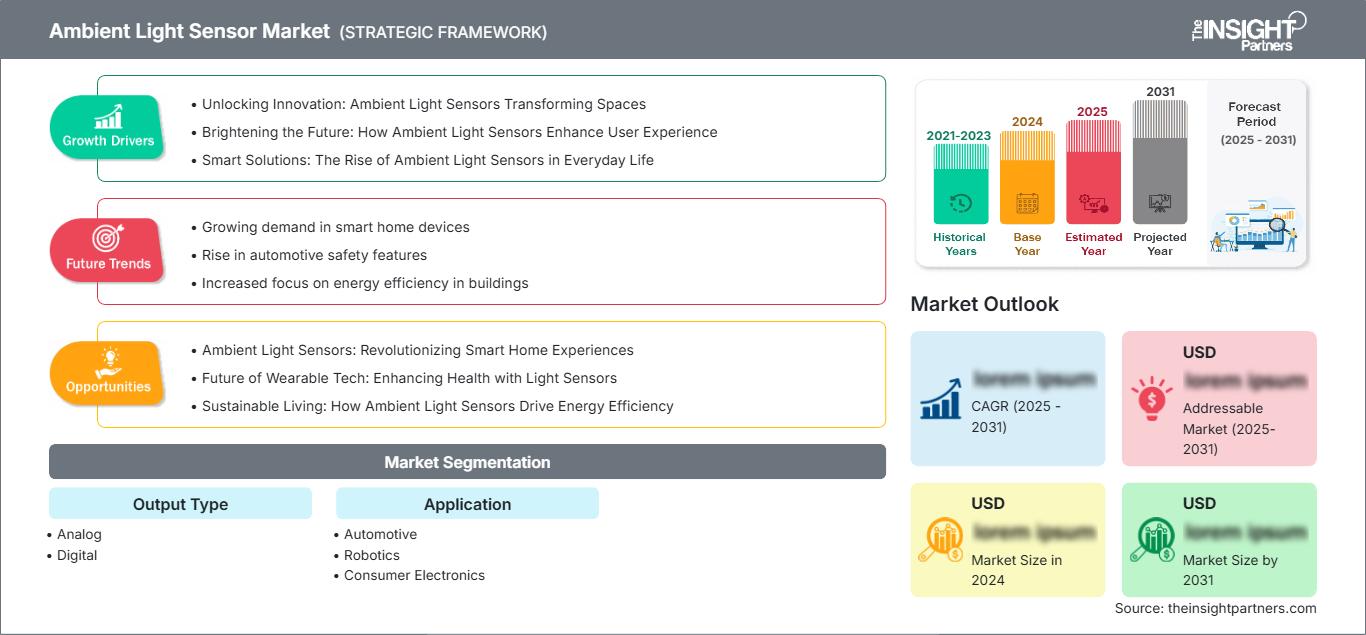
Ambient Light Sensor Market: Strategic Insights
Regional Insights
North America Ambient Light Sensor Market
North America represented 33–36% of global revenue in 2025 and is projected to expand at 10.8–11.6% CAGR during 2026–2034. The regional Ambient Light Sensor Market share is supported by vehicle cockpit digitization, connected home devices, and medical electronics. The demand is primarily associated with adaptive displays, daylight-sensing lighting controls, and low-power wearable user interfaces.
Key structural forces in this industry include the ability to design semiconductors, automobile safety electronics, and the greater use of premium consumer goods. Building regulations regarding energy savings, as well as healthcare manufacturers requiring reliable performance in changing lighting conditions, favor the automatic brightness controls for displays and buildings.
U.S. Ambient Light Sensor Market
The U.S. accounted for 76–80% of North America in 2025 and is expected to grow at 10.9–11.7% CAGR through 2034. The domestic demand is characterized by automotive electronics, cell phones, laptops, smart speakers, and certified medical devices. Designing initiatives by semiconductor firms generates qualification chances prior to moving the production process to international assembly hubs.
Applications are influenced by high dynamic range, dark glass capabilities, and interruptible functionality in products that are power-conscious. In addition, the market environment in the United States is influenced by automotive display modules and robotics in warehousing. The influence of semiconductor firms such as Broadcom Inc., Texas Instruments Incorporated, Analog Devices, Inc., and Vishay Intertechnology, Inc. is significant.
Europe Ambient Light Sensor Market
Europe held 21–24% share in 2025 and is forecast to grow at 10.4–11.2% CAGR. Germany dominates due to the need for reliability in premium cars, industrial automation, and lighting electronics. The UK provides demand via the use of medical devices and smart building controls through the use of low-power sensors for user comfort and energy laws.
France, Italy, and Spain contribute demand through the automotive industry, consumer appliances, and infrastructure upgrade projects. The market in Europe is impacted by the ecodesign legislation, which encourages automatic dimming in connected devices. Suppliers with automotive certifications and local design capabilities have an advantage in long platform life cycles.
APAC Ambient Light Sensor Market
APAC accounted for 34–38% share in 2025 and is projected to grow at 12.6–13.4% CAGR. China emerges as the leader in consumer electronics assembly and electric vehicle manufacturing, while Japan and South Korea provide high-end optical components. Device manufacturing is gaining momentum in India, and Australia provides a contribution in terms of healthcare and infrastructure.
Industrial policies, localization of electronics, and semiconductor package capability improve the regional prospects. APAC market can leverage its shorter design-to-production cycle time and high-volume device introductions. Automotive dashboard, robotics control, smart appliances, and medical wearable devices will contribute to the adoption of technology in analog as well as digital form.
Middle East & Africa Ambient Light Sensor Market
The Middle East & Africa is expected to grow at 9.6–10.4% CAGR during 2026–2034, led by Saudi Arabia and the UAE. Demand for smart city initiatives, airport developments, and energy-efficient buildings requires daylighting control. Industrial electronics and healthcare electronics segments offer business opportunities in South Africa. At the same time, the Rest of the MEA region relies on projects only.
Efforts towards diversification of energy in MEA drive towards efficient lighting and networked infrastructure, yet the lack of semiconductor manufacturing facilities locally leaves the region dependent on imports. Devices that are rugged and easy to integrate into systems are expected to be more popular in the region’s market.
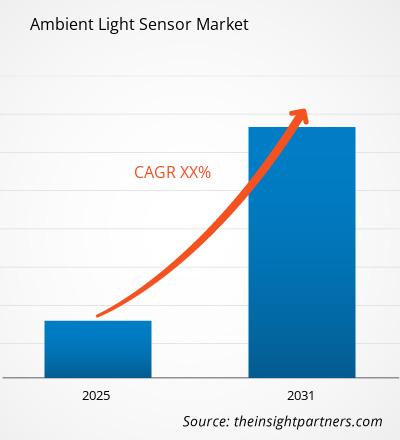
Segmentation Analysis
Output Type
Output Type is projected to grow at 11.4–12.2% CAGR during 2026–2034 as OEMs balance simple analog sensing with programmable digital interfaces. The Ambient Light Sensor Market scope within this segment is shaped by power budgets, microcontroller architecture, latency needs, and qualification standards. Digital output is gaining in compact connected devices, while analog devices remain relevant in cost-sensitive platforms.
- Analog sensors retain demand in low-cost devices, simple lighting controls, and legacy automotive modules where direct voltage response, low latency, and minimal firmware complexity support predictable integration.
- Digital sensors are preferred in smartphones, wearables, medical devices, and robotics panels because I2C interfaces, interrupt settings, and calibrated lux readings simplify software-driven power management.
Application
Application is expected to expand at 11.8–12.6% CAGR during 2026–2034, reflecting wider use across displays, cabins, robots, and portable diagnostic equipment. Consumer electronics provide scale, automotive creates high-value qualification demand, robotics requires stable panel visibility, and medical devices need low-power optical sensing under controlled and changing illumination.
- In the automotive industry, usage of ambient sensing is increasing in applications such as adaptive headlamps, infotainment screens, rear seat displays, and instrument clusters, where lighting-aware control enhances safety and performance, and reduces power consumption.
- The robotics sector employs ambient sensing in operator panels, dock stations, and environmental sensing, especially in warehouses and service robots that traverse environments with changing indoor lighting.
- Consumer Electronics is the biggest market for ambient sensing technology, as smartphones, tablets, laptops, televisions, and wearable devices use ambient sensing for enhanced brightness and power savings.
- Medical Devices utilize low-power sensors for wearables, monitors, and portable instrumentation, where screen legibility and optical stability play an important role.
Opportunity Snapshot
| Application | Revenue Contribution | Trend Tag | Adoption Stage |
| Automotive | High | Adaptive Cockpit | Scaling |
| Robotics | Medium | Panel Sensing | Emerging |
| Consumer Electronics | High | Display Power | Mature |
| Medical Devices | Medium | Wearable Care | Scaling |
Ambient Light Sensor Market Growth Drivers and Impact Analysis
Display Power Optimization in Connected Devices
Displays are some of the biggest energy consumers in smartphones, tablets, laptops, and wearables; hence, automatic brightness is a direct design requirement. With ambient sensors, it is possible to lower the backlight of mobile devices in dark conditions and still ensure that the display is readable outdoors. It is important for OEMs since energy consumption, heat dissipation, and user experience have an impact on reviews and replacement cycles of devices. In view of eco-design regulations and labeling of products in terms of their energy consumption, automatic brightness is a less optional requirement and becomes part of the minimum requirements for the devices.
Automotive Cockpit and Lighting Electronics Expansion
Car cabins are increasingly becoming a combination of large infotainment displays, digital clusters, head-up displays, ambient lighting, and adaptive exterior lighting. Light-sensing features will assist in regulating display brightness, reducing any form of glare, and ensuring smooth transition from daytime to tunnel and nighttime driving. Applications in the automotive industry require durability, tolerance of different temperatures, and compliance with accepted standards, thereby increasing their value per design win. This will be felt most in electric and luxury cars, where software-defined car cabins will feature a higher number of displays and lighting zones. In the automotive industry, applications bring more revenue predictability than consumer sockets but involve higher validation costs and application expertise.
Miniaturized Optical Sensing for Medical and Robotics Platforms
The medical wearables, monitoring devices, service robots, and warehouse automation applications need small sensors that can work effectively without any increase in power consumption and the physical size of the device. Light data helps in displaying information on the screen, indicating the status of the device, docking, and even calibration of the optical sub-systems. This effect is functional because the device has to be easily seen under the lights, such as fluorescent, LED, and natural. Smaller packages make it possible for sensors to be placed behind the glass or curved surfaces.
Ambient Light Sensor Market Future Trends
Spectral Accuracy for Human-Centric Interfaces
The next phase of Ambient Light Sensor Market trends will prioritize spectral matching rather than simple brightness detection. For device makers to be able to differentiate between sunlight, LED light, and display reflection, it would be necessary to have sensors capable of detecting these conditions properly, since HMI is based on perception and not on lux. As a result, multi-sensing channels, advanced optical filters, and algorithms to correct for dark glass and curved screens will be encouraged. Eventually, accurate sensors will help to adjust color temperatures, improve visibility in vehicles, and ensure good readability on wearables.
Sensor Fusion with Edge Intelligence
The ambient light sensors are supposed to form an integral part of the larger edge-sensing clusters that will consist of proximity sensors, color sensors, motion sensors, temperature sensors, and occupancy sensors. This will enable the devices and vehicles to adapt in a context-sensitive manner without requiring cloud computing all the time. In the field of robotics, it will enhance the docking of robots and user interface panel interactions, while in the field of healthcare equipment, it will lead to better screen display and indicator behaviors. The digital-output devices that have programmable thresholds and firmware support will dominate.
Ambient Light Sensor Market Opportunities
Automotive Platform Design Wins
Automotive electronics offer one of the clearest investment opportunities because design wins can translate into multi-year revenue across vehicle platforms. Suppliers should focus on AEC-qualified packages, high dynamic range, low temperature drift, and integration support for cockpit modules. The Ambient Light Sensor Market Forecasts indicate that higher display count per vehicle will increase attach rates for adaptive brightness and lighting-control functions. Commercial action should prioritize tier-one suppliers, electric vehicle platforms, and premium interior programs where optical performance is valued. Partnerships with software and display-controller vendors can also shorten qualification cycles and improve the probability of repeat platform adoption.
Localized Electronics Manufacturing in APAC
APAC sensor manufacturing localization provides opportunities for those suppliers who can offer competitive pricing while not sacrificing calibration capability. There will be an emergence of electronics and automotive supply chains in India, Vietnam, China, Japan, and South Korea, leading to OEM qualification of various sensor manufacturers. It becomes possible for the companies to build up technical support in the region, distributor training, and reference boards for applications such as displays, lighting, and wearables. However, the area of application for sensors is not limited to high-volume smartphones. There is a need for sensing technology for smart appliances, robotics, and mobile medical devices.
Recent Developments
- June 2026: Vishay Intertechnology launched new automotive-grade ambient light sensors (VEMD4210FX02 and VEMD5525FX02) featuring human-eye-matched spectral response and no infrared (IR) bump. The sensors provide accurate visible light measurement for automotive displays, head-up displays, automatic lighting systems, and industrial applications.
- June 2026: Vishay expanded its optical sensor portfolio with advanced proximity and ambient light sensing solutions, focusing on compact designs, improved accuracy, and reliable performance for automotive and consumer applications.
- July 2026: Infineon Technologies completed the acquisition of the non-optical analog/mixed-signal sensor portfolio from ams OSRAM, strengthening its sensor capabilities for automotive, industrial, and medical applications. The acquisition adds around 230 employees, new sensor technologies, and expands Infineon’s Edge Systems portfolio.
Frequently Asked Questions

- Comprehensive Market Sizing and Forecast Analysis
- Detailed Segmentation Analysis
- In-Depth Market Dynamics Assessment
- Regional and Country-Level Insights
- Competitive Landscape and Company Benchmarking
- Strategic Business Intelligence
Recent Reports
Testimonials

The Insight Partners' SCADA System Market report is comprehensive, with valuable insights on current trends and future forecasts. The team was highly professional, responsive, and supportive throughout. We are very satisfied and highly recommend their services.
RAN KEDEM Partner, Reali Technologies LTDs
I requested a report on a very specific software market and the team produced the report in a few days. The information was very relevant and well presented. I then requested some changes and additions to the report. The team was again very responsive and I got the final report in less than a week.
JEAN-HERVE JENN Chairman, Future Analytica
We worked with The Insight Partners for an important market study and forecast. They gave us clear insights into opportunities and risks, which helped shape our plans. Their research was easy to use and based on solid data. It helped us make smart, confident decisions. We highly recommend them.
PIYUSH NAGPAL Sr. Vice President, High Beam Global
The Insight Partners delivered insightful, well-structured market research with strong domain expertise. Their team was professional and responsive throughout. The user-friendly website made accessing industry reports seamless. We highly recommend them for reliable, high-quality research services
YUKIHIKO ADACHI CEO, Deep Blue, LLC.
This is the first time I have purchased a market report from The Insight Partners.While I was unsure at first, I visited their web site and felt more comfortable to take the risk and purchase a market report.I am completely satisfied with the quality of the report and customer service. I had several questions and comments with the initial report, but after a couple of dialogs over email with their analyst I believe I have a report that I can use as input to our strategic planning process.Thank you so much for taking the extra time and making this a positive experience.I will definitely recommend your service to others and you will be my first call when we need further market data.
JOHN SUZUKI President and Chief Executive Officer, Board Director, BK Technologies
I wish to appreciate your support and the professionalism you displayed in the course of attending to my request for information regarding to infectious disease IVD market in Nigeria. I appreciate your patience, your guidance, and the fact that you were willing to offer a discount, which eventually made it possible for us to close a deal. I look forward to engaging The Insight Partners in the future, all thanks to the impression you have created in me as a result of this first encounter.
DR CHIJIOKE ONYIA MANAGING DIRECTOR, PineCrest Healthcare Ltd.Reason to Buy
- Informed Decision-Making
- Understanding Market Dynamics
- Competitive Analysis
- Identifying Emerging Markets
- Customer Insights
- Market Forecasts
- Risk Mitigation
- Boosting Operational Efficiency
- Strategic Planning
- Investment Justification
- Tracking Industry Innovations
- Aligning with Regulatory Trends





 Get Free Sample for