
Athletic Footwear Market Demand, Size & Forecast by 2034
Coverage: By Foot Wear Type (Sneakers, Running Footwear, Hiking Footwear, Basketball Footwear, Football Footwear, Others); End-User (Men, Women, Unisex); Distribution Channel (Supermarkets and Hypermarkets, Specialty Stores, Online Retail, Others) , and Geography (North America, Europe, Asia Pacific, and South and Central America)
- Status : Data Released
- Report Code : TIPRE00026979
- Category : Consumer Goods
- No. of Pages : 150
- Available Report Formats :


- Last update date : August 28, 2026


2025 Market Size
US$ 152.11 Bn
Base year value
2034 Forecast
US$ 238.20 Bn
Projected by 2034
CAGR 2026-2034
5.11 %
Growth rate
Addressable Market
US$ 1,770.96 Bn
(2026-2034)
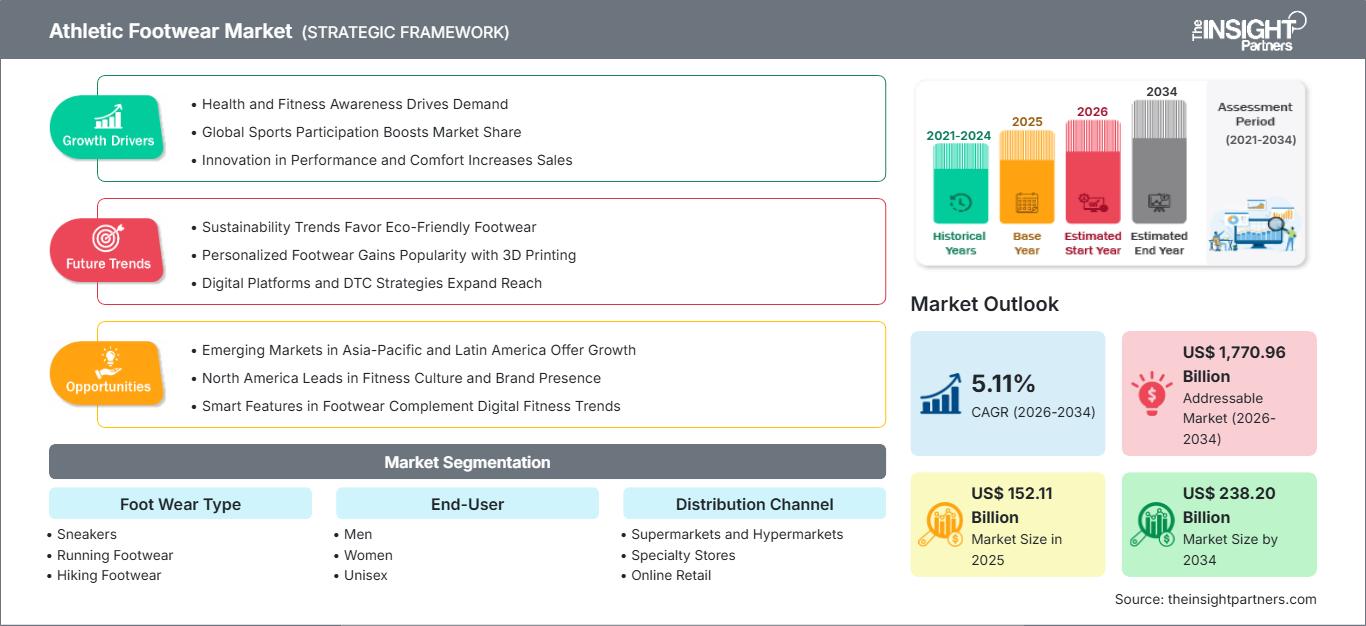
The athletic footwear market is projected to grow from US$ 152.11 Billion in 2025 to US$ 238.20 Billion by 2034, registering a CAGR of 5.11% during 2026–2034. Demand is shaped by fitness participation, athleisure adoption, performance material innovation, and direct-to-consumer expansion. Brands are balancing technical running products, court-sport silhouettes, outdoor-ready shoes, and everyday sneakers to capture broader usage occasions across developed and emerging economies.
North America remains a high-value revenue base, supported by structured sports participation, premium sneaker culture, and a mature specialty retail network. The athletic footwear market size in the region is supported by running, training, basketball, and lifestyle footwear purchases, with 2026–2034 growth estimated at 5.0–5.5%. Physical activity participation in the US reached 80% in 2024, reinforcing recurring replacement demand across performance and casual categories.
Athletic Footwear Market Assessment and Insights
- North America accounted for 34–37% share in 2025 and is expected to grow at a CAGR of 5.0–5.5% during 2026–2034, driven by sports participation, premium pricing, and strong omnichannel retail.
- US represented 82–85% of North America revenue in 2025 and is projected to grow at 5.1–5.6%, led by running, basketball, walking, and lifestyle sneaker demand.
- Europe held 24–27% share in 2025 and is forecast to expand at 4.5–5.0%, with Germany, the UK, France, Italy, and Spain leading retail turnover.
- Asia Pacific captured 28–31% share in 2025 and is set to advance at 5.8–6.4%, supported by China, Japan, India, South Korea, and Australia.
- Largest Segment: Sneakers held 34–38% market share in 2025 and is expected to grow at 4.8–5.3% as lifestyle and athleisure purchases expand.
- High Growth Segment: Running footwear held 22–26% share in 2025 and is projected to grow at 5.9–6.5%, supported by road running, walking, and marathon participation.
- Key companies analyzed in detail: adidas America, Inc.; PUMA SE; Nike, Inc.; ASICS Corporation; Skechers U.S.A., Inc.; Mizuno USA, Inc.; Merrell; Vibram S.p.A.; K-Swiss Inc.; Under Armour, Inc.
Source: The Insight Partners' analysis based on proprietary research, government publications, company annual reports, investor presentations, industry databases, and expert interviews.
Product category development has evolved from functional value in particular sports to an ecosystem of performance, health, and lifestyle applications. Advances in foam chemistry, knit uppers, plated propulsion systems, recycled content and fit development using data have altered product development cycles. Market expansion is further aided by shortened refresh cycles, collaboration-driven launches and regional collections that enable brands to drive sell-through beyond annual seasonal mass launches.
Future outlook is still positive with emerging markets adding more customers while developed markets premiumize via running, trail and court franchises. Margins will be driven by tariffs, diversified supply chains and better inventory management. However, increasing fitness aspirations, e-commerce-enabled product discovery and performance design for women will contribute to consistent market expansion. Increasing sustainability demands will drive material substitutions and circularity efforts.
Athletic Footwear Market Report Scope
| Report Attribute | Details |
|---|---|
| Market size in 2025 | US$ 152.11 Billion |
| Market Size by 2034 | US$ 238.20 Billion |
| Global CAGR (2026 - 2034) | 5.11% |
| Historical Data | 2021-2024 |
| Forecast period | 2026-2034 |
Athletic Footwear Market Analysis
Demand is driven by three interrelated activities: team sports, personal training, and leisure sneakers usage. Team sports, gym attendance, school physical activities, and walks establish periodic replacement cycles; fashion-based wearing of sneakers increases the target audience beyond athletes. The supply chains are diversified in Asia; manufacturers leverage Vietnam, Indonesia, China, and India to balance costs, speed of deliveries, and tariffs.
The value chain is becoming controlled via retailer ownership, apps, loyalty programs, and storytelling done by athletes. The product development concentrates on cushioning, light uppers, outsole grip, and reducing injury risks. The market analysis demonstrates that those brands that manage to combine technical validity with lifestyle appeal will be capable of maintaining pricing despite price-sensitive consumers' comparison of promotions on different platforms.
The competition intensity is quite high since global competitors and experts have identified similar occasions for use. Competitors like Nike, Inc., adidas America, Inc., PUMA SE, ASICS Corporation, Skechers U.S.A., Inc., Under Armour, Inc., Mizuno USA, Inc., Merrell, Vibram S.p.A., and K-Swiss Inc. compete by using innovation calendars, endorsements of athletes, wholesalers, and direct marketing efforts. Other brands in the running and outdoor sub-category compete to gain more attention in the market.
The investment is being made into creating a platform for footwear that allows various silhouettes, colorways, and regional drops. The brands are also focusing on demand sensing digitally, limited collaborations, and category-specific merchandising. Such a strategy lowers the chances of markdowns and helps in launching at full price.
● REPORT CUSTOMIZATION
Tailor This Report To Align With Your Specific Business Requirements
This report can be customized to align precisely with your business objectives, scope, and target markets. Customization options include tailored segmentation, geography, competitive analysis, and strategic insights to support informed decision-making.
Customize This Report →WHAT YOU CAN ADJUST
- ● Segmentations
- ● Geography
- ● Competitive Analysis
- ● Language Preferences
Athletic Footwear Market: Strategic Insights
Regional Insights
North America athletic footwear market
North America held 34–37% of 2025 revenue and is projected to grow at a CAGR of 5.0–5.5% during 2026–2034. This market share of athletic footwear in this region is backed up by high sports participation, sneaker culture, and high purchasing power. The activity level as reported by the SFIA drives demand for running, walking, basketball, and training footwear.
Retail maturity continues to be the key differentiating factor. Premium products benefit from specialty, owned, and digital retail outlets, and seasonal inventory management is aided by these outlets. This region is the leader in athlete marketing and limited edition stories.
U.S. athletic footwear Market
The US represented 82–85% of North America revenue in 2025 and is expected to expand at 5.1–5.6% through 2034. Demand is grounded in school athletics, fitness clubs, running community, and basketball. Bigger shoe wardrobes in households facilitate regular replacement and multiple pair ownership.
There is significant company presence with Nike, Inc., Skechers U.S.A., Inc., Under Armor, Inc., ASICS Corporation, adidas America, Inc., and PUMA SE, having a good wholesale and direct distribution network. Product usage is increasingly influenced by comfort, foot health, inclusive sizing, and performance for women.
Europe athletic footwear Market
Europe accounted for 24–27% share in 2025 and is forecast to grow at 4.5–5.0% during 2026–2034. The German and British markets excel in sport and outdoor activities, whereas the French, Italian, and Spanish markets thrive from luxury lifestyle sneakers. Sustainability compliance and consumer awareness are driving the recycled materials and minimal impact materials categories.
The running and football footwear categories continue to be relevant, although fashion-oriented sneakers offer reliable volume. Storytelling focuses on tradition, performance, and ethical sourcing. Localized assortment is used to deal with seasonality and weather variation.
APAC athletic footwear Market
APAC held 28–31% share in 2025 and is projected to post a CAGR of 5.8–6.4% through 2034. China is still the biggest market, while India experiences faster adoption due to increased income, online sales, and exercising at gyms. Japan and South Korea maintain a high demand for luxury running, outdoor, and lifestyle sneakers.
Proximity in manufacturing provides for a faster delivery of products at a flexible cost. Growth in the region is also associated with increasing malls, sports events, product launches by influencers, and health-related government programs. The country of Australia contributes a stable demand for running, training, and outdoor sneakers.
Middle East & Africa athletic footwear Market
The Middle East & Africa is expected to grow at 4.7–5.2% during 2026–2034, supported by mall-based retail, tourism-led premium shopping, and expanding sports infrastructure. Saudi Arabia and the UAE lead regional spending, while South Africa contributes a broader mass-market base.
Fitness clubs, school sports, football participation, and walking programs strengthen demand in urban centers. Affordability remains uneven, so brands use tiered pricing and outlet formats to broaden access while maintaining premium launches in high-income retail districts, according to the Athletic Footwear Market report.
Segmentation Analysis
Foot Wear Type
Footwear type is central to the market scope because usage occasions differ by sport, terrain, cushioning preference, and fashion need. This segment is projected to grow at 5.1–5.6% during 2026–2034 as brands refine product architecture across performance and lifestyle platforms.
- Sneakers dominate through athleisure adoption, workplace casualization, collaborations, and broad price coverage, making them the largest revenue contributor across men, women, and unisex buyers.
- Running Footwear benefits from road running, walking, marathon events, and comfort-led daily training, with innovation focused on foam resilience, rocker geometry, breathable uppers, and stability.
- Hiking Footwear serves outdoor recreation, trail walking, and travel use, with demand centered on grip, waterproofing, ankle support, durability, and hybrid city-to-trail styling.
- Basketball Footwear remains culturally influential, supported by athlete endorsements, court performance requirements, retro franchises, and lifestyle resale interest.
- Football Footwear is driven by club participation, school programs, and tournament cycles, with demand varying by surface type, stud configuration, fit, and lightweight construction.
End-User
End-User segmentation is projected to grow at 5.0–5.5% as brands expand inclusive sizing, women-specific anatomy, and unisex styling. Men remain a large spending group, but women and younger consumers are increasingly influencing product design and marketing priorities.
- Men represent a strong demand for running, basketball, football, gym, and lifestyle sneakers, with purchase decisions influenced by performance claims, brand loyalty, and sneaker culture.
- Women are gaining strategic importance as participation in fitness, running, and walking rises, encouraging brands to invest in fit, cushioning, and width options, and targeted merchandising.
- Unisex footwear supports fashion-led launches, collaborations, and casual wear, enabling brands to simplify inventory while widening appeal across streetwear and lifestyle customers.
Distribution Channel
Distribution Channel is expected to grow at 5.2–5.8% as shoppers combine in-store trial with online comparison and app-based launches. Omnichannel integration is essential for size availability, returns, loyalty engagement, and full-price product drops.
- Supermarkets and Hypermarkets support value footwear and family purchases, mainly in price-sensitive markets where convenience, discounts, and broad accessibility matter.
- Specialty Stores deliver fitting support, gait advice, sport-specific assortments, and premium product education, making them important for performance running and outdoor categories.
- Online Retail is expanding through brand apps, marketplaces, influencer content, and launch calendars, offering a wider selection, reviews, and personalized recommendations.
Opportunity Snapshot
| End-User | Revenue Contribution | Trend Tag | Adoption Stage |
| Men | High | Performance Fit | Mature |
| Women | Medium | Women-Specific | Scaling |
| Unisex | Medium | Lifestyle Drops | Scaling |
Athletic Footwear Market Growth Drivers and Impact Analysis
Rising Fitness Participation and Everyday Performance Use
With increased engagement in running, walking, fitness classes, school sports, and recreational league sports, there will be an increase in replacement needs across all price ranges, reflecting key Athletic Footwear Market trends. For instance, in the U.S., activity participation reached 80% in 2024, highlighting a large consumer base requiring comfortable, durable, and sport-oriented footwear. This factor positively impacts demand for running, casual, and training shoes, as consumers increasingly prefer activity-specific footwear designed for different sports and fitness routines.
Athleisure and Sneaker Culture Expanding Wearing Occasions
The athleisure trend has made it possible for shoes to transition from being a sports-related product to becoming part of everyday wear. With sneakers being used for work, commuting, socializing, and recreation, there is an increase in their purchasing frequency and premium storytelling becomes possible through collaborations, limited-editions, retros, and athlete-inspired collections. Such actions reinforce the athletic shoe industry by expanding its customer base to non-competing sports users.
Material Innovation Improving Cushioning, Weight, and Sustainability
Brand competition involves foam materials, carbon or nylon plates, special mesh, sustainable yarns, rubber outsoles, and digital fit technologies. These technologies enhance the efficiency, comfort, breathability, and durability of running shoes and help the companies manage the expectations regarding sustainability. This influence is felt in terms of faster iterations, more focus on specialties, and rising ASPs. Technology-enabled differentiation is also valuable for brands in defending margins from private labels and value competition.
Athletic Footwear Market Future Trends
Personalized Fit and Data-Led Product Design
Future trends for athletic footwear will revolve more around personalization based on scan data, return data, purchasing history, and activity levels. Based on such information, the brands can optimize their lasts, width, cushioning requirements, and product recommendations based on customers' needs. A good fit translates to fewer returns, loyalty from the consumers, and the ability to command higher prices. With the increasing strength of apps as shopping portals, product recommendations will become more individualized.
Circular Materials and Lower-Impact Footwear Platforms
The development of future products will give more importance to the use of recycled materials, mono-material composition, repairs, and recycling programs. Regulatory actions in Europe and consumer pressure in developed countries are forcing companies to provide transparency about material selection and minimize waste. Circular systems will help to mitigate supply chain risks in the long term as well. Sustainability combined with comfort and performance should build brand trust.
Athletic Footwear Market Opportunities
Premium Running and Walking Footwear for Wider Consumer Groups
The athletic footwear market Forecasts indicate a strong opportunity in running and walking footwear because both activities attract beginners, older adults, and performance consumers. Brands can expand through cushioned daily trainers, stability shoes, recovery walking models, and women-specific designs. Specialty fitting, subscription replacement reminders, and local running-community partnerships can improve conversion. This opportunity is attractive because it combines recurring replacement cycles with higher average prices than basic lifestyle footwear.
Online Retail Expansion in Emerging Urban Markets
Emerging cities across the Asia Pacific, the Middle East, and parts of Africa offer room for online-first growth. Consumers increasingly discover products through marketplaces, brand apps, creators, and sports communities before visiting stores or ordering directly. Brands can localize size curves, payment options, and entry-price collections while preserving premium launches for affluent consumers. The main opportunity lies in connecting digital demand signals with faster replenishment and regional assortments.
Frequently Asked Questions

- Comprehensive Market Sizing and Forecast Analysis
- Detailed Segmentation Analysis
- In-Depth Market Dynamics Assessment
- Regional and Country-Level Insights
- Competitive Landscape and Company Benchmarking
- Strategic Business Intelligence
Recent Reports
Testimonials

The Insight Partners' SCADA System Market report is comprehensive, with valuable insights on current trends and future forecasts. The team was highly professional, responsive, and supportive throughout. We are very satisfied and highly recommend their services.
RAN KEDEM Partner, Reali Technologies LTDs
I requested a report on a very specific software market and the team produced the report in a few days. The information was very relevant and well presented. I then requested some changes and additions to the report. The team was again very responsive and I got the final report in less than a week.
JEAN-HERVE JENN Chairman, Future Analytica
We worked with The Insight Partners for an important market study and forecast. They gave us clear insights into opportunities and risks, which helped shape our plans. Their research was easy to use and based on solid data. It helped us make smart, confident decisions. We highly recommend them.
PIYUSH NAGPAL Sr. Vice President, High Beam Global
The Insight Partners delivered insightful, well-structured market research with strong domain expertise. Their team was professional and responsive throughout. The user-friendly website made accessing industry reports seamless. We highly recommend them for reliable, high-quality research services
YUKIHIKO ADACHI CEO, Deep Blue, LLC.
This is the first time I have purchased a market report from The Insight Partners.While I was unsure at first, I visited their web site and felt more comfortable to take the risk and purchase a market report.I am completely satisfied with the quality of the report and customer service. I had several questions and comments with the initial report, but after a couple of dialogs over email with their analyst I believe I have a report that I can use as input to our strategic planning process.Thank you so much for taking the extra time and making this a positive experience.I will definitely recommend your service to others and you will be my first call when we need further market data.
JOHN SUZUKI President and Chief Executive Officer, Board Director, BK Technologies
I wish to appreciate your support and the professionalism you displayed in the course of attending to my request for information regarding to infectious disease IVD market in Nigeria. I appreciate your patience, your guidance, and the fact that you were willing to offer a discount, which eventually made it possible for us to close a deal. I look forward to engaging The Insight Partners in the future, all thanks to the impression you have created in me as a result of this first encounter.
DR CHIJIOKE ONYIA MANAGING DIRECTOR, PineCrest Healthcare Ltd.Reason to Buy
- Informed Decision-Making
- Understanding Market Dynamics
- Competitive Analysis
- Identifying Emerging Markets
- Customer Insights
- Market Forecasts
- Risk Mitigation
- Boosting Operational Efficiency
- Strategic Planning
- Investment Justification
- Tracking Industry Innovations
- Aligning with Regulatory Trends





 Get Free Sample for