
Iron Ore Mining Market Size, Share & Trends by 2034
Coverage: By Product Type (Iron Ore Fines, Iron Ore Pellets and Pellet Feed, Others); Minning Type (Surface Mining, Underground Mining, Others); End User Industry (Construction, Transportation, Others) , and Geography (North America, Europe, Asia Pacific, and South and Central America)
- Status : Data Released
- Report Code : TIPRE00029663
- Category : Manufacturing and Construction
- No. of Pages : 150
- Available Report Formats :


- Last update date : July 13, 2026


2025 Market Size
US$ 362.62 Bn
Base year value
2034 Forecast
US$ 484.87 Bn
Projected by 2034
CAGR 2026-2034
3.28 %
Growth rate
Addressable Market
US$ 3,848.42 Bn
(2026-2034)
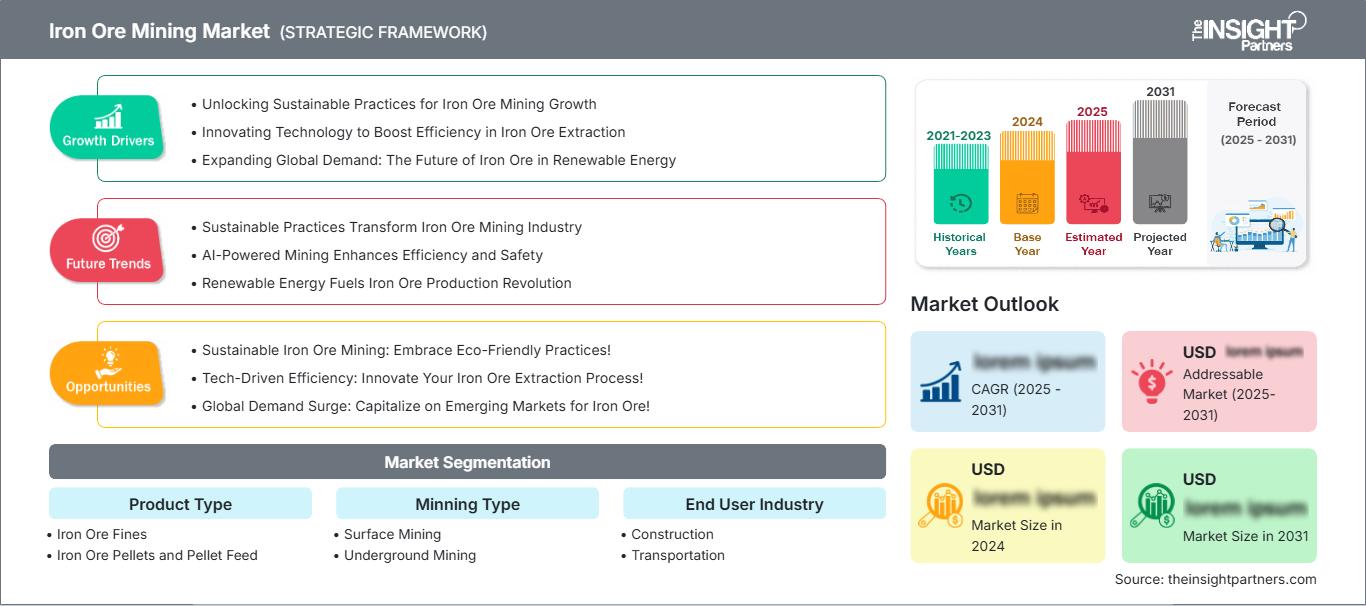
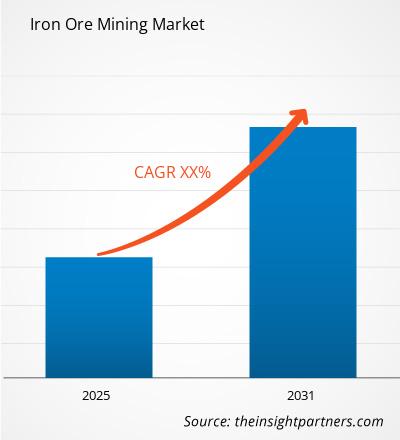
The iron ore mining market size is projected to grow from US$ 362.62 billion in 2025 to US$ 484.87 billion by 2034; it is expected to register a CAGR of 3.28% from 2026 to 2034. The market is influenced by the demand for steel, investment in infrastructure, growth of industrial capacity, and the constant requirement for high-quality feedstock through blast furnace and direct reduction routes.
The North American market is projected to experience a CAGR of 2.4-2.9% until 2034 owing to the balance that steelmakers maintain between domestically available ore and imports while improving raw materials through decarbonization. The U.S. construction projects along with pellets production in Canada have been contributing to steady sourcing. The region’s iron ore mining market report remains disciplined because incremental demand is tied to capacity utilization rather than rapid new mine commissioning.
Iron Ore Mining Market Assessment and Insights
- North America: Share in 2025 is 9–11%, growing at a CAGR between 2026–2034 of 2.4–2.9%, supported by integrated steel operations, pellet demand, and logistics reliability.
- US: Share in 2025 is 72–76% of North America, growing at a CAGR between 2026–2034 of 2.3–2.8%, led by automotive steel, construction, and electric-arc furnace blending needs.
- Europe: Share in 2025 is 12–14%, growing at a CAGR between 2026–2034 of 2.0–2.6%, with Sweden, Germany, France, and the UK influencing pellet procurement and low-carbon steel feedstock strategies.
- Asia Pacific: Share in 2025 is 58–62%, growing at a CAGR between 2026–2034 of 3.5–4.1%, led by China, India, Japan, South Korea, and Australia across production, consumption, and export flows.
- Largest Segment: Surface Mining holds a market share range of 83–87% in 2025 and is growing at a CAGR range of 3.0–3.5%, driven by scale economics and open-pit productivity.
- High Growth Segment: Iron Ore Pellets and Pellet Feed holds an iron ore mining market share range of 24–28% in 2025 and is growing at a CAGR range of 3.8–4.4%, supported by steel decarbonization requirements.
- Key companies analyzed in detail: BHP Group Limited, Rio Tinto Group, Northern Iron Pty Ltd., Shree Minerals Limited, Mount Gibson Iron Limited, ArcelorMittal S.A., NIPPON STEEL CORPORATION, POSCO Holdings Inc., Tata Steel Limited, Great Panther Mining Limited, Vale S.A., Fortescue Ltd, Anglo American plc.
Source: The Insight Partners' analysis based on proprietary research, government publications, company annual reports, investor presentations, industry databases, and expert interviews.
The focus has moved from volume growth through production to ore quality, beneficiation, automation, and the mine-to-port approach. Surface mining operations remain prevalent owing to their ability to keep unit costs low and handle throughput. Investments in pellet feed are becoming significant as steel makers look for ores with low gangue, high iron ore content, and improved sintering characteristics. The areas of autonomous drilling, fleet optimization, predictive maintenance, and digital grade control have become integral parts of Iron Ore Mining research.
Demand is set to become geographically balanced in the future, with India, Southeast Asia, and the Middle East boosting steel capacity while China will act as the pricing consumption base. Government backing for infrastructure projects, rail corridors, renewable energy facilities, and industrial parks will ensure continued scope of Iron Ore Mining. Tailings management, emissions, water, and indigenous peoples will become more prominent regulatory considerations.
Iron Ore Mining Market Report Scope
| Report Attribute | Details |
|---|---|
| Market size in 2025 | US$ 362.62 Billion |
| Market Size by 2034 | US$ 484.87 Billion |
| Global CAGR (2026 - 2034) | 3.28% |
| Historical Data | 2021-2024 |
| Forecast period | 2026-2034 |
Iron Ore Mining Market Analysis
Steel remains the primary demand channel, linking iron ore consumption to construction, transportation equipment, machinery, energy infrastructure, and shipbuilding. World Steel Association data show steel production remains concentrated in Asia, making ore trade highly sensitive to mill utilization, port inventories, and grade premiums. The Iron Ore Mining Market benefits when public infrastructure pipelines and private manufacturing investment lift apparent steel use.
The value chain includes exploration, mine planning, drilling, blasting, crushing, screening, processing, pelletizing, rail transportation, port loading, and ocean transport. Ore characteristics, stripping ratio, weather disruptions, permits, and logistics cost have become more dominant in supply. Hematite and magnetite deposits have become strategically important owing to their efficiency in lowering the energy consumed and improving the output of blast furnaces.
Competition is dominated by diversified mining companies and vertically integrated steel producers. Competitors include BHP Group Limited, Rio Tinto Group, Vale S.A., Fortescue Ltd, ArcelorMittal S.A., Tata Steel Limited, POSCO Holdings Inc., and NIPPON STEEL CORPORATION competing based on resource quality, logistics, closeness to customers, and low cost production systems instead of product differentiation.
Capital expenditure is being made on mines replacement, ore processing plants modernization, autonomous transportation, conveyor electrification, water reutilization, and pellet feed plant construction. Positioning strategy is also determined by long-term offtake agreements, joint ventures with steel producers, and premium products exposure. The iron ore mining market trends therefore favor operators that can protect margins during price cycles while meeting stricter environmental and traceability requirements.
● REPORT CUSTOMIZATION
Tailor This Report To Align With Your Specific Business Requirements
This report can be customized to align precisely with your business objectives, scope, and target markets. Customization options include tailored segmentation, geography, competitive analysis, and strategic insights to support informed decision-making.
Customize This Report →WHAT YOU CAN ADJUST
- ● Segmentations
- ● Geography
- ● Competitive Analysis
- ● Language Preferences
Iron Ore Mining Market: Strategic Insights
Regional Insights
North America Iron Ore Mining Market
The North American market will hold 9-11% share in 2025 and is expected to exhibit a CAGR of 2.4-2.9%. Demand dynamics in North America are influenced by U.S. steel production, Canadian pellets production, Great Lakes transportation, and mines development due to replacement. Iron Ore Mining Market share is relatively small, however, the security of supply became a matter of strategy for automotive, construction and power generation steel.
The main factors behind the growth include better pellets quality standards, preference for local supply and investments in railway, ports and beneficiation facilities. The development of electric arc furnaces does not reduce the iron ore consumption since direct reduced iron and hot briquetted iron are made using high-quality ore sources.
U.S. Iron Ore Mining Market
The USA comprises 72-76% of North America by 2025, growing at a CAGR of 2.3-2.8%. The drivers behind demand include flat steel, automotive production, non-residential construction, and infrastructure renovation. Availability of domestic ore and pellet supplies limits reliance on imports, along with a company's location close to steel production plants.
The application trends reveal an increasing focus on blast furnace efficiency, low impurities, and homogeneity of raw materials. While federal infrastructure investments and power grid improvements help boost steel intensity, mining capacity growth is moderate. Suppliers with versatile pellet specifications and good lake shipping routes have a better advantage as mills cope with emission reduction goals and volatile costs.
Europe Iron Ore Mining Market
Europe possesses a 12% – 14% share in 2025 with a growth rate of 2.0% - 2.6% CAGR. Sweden is the most prominent country for mining relevance in the region. Import dependence in the UK market, but demand from construction, offshore wind energy foundations, rail replacement, and military-related steels helps maintain the regular procurement of quality ores and pellets.
The largest steel-consuming economy in Europe is Germany. Here the ore consumption is linked to automotive manufacturing, machinery, and industrial equipment manufacture. Projects related to decarbonization and use of direct reduction technology are driving the demand for high-quality feedstock for pelletizing plants. This helps the players with evidence about low impurities and supply reliability to succeed.
France, Italy, and Spain are import-reliant markets but remain significant in terms of infrastructure construction, automobile parts, ships, and industries requiring steel. Green steel, emissions reduction, and recycling support changes in ore procurement standards. Therefore, the size of Iron Ore Mining in Europe is more about premium rather than expansion of mines capacity.
APAC Iron Ore Mining Market
APAC has 58-62% market share in 2025 and is estimated to expand at a 3.5-4.1% CAGR. The dominant consumer is China, whereas Australia provides ore exports via large scale open pits, rail networks, and ports.
India represents the fastest demand growth driver owing to growing steel capacities and pipeline of infrastructures resulting in higher ore demand. Japan and South Korea focus on stable sourcing and high-quality feed for efficient steel production.
The regulatory factors consist of development of industry corridors, urban transport systems, ships, renewable energy systems, and mineral security programs. The future of Australia's replacement mines and ore processing projects will be crucial for APAC supply reliability.
Middle East & Africa Iron Ore Mining Market
The Middle East & Africa iron ore mining market is projected to grow at a 3.2–3.8% CAGR, supported by steel capacity, energy projects, and infrastructure diversification. South Africa remains the leading mining country, while Guinea and Liberia strengthen long-term export relevance.
The increased use of steel products in Saudi Arabia and the UAE is being achieved via construction, logistics, ports, and industrial estates. Their ore requirement is largely imports-oriented, with procurement based on pellet and direct reduction suitability.
RoMEA development requires rail, power, and port development. The success of financing, political stability, and environment will determine whether high-grade ore deposits explored can be banked into production.
Segmentation Analysis
Product Type
Product Type in the iron ore mining market forecast is expected to grow at a 3.1–3.6% CAGR between 2026–2034 as steelmakers adjust feed blends for productivity, emissions, and cost control. Fines remain essential for sinter plants, while pellets and pellet feed gain strategic value in lower-carbon steel routes. This segmentation captures how ore form, chemistry, and processing intensity influence pricing and customer qualification.
- Iron Ore Fines remain the dominant traded product because sintering networks in Asia and Europe require large, consistent volumes for blast furnace operations and cost-optimized blending.
- Iron Ore Pellets and Pellet Feed are strategically important for direct reduction, lower impurity steelmaking, and productivity gains, supporting higher premiums in markets pursuing emissions reduction.
Minning Type
Minning Type is projected to expand at a 3.0–3.5% CAGR between 2026–2034, reflecting the dominance of large open-pit systems and selective use of underground extraction. Surface mines benefit from scale, automation, and lower operating costs. Underground mining remains relevant where ore bodies, land access, or environmental constraints limit open-pit expansion.
- Surface Mining leads because large deposits in Australia, Brazil, India, and South Africa support high-throughput operations, mechanized fleets, and integrated processing infrastructure.
- Underground Mining serves narrower or deeper deposits where surface disturbance is constrained, requiring higher capital discipline, safety systems, ventilation planning, and selective extraction economics.
End User Industry
End User Industry is forecast to grow at a 3.2–3.7% CAGR between 2026–2034 as steel demand broadens across buildings, mobility, logistics, and industrial assets. Construction accounts for the largest steel intensity, while transportation supports premium flat steel demand. The segment reflects how infrastructure cycles and manufacturing utilization translate into ore procurement decisions.
- Construction drives bulk ore consumption through rebar, structural sections, bridges, rail stations, industrial buildings, energy assets, and urban infrastructure programs across emerging and developed economies.
- Transportation supports higher-value steel demand for automotive bodies, rail systems, shipbuilding, heavy vehicles, and logistics equipment, encouraging stable procurement of consistent ore grades.
Opportunity Snapshot
| Segment Name | Revenue Contribution | Trend Tag | Adoption Stage |
| Construction | High | Urban Buildout | Mature |
| Transportation | Medium | Fleet Steel | Scaling |
Iron Ore Mining Market Growth Drivers and Impact Analysis
Infrastructure-Led Steel Consumption
Pipelines for public infrastructure continue to be an anchor of measured demand as bridges, railroads, ports, industrial zones, transmission towers, and mass transit facilities require large amounts of long and flat steel. Public investment initiatives that are connected with the IMF and industrial policies of countries such as India, Southeast Asia, the Gulf, and North America are boosting the demand for steel in these countries. The most positively impacted by this will be those firms which provide ore and pellets in reliable quantities because mill capacity utilization will rise once order backlog is translated into orders.
Premium Feedstock for Lower-Emission Steelmaking
Iron ore is increasingly being assessed with respect to emissions impact rather than cost alone. The higher concentration of iron with fewer impurities helps in reducing the usage of coke, making the blast furnaces more efficient, and providing avenues for direct reduction process. According to the IEA’s outlook on industrial decarbonization, it has become critical that there is a need for cleaner raw materials by the steel plants in order to achieve low carbon footprint.
Mine Automation and Logistics Productivity
Automation is improving mine productivity by reducing variability in drilling, haulage, crushing, and maintenance. Autonomous trucks, remote operations centers, computer vision, and predictive analytics help miners protect throughput despite labor shortages, weather interruptions, and equipment downtime. The market impact is visible in lower unit costs, higher asset utilization, and more predictable shipment performance. Large miners with integrated rail and port systems can convert operational data into customer reliability, strengthening contract positions. Smaller operators face pressure to adopt digital tools or partner with technology providers to remain cost competitive.
Iron Ore Mining Market Future Trends
Shift Toward Beneficiated and Pellet-Ready Ore
Future supply strategies will emphasize ore upgrading rather than simple volume growth. Beneficiation, magnetic separation, flotation, and pellet feed preparation will gain investment as steelmakers demand lower silica, alumina, and phosphorus levels. This trend will create a clearer price divide between standard fines and premium feedstock suited to direct reduction or high-productivity blast furnaces. It will also increase the importance of water management and tailings technology because processing intensity rises with ore upgrading. Producers able to deliver consistent pellet-ready material should capture stronger margins across the Iron Ore Mining Market.
New Supply Corridors Outside Traditional Export Basins
Emerging supply corridors in West Africa, India, and selected Middle East-linked trade routes are expected to diversify long-term sourcing. Buyers are seeking alternatives that reduce dependence on a small number of export basins and improve resilience against weather, geopolitics, and freight disruption. However, these corridors require railways, deepwater ports, power, and governance structures before they can influence seaborne balances. The trend favors consortium-led development, steelmaker participation, and government-backed infrastructure models that can convert high-grade resources into dependable commercial flows.
Iron Ore Mining Market Opportunities
Pellet Feed Partnerships with Steel Producers
Long-term pellet feed partnerships offer a practical route for miners to secure demand while helping steelmakers manage decarbonization risk. Joint investment in beneficiation, pelletizing, and logistics can align ore chemistry with specific furnace or direct reduction requirements. This opportunity is attractive where steel producers need predictable quality but cannot fully internalize mining assets. Contract structures may include offtake commitments, price premiums for chemistry, and shared investment in processing capacity. The result is stronger customer lock-in and improved bankability for upstream projects.
Digital Mine Optimization for Mid-Tier Operators
Mid-tier miners can unlock value by deploying scalable digital systems across grade control, dispatch, maintenance, and energy use. Unlike mega-projects, these upgrades can be phased and measured through throughput, fuel consumption, dilution reduction, and downtime metrics. Technology vendors, equipment suppliers, and mining services firms can structure performance-linked contracts that reduce adoption barriers. The opportunity is particularly relevant for operators with constrained capital but competitive resources, because improved reliability and quality consistency can strengthen negotiations with steel customers and traders.
Recent Developments
- April 2026: Iron Bear Resources has made a strong start to 2026, completing the main technical and environmental studies vital to the upcoming prefeasibility study for its namesake iron ore project in Canada.
- April 2026: Rio Tinto increased its iron ore production in the first quarter of 2026, led by strong performance in Pilbara operations, though shipments were constrained by cyclone related disruptions. Sales rose only slightly, while the first Simandou shipment to China marked a key milestone.
- November 2025: Cyclone Metals is focused on delivering key milestones in the coming year as the junior works with iron ore major Vale towards developing its high-grade Iron Bear project in Canada.
Frequently Asked Questions

- Comprehensive Market Sizing and Forecast Analysis
- Detailed Segmentation Analysis
- In-Depth Market Dynamics Assessment
- Regional and Country-Level Insights
- Competitive Landscape and Company Benchmarking
- Strategic Business Intelligence
Recent Reports
Testimonials

The Insight Partners' SCADA System Market report is comprehensive, with valuable insights on current trends and future forecasts. The team was highly professional, responsive, and supportive throughout. We are very satisfied and highly recommend their services.
RAN KEDEM Partner, Reali Technologies LTDs
I requested a report on a very specific software market and the team produced the report in a few days. The information was very relevant and well presented. I then requested some changes and additions to the report. The team was again very responsive and I got the final report in less than a week.
JEAN-HERVE JENN Chairman, Future Analytica
We worked with The Insight Partners for an important market study and forecast. They gave us clear insights into opportunities and risks, which helped shape our plans. Their research was easy to use and based on solid data. It helped us make smart, confident decisions. We highly recommend them.
PIYUSH NAGPAL Sr. Vice President, High Beam Global
The Insight Partners delivered insightful, well-structured market research with strong domain expertise. Their team was professional and responsive throughout. The user-friendly website made accessing industry reports seamless. We highly recommend them for reliable, high-quality research services
YUKIHIKO ADACHI CEO, Deep Blue, LLC.
This is the first time I have purchased a market report from The Insight Partners.While I was unsure at first, I visited their web site and felt more comfortable to take the risk and purchase a market report.I am completely satisfied with the quality of the report and customer service. I had several questions and comments with the initial report, but after a couple of dialogs over email with their analyst I believe I have a report that I can use as input to our strategic planning process.Thank you so much for taking the extra time and making this a positive experience.I will definitely recommend your service to others and you will be my first call when we need further market data.
JOHN SUZUKI President and Chief Executive Officer, Board Director, BK Technologies
I wish to appreciate your support and the professionalism you displayed in the course of attending to my request for information regarding to infectious disease IVD market in Nigeria. I appreciate your patience, your guidance, and the fact that you were willing to offer a discount, which eventually made it possible for us to close a deal. I look forward to engaging The Insight Partners in the future, all thanks to the impression you have created in me as a result of this first encounter.
DR CHIJIOKE ONYIA MANAGING DIRECTOR, PineCrest Healthcare Ltd.Reason to Buy
- Informed Decision-Making
- Understanding Market Dynamics
- Competitive Analysis
- Identifying Emerging Markets
- Customer Insights
- Market Forecasts
- Risk Mitigation
- Boosting Operational Efficiency
- Strategic Planning
- Investment Justification
- Tracking Industry Innovations
- Aligning with Regulatory Trends





 Get Free Sample for