
Closed Die Forging Market Growth, Trends & Forecast by 2040
Coverage: By Material Type (Aluminum Alloys, Titanium Alloys, and Nickel Alloys), Material by End Use Industry (Aerospace, Automotive, Industrial Machinery, Construction, Shipbuilding, and Others), and Geography
- Status : Published
- Report Code : TIPRE00026903
- Category : Manufacturing and Construction
- No. of Pages : 608
- Available Report Formats :


- Last update date : September 01, 2026


2025 Market Size
US$ 22.38 Bn
Base year value
2040 Forecast
US$ 42.94 Bn
Projected by 2040
CAGR 2026-2040
4.44 %
Growth rate
Addressable Market
US$ 483.63 Bn
(2026-2040)
The Closed Die Forging Market was valued at US$ 22.38 Billion in 2025 and is projected to reach US$ 42.94 Billion by 2040, expanding at a CAGR of 4.44% during 2026–2040. Demand is supported by precision metal forming requirements across aerospace, automotive, industrial machinery, construction, shipbuilding, and other heavy-duty applications where forged components must deliver fatigue resistance, dimensional consistency, and high strength under demanding operating conditions.
North America remains a structurally important demand center, with regional expansion likely to track a 4.75% CAGR through 2040. The Closed Die Forging Market size in the region is shaped by aircraft component replacement cycles, defense procurement, reshoring of critical metalworking capacity, and automotive lightweighting programs. Investments in automated presses, simulation-led die design, and alloy-specific heat treatment are strengthening regional competitiveness.
Closed Die Forging Market Assessment and Insights
- North America accounted for 7.88%share in 2025 and is expected to grow at a CAGR of 4.75% during 2026–2040, supported by aerospace, defense, and industrial machinery renewal.
- US represented 75.46% of North America in 2025 and is projected to grow at a CAGR of 4.75% during 2026–2040, led by aircraft, defense, and automotive applications.
- Europe held 16.08% share in 2025 and is forecast to grow at a CAGR of 4.28% during 2026–2040, with Germany, France, Italy, Spain, and the UK leading precision forging demand.
- Asia Pacific captured 71.86% share in 2025 and is likely to expand at a CAGR of 4.48% during 2026–2040, driven by China, India, Japan, and South Korea.
- Largest Segment Automotive held 41.53% market share in 2025 for the aluminum alloy segment and is projected to grow at a CAGR of 4.16% during 2026–2040, supported by driveline, chassis, and suspension components.
- High Growth Segment Aerospace held 14.00% market share in 2025 for the aluminum alloy segment and is expected to grow at a CAGR of 5.20% during 2026–2040, supported by landing gear and engine component demand.
- Key companies analyzed in detail: ANDRITZ AG, Bharat Forge Limited, ATI Inc., EQI Ltd., Riganti S.p.A., SIFCO Industries, Inc., The VIVA Forging Company, Densen Group, Forged Solutions Group, and Henan Chalco Aluminum Co., Ltd.
Source: The Insight Partners' analysis based on proprietary research, government publications, company annual reports, investor presentations, industry databases, and expert interviews.
Changes in the Closed Die Forging Market are taking place thanks to new manufacturing technologies. These include the usage of high-tonnage hydraulic presses, computer-designed die cavities, more stringent metallurgical regulations, and the implementation of machining processes. The trend is changing among manufacturers as they start thinking about yield, waste management, grain structure control and the possibility of achieving high dimensional accuracy in Closed Die Forging production. Airlines and mobility manufacturers are putting more emphasis on such suppliers' qualities as alloy traceability, the ability to perform non-invasive quality control and the documented process.
Further generation of the demand is supposed to be led by the fact that developing economies are working on localizing the supply chain for aircraft, railways, military purposes, energy production, and construction equipment. Government incentives aimed at encouraging the development of high-tech manufacturing and infrastructure construction allow forging companies to adopt automated handling systems, build heat treatment facilities, and develop specific tools for production. Ultimately the Closed Die Forging Market is moving away from the purely export-oriented manufacturing methods.
Closed Die Forging Market Report Scope
| Report Attribute | Details |
|---|---|
| Market size in 2025 | US$ 22.38 Billion |
| Market Size by 2040 | US$ 42.94 Billion |
| Global CAGR (2026 - 2040) | 4.44% |
| Historical Data | 2021-2024 |
| Forecast period | 2026-2040 |
Closed Die Forging Market Analysis
The growth character of the Closed Die Forging industry is linked to sectors that rely on pieces with the properties of enduring considerable cyclic loads and thermal processes. Companies from the automotive industry manufacture the forgings of crankshafts, wheels, axles, and suspension to reduce the likelihood of failure, while the aerospace industry works with parts forged of titanium, aluminum, and nickel that form the landing gear, engine disks, and constructions.
The supply of items is connected to such issues as the availability of billets, the price of energy, and qualified metallurgic labour as well as die life management. Manufacturers are currently working with simulations in order to predict the flow of metal and to reduce laps and remakes prior to the trial production process.
Closed Die Forging Market analysis reveals a growing market where size, metallurgical know-how, and level of customer qualification play major roles in ensuring that suppliers survive in the competition. Bharat Forge Limited is offering its services across the realms of mobility, defense, and aerospace, while ATI Inc. is working on developing ecosystems of high-performing alloys. ANDRITZ AG strengthens the competencies of equipment, and specialized firms such as SIFCO Industries, Riganti S.p.A., and Forged Solutions Group compete based on application-engineering.
The investment focus shifts towards press automation, closed-loop temperature monitoring, die refurbishing, and post-forging machining integration. A precedent of the way regional industrial players take their positions along the cost-efficient production and specialized alloy route can be shown by EQI Ltd., The VIVA Forging Company, Densen Group, and Henan Chalco Aluminum Co., Ltd. Overall, competitive advantage relies heavily on observed process improvement, shorter development timelines, and localization to strategic OEM clusters.
● REPORT CUSTOMIZATION
Tailor This Report To Align With Your Specific Business Requirements
This report can be customized to align precisely with your business objectives, scope, and target markets. Customization options include tailored segmentation, geography, competitive analysis, and strategic insights to support informed decision-making.
Customize This Report →WHAT YOU CAN ADJUST
- ● Segmentations
- ● Geography
- ● Competitive Analysis
- ● Language Preferences
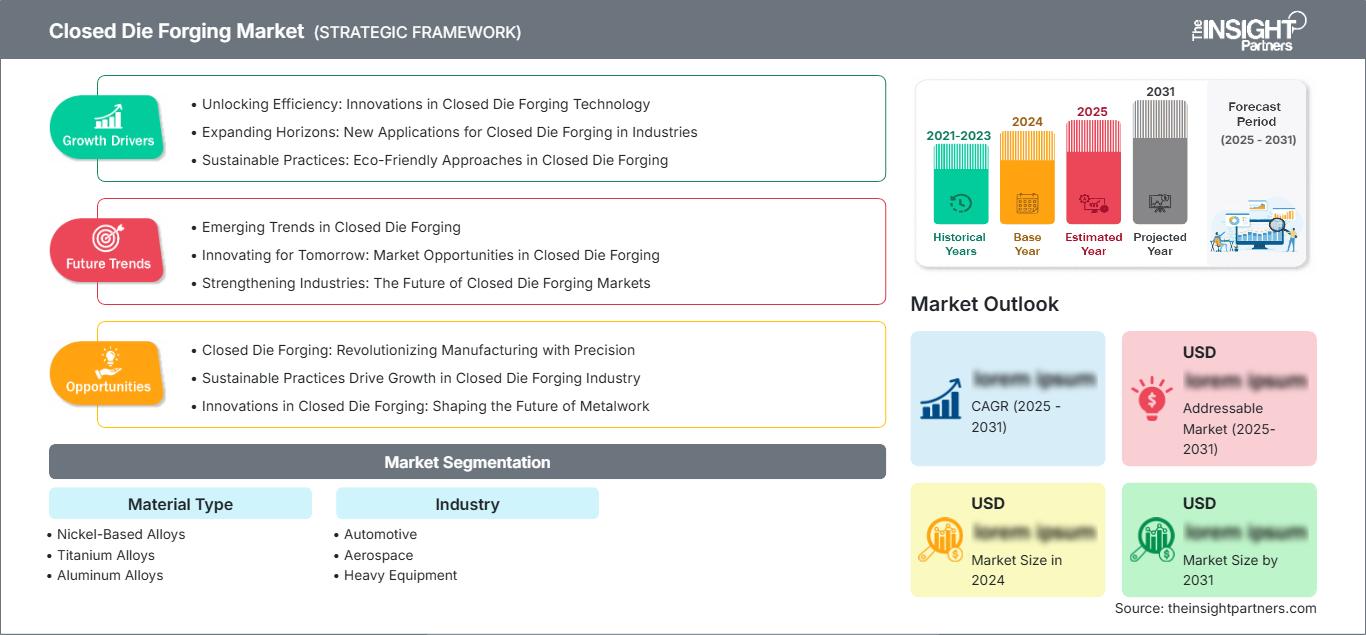
Closed Die Forging Market: Strategic Insights
Regional Insights
North America Closed Die Forging Market
North America represented 7.88%of global demand in 2025 and is projected to grow at a CAGR of 4.75% during 2026–2040. The Closed Die Forging Market share in the region is supported by aircraft production recovery, defense platform sustainment, and reshoring of safety-critical forged parts. Suppliers are focusing on automated press lines, nondestructive testing, and alloy traceability to meet aerospace and mobility standards.
The regional base has advantages such as qualified die engineering, heat treatment capacity, and the presence of OEM qualification teams. In terms of demand, it is strongest for the components of landing gear, turbine-related parts, trucks, and industrial machinery. Spending on energy transition also supports forged products used for energy transmission, compression, and industrial machinery.
U.S. Closed Die Forging Market
The U.S. accounted for 75.46% of North America in 2025 and is expected to expand at a CAGR of 4.75% during 2026–2040. Demand is concentrated in aerospace, defense, commercial vehicles, off-highway equipment, and energy infrastructure. Domestic procurement preferences and qualification barriers favor suppliers with certified metallurgy, machining, testing, and documentation capabilities.
The company’s presence is supported by specialists in aerospace alloys, suppliers of forged machinery, and producers of precision components for OEMs and its suppliers. ATI Inc. and SIFCO Industries, Inc., which deal with high-performance metal and engineered forged parts, work in this area, but the overall activities in other areas promote the signing of closed-die contracts for applications that require specific strength and durability properties.
Europe Closed Die Forging Market
Europe held 16.08% share in 2025 and is forecast to grow at a CAGR of 4.28% during 2026–2040. Germany remains the leading country because of automotive engineering depth, machinery exports, and industrial automation capability. The UK supports aerospace and defense forgings, while Italy contributes specialist forging clusters and precision machining know-how.
In France, the demand for aerospace, rail, and energy equipment is one of the main factors contributing to the success of long-term industrial projects in this region. Spain strengthens the production capacity due to its auto manufacturing and shipbuilding channels. At the same time, the Nordic and Central European manufacturers specialize in producing high-integrity components. Regional manufacturers want to reduce material spent in the production process as much as possible while documenting the reduction.
APAC Closed Die Forging Market
APAC accounted for 71.86% share in 2025 and is projected to grow at a CAGR of 4.48% during 2026–2040. China leads regional output through automotive, machinery, construction equipment, and shipbuilding scale, while Japan and South Korea support advanced mobility and industrial precision demand.
India is gaining momentum through defense localization, rail investment, and expanding commercial vehicle platforms. Australia contributes mining and heavy equipment requirements. Policy support for manufacturing localization, export competitiveness, and infrastructure expansion strengthens regional forging utilization across aluminum, titanium, and nickel alloy applications.
Middle East & Africa Closed Die Forging Market
Middle East & Africa is expected to grow at a CAGR of 3.76% during 2026–2040, led by Saudi Arabia. Energy infrastructure, refining, industrial maintenance, ship repair, and construction machinery create demand for robust forged parts used in harsh operating conditions.
The UAE offers provisions in terms of logistics, possible aerospace solutions, and naval activities, and South Africa provides assistance in mining operations, railway transportation, and industrial machines. Other areas of MEA still rely on projects that are currently implemented, but there are new regulations and new infrastructures that may create successful conditions for regional producers.
Segmentation Analysis
Material Type
Material Type, aluminum alloy is projected to grow at a CAGR of 4.34% during 2026–2040 as alloy selection becomes central to component weight, heat tolerance, fatigue resistance, and machinability. The Closed Die Forging Market scope across materials is expanding as OEMs balance cost, certification requirements, and performance needs in aerospace, automotive, and industrial machinery programs.
- Aluminum Alloys are used where lightweight structures, corrosion resistance, and machinability are critical, particularly in aerospace frames, automotive suspension parts, and industrial components requiring lower mass.
- Titanium Alloys serve high-value aerospace, defense, and performance engineering applications where strength-to-weight ratio, fatigue resistance, and heat tolerance justify higher material and processing costs.
- Nickel Alloys remain strategically important for hot-section, turbine-adjacent, marine, and energy components exposed to elevated temperatures, corrosion, and demanding load cycles.
Industry
Industry, automotive segment for aluminum alloy based forging is expected to expand at a CAGR of 4.16% during 2026–2040, reflecting wider use of forged parts in mobility, aviation, infrastructure equipment, and marine systems. Demand varies by qualification intensity, unit volume, and performance requirements, with automotive leading volume and aerospace delivering higher value through certified alloy and process controls.
- Aerospace uses forged landing gear, engine, and structural parts where fatigue resistance, alloy traceability, and certification depth are decisive for long service lives and safety-critical performance.
- Automotive remains the largest volume base, using forgings in crankshafts, gears, driveline, chassis, and suspension components where strength, cost efficiency, and repeatability matter.
- Industrial Machinery requires forged shafts, couplings, gears, and load-bearing components that withstand vibration, torque, and continuous-duty operation in manufacturing and processing environments.
- Construction demand is tied to excavators, loaders, cranes, and infrastructure equipment, where forged pins, links, axles, and structural elements improve durability under heavy loads.
- Shipbuilding uses forged marine shafts, couplings, valve bodies, and engine components that must resist corrosion, shock loads, and long operating cycles in harsh environments.
Opportunity Snapshot
| Industry | Revenue Contribution | Trend Tag | Adoption Stage |
| Aerospace | High | Fleet Renewal | Scaling |
| Automotive | High | Lightweighting | Mature |
| Industrial Machinery | Medium | Automation Parts | Scaling |
| Construction | Medium | Infrastructure Build | Scaling |
| Shipbuilding | Medium | Marine Shafts | Emerging |
| Others | Low | Niche Components | Emerging |
Closed Die Forging Market Growth Drivers and Impact Analysis
Aerospace Fleet Renewal and Safety-Critical Component Demand
Commercial aviation recovery, defense modernization, and aircraft maintenance cycles are increasing demand for forged titanium, aluminum, and nickel alloy components. According to aviation industry capacity indicators, airlines continue to prioritize fuel-efficient fleets, which raises the need for lighter structural and rotating parts. Closed die forging is preferred because controlled grain flow improves fatigue performance in landing gear, engine discs, shafts, and high-load fittings. The market impact is significant because aerospace qualification creates long supplier relationships, high entry barriers, and premium pricing for validated processes. Forging companies with heat treatment, testing, and machining integration can capture more value per component while supporting shorter OEM development timelines.
Vehicle Lightweighting and Durable Powertrain Architectures
Automotive manufacturers continue to reduce mass while preserving crashworthiness, torque transfer, and long-term durability. Forged aluminum and advanced alloy components support lighter suspension, chassis, driveline, and steering systems, while steel and nickel alloy forgings remain relevant in heavy-duty vehicles and hybrid powertrains. The transition to electric platforms does not eliminate forging demand; it shifts demand toward motor shafts, gear sets, housings, and structural load paths. The practical impact is a broader component mix, with suppliers needing flexible tooling, faster die changeovers, and stronger collaboration with OEM engineering teams. Cost-efficient repeatability remains essential because automotive volumes magnify scrap and downtime penalties.
Industrial Infrastructure and Heavy Equipment Modernization
Infrastructure expansion, mining equipment replacement, construction machinery upgrades, and energy system maintenance are supporting steady demand for heavy-duty forged parts. Industrial users select closed die forgings for gears, shafts, pins, couplings, and valve bodies because failure can halt high-value operations. IMF-linked capital expenditure trends and national infrastructure programs are reinforcing demand in emerging economies, while developed markets are replacing aging assets with more efficient machinery. The market impact is a resilient baseline beyond automotive cycles. Suppliers that offer medium-volume customization, repair-part responsiveness, and documented metallurgical consistency can serve equipment OEMs and aftermarket channels with lower demand volatility.
Closed Die Forging Market Future Trends
Digital Forging Cells and Predictive Process Control
Closed Die Forging Market trends are moving toward connected forging cells that combine die simulation, billet temperature tracking, press force analytics, and automated handling. Over the forecast period, these systems will reduce trial-and-error development, improve first-pass yield, and allow faster qualification of complex alloy components. Predictive maintenance will also become more important as high-tonnage presses face utilization pressure from aerospace and industrial programs. The trend favors companies able to convert production data into customer-facing quality evidence, because OEMs increasingly want traceable process histories rather than only final inspection certificates.
Low-Carbon Metalworking and Material Efficiency
Forging producers are expected to face stronger customer scrutiny on energy intensity, scrap utilization, and alloy sourcing. Closed die forging already offers material efficiency compared with subtractive manufacturing for many geometries, but future competitiveness will depend on documented reductions in energy use, furnace optimization, and recycled input integration where specifications allow. Customers in Europe, North America, and Japan are likely to request supplier-level emissions data during sourcing. This trend will reward plants that modernize heating systems, optimize die life, and demonstrate lower rework without compromising mechanical performance.
Closed Die Forging Market Opportunities
Qualification Partnerships with Aerospace and Defense OEMs
Forging suppliers can create long-term value by entering early-stage qualification partnerships with aerospace and defense OEMs. These programs require rigorous documentation, alloy expertise, fatigue testing, and repeatable heat treatment, but they also create high switching costs once parts are approved. Investment should focus on titanium and nickel alloy capability, nondestructive testing, machining integration, and engineering support during design-for-forging reviews. The opportunity is strongest for suppliers that can reduce development time while meeting safety-critical standards. Partnerships may also support localization strategies as governments seek secure supply for aircraft, missiles, naval platforms, and defense vehicles.
Localized Forging Hubs for Emerging Industrial Economies
Emerging economies present opportunities for localized forging hubs serving construction equipment, commercial vehicles, rail, energy, and industrial machinery. Import dependence remains high for precision forged components in several markets, creating room for joint ventures, technology licensing, and staged capacity additions. Investors should prioritize regions with OEM clusters, improving steel and alloy supply, skilled labor availability, and government incentives for advanced manufacturing. The opportunity differs from low-cost production because customers increasingly need validated metallurgy, machining, and quality systems close to assembly sites. Regional hubs can shorten lead times and reduce exposure to trade disruptions.
Recent Developments
- May 2026: Bharat Forge Ltd. announced that it has entered into a long-term contract with Embraer for the manufacturing and supply of critical landing gear forgings and becomes the first supplier from India to enter Embraer global Aerospace supply chain for forged components.
- May 2026: Forged Solutions Group demonstrate its technical expertise and engage with industry stakeholders from around the world at the Paris Air Show 2025. The company will present the latest developments in forged component technologies, designed to meet the complex demands of today’s aerospace and defence programmes.
- July 2025: Maxiforja Group, a Brazilian manufacturer serving the heavy truck and agricultural equipment industries, has started production using the world’s largest 6,500-ton forging press equipped with ANDRITZ Schuler’s Kinetic Energy Recovering System (KERS). The new GLK 6500 press, developed by ANDRITZ Farina and built in Brazil, is designed to increase production capacity for large, forged components while reducing power consumption by up to 40% compared to conventional presses of similar size. The investment enhances productivity, precision, and energy efficiency, supporting Maxiforja’s sustainability goals and marking its first adoption of ANDRITZ Schuler forging technology.
Frequently Asked Questions

- Comprehensive Market Sizing and Forecast Analysis
- Detailed Segmentation Analysis
- In-Depth Market Dynamics Assessment
- Regional and Country-Level Insights
- Competitive Landscape and Company Benchmarking
- Strategic Business Intelligence
Recent Reports
Testimonials

The Insight Partners' SCADA System Market report is comprehensive, with valuable insights on current trends and future forecasts. The team was highly professional, responsive, and supportive throughout. We are very satisfied and highly recommend their services.
RAN KEDEM Partner, Reali Technologies LTDs
I requested a report on a very specific software market and the team produced the report in a few days. The information was very relevant and well presented. I then requested some changes and additions to the report. The team was again very responsive and I got the final report in less than a week.
JEAN-HERVE JENN Chairman, Future Analytica
We worked with The Insight Partners for an important market study and forecast. They gave us clear insights into opportunities and risks, which helped shape our plans. Their research was easy to use and based on solid data. It helped us make smart, confident decisions. We highly recommend them.
PIYUSH NAGPAL Sr. Vice President, High Beam Global
The Insight Partners delivered insightful, well-structured market research with strong domain expertise. Their team was professional and responsive throughout. The user-friendly website made accessing industry reports seamless. We highly recommend them for reliable, high-quality research services
YUKIHIKO ADACHI CEO, Deep Blue, LLC.
This is the first time I have purchased a market report from The Insight Partners.While I was unsure at first, I visited their web site and felt more comfortable to take the risk and purchase a market report.I am completely satisfied with the quality of the report and customer service. I had several questions and comments with the initial report, but after a couple of dialogs over email with their analyst I believe I have a report that I can use as input to our strategic planning process.Thank you so much for taking the extra time and making this a positive experience.I will definitely recommend your service to others and you will be my first call when we need further market data.
JOHN SUZUKI President and Chief Executive Officer, Board Director, BK Technologies
I wish to appreciate your support and the professionalism you displayed in the course of attending to my request for information regarding to infectious disease IVD market in Nigeria. I appreciate your patience, your guidance, and the fact that you were willing to offer a discount, which eventually made it possible for us to close a deal. I look forward to engaging The Insight Partners in the future, all thanks to the impression you have created in me as a result of this first encounter.
DR CHIJIOKE ONYIA MANAGING DIRECTOR, PineCrest Healthcare Ltd.Reason to Buy
- Informed Decision-Making
- Understanding Market Dynamics
- Competitive Analysis
- Identifying Emerging Markets
- Customer Insights
- Market Forecasts
- Risk Mitigation
- Boosting Operational Efficiency
- Strategic Planning
- Investment Justification
- Tracking Industry Innovations
- Aligning with Regulatory Trends





 Get Free Sample for