
Liquid Applied Roofing Market Growth, Demand & Size by 2034
Coverage: By Type (Bituminous, Elastomeric, Cementitious); Application (Roofing, Walls, Building Structures, Roadways); Industry (Residential, Commercial, Public Infrastructure) , and Geography (North America, Europe, Asia Pacific, and South and Central America)
- Status : Data Released
- Report Code : TIPRE00024028
- Category : Chemicals and Materials
- No. of Pages : 150
- Available Report Formats :


- Last update date : July 16, 2026


2025 Market Size
US$ 9.4 Bn
Base year value
2034 Forecast
US$ 17.66 Bn
Projected by 2034
CAGR 2026-2034
7.26 %
Growth rate
Addressable Market
US$ 122.08 Bn
(2026-2034)
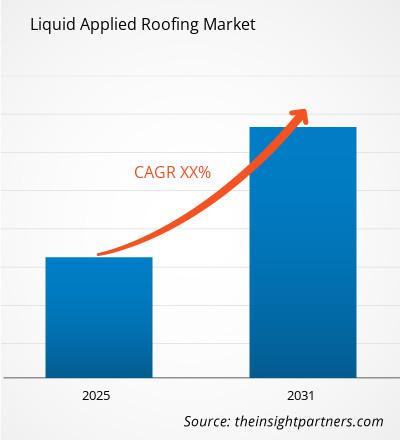
The Liquid Applied Roofing market held value at US$ 9.4 Billion in 2025 and is anticipated to attain US$ 17.66 Billion by 2034, registering a CAGR of 7.26% from 2026 to 2034. Increasing demand for seamless waterproofing systems that increase the life cycle of the roofs and have fewer chances of failures due to shifting from sheet membranes is driving the market.
In North America, the growth rate of the Liquid Applied Roofing market size is estimated to grow at a CAGR of 6.8–7.4% up to 2034. Aging commercial properties are increasingly being reroofed and the need for low VOC and reflectivity coating has increased the market demand in the region.
Liquid Applied Roofing Market Assessment and Insights
- North America accounted for 31–34% share in 2025 and is growing at a 6.8–7.4% CAGR between 2026–2034, driven by commercial reroofing, energy-code compliance, and low-disruption refurbishment.
- US represented 78–82% of North America in 2025 and is growing at a 6.9–7.5% CAGR between 2026–2034, led by warehouses, schools, and healthcare reroofing.
- Europe held 24–27% share in 2025 and is growing at a 6.4–7.0% CAGR between 2026–2034, with Germany, the UK, France, Italy, and Spain leading renovation-led demand.
- Asia Pacific captured 28–31% share in 2025 and is growing at a 7.8–8.6% CAGR between 2026–2034, supported by China, India, Japan, South Korea, and Australia infrastructure spending.
- Largest Segment Roofing held 42–46% market share in 2025 and is growing at a 7.1–7.7% CAGR between 2026–2034 due to reroofing and waterproofing priority.
- High Growth Segment Public Infrastructure held 18–22% market share in 2025 and is growing at an 8.0–8.8% CAGR between 2026–2034 as transport and civic assets require durable membranes.
- Key companies analyzed in detail: Sika AG, GCP Applied Technologies Inc., Carlisle Companies Incorporated, SOPREMA SAS, MAPEI S.p.A., Fosroc International Limited, Johns Manville, Tremco Incorporated, GAF Materials LLC, Henry Company LLC.
Source: The Insight Partners' analysis based on proprietary research, government publications, company annual reports, investor presentations, industry databases, and expert interviews.
The Liquid Applied Roofing market forecast indicates that the market is evolving from solvents-laden products to those that are elastomeric, bituminous or cementitious, which offer strong bonding properties, quick curing process, and crack-bridging capability. Process approaches focus on aqueous chemistry, polymer blending, and substrate tolerance of current concrete, metal, and bitumen. Liquid roofing membranes are popular among contractors for their ability to flow around penetrations, parapets, drains, and other non-standard roof surfaces where membrane sheets would require more seams.
Liquid Applied Roofing market trends point to its expansion in urban clusters that will face the impact of heat, rainfall, and infrastructure replacement at once. Public procurements for transport centers, hospitals, schools, and other facilities should be oriented towards technologies that minimize tearing off waste and accelerate construction processes. Compliance with volatile organic compounds, building envelope requirements, and cool-roof standards will contribute to specification expansion in established and congested markets.
Liquid Applied Roofing Market Report Scope
| Report Attribute | Details |
|---|---|
| Market size in 2025 | US$ 9.4 Billion |
| Market Size by 2034 | US$ 17.66 Billion |
| Global CAGR (2026 - 2034) | 7.26% |
| Historical Data | 2021-2024 |
| Forecast period | 2026-2034 |
Liquid Applied Roofing Market Analysis
The development of Liquid Applied Roofing market will be driven by the demand to prolong the serviceable life of building envelopes without roof replacements. Lowering of lifecycle costs, ease of installation, and waterproofing through all roofing penetrations will be key considerations of building owners. Value chain will include resin providers, membrane formulation companies, distributors, trained applicators, and facility managers making specification decisions.
Improved supply dynamics will emerge in localizing production of blends, training contractors, and developing products that can cope with humid, hot, and cold weather conditions. Systems based on bituminous will still remain relevant for the purposes of renovation, while elastomeric ones will capitalize on their ability to withstand UV and flexible nature.
From the Liquid Applied Roofing market analysis, competition exists within the industry and depends on broad formulations, distribution networks, and warranty assurance in winning accounts. The companies competing in the market include Sika AG, Carlisle Companies Incorporated, SOPREMA SAS, MAPEI S.p.A., and Tremco Incorporated using complete waterproofing offerings, and GAF Materials LLC, Johns Manville, Henry Company LLC, Fosroc International Limited, and GCP Applied Technologies Inc. relying on reroofing systems and technical support.
There is an increase in investments in resins with low-VOC content, fast-curing polyurea and polyurethane systems, and reflective topcoats that can help in achieving energy-efficiency objectives. Competitive positioning is increasingly dependent on demonstrated performance in ponding water, thermal cycles, and adhesion post-weathering. Companies with local manufacturing facilities and installer certification are better positioned to sustain profit margins amid rising raw material price fluctuations.
● REPORT CUSTOMIZATION
Tailor This Report To Align With Your Specific Business Requirements
This report can be customized to align precisely with your business objectives, scope, and target markets. Customization options include tailored segmentation, geography, competitive analysis, and strategic insights to support informed decision-making.
Customize This Report →WHAT YOU CAN ADJUST
- ● Segmentations
- ● Geography
- ● Competitive Analysis
- ● Language Preferences
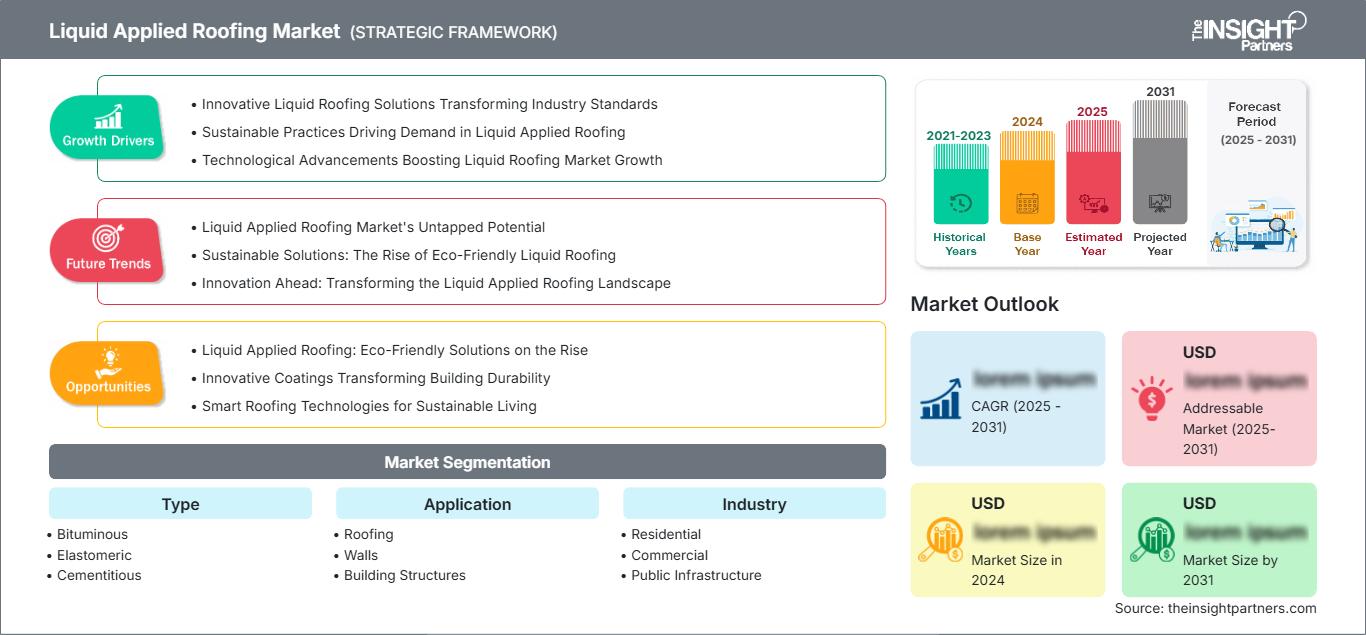
Liquid Applied Roofing Market: Strategic Insights
Regional Insights
North America Liquid Applied Roofing
The market share of North America was estimated at 31–34% in 2025, which is expected to increase further by 2034, with the growth rate at 6.8–7.4% CAGR over the period. High reroofing activity among commercial real estate, logistics assets, educational campuses, and healthcare estates is one of the major factors driving the Liquid Applied Roofing market share in North America.
Specifications driven by cool roof mandates, storm readiness planning, and labor efficiencies in application are some of the key trends in the region. Low odor and VOC systems for occupied buildings are being favored by manufacturers, while contractors are opting for detailing reduction around penetrations. The United States is a more prominent market than Canada in the region.
U.S. Liquid Applied Roofing Market
In 2025, the US is projected to hold 78–82% of North American shares and will register growth at a 6.9–7.5% CAGR in 2026-2034. Applications are found in low slope roof membranes on commercial rooftops, educational institutions, hospitals, retail centers, and warehouses where liquid roof coating enables phased installation. Market players include Sika AG, GAF Materials LLC, Carlisle Companies Incorporated, Tremco Incorporated, and Henry Company LLC with a wide range of specification programs.
Market applications are increasing in terms of reflective coating, liquid flashing, and reinforced systems for recovering aged single-ply, metal, and modified bitumen roof membranes. There is an added advantage of facility managers due to reduction in tear off waste, short closure time, and extended warranties. Demand is fueled by storm restoration, energy efficiency considerations, and increased roof equipment installations.
Europe Liquid Applied Roofing Market
The Europe region is contributing with 24–27% shares in 2025 and expected to record a CAGR of 6.4–7.0% from 2025 to 2034. Germany is the dominating country due to industrial re-surfacing, building renovations, and performance in terms of energy efficiency which are increasing the application of liquid membranes in flat roofs and complex-shaped roofs. In the UK region, the market is driven by school estates, retail parks, and logistics properties owing to low-disruption reroofing solutions.
France, Italy, and Spain are contributing due to urban housing renovations, transport infrastructure, and climate adaptation projects. Low VOC regulations and building energy regulations are providing boost to reflective and water-based formulations. SOPREMA SAS, MAPEI S.p.A., Sika AG, and Fosroc International Limited are benefiting due to regional technical expertise, whereas the contractors prefer such systems that are suitable for aging bitumen, concrete deck roofs, and heritage buildings.
APAC Liquid Applied Roofing Market
The APAC region has 28-31% market share in 2025 and will witness CAGR growth of 7.8-8.6% during 2026-2034. The region is led by China owing to the growth drivers of urban renewal, transportation construction, and industrial roofs. Countries like India, Japan, South Korea, and Australia contribute through building renovation, subway networks, and waterproofing of infrastructure.
The shift of policy focus towards resilience, heat reduction, and energy efficiency in buildings is boosting specification quality. Liquid Applied Roofing has been benefiting through contractor inclination toward rapid application due to challenges such as roof accessibility and weather conditions on urban sites.
Middle East & Africa Liquid Applied Roofing Market
Middle East & Africa region is expected to register a CAGR of 6.2%-6.8% during 2026-2034 with the dominant consumption in the Saudi Arabia region. The Middle East & Africa region gets contribution from UAE, South Africa, and Rest of MEA regions in terms of commercial buildings, airports, industrial constructions, and civic infrastructure, where heat, UV radiation, and sporadic rain showers occur.
The energy-efficient initiatives and large-scale public sector projects are driving reflective liquid membranes and advanced waterproofing systems. In such cases, the decision making is based on the performance of membranes such as heat resistance, crack bridging, and concrete adhesion.
Segmentation Analysis
Type
Type is expected to grow at a 6.9–7.6% CAGR during 2026–2034. The Liquid Applied Roofing scope across type is defined by substrate condition, exposure profile, expected service life, and installation environment. Elastomeric systems are gaining because of flexibility and UV resistance, bituminous systems remain important in recover applications, and cementitious products support mineral substrates and structural waterproofing needs.
- Bituminous systems remain strategically important for refurbishment because they bond well to aged asphaltic surfaces and support cost-sensitive reroofing where compatibility with existing membranes matters.
- Elastomeric products are preferred for roofs exposed to UV radiation, thermal cycling, and movement because they provide flexibility, crack bridging, and reflective performance options.
- Cementitious solutions address concrete-intensive structures, parapets, walls, and infrastructure interfaces where mineral adhesion, moisture tolerance, and surface durability are critical to specification.
Application
Application is projected to grow at a 7.0–7.8% CAGR during 2026–2034. Roofing remains the largest use case because waterproofing continuity directly affects building operations, insurance exposure, and maintenance cost. Walls, building structures, and roadways expand the addressable base as engineers use liquid systems to protect junctions, decks, retaining areas, and exposed surfaces from water ingress.
- Roofing leads adoption because seamless application reduces leak pathways around drains, skylights, HVAC supports, and parapets while enabling recover projects on occupied buildings.
- Walls use liquid membranes for façade interfaces, below-grade protection, and moisture control where continuous coatings improve durability on irregular surfaces.
- Building Structures benefit from waterproofing around decks, podiums, balconies, and concrete elements where movement and exposure require flexible protective layers.
- Roadways represent a specialized demand area for bridges, tunnels, and transport structures where waterproofing protects concrete and reinforcement from water and chloride damage.
Industry
Industry is expected to grow at a 7.2–8.0% CAGR during 2026–2034. Residential demand is tied to renovation and weatherproofing, commercial demand is shaped by operational continuity, and public infrastructure is the fastest-expanding area. Asset owners are increasingly comparing installation time, warranty coverage, reflectivity, and compatibility with existing substrates before specifying liquid systems.
- Residential demand is supported by flat roof repairs, terraces, balconies, and energy-conscious refurbishment where homeowners seek durable waterproofing without major structural disruption.
- Commercial users prioritize lifecycle cost, rapid installation, and warranty-backed protection for warehouses, retail centers, offices, hospitals, and schools with occupied-building constraints.
- Public Infrastructure is strategically important because transport terminals, civic buildings, bridges, and utilities require resilient waterproofing aligned with long asset lives and public procurement standards.
Opportunity Snapshot
| Segment Name | Revenue Contribution | Trend Tag | Adoption Stage |
| Roofing | High | Cool Roofs | Mature |
| Walls | Medium | Moisture Control | Scaling |
| Building Structures | Medium | Podium Decks | Scaling |
| Roadways | Low | Bridge Protection | Emerging |
Liquid Applied Roofing Market Growth Drivers and Impact Analysis
Reroofing Demand Across Aging Building Stock
Aging commercial, institutional, and residential roofs are leading to the emergence of continuous demand for waterproofing solutions which require no total destruction of existing roof system. Liquid Applied Roofing responds to such a challenge, as it is easy to apply it to various types of substrates that have been prepared, thus cutting down the amount of waste sent to the landfills and minimizing time needed to complete the works. It affects mature markets especially dramatically, where buildings are aged and budgets allocated for roof maintenance change to proactive ones.
Energy Codes and Low-VOC Specification Pressure
Changing roofing material choices are a result of new regulations on energy performance and indoor air quality. There is potential for liquid reflective coatings to minimize heat absorption by a roof with a low slope, whereas there are advantages to using systems which use water and have little odor when applying the coating on buildings like schools, hospitals, and office buildings which are occupied. This will impact procurement because requests are being made for information about VOCs, solar reflectivity, durability, and green building compatibility.
Infrastructure Resilience and Climate Exposure
Increasing frequency of heat stress, heavy rain, and recovery from storms is enhancing the need for strong waterproofing in both publicly and privately held property. Liquids systems are ideal in dealing with details, expansion joints, parapets, podium decks, and concrete joints that have a vulnerability to water. There is an impact on the market not only in roofing applications but also in transportation, utilities, and municipal buildings, where there are costs associated with any down time.
Liquid Applied Roofing Market Future Trends
Sensor-Ready Roof Restoration Systems
Trends within the Liquid Applied Roofing market will become more inclusive of roof assemblies which integrate sensors with liquid membranes, moisture sensing, inspection information, and asset management systems. Building owners are looking for early warning of ponding water, moisture entrapment, and membrane damage to prevent leaks from disrupting business activities. Manufacturers of this technology are at an advantage when their products offer documentation, digital recordkeeping, and smart-building integration capability. This new approach to roofing will likely be introduced to the data center, healthcare facility, airport, and logistics sectors.
Hybrid Chemistries for Faster Weather Windows
Future hybrid chemistries will decrease uncertainty about curing and widen the applicability of the products in humid, cold, or time-dependent circumstances. New combinations of polyurethane, polyurea, acrylic, and bitumen are being developed in order to enhance adhesion, weather resistance, elongation, and UV resistance. The trend is significant for businesses due to lack of workers and unexpected changes in weather that lead to additional costs from postponed roofing operations.
Liquid Applied Roofing Market Opportunities
Public Infrastructure Refurbishment Programs
Refurbishing of public infrastructures is one approach through which forecasts for Liquid Applied Roofing market can turn into specification-based revenues. Airports, train stations, municipal buildings, schools, and hospitals may require waterproofing without closing their doors for too long. Manufacturers have the chance to grab this opportunity through creation of approved applicator programs, warranty inspections, and compatibility with criteria on sustainability, minimal emissions, and longevity of the roofing materials. Those projects that would benefit from such systems due to complexity of roofs and occupancy issues would be the most lucrative.
Retrofit Bundles with Solar and Cool Roofs
Growth in rooftop solar panels and urban heat management provides an opportunity for a combined retrofit solution. The use of liquid membranes will be helpful in preparing old roofs for installation of the solar panel, as well as waterproofing areas where support is required, in addition to using reflective topcoats for temperature reduction. Contractors can distinguish themselves by providing surveys of the roof’s condition, restoration of the coating, strengthening of the roof at the penetration areas, and maintenance services prior to solar installations.
Recent Developments
- June 2026: Sika Corporation – Roofing & Waterproofing is pleased to announce the next generation of PMMA technologies available from Sika under one comprehensive Sikalastic Rapid brand. The move is aimed at consolidating PMMA products for both flashing and field membranes under one powerful worldwide brand name, thus emphasizing Sika’s dedication to innovation and quality. It’s not only good news for our PMMA flashing and field membranes applications, but also increases flexibility and compatibility while offering more options for roofing and waterproofing solutions.
- April 2026: Sika is proud to announce the winners of the 2025 Roofing & Waterproofing Projects of the Year competition, celebrating Sika’s approved applicators across the U.S. who demonstrate outstanding craftsmanship, innovation, and commitment to excellence.
- December 2025: Sika AG — Sika’s roofing and waterproofing team reported additions to its Sikalastic liquid-applied portfolio, including a two-component hot spray pure polyurea resin, Sikalastic-835 I, intended for professional hot-spray applicators.
- October 2025: Kiwiseal provide Liquid Membrane Roofing Guide 2025 | Waterproof Roof Solutions NZ. Kewiseal’s product line (Maxx, Ultra, Top Coat, Pro) is engineered to suit New Zealand’s climate and structural demands. Their membranes are water-based, high-elasticity formulas that resist UV degradation and aging.
Frequently Asked Questions

- Comprehensive Market Sizing and Forecast Analysis
- Detailed Segmentation Analysis
- In-Depth Market Dynamics Assessment
- Regional and Country-Level Insights
- Competitive Landscape and Company Benchmarking
- Strategic Business Intelligence
Recent Reports
Testimonials

The Insight Partners provided valuable market intelligence that supported our global go-to-market strategy. Their team was professional, responsive, and attentive to our feedback, providing thoughtful analysis and helpful methodological clarifications throughout the project.
Junmo Kim Chief Financial Officer (CFO), Enertech Co., Ltd.
The Insight Partners' SCADA System Market report is comprehensive, with valuable insights on current trends and future forecasts. The team was highly professional, responsive, and supportive throughout. We are very satisfied and highly recommend their services.
RAN KEDEM Partner, Reali Technologies LTDs
I requested a report on a very specific software market and the team produced the report in a few days. The information was very relevant and well presented. I then requested some changes and additions to the report. The team was again very responsive and I got the final report in less than a week.
JEAN-HERVE JENN Chairman, Future Analytica
We worked with The Insight Partners for an important market study and forecast. They gave us clear insights into opportunities and risks, which helped shape our plans. Their research was easy to use and based on solid data. It helped us make smart, confident decisions. We highly recommend them.
PIYUSH NAGPAL Sr. Vice President, High Beam Global
The Insight Partners delivered insightful, well-structured market research with strong domain expertise. Their team was professional and responsive throughout. The user-friendly website made accessing industry reports seamless. We highly recommend them for reliable, high-quality research services
YUKIHIKO ADACHI CEO, Deep Blue, LLC.
This is the first time I have purchased a market report from The Insight Partners.While I was unsure at first, I visited their web site and felt more comfortable to take the risk and purchase a market report.I am completely satisfied with the quality of the report and customer service. I had several questions and comments with the initial report, but after a couple of dialogs over email with their analyst I believe I have a report that I can use as input to our strategic planning process.Thank you so much for taking the extra time and making this a positive experience.I will definitely recommend your service to others and you will be my first call when we need further market data.
JOHN SUZUKI President and Chief Executive Officer, Board Director, BK Technologies
I wish to appreciate your support and the professionalism you displayed in the course of attending to my request for information regarding to infectious disease IVD market in Nigeria. I appreciate your patience, your guidance, and the fact that you were willing to offer a discount, which eventually made it possible for us to close a deal. I look forward to engaging The Insight Partners in the future, all thanks to the impression you have created in me as a result of this first encounter.
DR CHIJIOKE ONYIA MANAGING DIRECTOR, PineCrest Healthcare Ltd.Reason to Buy
- Informed Decision-Making
- Understanding Market Dynamics
- Competitive Analysis
- Identifying Emerging Markets
- Customer Insights
- Market Forecasts
- Risk Mitigation
- Boosting Operational Efficiency
- Strategic Planning
- Investment Justification
- Tracking Industry Innovations
- Aligning with Regulatory Trends





 Get Free Sample for