
Absolute Pressure Sensor Market Size, Demand & Growth by 2034
Absolute Pressure Sensor Market Size and Forecasts (2021–2034), Global and Regional Share, Trends, and Growth Opportunity Analysis by Pressure Rating (Bar 1, Bar 2, Bar 3, and Bar 4); Application (Medical Appliance, Consumer Electronics, Automotive, and Others); and Geography
- Status : Data Released
- Report Code : TIPRE00010753
- Category : Electronics and Semiconductor
- No. of Pages : 150
- Available Report Formats :


- Last update date : July 13, 2026


2025 Market Size
US$ 9.31 Bn
Base year value
2034 Forecast
US$ 12.47 Bn
Projected by 2034
CAGR 2026-2034
3.30 %
Growth rate
Addressable Market
US$ 98.91 Bn
(2026-2034)
The Absolute Pressure Sensor Market was valued at US$ 9.31 Billion in 2025 and is projected to reach US$ 12.47 Billion by 2034, expanding at a CAGR of 3.30% during 2026–2034. The market is supported by demand for vacuum-referenced sensing in medical appliances, consumer electronics, and automotive systems where altitude, manifold pressure, respiratory airflow, and environmental compensation require stable measurement against absolute pressure.
The North American region will witness a CAGR of 2.9-3.4% in the forecast period 2026-2034 due to automotive electronics integration, medical device production, semiconductor design, and industrial calibration needs. North America has strong suppliers, high adoption of connected diagnostics, and continued deployment of pressure sensors in engine management, tire pressure monitoring, ventilation, and consumer environment sensing platforms.
Absolute Pressure Sensor Market Assessment and Insights
- North America: 27–31% share in 2025, growing at a CAGR of 2.9–3.4% during 2026–2034, supported by automotive electronics, respiratory equipment, appliance controls, and semiconductor design activity.
- US: 80–84% share of North America in 2025, growing at a CAGR of 3.0–3.5% during 2026–2034, led by medical device production and connected vehicle platforms.
- Europe: 22–26% share in 2025, growing at a CAGR of 2.7–3.2% during 2026–2034, with Germany, France, the UK, Italy, and Spain leading automotive and industrial adoption.
- Asia Pacific: 34–38% share in 2025, growing at a CAGR of 3.6–4.2% during 2026–2034, led by China, Japan, South Korea, and India across electronics and vehicle manufacturing.
- Largest Segment: Automotive holds 42–46% market share in 2025, growing at a CAGR of 3.2–3.7% during 2026–2034 as manifold, brake, emissions, and battery systems expand sensor content.
- High Growth Segment: Medical Appliance holds 20–24% market share in 2025, growing at a CAGR of 4.0–4.6% during 2026–2034 due to respiratory care, infusion, diagnostics, and home monitoring.
- Key companies analyzed in detail: Avnet, Inc.; Continental Aktiengesellschaft; DENSO Corporation; Honeywell International Inc.; Infineon Technologies AG; Kistler Instrumente AG; Mitsubishi Electric Corporation; NXP Semiconductors N.V.; Robert Bosch GmbH; Setra Systems, Inc.; STMicroelectronics N.V.; TE Connectivity Ltd.
Source: The Insight Partners' analysis based on proprietary research, government publications, company annual reports, investor presentations, industry databases, and expert interviews.
The sensing technology in absolute pressure sensors has evolved from individual mechanical to miniaturized MEMS, piezo-resistive, and digitally compensated sensors embedded in control boards. The automotive industry uses absolute pressure sensors for manifold air pressure, barometric compensation, tire pressure monitoring systems, and battery safety diagnostics. Manufacturers of medical appliances need accurate low-pressure sensing for their ventilation and infusion systems, whereas makers of consumer electronics favor low-power barometric sensors for altitude detection, indoor navigation, drones, wearable devices, and smart appliances.
Forward demand will be driven by the localization of electronics manufacturing, stringent vehicle efficiency regulations, and the decentralization of the health care industry. Asia Pacific will continue to dominate manufacturing, while North America and Europe will focus on applications requiring high reliability and regulatory compliance. The Absolute Pressure Sensor Market scope is expanding because of the requirements from the OEMs for a smaller size, digital output, and temperature compensation.
Absolute Pressure Sensor Market Report Scope
| Report Attribute | Details |
|---|---|
| Market size in 2025 | US$ 9.31 Billion |
| Market Size by 2034 | US$ 12.47 Billion |
| Global CAGR (2026 - 2034) | 3.30% |
| Historical Data | 2021-2024 |
| Forecast period | 2026-2034 |
Absolute Pressure Sensor Market Analysis
The demand for pressure sensors stems from systems that rely on measuring pressure regardless of changes in the surrounding environment. In automobiles, absolute pressure sensors play a key role in controlling engines, emissions, turbochargers, braking, and thermal management systems for electric cars. In medical equipment, these sensors help measure airflow, vacuum, and fluid pressure in ventilators, sleep therapy devices, infusion systems, and diagnostic systems.
The value chain includes MEMS wafer processing, ASIC design, packaging, calibration, distribution, module assembly, and OEM qualification. The Absolute Pressure Sensor Market size considers not only shipments but also qualification efforts, reliability testing, and specialized packaging. Supply considerations tend to reward manufacturers that produce components suitable for automotive applications, have medical-grade certification, and offer distributor access.
The competitive landscape is moderately concentrated across semiconductor, automotive, and industrial instrumentation specialists. Honeywell International Inc., Infineon Technologies AG, NXP Semiconductors N.V., Robert Bosch GmbH, STMicroelectronics N.V., TE Connectivity Ltd., Continental Aktiengesellschaft, and DENSO Corporation compete through accuracy, packaging, diagnostics, and OEM relationships. Avnet, Inc. strengthens design-in access through distribution, while Kistler Instrumente AG, Mitsubishi Electric Corporation, and Setra Systems, Inc. address precision and industrial niches.
The investment areas will comprise MEMS miniaturization, low-power digital output, increased media compatibility, redundant sensors, and localized manufacturing. According to the Absolute Pressure Sensor Market Analysis, the need for strategic positioning now depends more on application engineering than on catalog breadth. It is possible to protect profit margins in automotive, medical and consumer electronics applications through such companies.
● REPORT CUSTOMIZATION
Tailor This Report To Align With Your Specific Business Requirements
This report can be customized to align precisely with your business objectives, scope, and target markets. Customization options include tailored segmentation, geography, competitive analysis, and strategic insights to support informed decision-making.
Customize This Report →WHAT YOU CAN ADJUST
- ● Segmentations
- ● Geography
- ● Competitive Analysis
- ● Language Preferences
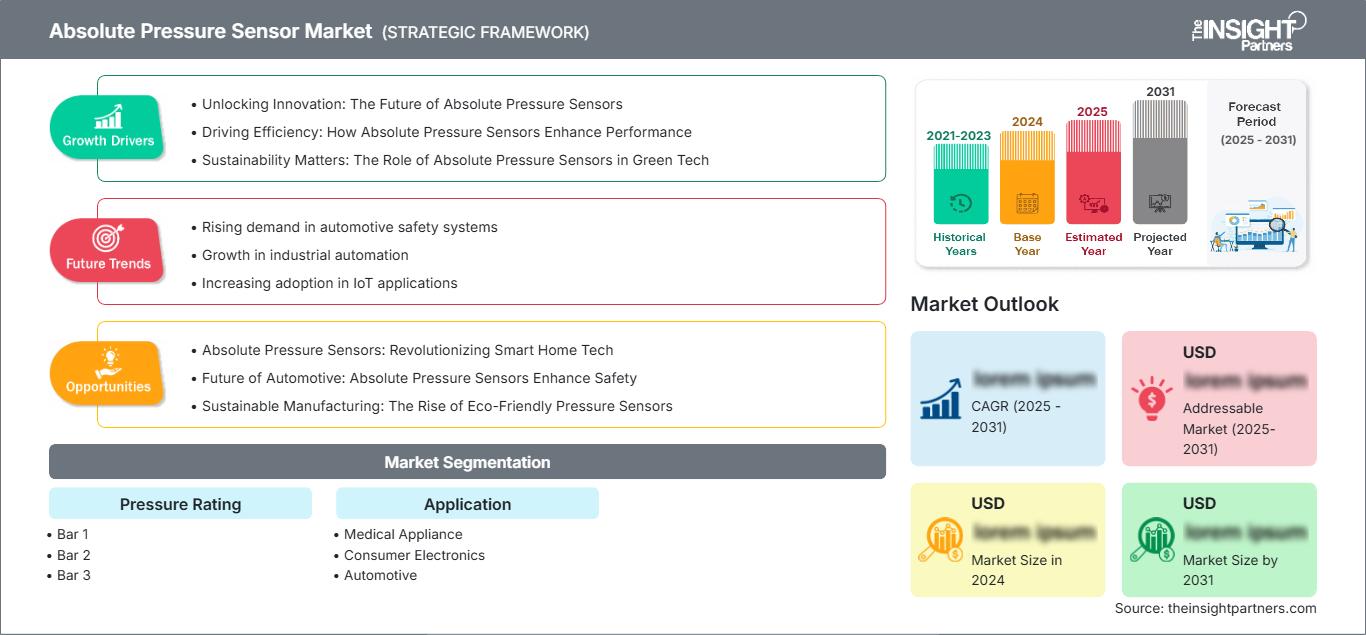
Absolute Pressure Sensor Market: Strategic Insights
Regional Insights
North America Absolute Pressure Sensor Market
North America accounts for 27–31% share in 2025 and is projected to grow at a CAGR of 2.9–3.4% during 2026–2034. Demand is supported by medical appliance production, automotive electronics, aerospace calibration, and industrial automation. The region benefits from FDA-regulated device development, connected diagnostics, and strong engineering links between semiconductor suppliers, distributors, and OEM design teams.
The structural factors comprise automotive safety electronics, robustness of respiratory equipment, and intelligent appliances. The North American market share is supported by suppliers such as Honeywell International Inc., Setra Systems, Inc., TE Connectivity Ltd., Avnet, Inc., and NXP Semiconductors N.V. Demand for these applications includes automotive controls, medical airflow, and industrial monitoring.
U.S. Absolute Pressure Sensor Market
The U.S. represents 80–84% of North American demand in 2025 and is expected to grow at a CAGR of 3.0–3.5% during 2026–2034. Demand is concentrated in medical appliances, automotive platforms, semiconductor distribution, and aerospace test systems. Honeywell International Inc., Avnet, Inc., Setra Systems, Inc., and TE Connectivity Ltd. support domestic design, sourcing, and qualification activity.
The application trends are toward miniaturized, calibrated, and digitally compensated sensors for use in ventilators, sleep apnea treatment devices, connected appliance technology, drones, and powertrains. The American OEMs focus on traceability, component longevity, and connectivity that complies with cybersecurity requirements. Another factor contributing to the growth of the Absolute Pressure Sensor Market in the country is reshoring.
Europe Absolute Pressure Sensor Market
Europe holds 22–26% share in 2025 and is forecast to grow at a CAGR of 2.7–3.2%. Germany leads regional demand because its automotive, automation, and industrial equipment ecosystem requires high-reliability pressure sensing. Continental Aktiengesellschaft, Robert Bosch GmbH, Infineon Technologies AG, and Kistler Instrumente AG strengthen local expertise in automotive-grade and precision applications.
Demand in the UK is met by devices for the medical sector, aircraft sensors, motorsports technology, and smart appliances. France supplies components for the automotive industry, medical devices, and process control systems. Documentation of compliance, product durability, calibration accuracy, and supply chain reliability is critical.
The European market is augmented by the demand in Italy and Spain for appliances, automotive parts, HVAC, and industrial machines. High accuracy components that consume less energy in accordance with regulations concerning vehicle efficiency, emissions, healthcare quality management systems, and sustainability of products ensure the growth of the market.
APAC Absolute Pressure Sensor Market
Asia Pacific accounts for 34–38% share in 2025 and is projected to grow at a CAGR of 3.6–4.2%. China leads regional demand through electronics assembly, vehicle production, appliance manufacturing, and industrial automation.
Japan and South Korea remain important for automotive electronics, MEMS technology, and high quality consumer goods. DENSO Corporation, Mitsubishi Electric Corporation, and semiconductor vendors provide regional qualification and systems integration.
India and Australia add value due to their requirements for medical devices, electronics in two wheelers and passenger vehicles, drones, and infrastructure monitoring. Policy drivers include electronics localization, EV manufacturing, healthcare access, and smart industrialization.
Middle East & Africa Absolute Pressure Sensor Market
The Middle East & Africa market is expected to grow at a CAGR of 2.4–3.0%. Saudi Arabia leads demand through energy infrastructure, hospital expansion, smart buildings, and industrial monitoring projects.
Adoption is driven by the UAE in aviation, healthcare, district cooling, logistics, and premium appliances. South Africa participates by means of automotive assembly, mining machinery, pharmaceutical imports, and industrial distribution systemization.
Rest of MEA continues to be price-sensitive and adoption will depend on distributor availability, calibration services, and infrastructure investment. Energy, water, healthcare, and HVAC systems form major near-term opportunities.
Segmentation Analysis
Pressure Rating
The pressure rating segment is expected to grow at a CAGR of 3.1–3.6% during 2026–2034. Selection depends on media type, operating envelope, calibration needs, and system safety margins. Lower bar ratings serve compact medical and consumer devices, while higher ratings support automotive, appliance, and industrial applications requiring robustness against vibration, temperature change, and pressure spikes.
- Bar 1: Positioned for low-pressure medical airflow, barometric sensing, altitude detection, and compact appliance controls where sensitivity, low power consumption, and small packaging are essential.
- Bar 2: Demand is linked to consumer electronics, respiratory systems, and light appliance monitoring where moderate pressure range, stable output, and cost-efficient calibration support high-volume programs.
- Bar 3: This rating supports automotive and appliance use cases requiring stronger tolerance against transient pressure changes while maintaining compact packaging and reliable electronic signal conditioning.
- Bar 4: Adoption is concentrated in more demanding automotive, industrial, and specialty equipment applications where durability, pressure headroom, and long operating life outweigh lowest-cost selection.
Application
The application segment is projected to grow at a CAGR of 3.3–3.8% during 2026–2034. Automotive remains the largest demand contributor because each platform uses pressure data for combustion control, emissions, braking, and electrified subsystems. Medical appliances show the strongest momentum, while consumer electronics drives miniaturized, low-power, and software-calibrated designs.
- Medical Appliance: Demand is rising in ventilators, CPAP devices, infusion pumps, diagnostic instruments, and portable monitoring systems where accurate low-pressure sensing supports patient safety and device control.
- Consumer Electronics: Adoption is driven by smartphones, wearables, drones, robotic vacuums, smart appliances, and indoor navigation devices that require compact barometric and environmental sensing functions.
- Automotive: This sub-segment holds the strongest position because manifold air pressure, TPMS, emission systems, braking, thermal management, and EV battery monitoring require reliable pressure feedback.
Opportunity Snapshot
| Application | Revenue Contribution | Trend Tag | Adoption Stage |
| Medical Appliance | Medium | Respiratory Care | Scaling |
| Consumer Electronics | Medium | Barometric UX | Mature |
| Automotive | High | Powertrain Control | Mature |
Absolute Pressure Sensor Market Growth Drivers and Impact Analysis
Rising Sensor Content in Vehicles and Electrified Platforms
Vehicle platforms increasingly depend on absolute pressure data to regulate air intake, fuel efficiency, turbocharging, exhaust treatment, brake assistance, tire pressure, and battery safety. The impact is structural because pressure sensors are embedded during platform design and remain qualified across long production cycles Electrification does not eliminate the need for pressure measurement; it shifts part of the demand toward thermal management, battery enclosure monitoring, and brake-by-wire systems, reinforcing the positive Absolute Pressure Sensor Market Forecast. This driver strengthens the growth outlook by linking revenue to vehicle electronics density rather than only combustion-engine volumes.
Medical Appliances Need Accurate Low-Pressure Control
Respiratory devices, sleep therapy systems, infusion equipment, blood pressure monitors, and diagnostic instruments require pressure sensing that is stable, repeatable, and traceable. The market impact is reinforced by aging populations, home-care expansion, and hospital procurement of connected devices. Absolute pressure sensors help control airflow, detect blockage, support vacuum measurement, and improve equipment feedback loops. Suppliers that meet medical quality expectations can capture longer design cycles and better margins, strengthening their Absolute Pressure Sensor Market Share as device makers prioritize documentation, calibration, sterilization compatibility, and dependable component availability over lowest-cost sourcing.
Miniaturization Expands Consumer and Appliance Integration
Smaller MEMS packages, lower power consumption, and digital compensation are expanding use in smartphones, wearables, drones, robotic vacuums, smart appliances, and environmental monitoring devices. The real-world impact is wider addressable volume because pressure sensing can be added without major redesign of compact electronics. Barometric data supports altitude tracking, indoor navigation, weather awareness, suction control, and adaptive appliance performance. This driver improves the Absolute Pressure Sensor Market trends profile by moving the technology from specialized instrumentation into everyday connected devices and software-defined user experiences.
Absolute Pressure Sensor Market Future Trends
Digital Calibration and Edge Diagnostics Become Standard
Future absolute pressure sensors will increasingly ship with embedded calibration, temperature compensation, self-diagnostics, and digital interfaces that reduce engineering effort for OEMs. This shift will matter most in automotive and medical appliances, where field reliability and regulatory evidence are critical. Edge diagnostics can detect drift, contamination, blockage, or abnormal pressure events before they affect system performance. Suppliers with strong ASIC design and software support will gain influence, helping strengthen their Market Share as customers evaluate sensing modules as intelligent subsystems rather than basic transducers.
Pressure Sensing Converges with Multi-Sensor Platforms
Pressure data will be combined more often with temperature, humidity, motion, gas, and acoustic sensing to improve context awareness in vehicles, wearables, appliances, and industrial nodes. Multi-sensor fusion can improve navigation, predictive maintenance, respiratory monitoring, and energy efficiency by interpreting pressure events alongside other environmental signals. This trend will encourage platform partnerships between semiconductor vendors, software developers, and module makers, aligning with emerging Absolute Pressure Sensor Market Trends. It also raises switching costs because OEMs will value validated sensor combinations, reference designs, and application algorithms.
Absolute Pressure Sensor Market Opportunities
Design-In Partnerships for Medical and Home-Care Devices
Medical appliance OEMs need suppliers that can support early design, regulatory documentation, calibration stability, and long-term component availability. Sensor makers and distributors can create value by offering reference designs for airflow, vacuum, and fluid-pressure measurement in ventilators, CPAP systems, infusion pumps, and portable diagnostics. The opportunity is action-oriented because home-care growth is pushing device makers to combine clinical reliability with compact, low-power electronics. Companies that provide engineering support, traceability, and rapid qualification assistance can win recurring platform revenue, supporting long-term Market Size expansion.
Localized Supply for Automotive Electronics Programs
Automotive OEMs and Tier 1 suppliers are reassessing sourcing resilience for safety-critical electronics. Absolute pressure sensor suppliers can benefit by expanding regional assembly, second-source strategies, and application-specific qualification support. The opportunity is strongest in Asia Pacific, North America, and Europe, where EV programs, emissions controls, and brake systems require qualified pressure feedback. Vendors that combine local technical support with global quality systems can reduce customer risk, shorten validation timelines, and improve share of wallet across multiple vehicle platforms, supporting the long-term Absolute Pressure Sensor Market Forecast.
Recent Developments
- April 2026: Angst+Pfister Sensors and Power announced the launch of the APP-A230 Series, a new high precision MEMS absolute pressure sensor now available in our product portfolio. The APP-A230 integrates a piezoresistive sensing element and ASIC in a single compact SMD package (3.1 x 3.1 x 2.7 mm). It delivers a fully calibrated 24-bit digital pressure output and a 16-bit temperature output via I2C, covering absolute pressure ranges from 0 to 20 Bar.
- April 2025: Kistler launches a new absolute pressure sensor to measure hydrogen pressure. The new 4012A absolute pressure sensor from Kistler delivers the reliable measurements that are essential for optimizing hydrogen fueled combustion engines, and for pressure monitoring in fuel cells. With a design developed for use in H2 environments, this sensor features a high resilience to hydrogen – proven by testing.
- January 2024: Melexis launches the MLX90830, its first product to feature the new patented Triphibian® technology. This unprecedented miniaturized MEMS pressure sensor handles gas and liquid media measurement from 2 to 70 bar in a robust way. The factory-calibrated device measures the absolute pressure and delivers a proportional analog output signal. The MLX90830 makes the module cost-effective by simplifying the system integration into the latest electric vehicles (EVs) thermal management systems.
Frequently Asked Questions

- Comprehensive Market Sizing and Forecast Analysis
- Detailed Segmentation Analysis
- In-Depth Market Dynamics Assessment
- Regional and Country-Level Insights
- Competitive Landscape and Company Benchmarking
- Strategic Business Intelligence
Recent Reports
Testimonials

The Insight Partners' SCADA System Market report is comprehensive, with valuable insights on current trends and future forecasts. The team was highly professional, responsive, and supportive throughout. We are very satisfied and highly recommend their services.
RAN KEDEM Partner, Reali Technologies LTDs
I requested a report on a very specific software market and the team produced the report in a few days. The information was very relevant and well presented. I then requested some changes and additions to the report. The team was again very responsive and I got the final report in less than a week.
JEAN-HERVE JENN Chairman, Future Analytica
We worked with The Insight Partners for an important market study and forecast. They gave us clear insights into opportunities and risks, which helped shape our plans. Their research was easy to use and based on solid data. It helped us make smart, confident decisions. We highly recommend them.
PIYUSH NAGPAL Sr. Vice President, High Beam Global
The Insight Partners delivered insightful, well-structured market research with strong domain expertise. Their team was professional and responsive throughout. The user-friendly website made accessing industry reports seamless. We highly recommend them for reliable, high-quality research services
YUKIHIKO ADACHI CEO, Deep Blue, LLC.
This is the first time I have purchased a market report from The Insight Partners.While I was unsure at first, I visited their web site and felt more comfortable to take the risk and purchase a market report.I am completely satisfied with the quality of the report and customer service. I had several questions and comments with the initial report, but after a couple of dialogs over email with their analyst I believe I have a report that I can use as input to our strategic planning process.Thank you so much for taking the extra time and making this a positive experience.I will definitely recommend your service to others and you will be my first call when we need further market data.
JOHN SUZUKI President and Chief Executive Officer, Board Director, BK Technologies
I wish to appreciate your support and the professionalism you displayed in the course of attending to my request for information regarding to infectious disease IVD market in Nigeria. I appreciate your patience, your guidance, and the fact that you were willing to offer a discount, which eventually made it possible for us to close a deal. I look forward to engaging The Insight Partners in the future, all thanks to the impression you have created in me as a result of this first encounter.
DR CHIJIOKE ONYIA MANAGING DIRECTOR, PineCrest Healthcare Ltd.Reason to Buy
- Informed Decision-Making
- Understanding Market Dynamics
- Competitive Analysis
- Identifying Emerging Markets
- Customer Insights
- Market Forecasts
- Risk Mitigation
- Boosting Operational Efficiency
- Strategic Planning
- Investment Justification
- Tracking Industry Innovations
- Aligning with Regulatory Trends





 Get Free Sample for