
Active and Smart and Intelligent Packaging Market Size, Trends & Demand by 2034
Coverage: By Type (Intelligent, Active, Modified); Application (Packaged food, Beverages, Frozen food, Dairy, Chilled processed food, Dried processed food), and Geography (North America, Europe, Asia Pacific, and South and Central America)
- Status : Data Released
- Report Code : TIPRE00014769
- Category : Electronics and Semiconductor
- No. of Pages : 150
- Available Report Formats :


- Last update date : July 10, 2026


2025 Market Size
US$ 103.69 Bn
Base year value
2034 Forecast
US$ 191.48 Bn
Projected by 2034
CAGR 2026-2034
7.05 %
Growth rate
Addressable Market
US$ 1,332.33 Bn
(2026-2034)
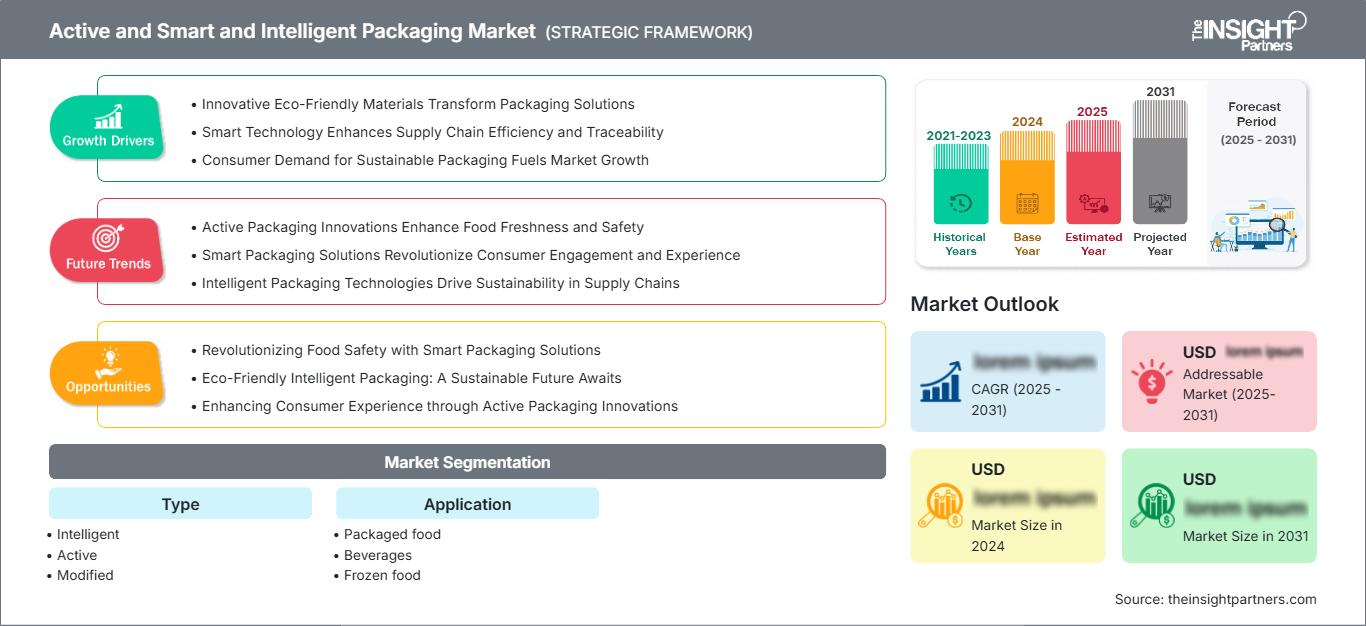
The Active and Smart and Intelligent Packaging Market was valued at US$ 103.69 Billion in 2025 and is projected to reach US$ 191.48 Billion by 2034, registering a CAGR of 7.05% from 2026 to 2034. The factors that determine the demand for such packaging include food safety, shelf-life optimization, cold chain visibility, traceability needs, and the incorporation of active, intelligent, and modified packaging functionalities in packaged foods, beverages, frozen foods, dairy products, chilled processed foods, and dried processed foods.
North America is estimated to grow at a 6.6%–7.4% CAGR due to the use of food packaging solutions that minimize losses and ensure freshness during food transportation. The advantage for the region lies in mature grocery supply chains, increased use of time-temperature indicators, and the adoption of smart labels for dairy products, frozen meals, beverages, and chilled processed foods.
Active and Smart and Intelligent Packaging Market Assessment and Insights
- North America: The region held 28%–32% share of the Active and Smart and Intelligent Packaging market in 2025 and is growing at a CAGR range of 6.6%–7.4% during 2026–2034, supported by packaged food scale, cold-chain maturity, and retailer-led shrink reduction.
- US: The US represented 78%–84% of North America in 2025 and is growing at a CAGR range of 6.7%–7.5% during 2026–2034, led by grocery logistics and foodservice distribution.
- Europe: Europe held 24%–29% share in 2025 and is growing at a CAGR range of 6.4%–7.1% during 2026–2034, with Germany, the UK, France, Italy, and Spain leading adoption.
- Asia Pacific: Asia Pacific held 30%–35% share in 2025 and is growing at a CAGR range of 7.7%–8.6% during 2026–2034, led by China, Japan, South Korea, India, and Australia.
- Largest Segment: Active packaging held 36%–40% share of the Active and Smart and Intelligent Packaging market in 2025 and is growing at a CAGR range of 6.8%–7.6% during 2026–2034 because preservation value is immediate.
- High Growth Segment: Intelligent packaging held 28%–32% market share in 2025 and is growing at a CAGR range of 7.8%–8.8% during 2026–2034 as sensing labels scale.
- Key companies analyzed in detail: Amcor plc, Ball Corporation, Graham Packaging Company, L.P., Lifecore Biomedical, Inc., Mitsubishi Gas Chemical Company, Inc., Sealed Air Corporation, Sysco Corporation, Timestrip plc, VIP Packaging Pty Ltd., ProAmpac Holdings Inc.
Source: The Insight Partners' analysis based on proprietary research, government publications, company annual reports, investor presentations, industry databases, and expert interviews.
The Active and Smart and Intelligent Packaging market has moved from protective packings to active packaging systems and signal systems for product condition management and signaling. The active scavengers, modified-atmosphere packages, printed sensors, and low-power labels are being integrated into manufacturing processes rather than retrofitted onto the packaged product. This creates new economics for suppliers, as converters, sensor manufacturers, battery producers, and food processors must come together to validate compliance, cost, recyclability, and functionality in storage environments.
Forward demand for Asia Pacific, Middle East, and select European export routes will expand with the development of food safety, e-commerce, grocery delivery services, and capital investment, driving demand for condition assurance. Regulatory drivers aimed at minimizing waste and improving traceability will favor established forms and contribute to the long-term Active and Smart and Intelligent Packaging Market Forecast. The Active and Smart and Intelligent Packaging scope is therefore expanding from premium trials to category-specific deployments.
Active and Smart and Intelligent Packaging Market Report Scope
| Report Attribute | Details |
|---|---|
| Market size in 2025 | US$ 103.69 Billion |
| Market Size by 2034 | US$ 191.48 Billion |
| Global CAGR (2026 - 2034) | 7.05% |
| Historical Data | 2021-2024 |
| Forecast period | 2026-2034 |
Active and Smart and Intelligent Packaging Market Analysis
The factors driving demand include the commercial costs associated with spoilage, foodborne illness risk, the rise in premium packaged food, and increased frozen/chilled distribution. According to the WHO, unsafe food poses public health risks, whereas food losses remain a key focus for the FAO, continuing to affect retailers and the government. These issues render the Active and Smart and Intelligent Packaging market analysis relevant to both cost reduction and customer confidence.
The value chain involves barrier materials companies, oxygen and moisture control systems providers, battery components companies, label converters, data management systems, food manufacturers, retailers, and cold chain operators. Favorable supply chain dynamics include scalable solutions that can integrate with high-speed filling lines. Buyers are prioritizing measurable shelf-life gains, simple handling, food-contact compliance, and recyclable structures over complex features that add cost without operational evidence, influencing future Active and Smart and Intelligent Packaging Market Share across solution providers.
The competitive landscape is fragmented across packaging scale leaders and technology specialists. Amcor plc, Ball Corporation, Sealed Air Corporation, Graham Packaging Company, L.P., Mitsubishi Gas Chemical Company, Inc., and ProAmpac Holdings Inc. compete through materials, containers, and active films, while Timestrip plc supports condition indicators and Sysco Corporation influences downstream foodservice requirements.
Investments will be made in printable batteries, near-field communication and quick-response label technology, monomaterial barrier films, and water absorbing solutions. Positioning requires the balancing of preservation, traceability, and sustainability without compromising productivity. The Active and Smart and Intelligent Packaging growth strategy will prove most successful when retailers can relate their packaging investments to reduced returns and waste management.
● REPORT CUSTOMIZATION
Tailor This Report To Align With Your Specific Business Requirements
This report can be customized to align precisely with your business objectives, scope, and target markets. Customization options include tailored segmentation, geography, competitive analysis, and strategic insights to support informed decision-making.
Customize This Report →WHAT YOU CAN ADJUST
- ● Segmentations
- ● Geography
- ● Competitive Analysis
- ● Language Preferences
Active and Smart and Intelligent Packaging Market: Strategic Insights
Regional Insights
North America Active and Smart and Intelligent Packaging
North America held 28%–32% share in 2025 and is expected to grow at a 6.6%–7.4% CAGR during 2026–2034. Demand is anchored in packaged food, dairy, beverages, frozen meals, and chilled processed food, where retailers need freshness assurance, lower shrink, and evidence of cold-chain performance.
The region’s structure favors early adoption because converters, grocery chains, distributors, and brand owners already manage sophisticated quality programs. CDC-reported foodborne illness burden in the US reinforces the value of better condition monitoring. Sealed Air Corporation, Amcor plc, Ball Corporation, Sysco Corporation, and Timestrip plc support deployment across packaging, distribution, and indicator technologies.
U.S. Active and Smart and Intelligent Packaging Market
The US accounted for 78%–84% of North America in 2025 and is projected to grow at a 6.7%–7.5% CAGR. Large grocery chains, foodservice distribution, online ordering, and premium refrigerated categories create strong demand for packages that verify temperature exposure and preserve product integrity.
Company presence is broad across flexible packaging, cans, bottles, protective food packaging, and distribution. Amcor plc, Ball Corporation, Graham Packaging Company, L.P., Sealed Air Corporation, Sysco Corporation, Lifecore Biomedical, Inc., and Timestrip plc are relevant to application trends in dairy, chilled foods, beverages, frozen meals, and packaged food.
Europe Active and Smart and Intelligent Packaging Market
Europe held 24%–29% share of the Active and Smart and Intelligent Packaging Market in 2025 and is forecast to grow at a 6.4%–7.1% CAGR. The UK benefits from ready-meal consumption, private-label competition, and online grocery maturity, which support Active and Smart and Intelligent Packaging share expansion in chilled, frozen, and premium packaged foods.
Germany is the leading country because of its food processing base, engineering capability, dairy output, beverage packaging demand, and export-oriented packaged goods, strengthening the region's Active and Smart and Intelligent Packaging Market Share. Buyers emphasize line efficiency, validated barrier performance, recyclable design, and packaging that supports EU waste reduction and traceability priorities.
France, Italy, and Spain add demand through premium food exports, wine and beverage packaging, dairy, seafood, and Mediterranean chilled distribution. France prioritizes quality and retail traceability, Italy favors premium packaged foods, and Spain’s logistics networks support produce, chilled products, and frozen categories across domestic and European channels.
APAC Active and Smart and Intelligent Packaging Market
APAC held 30%–35% share in 2025 and is projected to expand at a 7.7%–8.6% CAGR. China leads through packaged food manufacturing, beverage scale, e-commerce grocery, and electronics capacity supporting sensors and labels.
Japan and South Korea contribute through convenience foods, seafood, premium dairy, and technology-led retail formats. India is gaining through organized retail, dairy processing, and frozen food expansion, while Australia supports cold-chain quality control for meat, seafood, dairy, and premium grocery categories.
Policy and industrial drivers include food safety modernization, local packaging manufacturing, waste reduction programs, and cold-chain investment. Regional buyers often prefer modular active packaging and simple indicators before adopting battery-enabled connected formats at scale.
Middle East & Africa Active and Smart and Intelligent Packaging Market
The Middle East & African Active and Smart and Intelligent Packaging Market is expected to grow at a 6.8%–7.8% CAGR. Saudi Arabia leads because food security programs, import reliance, hot-climate logistics, and modern retail expansion increase the value of preservation and temperature visibility.
The UAE benefits from premium grocery formats, re-export logistics, tourism-linked foodservice, and cold-chain investment. Energy and infrastructure context matters because long routes, heat exposure, and centralized distribution hubs increase spoilage risk for chilled and frozen products.
South Africa and the rest of MEA show selective adoption in dairy, beverages, frozen food, meat, and imported packaged goods. Cost sensitivity remains a restraint, but retailers increasingly assess smart indicators when returns and cold-chain failures are measurable.
Segmentation Analysis
Type
The Type segment is expected to grow at a 7.1%–8.0% CAGR during 2026–2034. Adoption is shaped by how directly each format solves deterioration, visibility, or atmosphere-control needs. Active solutions remain broadly commercial, intelligent formats gain from sensing and authentication, and modified packaging supports categories requiring controlled gases and longer freshness windows.
- Intelligent: Intelligent packaging uses indicators, sensors, and communication features to verify freshness, temperature exposure, authenticity, or handling conditions, making it strategically important for premium and temperature-sensitive supply chains.
- Active: Active packaging leads commercialization because oxygen scavengers, moisture regulators, antimicrobial systems, and ethylene absorbers directly improve shelf life and reduce product deterioration during storage and distribution.
- Modified: Modified packaging controls internal atmosphere composition to slow spoilage, preserve texture, and extend freshness, especially in chilled processed food, dairy, frozen food, and packaged meal applications.
Application
The Application segment is projected to grow at a 6.9%–7.8% CAGR during 2026–2034. Packaged food and dairy remain high-value categories because freshness and safety are visible to consumers. Beverages require flavor and authenticity protection, while frozen and chilled processed foods create demand for temperature assurance across retail and e-grocery channels.
- Packaged food: Packaged food generates strong demand because freshness, safety, shelf appeal, and inventory efficiency influence retailer margins and consumer confidence across ready meals, snacks, bakery, and processed items.
- Beverages: Beverages use active and intelligent packaging to protect flavor, carbonation, light sensitivity, authenticity, and temperature experience while supporting premium positioning in functional drinks and dairy beverages.
- Frozen food: Frozen food benefits from temperature indicators and packaging systems that detect thawing risk, protect texture, and support cold-chain accountability across retail freezers and home delivery channels.
- Dairy: Dairy requires high-performance packaging because spoilage, oxygen exposure, light sensitivity, and microbial risk directly affect safety, taste, shelf life, and brand trust in milk, cheese, yogurt, and desserts.
- Chilled processed food: Chilled processed food adoption is driven by ready-meal growth, strict freshness windows, and the need for packaging that preserves quality while signaling temperature abuse or shelf-life status.
- Dried processed food: Dried processed food uses moisture-control and oxygen-management formats to maintain crispness, flavor stability, and product integrity in snacks, cereals, powders, instant mixes, and shelf-stable packaged foods.
Opportunity Snapshot
| Segment Name | Revenue Contribution | Trend Tag | Adoption Stage |
| Packaged food | High | Freshness Control | Mature |
| Beverages | Medium | Flavor Protection | Scaling |
| Frozen food | Medium | Thaw Detection | Scaling |
| Dairy | High | Spoilage Control | Mature |
| Chilled processed food | High | Cold Visibility | Scaling |
| Dried processed food | Medium | Moisture Control | Mature |
Active and Smart and Intelligent Packaging Market Growth Drivers and Impact Analysis
Rising Need to Reduce Food Waste Across Supply Chains
Food wastage is another key driver, as it leads to losses in profitability, sustainability, and customer confidence. Active packaging reduces wastage by controlling oxygen, moisture, ethylene gas, and bacteria, while intelligent labels provide information about freshness and temperatures encountered. Battery-enabled smart packaging becomes valuable when sensors or communication features require dependable low-power operation. The Active and Smart and Intelligent Packaging market impact is strongest in dairy, chilled processed foods, frozen meals, and packaged foods with narrow freshness windows. Retailers can reduce shrink, manufacturers can protect brand equity, and logistics providers can identify weak points in handling.
Expansion of Cold-Chain and E-Grocery Distribution
Cold-chain and e-grocery expansion increase demand for packaging that protects products outside predictable store-based distribution. Frozen food, dairy, chilled processed meals, and beverages move through warehouses, delivery vehicles, curbside pickup, and last-mile networks where temperature abuse can occur. Smart labeling and intelligent sensors enable confirmation of the product's condition, and the active format ensures stability over longer distances. The effect will be a shift from viewing packaging as a cost factor to seeing it as an essential means of managing risks, further confirming the positive Active Smart and Intelligent Packaging Market Forecast. Adoption will increase in places where packaging reduces returns and keeps customers safe.
Integration of Sensors and Low-Power Packaging Electronics
The integration of sensors, printed electronics, and compact batteries is expanding the functional role of packaging. Time-temperature indicators, freshness sensors, authentication tags, and connected labels can support better inventory decisions and stronger product assurance. The need for batteries may differ based on applications, but packaging has become an informational layer in food and beverage supply chains. There will be greater visibility regarding handling conditions, rapid identification of damaged shipments, and more effective coordination among processors, retailers, and distributors. This driver also changes competitive strategy because material suppliers must work with electronics developers, label converters, and software partners, strengthening the overall Active and Smart and Intelligent Packaging Market Analysis.
Active and Smart and Intelligent Packaging Market Future Trends
Printed Batteries and Sensor Labels Moving Toward Scale
Printed batteries and sensor labels are expected to become more commercially relevant as smart packaging shifts from demonstration projects to targeted operational use. Thin form factors, flexibility in integration, and the ability to provide freshness, temperature, authentication, or logistics sensing without bulkier elements increase the likelihood of acceptance. The demand for such technology will remain high in areas where product failure could incur higher costs, such as refrigerated foods, dairy products, frozen items, premium drinks, and exported packaged goods. Suppliers must prove shelf compatibility, food-contact safety, recyclability, and performance across humidity and temperature ranges before broad deployment, reflecting evolving Active and Smart and Intelligent Packaging Market Trends.
Sustainability-Aligned Active and Intelligent Formats
Sustainability will define future trends in Active, Smart, and Intelligent Packaging because consumers will demand preservation and traceability without compromising recyclability or material savings. This will force active and intelligent packaging to adopt mono-material construction, label separation, less environmentally harmful barrier coating, and designs that minimize waste generation during the product life cycle. Competing in the future will require demonstrating value from an environmental and operational perspective. The best solution will be able to reduce waste while still meeting the performance demands of fast-moving food/beverage packaging operations.
Active and Smart and Intelligent Packaging Market Opportunities
Premium Cold-Chain Packaging for Dairy and Chilled Foods
Dairy and chilled processed food offer attractive opportunities because product quality depends heavily on temperature control, oxygen management, and short shelf-life execution. Premium yogurts, cheeses, desserts, ready meals, and proteins can benefit from Active and Intelligent Packaging where the latter helps in reducing spoilage and maintaining flavor integrity. Investment should be in terms of scaleable indicators, modified atmosphere packaging, oxygen management technologies, and low energy consumption labels suitable for use in cold-chain retailing and electronic grocery operations. Value can be added to suppliers’ offerings through validation studies, system compatibility, and category-specific costing models to ensure continuous Active and Smart and Intelligent Packaging Market Size expansion.
Smart Packaging for Export-Oriented Food and Beverage Brands
Export-oriented food and beverage brands present a strong opportunity because longer routes, customs delays, multi-temperature handling, and diverse retail conditions increase quality risk. Intelligent and active packaging can protect product integrity while giving distributors better evidence of handling conditions. Beverage, dairy, frozen food, dried processed food, and packaged specialty products can use indicators, oxygen or moisture control, and authentication features to support premium positioning. Investment should prioritize region-specific packaging formats, supply-chain pilots, and partnerships with logistics providers that can document return-on-investment evidence, aligning with emerging Active and Smart and Intelligent Packaging Market Trends.
Recent Developments
- In March 2025: ProAmpac expanded its ProActive Intelligence® Moisture Protect portfolio with new moisture-adsorbing packaging films designed to improve product protection while supporting sustainability goals. The new range includes foil-based, foil-free, and recycle-ready solutions developed in collaboration with Aptar CSP Technologies. By integrating moisture-adsorbing technology directly into the packaging film, the solutions eliminate the need for separate desiccant packets and help extend product shelf life across food, pharmaceutical, and consumer goods applications.
- In August 2024: Aptar Food Protection expanded its SeaWell active packaging system into the e-commerce market, enabling direct-to-consumer seafood deliveries with improved freshness and product quality. The packaging uses proprietary Drip-Lock technology to absorb excess liquids, reducing leaks, microbial growth, odors, and product degradation during transit. Already adopted by leading home delivery companies, the solution can extend in-home shelf life by up to one day while improving the consumer unboxing experience and reducing food waste
Frequently Asked Questions

- Comprehensive Market Sizing and Forecast Analysis
- Detailed Segmentation Analysis
- In-Depth Market Dynamics Assessment
- Regional and Country-Level Insights
- Competitive Landscape and Company Benchmarking
- Strategic Business Intelligence
Recent Reports
Testimonials

The Insight Partners provided valuable market intelligence that supported our global go-to-market strategy. Their team was professional, responsive, and attentive to our feedback, providing thoughtful analysis and helpful methodological clarifications throughout the project.
Junmo Kim Chief Financial Officer (CFO), Enertech Co., Ltd.
The Insight Partners' SCADA System Market report is comprehensive, with valuable insights on current trends and future forecasts. The team was highly professional, responsive, and supportive throughout. We are very satisfied and highly recommend their services.
RAN KEDEM Partner, Reali Technologies LTDs
I requested a report on a very specific software market and the team produced the report in a few days. The information was very relevant and well presented. I then requested some changes and additions to the report. The team was again very responsive and I got the final report in less than a week.
JEAN-HERVE JENN Chairman, Future Analytica
We worked with The Insight Partners for an important market study and forecast. They gave us clear insights into opportunities and risks, which helped shape our plans. Their research was easy to use and based on solid data. It helped us make smart, confident decisions. We highly recommend them.
PIYUSH NAGPAL Sr. Vice President, High Beam Global
The Insight Partners delivered insightful, well-structured market research with strong domain expertise. Their team was professional and responsive throughout. The user-friendly website made accessing industry reports seamless. We highly recommend them for reliable, high-quality research services
YUKIHIKO ADACHI CEO, Deep Blue, LLC.
This is the first time I have purchased a market report from The Insight Partners.While I was unsure at first, I visited their web site and felt more comfortable to take the risk and purchase a market report.I am completely satisfied with the quality of the report and customer service. I had several questions and comments with the initial report, but after a couple of dialogs over email with their analyst I believe I have a report that I can use as input to our strategic planning process.Thank you so much for taking the extra time and making this a positive experience.I will definitely recommend your service to others and you will be my first call when we need further market data.
JOHN SUZUKI President and Chief Executive Officer, Board Director, BK Technologies
I wish to appreciate your support and the professionalism you displayed in the course of attending to my request for information regarding to infectious disease IVD market in Nigeria. I appreciate your patience, your guidance, and the fact that you were willing to offer a discount, which eventually made it possible for us to close a deal. I look forward to engaging The Insight Partners in the future, all thanks to the impression you have created in me as a result of this first encounter.
DR CHIJIOKE ONYIA MANAGING DIRECTOR, PineCrest Healthcare Ltd.Reason to Buy
- Informed Decision-Making
- Understanding Market Dynamics
- Competitive Analysis
- Identifying Emerging Markets
- Customer Insights
- Market Forecasts
- Risk Mitigation
- Boosting Operational Efficiency
- Strategic Planning
- Investment Justification
- Tracking Industry Innovations
- Aligning with Regulatory Trends





 Get Free Sample for