
Active Insulation Market Growth, Size & Forecast by 2034
Coverage: by Product Type (Wool, Cotton, Nylon, Polyester, Others); Application (Textile, Building and Construction) , and Geography (North America, Europe, Asia Pacific, and South and Central America)
- Status : Data Released
- Report Code : TIPRE00009594
- Category : Chemicals and Materials
- No. of Pages : 150
- Available Report Formats :


- Last update date : July 15, 2026


2025 Market Size
US$ 395.79 Mn
Base year value
2034 Forecast
US$ 728.91 Mn
Projected by 2034
CAGR 2026-2034
7.02 %
Growth rate
Addressable Market
US$ 5,077.79 Mn
(2026-2034)
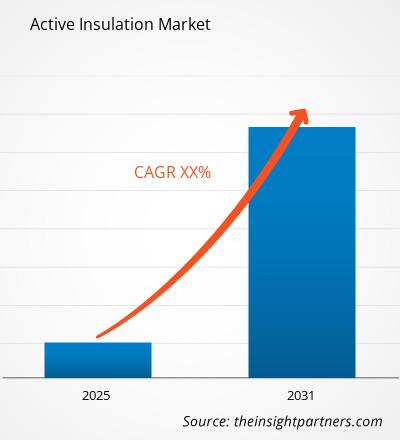
The active insulation market size was valued at US$ 395.79 million in 2025 and is projected to reach US$ 728.91 million by 2034, expanding at a CAGR of 7.02% during 2026–2034. Market expansion is supported by increasing demand for lightweight thermal insulation materials across apparel and construction applications, continuous innovation in moisture-regulating fabrics, and growing emphasis on energy-efficient building solutions. Advancements in insulation technologies and sustainable raw materials are further strengthening adoption across both consumer and industrial sectors.
Across North America, demand continues to accelerate due to rising investments in high-performance outdoor apparel, green buildings, and advanced insulation technologies. The active insulation market size benefits from stringent building energy efficiency regulations and growing consumer preference for thermally adaptive clothing that delivers comfort across varying environmental conditions. The regional market is expected to register a CAGR of 6.7–7.1% through 2034, supported by continuous product innovation and increasing adoption of sustainable insulation materials.
Active Insulation Market Assessment and Insights
- North America: Accounted for 33–37% of the active insulation market share in 2025 and is anticipated to expand at a CAGR of 6.7–7.1% during 2026–2034. Strong demand from outdoor apparel manufacturers, green construction projects, and advanced insulation technologies continues to support regional leadership.
- US: Represented 78–82% of the North American market in 2025 and is projected to register a CAGR of 6.8–7.2% during 2026–2034, supported by robust outdoor recreation participation, premium apparel demand, and sustainable building initiatives.
- Europe: Held 29–33% share in 2025 and is expected to grow at a CAGR of 6.8–7.3% during 2026–2034. Germany, France, the UK, Italy, and the Nordic countries remain major markets owing to stringent energy-efficiency regulations and mature technical textile industries.
- Asia Pacific: Captured 24–28% share in 2025 and is forecast to record the fastest expansion at a CAGR of 8.2–8.6% during 2026–2034, driven by China, Japan, South Korea, and India through expanding textile production and infrastructure development.
- Largest Segment: Textile accounted for 66–70% market share in 2025 and is projected to grow at a CAGR of 7.1–7.5% during 2026–2034, supported by increasing demand for performance apparel, military clothing, and outdoor sportswear.
- High Growth Segment: Building and Construction represented 30–34% market share in 2025 and is expected to expand at a CAGR of 7.8–8.2% during 2026–2034, driven by green building regulations and increasing adoption of energy-efficient insulation materials.
- Key companies analyzed in detail: ACTIS, Armacell International S.A., Autex Industries Limited, H. Dawson Sons & Company (Wool) Ltd., Polartec LLC, PrimaLoft, Inc., Sintex, UdiDÄMMSYSTEME GmbH, W. L. Gore & Associates, Inc., Wacker Chemie AG.
Source: The Insight Partners' analysis based on proprietary research, government publications, company annual reports, investor presentations, industry databases, and expert interviews.
There's been massive innovation in the material science which is altering the dynamic the active insulation market trends. This innovation means manufacturers of lightweight active insulation that maintain your body temperature while remaining breathable and moisture-wicking (all without diminishing durability) are in high demand, as is the construction sector that relies on state-of-the-art insulation materials to increase the energy efficiency of their buildings, in accordance with increasingly rigid environmental regulations. The persistent investment in bio-based and recycled fibres, and revolutionary new production methods, is only going to accelerate these trends in insulation technology, bringing new opportunities in fashion and construction.
Active Insulation Market Report Scope
| Report Attribute | Details |
|---|---|
| Market size in 2025 | US$ 395.79 Million |
| Market Size by 2034 | US$ 728.91 Million |
| Global CAGR (2026 - 2034) | 7.02% |
| Historical Data | 2021-2024 |
| Forecast period | 2026-2034 |
Active Insulation Market Analysis
Next generation insulation material manufacturers see increased forward-looking investments flowing into Asia Pacific, Eastern Europe, and some Middle Eastern economies, primarily due to urbanization rate, textile manufacturing growth, and stricter standards for building efficiency, which are creating lucrative opportunities for the active insulation market growth. With the growing emphasis on government incentives, sustainable building materials, and circular textile production, manufacturers anticipate commercialisation of new-generation insulation materials. The continued collaboration of material developers with clothing brands and building companies will enable a wider application portfolio while solidifying supply chains in the long run. In active insulation material market, increasing consumer preference for high-performance outdoor apparel, the escalating demand for energy-efficient building materials, and technological advancements in the field of thermal insulation is driving market growth.
Material providers across the value chain from raw materials suppliers to insulation material companies are strengthening ties, ranging from specialty fibre producers and insulation technology developers to textile producers and construction material suppliers to boost efficiency of products and supply chain and provide a sustainable impact. Increasing demand for natural wool fibres, recycled polyester and bio-based insulation materials have made the active insulation market’s supply more resilient and addressed global sustainability objectives. Additionally, companies are focusing on optimizing the product’s manufacturing processes to provide lower weight and breathability and increased thermal regulation. The overall supply chain has undergone restructuring and manufacturers are increasingly relying on more diversified supply sourcing and expanded manufacturing capabilities closer to consumer bases.
The advent of automated textile manufacturing, the increased implementation of advanced fibre processing technology, and novel sustainable insulation techniques are improving manufacturing efficiency and minimising waste generation. Adoption of modern quality monitoring systems, along with the use of digital manufacturing technologies across production lines also enhance uniformity. With greater need for protection clothing, sportswear, homes and buildings, suppliers are inclined to diversify their product portfolio to meet the consumer’s demand more precisely. The competitive ecosystem of the active insulation market is dynamic and dynamic with a focus on innovations, strategic alliances, and sustainability investments.
Key companies highlighted in the active insulation market report include W. Gore & Associates, Inc., Armacell International S.A. And PrimaLoft, Inc., Sintex, ACTIS, Autex Industries Limited, UdiDMMSYSTEME GmbH, H. Dawson Sons & Company (Wool) Ltd. Leading businesses have been emphasising innovative, sustainable raw materials, advanced production technologies, high performance, and a comprehensive product portfolio to gain market share. Competitive edges in the industry are based on improved performance through lower weight, higher thermal regulation, enhanced breathability and more sustainable materials, alongside a better environmental profile.
Investors continue to invest in boosting manufacturing capacity and fostering bio-based insulation technologies and are keenly integrating circularity principles into their products and processes. As the active insulation market expands, material makers are actively forging partnerships with other companies from the textile sector, construction, and the chemicals industries to introduce innovative building solutions and apparel components to a wider audience. Investment will likely surge as businesses focus on fibre performance, lightweighting, biodegradability and end-of-life strategies in a push to stay ahead of both regulatory demands and consumer expectations for more sustainable materials.
● REPORT CUSTOMIZATION
Tailor This Report To Align With Your Specific Business Requirements
This report can be customized to align precisely with your business objectives, scope, and target markets. Customization options include tailored segmentation, geography, competitive analysis, and strategic insights to support informed decision-making.
Customize This Report →WHAT YOU CAN ADJUST
- ● Segmentations
- ● Geography
- ● Competitive Analysis
- ● Language Preferences
Active Insulation Market: Strategic Insights
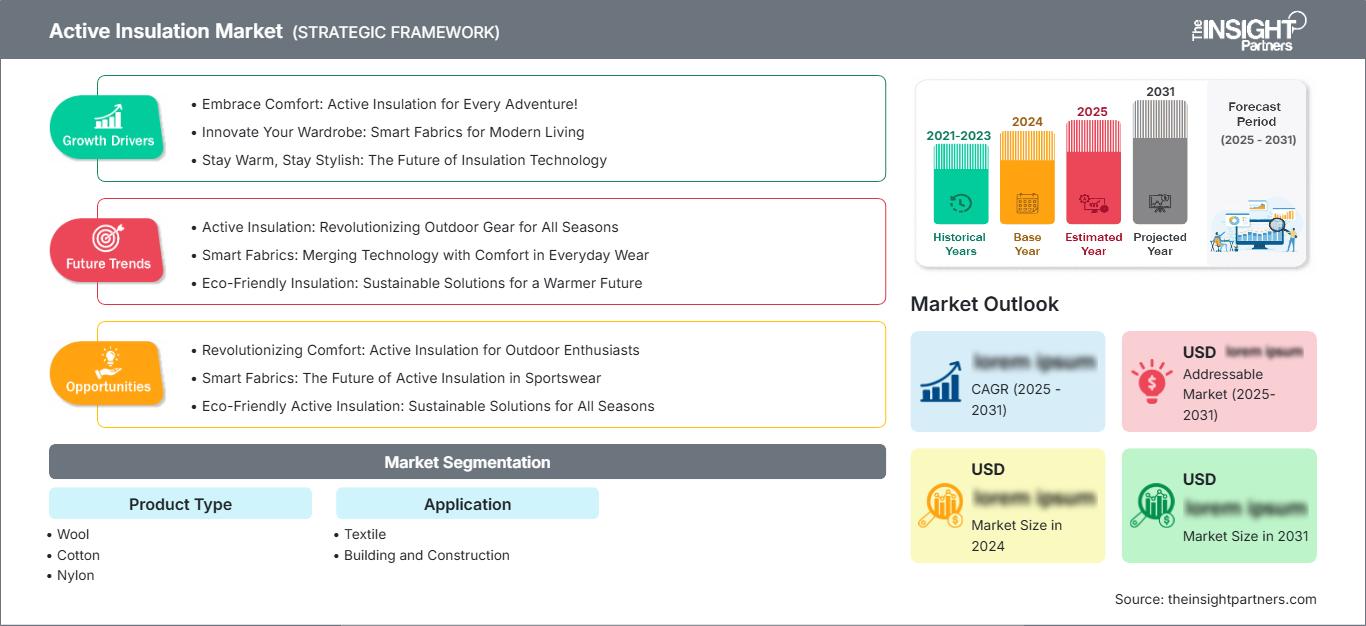
Regional Insights
North America Active Insulation Market
North America accounted for 33–37% of the global market in 2025 and is projected to register a CAGR of 6.7–7.1% during 2026–2034. The active insulation market share in the region is supported by strong demand for premium outdoor apparel, military uniforms, protective workwear, and energy-efficient construction materials. Rising consumer participation in outdoor recreation, together with stringent building energy codes and sustainability initiatives, continues to encourage adoption of high-performance insulation products. Manufacturers also benefit from well-established technical textile capabilities and continuous investments in advanced material technologies.
The United States and Canada remain the primary contributors owing to mature outdoor apparel industries and increasing investments in green infrastructure. Growing emphasis on low-carbon buildings, high-performance thermal envelopes, and lightweight insulation systems supports long-term market expansion. Innovation in recycled insulation fibers and environmentally responsible manufacturing processes is further strengthening regional competitiveness while meeting evolving consumer and regulatory expectations.
U.S. Active Insulation Market
The United States represented 78–82% of the North American market in 2025 and is expected to expand at a CAGR of 6.8–7.2% during 2026–2034. The country benefits from a large base of outdoor apparel manufacturers, advanced textile research, and increasing investments in sustainable building materials. Companies continue introducing thermally adaptive insulation technologies that improve comfort, moisture management, and durability for sportswear, military clothing, and industrial protective garments.
Demand is also supported by growing construction of energy-efficient residential and commercial buildings. Federal and state initiatives promoting improved building insulation and lower operational energy consumption are encouraging adoption of advanced insulation materials. Continued investments in technical textile innovation, coupled with increasing consumer preference for lightweight performance apparel, are expected to maintain steady market growth throughout the forecast period.
Europe Active Insulation Market
Europe held 29–33% of the global market in 2025 and is anticipated to grow at a CAGR of 6.8–7.3% during 2026–2034. Germany remains the largest regional market owing to its strong technical textile industry and leadership in energy-efficient construction. The region benefits from stringent environmental regulations, increasing renovation activities, and sustained demand for premium outdoor clothing.
The UK continues to witness stable adoption through expanding sustainable construction practices and rising consumer demand for performance apparel designed for diverse weather conditions. Germany maintains market leadership with advanced insulation technology development, established industrial manufacturing, and strong demand from construction and technical textile sectors. France, Italy, and Spain collectively contribute significant regional demand through growing investments in green buildings, premium fashion textiles, and energy-efficient renovation projects. Increasing emphasis on circular economy initiatives and recycled insulation materials further supports long-term regional expansion.
APAC Active Insulation Market
Asia Pacific accounted for 24–28% of the global market in 2025 and is forecast to record the highest regional CAGR of 8.2–8.6% during 2026–2034. China leads production and consumption, followed by Japan, South Korea, and India through expanding textile manufacturing and infrastructure investments.
Government initiatives supporting sustainable buildings, industrial modernization, and advanced textile production continue strengthening regional demand. Australia also contributes through growing adoption of energy-efficient construction materials and increasing participation in outdoor recreational activities requiring high-performance insulated apparel.
Middle East & Africa Active Insulation Market
The Middle East & Africa market is projected to expand at a CAGR of 7.1–7.5% during 2026–2034, supported by increasing investments in modern infrastructure, commercial construction, and sustainable building technologies. Saudi Arabia and the UAE continue implementing energy-efficiency initiatives that encourage greater adoption of advanced insulation systems.
South Africa remains an important market due to infrastructure modernization and expanding industrial activities. The Rest of the Middle East & Africa is gradually adopting high-performance insulation materials across commercial buildings and specialized textile applications as governments continue investing in sustainable urban development and improved energy management systems.
Segmentation Analysis
Product Type
The Product Type segment is expected to register a CAGR of 7.0–7.4% during 2026–2034. The active insulation market scope continues to expand as manufacturers develop lightweight, breathable, and thermally efficient insulation materials for apparel and construction applications. Growing emphasis on sustainability, recycled fibers, and improved moisture management is encouraging innovation across natural and synthetic insulation products. Manufacturers are also investing in advanced fiber engineering to enhance durability, compressibility, and thermal performance while reducing environmental impact.
- Wool: Wool remains a preferred natural insulation material because of its excellent thermal regulation, moisture absorption, and biodegradability. Demand is supported by premium outdoor apparel, performance clothing, and sustainable building insulation applications.
- Cotton: Cotton-based insulation is increasingly utilized where breathability, comfort, and renewable material content are prioritized. Product innovation focuses on recycled cotton fibers and improved thermal performance for apparel and specialized insulation systems.
- Nylon: Nylon insulation materials are widely adopted in technical garments requiring durability, abrasion resistance, and lightweight construction. Growing demand from military, industrial workwear, and outdoor sports apparel supports continued market relevance.
- Polyester: Polyester represents the largest synthetic insulation category due to its durability, moisture resistance, lightweight properties, and increasing availability of recycled fibers. Continuous innovation enhances thermal efficiency while supporting sustainability objectives across multiple industries.
Application
The Application segment is projected to expand at a CAGR of 7.3–7.7% during 2026–2034. Increasing consumer demand for performance apparel, combined with stricter energy-efficiency standards in buildings, continues to support adoption across both major application areas. Manufacturers are developing application-specific insulation solutions that balance thermal efficiency, weight reduction, breathability, and environmental performance to satisfy evolving customer expectations.
- Textile: The dominant application segment benefits from rising demand for outdoor apparel, sportswear, military uniforms, protective clothing, and premium lifestyle garments requiring adaptive thermal regulation, lightweight construction, and effective moisture management.
- Building and Construction: Demand continues increasing as governments strengthen energy-efficiency regulations and promote sustainable construction practices. Active insulation materials help improve building thermal performance, reduce operational energy consumption, and support green building certification initiatives.
Opportunity Snapshot
| Segment Name | Revenue Contribution | Trend Tag | Adoption Stage |
| Textile | High | Smart Apparel | Mature |
| Building and Construction | Medium | Green Buildings | Scaling |
Active Insulation Market Growth Drivers and Impact Analysis
Growing demand for high-performance outdoor and sports apparel
Growth in the number of outdoor activities, adventure travel, winter sports, and exercise activities is creating the need for high-quality insulating materials that can provide heat but do not hinder breathability and flexibility. There is an increasing preference for lightweight fabrics that can adjust to varying weather conditions while still allowing for maximum comfort when engaged in strenuous activities. This has led to the incorporation of active insulation technology in jackets, base layers, and protection fabrics by apparel makers. Innovation in synthetic materials, moisture wicking capability, and recycled insulating materials will further boost their functionality. Higher disposable income levels, premiumization of outdoor apparel, and growth in online shopping platforms are other factors boosting global demand.
Stringent energy-efficiency regulations in the construction sector
Around the globe, governments are tightening energy efficiency standards for buildings to curb the release of greenhouse gases and promote energy conservation, thus forming ideal conditions for the use of advanced insulation materials. Smart insulation materials ensure efficient heat regulation, lower need for heating and cooling, and result in sustainable performance of buildings. Growing investment in retrofits in residences, commercial buildings, and green infrastructure is fueling demand for advanced insulation materials in developed and developing nations. Energy-efficient buildings through certification schemes motivate builders to adopt smart insulation materials. Demand for advanced insulation materials will continue to stay robust amid efforts towards achieving zero net emission.
Advancements in sustainable fiber and insulation technologies
The industry is increasingly putting its resources into recycled polyester, responsibly sourced wool, biopolymers, and textile innovations to boost insulation properties with minimum environmental footprint. Studies are being conducted to find ways of creating materials that would provide exceptional temperature and moisture regulation, high strength and recyclability without adding any extra weight to the products. Collaborations between textile manufacturers, chemical firms, and research organizations are making it faster to bring new generation insulation technologies to market. The preference of consumers for more eco-friendly products motivates brands to diversify their sustainable offerings.
Active Insulation Market Future Trends
Expansion of circular and recycled insulation materials
Manufacturers are increasingly incorporating recycled polyester, regenerated fibers, and renewable raw materials into insulation products to reduce carbon emissions and improve resource efficiency. The active insulation market trends indicate growing collaboration between apparel brands, material innovators, and recycling companies to develop circular production models that maintain thermal performance while reducing environmental impact. Demand for certified sustainable insulation materials is expected to increase as consumers and regulatory authorities place greater emphasis on product transparency, responsible sourcing, and lifecycle sustainability across both textile and construction industries.
Integration of smart textile technologies with thermal insulation
The next generation of insulated apparel is expected to combine adaptive insulation materials with wearable technologies capable of monitoring temperature, moisture, and user activity. Advances in conductive fibers, phase-change materials, and intelligent textile systems are enabling garments to deliver enhanced comfort across varying environmental conditions. These innovations are expected to expand opportunities in military applications, healthcare, professional sports, and industrial protective clothing, supporting the long-term evolution of performance insulation technologies.
Active Insulation Market Opportunities
Rising investments in sustainable building renovation projects
Increasing renovation activity across developed economies presents significant growth opportunities for insulation manufacturers. Active insulation market forecast suggest that stricter building energy regulations, financial incentives for energy-efficient retrofits, and growing demand for low-carbon construction materials will continue supporting investment in advanced insulation technologies. Companies offering lightweight, high-performance, and environmentally responsible insulation products are expected to strengthen their market position by addressing the evolving requirements of architects, contractors, and building owners seeking improved thermal efficiency and long-term operational savings.
Expansion into emerging performance apparel markets
Rapid urbanization, rising disposable incomes, and increasing participation in outdoor recreational activities across Asia Pacific, Latin America, and the Middle East are creating attractive opportunities for active insulation manufacturers. Local production partnerships, investment in regional distribution networks, and development of climate-specific insulation products can improve market penetration. Companies capable of combining premium performance, sustainability, and competitive pricing are expected to capitalize on expanding consumer demand while strengthening their presence in fast-growing emerging markets.
Recent Developments
- October 30, 2025: PrimaLoft, Inc. introduced PrimaLoft UltraPeak together with six next-generation insulation innovations, including the PrimaLoft ReRun textile-to-textile recycling platform. The new portfolio improves warmth-to-weight performance, loft retention, durability, and circularity for outdoor apparel and technical garments. The launch reflects the industry's growing focus on sustainable active insulation materials with enhanced thermal regulation and lower environmental impact.
- June 23, 2025: Armacell inaugurated a new aerogel insulation manufacturing facility in Pune, India, to produce ArmaGel XGH and ArmaGel XGC insulation products. The investment significantly expands global production capacity for lightweight, high-performance thermal insulation materials used in industrial and energy applications, demonstrating continued investment in advanced insulation technologies and resilient global supply chains.
Frequently Asked Questions

- Comprehensive Market Sizing and Forecast Analysis
- Detailed Segmentation Analysis
- In-Depth Market Dynamics Assessment
- Regional and Country-Level Insights
- Competitive Landscape and Company Benchmarking
- Strategic Business Intelligence
Recent Reports
Testimonials

The Insight Partners provided valuable market intelligence that supported our global go-to-market strategy. Their team was professional, responsive, and attentive to our feedback, providing thoughtful analysis and helpful methodological clarifications throughout the project.
Junmo Kim Chief Financial Officer (CFO), Enertech Co., Ltd.
The Insight Partners' SCADA System Market report is comprehensive, with valuable insights on current trends and future forecasts. The team was highly professional, responsive, and supportive throughout. We are very satisfied and highly recommend their services.
RAN KEDEM Partner, Reali Technologies LTDs
I requested a report on a very specific software market and the team produced the report in a few days. The information was very relevant and well presented. I then requested some changes and additions to the report. The team was again very responsive and I got the final report in less than a week.
JEAN-HERVE JENN Chairman, Future Analytica
We worked with The Insight Partners for an important market study and forecast. They gave us clear insights into opportunities and risks, which helped shape our plans. Their research was easy to use and based on solid data. It helped us make smart, confident decisions. We highly recommend them.
PIYUSH NAGPAL Sr. Vice President, High Beam Global
The Insight Partners delivered insightful, well-structured market research with strong domain expertise. Their team was professional and responsive throughout. The user-friendly website made accessing industry reports seamless. We highly recommend them for reliable, high-quality research services
YUKIHIKO ADACHI CEO, Deep Blue, LLC.
This is the first time I have purchased a market report from The Insight Partners.While I was unsure at first, I visited their web site and felt more comfortable to take the risk and purchase a market report.I am completely satisfied with the quality of the report and customer service. I had several questions and comments with the initial report, but after a couple of dialogs over email with their analyst I believe I have a report that I can use as input to our strategic planning process.Thank you so much for taking the extra time and making this a positive experience.I will definitely recommend your service to others and you will be my first call when we need further market data.
JOHN SUZUKI President and Chief Executive Officer, Board Director, BK Technologies
I wish to appreciate your support and the professionalism you displayed in the course of attending to my request for information regarding to infectious disease IVD market in Nigeria. I appreciate your patience, your guidance, and the fact that you were willing to offer a discount, which eventually made it possible for us to close a deal. I look forward to engaging The Insight Partners in the future, all thanks to the impression you have created in me as a result of this first encounter.
DR CHIJIOKE ONYIA MANAGING DIRECTOR, PineCrest Healthcare Ltd.Reason to Buy
- Informed Decision-Making
- Understanding Market Dynamics
- Competitive Analysis
- Identifying Emerging Markets
- Customer Insights
- Market Forecasts
- Risk Mitigation
- Boosting Operational Efficiency
- Strategic Planning
- Investment Justification
- Tracking Industry Innovations
- Aligning with Regulatory Trends





 Get Free Sample for