
Adaptive Stroller Market Size, Growth & Trends by 2034
Coverage: By Type (Single Seat, Multiple Seats); Distribution Channel (Supermarkets and Hypermarkets, Specialty Stores, Online Retail, Others) , and Geography (North America, Europe, Asia Pacific, and South and Central America)
- Status : Data Released
- Report Code : TIPRE00028220
- Category : Consumer Goods
- No. of Pages : 150
- Available Report Formats :


- Last update date : August 10, 2026


2025 Market Size
US$ 601.00 Mn
Base year value
2034 Forecast
US$ 980.00 Mn
Projected by 2034
CAGR 2026-2034
5.58 %
Growth rate
Addressable Market
US$ 7,166.13 Mn
(2026-2034)
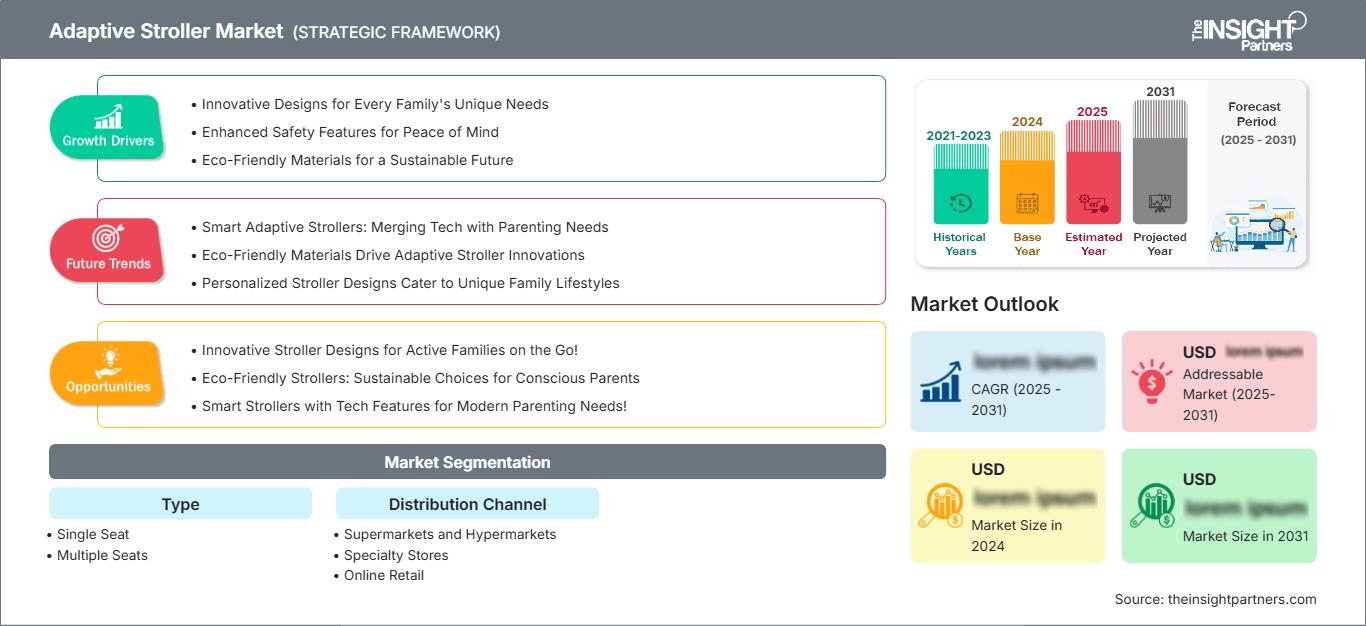
The Adaptive Stroller market was valued at US$ 601 million in 2025 and is expected to reach US$ 980 million by 2034; it is estimated to record a CAGR of 5.58% during 2026-2034.
Adaptive Stroller Market Assessment and Insights
- North America: Strong reimbursement frameworks and extensive rehabilitation infrastructure sustain leadership. Share in 2025 is estimated at 36%–40%, with CAGR between 5.8%–6.6% during 2026–2034.
- US: High adoption of pediatric mobility products and broad presence of specialized distributors support continued expansion. Share of regional market in 2025 is estimated at 77%–81%, growing at a CAGR of 5.9%–6.7% during 2026–2034.
- Europe: Mature healthcare systems and favorable disability-support programs sustain demand across Germany, the UK, France, Italy, and Spain. Share in 2025 is estimated at 29%–33%, with CAGR of 5.7%–6.5% during 2026–2034.
- Asia Pacific: Rising healthcare expenditure and expanding access to rehabilitation services accelerate adoption in China, Japan, India, South Korea, and Australia. Share in 2025 is estimated at 22%–26%, growing at 6.8%–7.6% CAGR during 2026–2034.
- Largest Segment: Single Seat products remain dominant due to affordability, availability, and compatibility with most pediatric mobility applications. Market share in 2025 stands at 68%–72%, with CAGR of 5.9%–6.7% during 2026–2034.
- High Growth Segment: Online Retail continues to benefit from digital comparison tools and wider product accessibility. Market share in 2025 is estimated at 18%–22%, with CAGR of 7.2%–8.0% during 2026–2034.
- Key companies analyzed in detail: Adaptive Star Mobility, Bergeron Health Care, Deming Designs, Inc., Etac AB, Eurovema Mobility AB, Invacare Corporation, MEYRA Group GmbH, Ormesa S.r.l., Sunrise Medical LLC, Thomashilfen GmbH
Source: The Insight Partners' analysis based on proprietary research, government publications, company annual reports, investor presentations, industry databases, and expert interviews.
The adaptive stroller market has evolved from basic mobility support devices toward highly configurable transportation systems designed for enhanced positioning, safety, and user comfort. Manufacturers increasingly integrate lightweight aluminum frames, adjustable seating systems, shock-absorption technologies, and modular accessories that improve usability across clinical and everyday environments. Production strategies have shifted toward customization and shorter development cycles, enabling suppliers to address diverse patient requirements while maintaining regulatory compliance and performance standards.
Over the forecast period, adaptive stroller market growth will increasingly emerge from Asia Pacific and selected Middle Eastern markets where rehabilitation infrastructure is expanding. Government initiatives promoting disability inclusion, improved access to pediatric care, and investments in assistive technology procurement are expected to create favorable conditions. As mobility specialists, healthcare providers, and distributors collaborate more closely, the market is positioned to benefit from broader product accessibility and stronger awareness among caregivers and clinical professionals.
Adaptive Stroller Market Report Scope
| Report Attribute | Details |
|---|---|
| Market size in 2025 | US$ 601.00 Million |
| Market Size by 2034 | US$ 980.00 Million |
| Global CAGR (2026 - 2034) | 5.58% |
| Historical Data | 2021-2024 |
| Forecast period | 2026-2034 |
Adaptive Stroller Market Analysis
Growing diagnosis rates of cerebral palsy, muscular dystrophy, autism spectrum disorders, and other mobility-related conditions continue to support adaptive stroller market growth. Demand is reinforced by increasing emphasis on early mobility interventions, which healthcare professionals consider important for improving participation, social engagement, and physical development. Families increasingly seek products that combine therapeutic positioning benefits with outdoor mobility, encouraging manufacturers to deliver versatile solutions suitable for both clinical and everyday settings.
The value chain encompasses component manufacturers, specialized seating providers, mobility equipment producers, rehabilitation clinicians, distributors, and end users. Supply dynamics are supported by growing adoption of modular product platforms that allow customization without extensive redesign. Improved sourcing strategies and expanded manufacturing capabilities have enabled leading producers to reduce lead times while accommodating individualized seating and positioning requirements.
The competitive environment remains moderately consolidated, with established mobility specialists focusing on product innovation, clinical collaboration, and geographic expansion. Within the broader adaptive stroller market analysis, companies such as Sunrise Medical LLC, Etac AB, Invacare Corporation, Thomashilfen GmbH, and Ormesa S.r.l. continue to emphasize ergonomic design, pediatric mobility expertise, and clinician-focused product development. Strategic investments increasingly target enhanced seating technologies, lightweight materials, and improved transport compatibility.
Regional expansion strategies are also shaping competitive positioning. Adaptive Star Mobility, MEYRA Group GmbH, Eurovema Mobility AB, Bergeron Health Care, and Deming Designs, Inc. are strengthening distribution relationships and expanding specialized dealer networks to improve market penetration. Investments in clinician education, product demonstration programs, and digital configuration tools are helping suppliers differentiate offerings while addressing rising expectations for customized mobility solutions.
● REPORT CUSTOMIZATION
Tailor This Report To Align With Your Specific Business Requirements
This report can be customized to align precisely with your business objectives, scope, and target markets. Customization options include tailored segmentation, geography, competitive analysis, and strategic insights to support informed decision-making.
Customize This Report →WHAT YOU CAN ADJUST
- ● Segmentations
- ● Geography
- ● Competitive Analysis
- ● Language Preferences
Adaptive Stroller Market: Strategic Insights
Regional Insights
North America Adaptive Stroller Market
North America accounts for an estimated 36%–40% adaptive stroller market share in 2025, supported by advanced healthcare infrastructure, high awareness of mobility-assistance technologies, and established reimbursement mechanisms. The region is projected to expand at a CAGR of 5.8%–6.6% during 2026–2034. Demand remains concentrated within pediatric rehabilitation programs, special-needs education systems, and home-care environments where mobility support is considered an essential component of long-term care plans.
Market development is also supported by close collaboration between clinicians, distributors, and manufacturers. Regulatory emphasis on accessibility and inclusion continues to encourage procurement across healthcare institutions and community care settings. Product innovation around transport safety, modular seating systems, and caregiver convenience is further supporting adoption. Growth opportunities are expected to remain strongest in advanced rehabilitation networks, particularly where customized mobility solutions are increasingly integrated into patient-centered treatment pathways.
U.S. Adaptive Stroller Market
The United States represents approximately 77%–81% of the North American market in 2025 and is forecast to grow at a CAGR of 5.9%–6.7% through 2034. The market benefits from a large base of specialty rehabilitation clinics, pediatric hospitals, and mobility equipment providers. Demand is strengthened by increasing awareness among caregivers regarding the benefits of posture-supporting and mobility-enhancing transportation systems.
Leading manufacturers and distributors maintain extensive commercial presence throughout the country, enabling broad product availability and customization support. Clinical adoption trends increasingly favor lightweight and highly adjustable mobility systems capable of accommodating changing patient needs. Healthcare organizations continue to emphasize mobility participation and community inclusion, creating favorable conditions for sustained adoption. Innovation in ergonomic design, transport efficiency, and caregiver usability remains central to competitive differentiation across the U.S. adaptive stroller market.
Europe Adaptive Stroller Market
Europe accounts for approximately 29%–33% of the global adaptive stroller market in 2025 and is anticipated to register a CAGR of 5.7%–6.5% through 2034. Germany remains the leading national market due to its extensive rehabilitation ecosystem and established funding pathways for assistive mobility equipment. Strong clinical involvement and high levels of awareness continue to support product adoption across healthcare and educational settings.
The United Kingdom will reap the benefits of support programs for people with disabilities and of the increasing demand for personalized pediatric mobility devices. There is still strong demand for high-end positioning devices and advanced mobility equipment in Germany. The combined efforts of France, Italy, and Spain in terms of their contributions to rehabilitation services and increased government involvement in mobility will lead to substantial growth in the region.
APAC Adaptive Stroller Market
The Asia Pacific accounts for 22% to 26% of the global market and is projected to exhibit the highest growth rate, with a CAGR of 6.8% to 7.6% in 2026-2034. China is the largest regional market, while Japan and Australia are the leading markets in demand for luxury mobility devices.
India and South Korea have gained momentum due to the development of rehabilitation infrastructure, increased health care spending, and greater awareness of mobility devices. Public initiatives aimed at improving disability support and community inclusion continue to enhance long-term adoption prospects across the region.
Middle East & Africa Adaptive Stroller Market
The Middle East and Africa region is comparatively small, but its growth is gradual as a result of improved healthcare and increased investment in rehabilitation equipment. Middle Eastern nations, such as Saudi Arabia and the UAE, are among the pioneers in healthcare adoption and modernization, and in increased purchasing of mobility solutions.
South Africa will continue to be a major player due to its advanced infrastructure for rehabilitation equipment. The overall region will see a CAGR of 5.4%-6.2% between 2026-2034, supported by ongoing healthcare development initiatives and accessibility-focused programs.
Segmentation Analysis
Type
The Type segment is the industry's major revenue generator and is expected to grow at a CAGR of 6.1%-6.9% from 2026 to 2034. The choice of the product depends on the need for patient mobility, caregiver convenience, transportability, and clinical recommendations. The adaptive strollers market scope is widening further as manufacturers increasingly develop adaptive seating systems that cater to different physical support needs.
- Single Seat: The leading product category, supported by broad applicability across pediatric mobility needs. Demand is driven by affordability, easier transportation, compatibility with rehabilitation programs, and availability of customizable positioning accessories.
- Multiple Seats: Designed for families, institutions, and specialized transportation requirements. Adoption remains lower than single-seat products but benefits from increasing interest in mobility solutions that accommodate multiple dependents and complex care environments.
Distribution Channel
The Distribution Channel section is predicted to witness a CAGR of 6.4%-7.2% over the forecast period of 2026-2034. Companies operating in the adaptive stroller industry are increasingly adopting an omnichannel approach to ensure ease of access and convenience of purchase. This is fueled by increased digital participation from caregivers, improved ability to compare products, and the growing need for customized consultations.
- Supermarkets and Hypermarkets: Primarily relevant for entry-level mobility and support accessories. Their role remains limited compared with specialty-focused channels but contributes to broader product awareness among caregivers and families.
- Specialty Stores: Continue to represent a critical channel due to clinician collaboration, product demonstrations, fitting services, and customization support. These outlets remain highly influential in decision-making for medically complex mobility requirements.
- Online Retail: The fastest-evolving distribution avenue, benefiting from expanding digital health awareness, wider product visibility, competitive pricing structures, and direct manufacturer engagement through e-commerce platforms and virtual consultation tools.
Opportunity Snapshot
| Type | Revenue Contribution | Trend Tag | Adoption Stage |
| Single Seat | High | Custom Seating | Mature |
| Multiple Seats | Low | Family Mobility | Emerging |
Adaptive Stroller Market Growth Drivers and Impact Analysis
Rising Incidence of Pediatric Mobility-Related Conditions
Growing diagnosis rates of cerebral palsy, muscular dystrophy, spina bifida, and developmental disorders continue to generate long-term demand for specialized mobility solutions worldwide. Health professionals are also encouraging early intervention programs that promote movement, socialization, and involvement in community activities at an early age. Consequently, there is a need for mobility products that offer therapeutic positioning and also transport functionalities. This is helping to drive purchases by hospitals, rehabilitation centers, educational organizations, and even at-home care organizations. The manufacturers are catering to this demand with improved posture-support systems, accessories, and lightweight frameworks, thereby broadening the product range.
Expansion of Rehabilitation and Assistive Technology Infrastructure
The investment in rehabilitation clinics and the assistive technologies sector is positively influencing adoption trends across various parts of the region. Governments and health organizations are increasing access to mobility services as part of their disability inclusion strategies. The growing availability of rehabilitation professionals is facilitating more thorough assessments of mobility needs, leading to better prescriptions for mobility products. Moreover, schools educating children with mobility disabilities are also supporting the adoption by developing their own accessibility programs. The establishment of clinics and other community services increases caregiver awareness and improves the referral process.
Advancements in Ergonomic and Modular Product Design
Innovations in product development continue to be a key catalyst for growth, as producers pay greater attention to comfort, safety, and ease of use. New products feature innovative technology, including lighter frames, adjustable seats, improved suspension, and adjustable components to adapt to user needs. This makes products more user-friendly and requires less effort from caregivers during everyday patient transport. Improved compatibility with public transport and automobiles adds even more value to the product. The use of modular systems enables manufacturers to address more clinical needs by offering different systems without producing entirely new products, thereby reducing future ownership costs.
Adaptive Stroller Market Future Trends
Smart Customization and Digital Configuration Platforms
The adaptive stroller market trends increasingly reflect a shift toward digital customization ecosystems that simplify product selection and configuration. It is anticipated that manufacturers will invest in developing additional online evaluation software, virtual fitting capabilities, and dealer-led configuration systems to more efficiently support needs-based assessments by caregivers and clinicians. The use of visualization technologies can help increase consumer purchase confidence and minimize the number of product adjustments. In light of the growing importance of patient-specific care pathways, these technological tools are expected to provide a competitive advantage in the advanced mobility equipment segments in the future.
Growth of Lightweight and Travel-Friendly Mobility Solutions
Future product development will focus on innovations in materials, foldable designs, and mobility solutions for ease of transportation. More and more families demand products that promote an active lifestyle while allowing therapeutic positioning features. This results in manufacturers' efforts to develop lightweight structural materials, easy-to-fold designs, and improved compatibility with cars. All these innovations correspond to general consumer demands for comfort and ease of use. Eventually, travel-friendly mobility products can become popular among users who have previously used standard transportation devices. The trend is also expected to encourage stronger participation from specialty dealers and e-commerce platforms seeking differentiated products that address evolving caregiver preferences.
Adaptive Stroller Market Opportunities
Expansion into Underserved Emerging Healthcare Markets
The strongest expansion opportunities are likely to emerge in developing healthcare systems where access to specialized pediatric mobility products remains relatively limited. There is growing investment in the provision of rehabilitation facilities and disability support services, and in funding the purchase of assistive devices. With rising awareness, manufacturers can partner with rehabilitation facilities, distributors, and non-governmental organizations to boost their products' market penetration. Adaptive stroller market forecasts indicate that over the next ten years, Asia-Pacific, the Middle East, and selected countries in Latin America are likely to contribute more incremental demand. Manufacturers able to provide effective and cost-efficient products are likely to be at an advantage.
Development of Clinician-Centered Product Ecosystems
An important investment opportunity exists in building integrated ecosystems that combine mobility products, assessment tools, training programs, and after-sales support services. Rehabilitation specialists increasingly seek solutions that allow efficient prescription, configuration, and long-term monitoring of mobility equipment. Firms that enhance clinicians' engagement through educational programs and digital platforms can achieve sustainable competitive advantages. In addition, closer cooperation with hospitals, physical therapy facilities, and educational institutions may enhance referral networks and customer retention. The ecosystem approach will give firms opportunities to earn revenue by providing services, differentiate their brands, and integrate into the patient-care process.
Frequently Asked Questions

- Comprehensive Market Sizing and Forecast Analysis
- Detailed Segmentation Analysis
- In-Depth Market Dynamics Assessment
- Regional and Country-Level Insights
- Competitive Landscape and Company Benchmarking
- Strategic Business Intelligence
Recent Reports
Testimonials

The Insight Partners provided valuable market intelligence that supported our global go-to-market strategy. Their team was professional, responsive, and attentive to our feedback, providing thoughtful analysis and helpful methodological clarifications throughout the project.
Junmo Kim Chief Financial Officer (CFO), Enertech Co., Ltd.
The Insight Partners' SCADA System Market report is comprehensive, with valuable insights on current trends and future forecasts. The team was highly professional, responsive, and supportive throughout. We are very satisfied and highly recommend their services.
RAN KEDEM Partner, Reali Technologies LTDs
I requested a report on a very specific software market and the team produced the report in a few days. The information was very relevant and well presented. I then requested some changes and additions to the report. The team was again very responsive and I got the final report in less than a week.
JEAN-HERVE JENN Chairman, Future Analytica
We worked with The Insight Partners for an important market study and forecast. They gave us clear insights into opportunities and risks, which helped shape our plans. Their research was easy to use and based on solid data. It helped us make smart, confident decisions. We highly recommend them.
PIYUSH NAGPAL Sr. Vice President, High Beam Global
The Insight Partners delivered insightful, well-structured market research with strong domain expertise. Their team was professional and responsive throughout. The user-friendly website made accessing industry reports seamless. We highly recommend them for reliable, high-quality research services
YUKIHIKO ADACHI CEO, Deep Blue, LLC.
This is the first time I have purchased a market report from The Insight Partners.While I was unsure at first, I visited their web site and felt more comfortable to take the risk and purchase a market report.I am completely satisfied with the quality of the report and customer service. I had several questions and comments with the initial report, but after a couple of dialogs over email with their analyst I believe I have a report that I can use as input to our strategic planning process.Thank you so much for taking the extra time and making this a positive experience.I will definitely recommend your service to others and you will be my first call when we need further market data.
JOHN SUZUKI President and Chief Executive Officer, Board Director, BK Technologies
I wish to appreciate your support and the professionalism you displayed in the course of attending to my request for information regarding to infectious disease IVD market in Nigeria. I appreciate your patience, your guidance, and the fact that you were willing to offer a discount, which eventually made it possible for us to close a deal. I look forward to engaging The Insight Partners in the future, all thanks to the impression you have created in me as a result of this first encounter.
DR CHIJIOKE ONYIA MANAGING DIRECTOR, PineCrest Healthcare Ltd.Reason to Buy
- Informed Decision-Making
- Understanding Market Dynamics
- Competitive Analysis
- Identifying Emerging Markets
- Customer Insights
- Market Forecasts
- Risk Mitigation
- Boosting Operational Efficiency
- Strategic Planning
- Investment Justification
- Tracking Industry Innovations
- Aligning with Regulatory Trends





 Get Free Sample for