
Hair Wig Market Trends, Demand & Growth by 2034
Coverage: By Type (Human Hair and Synthetic Hair), By End User (Men and Women), By Distribution Channel (Specialty Stores, Online Retail and Others), and Geography (North America, Europe, Asia Pacific, Middle East and Africa, and South and Central America)
- Status : Published
- Report Code : TIPRE00028480
- Category : Consumer Goods
- No. of Pages : 247
- Available Report Formats :


- Last update date : September 10, 2026


2025 Market Size
US$ 4.12 Bn
Base year value
2034 Forecast
US$ 6.19 Bn
Projected by 2034
CAGR 2026-2034
4.6 %
Growth rate
Addressable Market
US$ 46.74 Bn
(2026-2034)
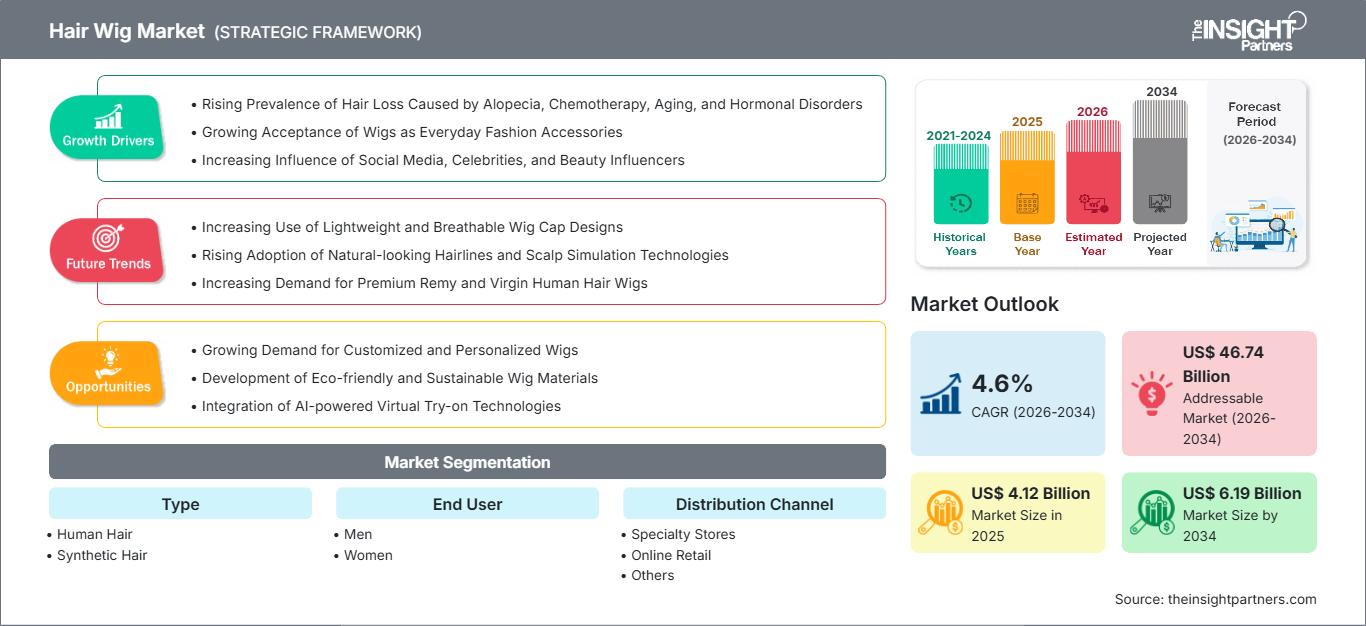
The hair wigs market was worth US$ 4.12 billion in 2025 and is expected to rise to US$ 6.19 billion by 2034, which represents a compound annual growth rate (CAGR) of 4.6% between 2026 and 2034. The demand for wigs is being driven by greater use for cosmetic styling, managing hair loss, the convenience they offer, and achieving a personalized look. Moreover, product innovation involving both human hair and synthetic fibres, better cap construction, and the expansion of digital retail channels are also altering consumer purchasing behavior.
North America continues to be an important market in terms of structure, thanks to its well-established wig retail distribution networks, high levels of consumer spending on beauty and personal-care products, and the general acceptance of alternative hair solutions. Demand is expected to rise in the region for natural-looking products, customization, lightweight cap designs, and hair replacement for medical reasons, which will, in turn, help drive regional growth during the forecast period.
Hair Wig Market Assessment and Insights
- North America: North America accounted for 35–38% of the market in 2025 and is projected to grow at a 4.5–5.0% CAGR between 2026 and 2034, supported by mature retail infrastructure and strong demand for premium hair solutions.
- US: The US accounted for 70–75% of North America's 2025 market and is expected to expand at a 4.5–5.0% CAGR during 2026–2034, supported by fashion and hair-loss applications.
- Europe: Europe held a 21–24% share in 2025 and is expected to register a 4.0–4.5% CAGR during 2026–2034, with Germany, the UK, France, Italy, and Spain representing major demand centres.
- Asia Pacific: Asia Pacific accounted for 31–34% of the market in 2025 and is anticipated to grow at a 5.0–5.5% CAGR during 2026–2034, led by China, Japan, India, South Korea, and Australia.
- Largest Segment: Human Hair held a 64–68% market share in 2025 and is expected to grow at a 4.7–5.2% CAGR during 2026–2034, supported by premium positioning and natural appearance.
- High Growth Segment: Online Retail represented an 18–22% market share in 2025 and is expected to expand at a 5.5–6.5% CAGR during 2026–2034, supported by direct-to-consumer purchasing and digital consultations.
- Key companies analyzed in detail: #A Few Grey Hairs Ltd, LuvmeHair ZA, MapofBeauty Inc, Smiffys II Ltd, The Jon Renau Collection Inc, Indique Hair LLC, UniWigs Inc, Papillon Hair World, Lordhair Co Ltd, Aleriana SRL, Shake-N-Go Inc, Artnature Inc, Henan Ruimei Products Co Ltd, HairUWear Inc, and Evergreen Products Group Ltd.
Source: The Insight Partners' analysis based on proprietary research, government publications, company annual reports, investor presentations, industry databases, and expert interviews.
The market for hair wigs has shifted from primarily focusing on hair replacement to a broader focus on beauty and personal expression. Thanks to advances in lace fronts, monofilament tops, hand-tied caps, heat-resistant synthetic fibers, and lighter construction, the wigs now offer greater realism and comfort. Nowadays, manufacturers tend to blend traditional synthetic fibres with high-quality human hair and offer customized cap designs. Through digital commerce, the gap between specialized producers and consumers seeking particular textures, densities, colors, and fits has narrowed.
In the future, growth is projected to spread across the Asia-Pacific region, and some European markets as online shopping, salon networks, and high-end hair products become more widely available. The greater focus on ethical sourcing, product transparency, scalp comfort, and personalization will affect the way investments are made. Moreover, digital visualization and virtual product displays are becoming increasingly important for converting customers, especially when consumers cannot examine products before buying.
Hair Wig Market Report Scope
| Report Attribute | Details |
|---|---|
| Market size in 2025 | US$ 4.12 Billion |
| Market Size by 2034 | US$ 6.19 Billion |
| Global CAGR (2026 - 2034) | 4.6% |
| Historical Data | 2021-2024 |
| Forecast period | 2026-2034 |
Hair Wig Market Analysis
The growth of the hair wig market is due to two closely linked groups of demand: the desire to improve one's appearance and the need for hair replacement. People experiencing hair thinning, alopecia, hair loss from chemotherapy, or changes associated with aging are now more likely than not to use wigs, just as those motivated by fashion who want to change their hairstyle temporarily do. For high-end products, human hair is still valued for its natural movement and ease of styling, while synthetic wigs offer a lower-maintenance option at more affordable prices.
The value chain starts with the collection of human hair and the production of synthetic fibre, then moves on to fibre processing, cap making, ventilation, coloring, styling, quality inspection, packaging, and distribution. Supply is centered on manufacturing sites in Asia, the main markets for consumption being North America and Europe. India remains a significant source of human hair, while China has substantial manufacturing and processing capacity. Because of rising input costs and the stringent sourcing requirements, manufacturers are encouraged to diversify their procurement and improve production efficiency.
The market is still made up of many separate players, the various companies distinguishing themselves by the quality of the hair, the way the caps are constructed, the range of styling options, the degree of customization available, and their distribution reach. Jon Renau Collection Inc and HairUWear Inc focus on product innovation and comfort, whereas Indique Hair LLC, UniWigs Inc, LuvmeHair ZA, and Evergreen Products Group Ltd all compete vigorously in both the human hair and the digitally enabled sectors. Artnature Inc holds a strong position in specialized hair solutions, and Henan Ruimei Products Co., Ltd. has advantages in manufacturing and sourcing.
More of their money is now being invested in acquiring customers online, offering personalized products, using lightweight construction methods, and adopting premium fibre technologies. Besides this, companies are using social media and partnerships with creators to lower barriers to acquiring customers and showcase the variety of styles available. As a result, the competitive situation favors firms that can combine large manufacturing scale with fast product development, effective digital merchandising, reliable fulfilment, and differentiating fitting or customization services.
● REPORT CUSTOMIZATION
Tailor This Report To Align With Your Specific Business Requirements
This report can be customized to align precisely with your business objectives, scope, and target markets. Customization options include tailored segmentation, geography, competitive analysis, and strategic insights to support informed decision-making.
Customize This Report →WHAT YOU CAN ADJUST
- ● Segmentations
- ● Geography
- ● Competitive Analysis
- ● Language Preferences
Hair Wig Market: Strategic Insights
Regional Insights
North America Hair Wig Market
In 2025, North America had a market share ranging from 35% to 38% and is projected to achieve a compound annual growth rate of 4.5% to 5.0% between 2026 and 2034. The region enjoys the advantages of well-developed specialty retail, existing salon networks, medical hair-replacement services, and a high level of acceptance of wigs as both functional and fashionable products. The United States is the main centre of demand, owing to high levels of consumer spending and the wide availability of products.
There is a growing trend towards lighter, more realistic, and customizable products. In high-end applications, human hair remains prominent, whereas heat-resistant synthetic products meet the needs of consumers seeking styling flexibility at more affordable prices. At the same time, online retail is making products more accessible, especially to younger consumers and those in the specialized textured-hair categories. Demand is also being sustained in the mature healthcare and oncology sectors for medical reasons, and usage is being extended beyond hair-loss cases due to influences from fashion, entertainment, and social media.
U.S. Hair Wig Market Market
The United States accounted for 70 to 75 percent of North America's market in 2025 and is expected to grow at a compound annual growth rate of 4.5 to 5.0 percent through 2034. This level of market presence is due to its vast network of specialty stores, well-established online retailers, salon partnerships, and high consumer awareness of alternative hair products. The market caters to both fashion-oriented and medically motivated consumers.
The company is involved in premium human hair specialist brands, synthetic wig companies, and firms that offer comprehensive hair solutions. Its efforts in product innovation are currently directed towards achieving a more realistic lace front, introducing breathable caps, using a low-density structure, and making installation easier. Online shopping is becoming more important as consumers consult product listings, colors, cap styles, and reviews before making a purchase. Demand is also being driven by growing interest in textured styles and personalized items, enabling suppliers to meet a wide range of consumer needs without relying solely on standard designs.
Europe Hair Wig Market
In 2025, Europe accounted for 21 to 24 percent and is projected to grow at a compound annual growth rate of 4.0 to 4.5 percent between 2026 and 2034; Germany is the largest, followed by the UK, France, Italy, and Spain. The demand is driven by the established beauty markets, medical hair-loss applications, specialist retailers, and consumers' interest in realistic hair solutions.
The UK enjoys a robust online retail sector along with a strong fashion-focused consumption pattern, whereas Germany has a well-established medical and specialist hair-replacement system. France and Italy play their part through their premium beauty image, their salon networks, and their influence in the fashion world. In the case of Spain, the country combines the growth of its digital retail with a demand for inexpensive styling products. Throughout the region, human hair remains significant in high-end products, while synthetic and heat-resistant fibres meet the needs of consumers seeking convenience, lower maintenance, and a wider range of styles.
APAC Hair Wig Market
In 2025, APAC had a market share of 31 to 34 percent and is projected to achieve a compound annual growth rate of 5.0 to 5.5 percent between 2026 and 2034, making it one of the fastest-growing regions. China is the main market, alongside Japan, South Korea, India, and Australia, all of which make significant contributions. The region's importance is supported by the concentration of manufacturing and the growth of consumer markets.
China makes the most of its large-scale production and processing capabilities, whereas India plays a significant role in sourcing human hair and meeting local demand. Japan and South Korea focus on high-end styling, technological innovation, and appearance-related products. India is also experiencing a rise in online distribution and in the availability of customized options. Australia takes advantage of its premium beauty spending and its specialized retail sector. The continued growth should be supported by increasing disposable income, the growth of digital commerce, the influence of social media, and better access to custom products.
Middle East & Africa Hair Wig Market
The Middle East and Africa region is expected to achieve a 3.5–4.0% compound annual growth rate from 2026 through to 2034, with the UAE and Saudi Arabia among the key markets in the Middle East and South Africa a major centre of demand in Africa. This growth is due to spending on premium beauty products, the growth of specialized retail, and the expansion of digital commerce.
Saudi Arabia and the UAE see high spending on beauty and personal care, whereas South Africa has a well-established market for texturized hair products. The rest of the region is smaller in scale but still offers opportunities through e-commerce and salon distribution. Among wealthy consumers, premium products made from human hair are especially relevant, while synthetic wigs are more affordable. Moreover, the modernization of retail outlets and tourism-linked beauty product consumption both contribute to market development.
Segmentation Analysis
Type
Human hair and synthetic hair represent distinct product propositions based on raw material, appearance, durability, styling flexibility, maintenance requirements, and price. The overall type segment is expected to register a 4.6–5.0% CAGR during 2026–2034, as manufacturers increasingly develop hybrid and heat-friendly solutions to bridge performance gaps.
- Human Hair: Premium positioning, natural movement, heat-styling flexibility, and customization support demand among consumers prioritizing realism and longer product longevity. Sourcing quality and price remain important purchasing considerations.
- Synthetic Hair: Lower cost, consistent styling, reduced maintenance, and broad color availability support mass-market adoption. Heat-friendly fibres are increasingly improving styling flexibility and narrowing the performance gap with human hair.
End User
Men and women represent distinct demand groups with different product requirements, styling preferences, and purchasing motivations. The segment is expected to grow at a 4.5–4.9% CAGR during 2026–2034. Women account for the bulk of demand for fashion and hair-loss products, while men's products increasingly emphasize discreet coverage, natural hairlines, and a convenient fit.
- Men: Demand is centered on discreet hair replacement, natural-looking density, hairline integration, and low-maintenance products. Online consultations and specialized hair-replacement services are increasing accessibility.
- Women: Women represent a broad customer base spanning fashion, styling, medical hair loss, and protective applications. Product variety across textures, lengths, colors, densities, and cap designs supports recurring purchases.
Distribution Channel
Distribution is shifting toward integrated omnichannel models as specialty stores continue to provide consultations and fitting while online channels offer wider product selection. The segment is expected to expand at a 4.8–5.4% CAGR during 2026–2034, supported by digital purchasing and direct-to-consumer strategies.
- Specialty Stores: Remain important for professional fitting, physical inspection, customization, and medical hair-replacement consultations. Premium consumers continue to value personalized service before purchasing higher-priced products.
- Online Retail: Benefits from extensive product catalogs, customer reviews, digital consultations, social-media discovery, and direct-to-consumer pricing. Virtual visualization and improved returns are reducing barriers to online purchases.
- Others: Include salons, clinics, distributors, department stores, and specialized healthcare channels. These channels remain relevant where professional advice, fitting, or medically oriented procurement influences purchasing decisions.
Opportunity Snapshot
| End User | Revenue Contribution | Trend Tag | Adoption Stage |
| Men | Medium | Discreet Coverage | Scaling |
| Women | High | Personalized Styling | Mature |
Hair Wig Market Growth Drivers and Impact Analysis
Rising Preference for Natural-Looking and Custom-Fit Hair Solutions
The characteristics important here include natural density, hair movement, scalp appearance, and hairline structure. As a result, lace fronts, monofilament tops, hand-tied caps, low-density construction, and custom sizing have become key factors that distinguish products. Human hair especially benefits from this development, as it can be cut, colored, and heat-styled in the same way as real hair. Moreover, advances in synthetic fibers are now enabling manufacturers to provide a realistic texture and maintain style at more affordable prices. This evolution of the product is driving a shift towards premium offerings and prompting consumers to replace their wigs more often, as they now consider comfort, realism, and appearance. Companies that can offer a custom fit alongside scalable production can tap into higher-value market demand while meeting the needs of people with different head sizes, textures, and styling preferences.
Expansion of Wigs Beyond Hair Loss into Fashion and Self-Expression
Wigs are being used more and more as temporary fashion items rather than just as a remedy for hair loss. Since consumers can alter the length, color, texture, and style of their wigs without chemically treating or cutting their natural hair, this offers a flexible alternative to permanent treatments. The presence of social media influencers, entertainment personalities, and beauty influencers has increased the visibility of changeable hairstyles and textured products. This wider range of uses has led to greater demand among younger consumers and has encouraged them to make frequent purchases of different styles. In response, manufacturers are expanding their color ranges, introducing seasonal designs, offering heat-resistant synthetic options, and producing lighter constructions. The outcome is a more diverse customer base, reduced reliance on medical purchases, and the ability for companies to leverage fashion cycles, influencer marketing, and limited-edition collections to generate repeat sales.
Digital Retail and Virtual Product Discovery Improve Consumer Accessibility
The growing role of e-commerce is changing how consumers discover, evaluate, and purchase wigs. Online shops offer a wide variety of wigs in different hair types, colors, cap constructions, sizes, and price ranges, which are generally not available in local specialist stores. Because of digital reviews, tutorial videos, social commerce content, and virtual visualization tools, information gaps are reduced, and customers can make more informed choices. For instance, Aderans has introduced AI-created wig models so that online shoppers can see how products might look on different faces and head shapes. These tools can increase shoppers' confidence when buying items online and promote personalization. As digital retailers improve their ability to fulfil orders, handle returns, provide consultations, and deliver customer service, online distribution should be able to attract even more consumers who value convenience and a wide range of products.
Hair Wig Market Future Trends
AI-Enabled Personalization and Virtual Wig Visualization
AI-enabled visualization is set to become increasingly integrated into the process of discovering and consulting about wigs. Rather than showing customers static photos of products, digital platforms will be able to display hairstyles on different face shapes, colors, densities, and styling arrangements. This will help to shorten the time it takes to make a decision and will reduce the uncertainty people experience when buying products online. Aderans has already incorporated AI-generated wig models into its online store, illustrating how facial visualization can be included in digital merchandising. Future systems might combine facial analysis, head measurements, hair-loss patterns, and preferred hair textures to suggest appropriate products. These features could also help retailers reduce returns by aligning customers' expectations about fit and style before purchase. The trend will benefit those brands that combine their own product data with effective digital customer interfaces.
Low-Density, Breathable, and Heat-Friendly Construction
Comfort is now being given greater emphasis without sacrificing realism. In the development of new products, low-density wigs, breathable wefting, lighter cap constructions, monofilament tops, transparent lace, and heat-friendly synthetic fibres are becoming important features. These elements are intended to address consumers' concerns about weight, heat buildup, stiffness, and an unnatural look when the wigs are worn for long periods. The latest products on the market reflect the industry trend, as manufacturers are launching lighter-density styles and improved lace technologies to achieve more natural movement and comfort. During the forecast period, innovation is expected to focus on reducing material weight, improving ventilation, softening the fibres, and ensuring the style remains durable. These advances will enable greater everyday use and increase consumer acceptance among those who have previously seen wigs as something to be used only occasionally or as uncomfortable.
Hair Wig Market Opportunities
Premium Human Hair and Ethical Sourcing Platforms
The chance for manufacturers to stand out lies in achieving traceability, ensuring quality consistency, and obtaining hair ethically. Nowadays, consumers look not just at how the hair looks and how long it lasts but also at where it comes from and how it is processed. By establishing well-documented procurement methods, conducting supplier audits, implementing traceability systems, and providing clearer classifications by product grade, companies can improve their market position. Digital product passports or QR codes containing sourcing information could increase transparency while also enabling premium pricing. In India and in other major sourcing areas, there are opportunities to carry out vertically integrated procurement, processing, and quality control. Manufacturers who combine dependable sourcing with custom color, density, and cap choices can create more valuable offerings. This strategy also helps to decrease reliance on generic products and enables stronger relationships with specialist retailers and direct sales to consumers.
Localized Product Development for Textured Hair and Diverse Consumers
There is a great opportunity to design products tailored to the specific hair types, facial features, climate conditions, and styling habits in different areas. Instead of sticking to standardized global ranges, companies can draw on local consumer insights to develop products with the right density, curl patterns, cap sizes, ventilation, and color range. The Asia-Pacific region, the Middle East, Africa, and the multicultural parts of North America all have particularly varied needs. By using digital feedback and data from social commerce platforms, businesses can quickly identify hair types and styles that are not well served. Forming local partnerships with salons, stylists, and creators can enhance product testing and help with market acceptance. Moreover, this localized approach can aid more accurate inventory planning by aligning product ranges with regional preferences rather than using the same collection across all international markets.
Recent Developments
- In July 2026, BeautyForever Hair expanded its product portfolio with the launch of next-generation MeltLine Half Wigs, featuring glueless wear, a natural-looking hairline, and enhanced comfort for everyday use. The launch reflects the industry's continued focus on developing beginner-friendly, realistic, and low-maintenance wig solutions to meet growing consumer demand.
- In April 2026, HairUWear Inc. selected Stretch PR to enhance marketing and brand activation for Hairdo Spirit Wear, a line of hair accessories aimed at sports fans. This partnership aims to boost awareness and growth, especially in the sports and campus retail markets, aligning with HairUWear's strategy to diversify its product offerings, including wigs and hair extensions.
Frequently Asked Questions

- Comprehensive Market Sizing and Forecast Analysis
- Detailed Segmentation Analysis
- In-Depth Market Dynamics Assessment
- Regional and Country-Level Insights
- Competitive Landscape and Company Benchmarking
- Strategic Business Intelligence
Recent Reports
Testimonials

The Insight Partners provided valuable market intelligence that supported our global go-to-market strategy. Their team was professional, responsive, and attentive to our feedback, providing thoughtful analysis and helpful methodological clarifications throughout the project.
Junmo Kim Chief Financial Officer (CFO), Enertech Co., Ltd.
The Insight Partners' SCADA System Market report is comprehensive, with valuable insights on current trends and future forecasts. The team was highly professional, responsive, and supportive throughout. We are very satisfied and highly recommend their services.
RAN KEDEM Partner, Reali Technologies LTDs
I requested a report on a very specific software market and the team produced the report in a few days. The information was very relevant and well presented. I then requested some changes and additions to the report. The team was again very responsive and I got the final report in less than a week.
JEAN-HERVE JENN Chairman, Future Analytica
We worked with The Insight Partners for an important market study and forecast. They gave us clear insights into opportunities and risks, which helped shape our plans. Their research was easy to use and based on solid data. It helped us make smart, confident decisions. We highly recommend them.
PIYUSH NAGPAL Sr. Vice President, High Beam Global
The Insight Partners delivered insightful, well-structured market research with strong domain expertise. Their team was professional and responsive throughout. The user-friendly website made accessing industry reports seamless. We highly recommend them for reliable, high-quality research services
YUKIHIKO ADACHI CEO, Deep Blue, LLC.
This is the first time I have purchased a market report from The Insight Partners.While I was unsure at first, I visited their web site and felt more comfortable to take the risk and purchase a market report.I am completely satisfied with the quality of the report and customer service. I had several questions and comments with the initial report, but after a couple of dialogs over email with their analyst I believe I have a report that I can use as input to our strategic planning process.Thank you so much for taking the extra time and making this a positive experience.I will definitely recommend your service to others and you will be my first call when we need further market data.
JOHN SUZUKI President and Chief Executive Officer, Board Director, BK Technologies
I wish to appreciate your support and the professionalism you displayed in the course of attending to my request for information regarding to infectious disease IVD market in Nigeria. I appreciate your patience, your guidance, and the fact that you were willing to offer a discount, which eventually made it possible for us to close a deal. I look forward to engaging The Insight Partners in the future, all thanks to the impression you have created in me as a result of this first encounter.
DR CHIJIOKE ONYIA MANAGING DIRECTOR, PineCrest Healthcare Ltd.Reason to Buy
- Informed Decision-Making
- Understanding Market Dynamics
- Competitive Analysis
- Identifying Emerging Markets
- Customer Insights
- Market Forecasts
- Risk Mitigation
- Boosting Operational Efficiency
- Strategic Planning
- Investment Justification
- Tracking Industry Innovations
- Aligning with Regulatory Trends






 Get Free Sample for