
Adjustable Standing Desks Market Trends, Share & Demand by 2034
Coverage: By End-User (Households, Commercials, Institutional); Material (Wood, Metal, Fiber, Others) , and Geography (North America, Europe, Asia Pacific, and South and Central America)
- Status : Data Released
- Report Code : TIPRE00028431
- Category : Consumer Goods
- No. of Pages : 150
- Available Report Formats :


- Last update date : August 10, 2026


2025 Market Size
US$ 6.49 Bn
Base year value
2034 Forecast
US$ 11.5 Bn
Projected by 2034
CAGR 2026-2034
6.03 %
Growth rate
Addressable Market
US$ 79.17 Bn
(2026-2034)
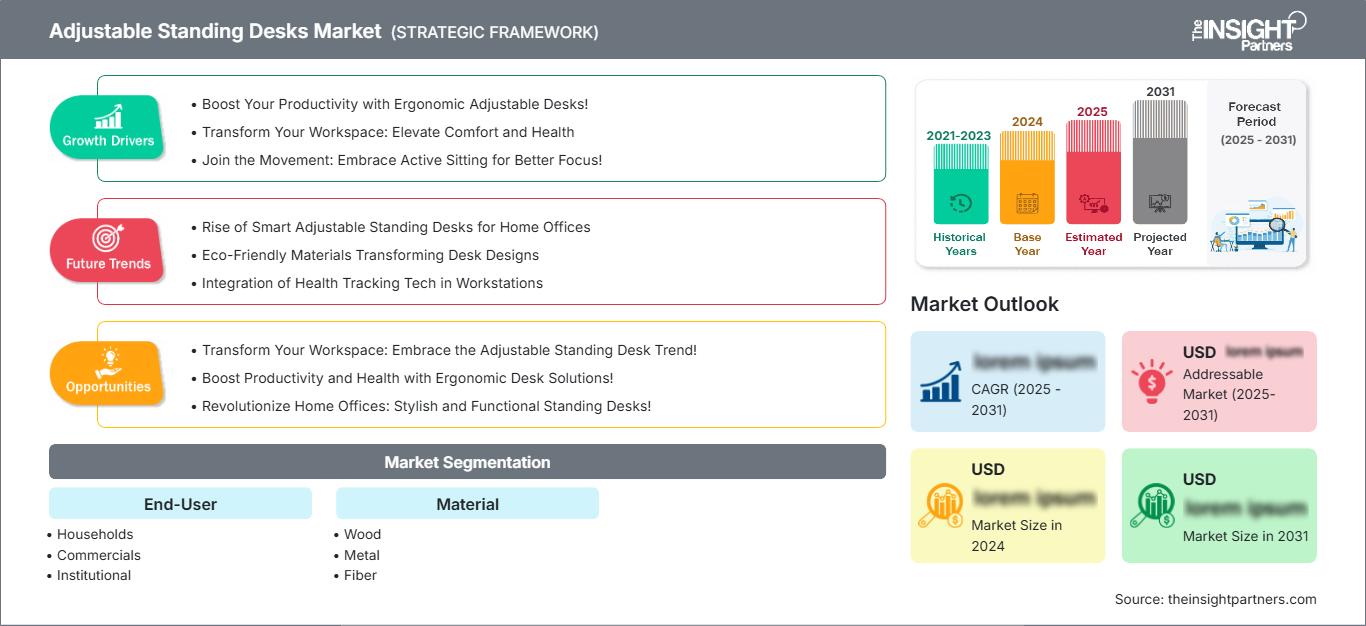
The adjustable standing desks market was valued at US$ 6.49 Billion in 2025 and is projected to reach US$ 11.5 Billion by 2034, expanding at a CAGR of 6.03% during 2026–2034. Demand is being supported by expanding ergonomic workspace investments, rising awareness of sedentary health risks, and broader integration of flexible office layouts across corporate and residential environments. Product innovation in electric lift systems, memory-position controls, and modular workstation designs continues to influence purchasing decisions across major end-user groups.
Across North America, workplace wellness initiatives, remote work adoption, and investments in premium office furniture continue to accelerate demand. The adjustable standing desks market size in the region benefits from strong replacement demand and high penetration among enterprise customers. Regional expansion is expected to progress at an estimated CAGR range of 5.7%–6.3% through 2034, supported by ergonomic procurement standards, hybrid workplace models, and sustained spending on employee productivity solutions.
Adjustable Standing Desks Market Assessment and Insights
- North America: A mature market characterized by strong commercial adoption, premium product demand, and widespread ergonomic compliance initiatives. Share in 2025 is estimated at 34%–38%, while the market is expected to grow at a CAGR of 5.7%–6.3% during 2026–2034.
- US: The country remains the largest revenue contributor within the region, supported by corporate wellness programs and home-office upgrades. Share of North America in 2025 is estimated at 78%–82% with a CAGR of 5.8%–6.4% during 2026–2034.
- Europe: Strong regulatory emphasis on occupational health and workplace modernization supports adoption. Key countries include Germany, the UK, and France. Share in 2025 is estimated at 26%–30%, growing at a CAGR of 5.5%–6.1% during 2026–2034.
- Asia Pacific: Expanding commercial infrastructure, urban workforce growth, and rising ergonomic awareness support market expansion. China, Japan, South Korea, and India remain leading contributors. Share in 2025 is estimated at 28%–32%, with CAGR of 6.8%–7.4% during 2026–2034.
- Largest Segment: Commercials account for the largest demand base owing to office refurbishment projects, enterprise procurement programs, and workplace wellness initiatives. Market share in 2025 is estimated at 48%–52% with CAGR of 5.8%–6.4% during 2026–2034.
- High Growth Segment: Households are expected to witness the fastest expansion, supported by hybrid work arrangements and increasing home-office investments. Market share in 2025 is estimated at 28%–32% with CAGR of 7.0%–7.8% during 2026–2034.
- Key companies analyzed in detail: Ergotron, Inc.; IKEA; MillerKnoll, Inc.; Keter Group; Ashley Furniture Industries, Inc.; Steelcase Inc.; Duronic Ltd.; Humanscale Corporation; MooreCo Inc.; Stand Steady Company.
Source: The Insight Partners' analysis based on proprietary research, government publications, company annual reports, investor presentations, industry databases, and expert interviews.
Rapid shifts in workplace design have transformed the adjustable standing desks market from a niche ergonomic category into a mainstream furniture segment. Electrically adjustable systems now dominate premium price bands, while improvements in actuator reliability, cable management, and digital control interfaces have enhanced user acceptance. Manufacturing strategies have also evolved toward modular production, enabling suppliers to offer customization without substantial cost escalation. These developments have broadened adoption across commercial buildings, educational institutions, and residential workspaces.
Looking ahead, geographic expansion opportunities are increasingly concentrated in emerging economies where workplace modernization programs continue to accelerate. Government initiatives encouraging worker well-being, combined with increasing investment in technology-enabled office environments, are expected to create favorable conditions for long-term demand. Product differentiation through sustainable materials, connected workplace functionality, and advanced ergonomic features is likely to remain a major focus area for both established manufacturers and specialist furniture providers.
Adjustable Standing Desks Market Report Scope
| Report Attribute | Details |
|---|---|
| Market size in 2025 | US$ 6.49 Billion |
| Market Size by 2034 | US$ 11.5 Billion |
| Global CAGR (2026 - 2034) | 6.03% |
| Historical Data | 2021-2024 |
| Forecast period | 2026-2034 |
Adjustable Standing Desks Market Analysis
The adjustable standing desks market growth trajectory is being driven by an increasing focus on employee health, workplace productivity, and ergonomic compliance. Organizations are investing in height-adjustable furniture to reduce prolonged sitting, improve workforce comfort, and support wellness objectives. The value chain extends from raw material suppliers and lifting-column manufacturers to furniture assemblers, distributors, and enterprise procurement channels. As awareness regarding musculoskeletal disorders increases, adoption continues to expand beyond conventional office environments into educational institutions, healthcare facilities, and government workplaces.
Supply-side developments are supporting broader market availability. Improvements in motorized lifting solutions, lower component costs, and scalable manufacturing capabilities have enabled suppliers to introduce a wider range of products across price points. Online distribution channels have further expanded accessibility, particularly among residential buyers. Rising demand for configurable workstations and multifunctional office furniture is also encouraging manufacturers to enhance production flexibility and reduce delivery lead times across major markets.
The adjustable standing desks market analysis indicates that competition remains moderately fragmented, with established furniture companies competing alongside specialized ergonomic product manufacturers. Product quality, lift stability, warranty coverage, sustainability credentials, and customization capabilities remain important differentiating factors. Companies continue to strengthen their market positions through product innovation, digital sales channels, and strategic partnerships with corporate procurement networks.
Industry participants such as Ergotron, Inc., Steelcase Inc., MillerKnoll, Inc., Humanscale Corporation, and IKEA continue to focus on product portfolio diversification to strengthen their competitive positioning. Meanwhile, Ashley Furniture Industries, Inc., Keter Group, MooreCo Inc., Duronic Ltd., and Stand Steady Company are targeting both commercial and residential segments through expanded distribution networks and value-oriented offerings. Investment activity is increasingly prioritizing intelligent workspace solutions, environmentally responsible materials, and scalable manufacturing infrastructure capable of supporting sustained future demand.
● REPORT CUSTOMIZATION
Tailor This Report To Align With Your Specific Business Requirements
This report can be customized to align precisely with your business objectives, scope, and target markets. Customization options include tailored segmentation, geography, competitive analysis, and strategic insights to support informed decision-making.
Customize This Report →WHAT YOU CAN ADJUST
- ● Segmentations
- ● Geography
- ● Competitive Analysis
- ● Language Preferences
Adjustable Standing Desks Market: Strategic Insights
Regional Insights
North America Adjustable Standing Desks Market
North America represents the largest regional contributor to the adjustable standing desks market, accounting for an estimated 34%–38% market share in 2025 and advancing at a CAGR of 5.7%–6.3% during 2026–2034. Demand remains concentrated among commercial offices, educational institutions, healthcare facilities, and remote professionals. Corporate wellness initiatives, combined with growing awareness of the productivity benefits associated with ergonomic furniture, continue to support replacement demand across established office environments.
The region benefits from strong purchasing power, advanced workplace standards, and extensive availability of premium furniture solutions. Large enterprises increasingly incorporate height-adjustable workstations into broader employee well-being strategies. Investments in workplace modernization and hybrid work infrastructure continue to create favorable market conditions. The presence of prominent furniture manufacturers, mature distribution channels, and sophisticated procurement systems further supports steady demand expansion throughout the forecast period.
U.S. Adjustable Standing Desks Market
The United States accounts for approximately 78%–82% of North American demand in 2025 and is projected to expand at a CAGR of 5.8%–6.4% during 2026–2034. Strong enterprise adoption, rising home-office spending, and increasing emphasis on occupational health continue to support market development. Government agencies, educational institutions, and private-sector employers are gradually integrating ergonomic procurement standards into workplace furnishing decisions.
A significant concentration of leading suppliers, distributors, and workplace solution providers supports innovation and product availability. The country's contribution to the overall adjustable standing desks market share remains substantial due to high commercial penetration and widespread acceptance of workplace wellness programs. Electrically adjustable desks continue to gain traction across both premium corporate environments and professional home-office setups. Hybrid work trends and ongoing office refurbishment projects are expected to sustain long-term market demand.
Europe Adjustable Standing Desks Market
Europe held an estimated 26%–30% share in 2025 and is anticipated to register a CAGR of 5.5%–6.1% through 2034. Germany remains the leading market due to its established office furniture manufacturing ecosystem and widespread corporate emphasis on occupational ergonomics. The United Kingdom continues to display steady adoption as organizations modernize workplaces and adapt to evolving hybrid work patterns.
Increased demand in France, Italy, and Spain is evident, with companies investing in workplace wellness and infrastructure upgrades to improve productivity. Increased regulations on employee well-being will continue to promote adoption among various end-user types. The growing need for sustainability is driving more purchases of long-lasting furniture made from sustainable materials. All these factors contribute to making Europe a significant part of the global market.
APAC Adjustable Standing Desks Market
The Asia Pacific region accounted for about 28%-32% of the global demand in 2025 and is expected to show the highest regional growth rate with a CAGR of 6.8%-7.4% between 2026-2034. The region continues to dominate owing to its well-developed manufacturing base and investments in its commercial infrastructure.
Japan, South Korea, India, and Australia are showing increased adoption owing to growing ergonomic awareness and the implementation of new-age offices. Investments in technology parks and other flexible working spaces are driving regional demand in this regard. Higher purchasing power among the middle class is also boosting demand in these countries.
Middle East & Africa Adjustable Standing Desks Market
The Middle East and Africa adjustable standing desk market is relatively small, but it offers significant long-term prospects. CAGR growth of 5.9%-6.5% during the period 2026-2034 is anticipated, driven by growth in commercial real estate development and office infrastructure construction across key countries.
The United Arab Emirates and Saudi Arabia remain the leaders in the regional market because of their modernization efforts in workplaces and large-scale business development projects. The country that should not be forgotten is South Africa; however, other regional markets are also showing an increase in ergonomic furniture adoption.
Segmentation Analysis
End-User
The End-User segment is estimated to grow at a CAGR of 6.0%-6.6% from 2026 to 2034. Factors such as workplace ergonomics, employee well-being programs, and the ongoing development of hybrid workplaces contribute to rising demand. The scope of the adjustable standing desks market within the End-User segment is growing due to the adoption of flexible office infrastructure and the rising trend of home offices.
- Households: Growing remote and hybrid work adoption has increased residential demand. Consumers increasingly seek ergonomic workstations featuring motorized adjustments, compact footprints, and aesthetic designs that integrate effectively into home-office environments.
- Commercials: This sub-segment represents the largest revenue contributor due to significant procurement volumes from corporate offices, coworking spaces, healthcare facilities, and technology enterprises focusing on employee wellness and productivity improvements.
- Institutional: Schools, universities, libraries, and public-sector facilities are gradually increasing adoption as awareness of ergonomic furniture benefits expands across educational and administrative environments requiring long-term user comfort.
Material
The Material segment is projected to have a CAGR of 5.8% to 6.4% for the global adjustable standing desks market from 2026 to 2034. Buying decisions have become increasingly dependent on factors such as durability, appearance, environmental friendliness, and total lifecycle costs. The manufacturers have been upgrading the material quality of their products and ensuring the use of environmentally friendly materials and sourcing practices.
- Wood: Wood-based products remain widely adopted for executive offices and premium residential settings due to their visual appeal, design versatility, and compatibility with contemporary workplace aesthetics and professional interior concepts.
- Metal: Metal remains strategically important because of its superior structural strength, stability, and durability. It is extensively utilized in electric standing desk frames supporting heavy equipment and long-term commercial applications.
- Fiber: Fiber-based materials are increasingly incorporated into lightweight and cost-efficient product designs. Manufacturers utilize these solutions to balance affordability, sustainability objectives, and functional performance across diverse end-user categories.
Opportunity Snapshot
| End-User | Revenue Contribution | Trend Tag | Adoption Stage |
| Households | Medium | Home Office | Scaling |
| Commercials | High | Hybrid Workspace | Mature |
| Institutional | Low | Learning Spaces | Emerging |
Adjustable Standing Desks Market Growth Drivers and Impact Analysis
Expansion of Hybrid and Flexible Workplace Models
The transition to hybrid work remains highly important in determining priorities for furniture purchasing by companies worldwide. Companies prefer to create flexible areas where workers can move, collaborate, and arrange their desks according to their needs. Adjustable desks are especially important for such purchases, as they meet the company's requirements for worker well-being and for creating a flexible space. Large companies are replacing their traditional furniture with ergonomic furniture to improve worker engagement and productivity. This tendency applies to multinationals and small and mid-sized firms seeking competitive workplaces.
Rising Awareness of Ergonomics and Occupational Health
Growing concern regarding sedentary lifestyles and work-related musculoskeletal conditions is significantly influencing purchasing behavior. Employers increasingly recognize the relationship between workplace ergonomics, employee satisfaction, productivity, and retention. With increased awareness, investments in infrastructure for health-focused office facilities will continue to grow in both the private and public sectors. The education sector, healthcare organizations, and even government institutions will include ergonomic furniture in their purchasing strategies. The adjustable-height desk allows the user to switch between sitting and standing postures during working hours. The trend toward preventive workplace health management will continue to be a major driver of market growth during the forecast period.
Product Innovation and Smart Workspace Integration
Technological advancements are increasing the attractiveness of modern standing desk solutions across a wider customer base. Manufacturers continue to introduce integrated memory settings, wireless charging capabilities, cable-management systems, occupancy sensors, and connected workplace features. These developments increase functionality and enable more effective space management. Product differentiation through intelligent ergonomic design is becoming increasingly crucial as competition intensifies and customer demands evolve. Digital technologies for workspaces enable companies to create better experiences for their employees while advancing workspace transformation. Thus, innovation-induced replacement demand is emerging as a significant driver of market growth.
Adjustable Standing Desks Market Future Trends
Acceleration of Sustainable Furniture Manufacturing
The adjustable standing desks market trends continue to increasingly align with environmentally sustainable manufacturing processes. Companies have been making efforts to adopt recycled metals, sustainably sourced wood, low-VOC paint finishes, and circular-economy manufacturing methods. Sustainability is becoming an important factor in companies' bulk buying, especially for multinationals and government agencies. Compliance with environmental standards and sustainability goals in companies will drive demand for furniture made from sustainable materials. Companies that have improved environmental performance can benefit from increased competitiveness throughout the forecast period.
Growth of Connected and Data-Enabled Workstations
Future workstation ecosystems are expected to integrate furniture with digital workplace management platforms. Height-adjustable desks featuring sensor technologies, usage analytics, occupancy tracking, and wellness monitoring capabilities are expected to become increasingly common. They are useful in ensuring that companies use space optimally and in implementing programs to promote employee well-being. They may also prove useful in improving efficiency in facility management and workplace planning. Given the increasing adoption of intelligent offices worldwide, there will definitely be revenue opportunities from these systems.
Adjustable Standing Desks Market Opportunities
Expansion Across Residential Productivity Ecosystems
Households represent a strong investment opportunity due to consumers' tendency to spend more on creating an office-like environment. In addition, the trend towards hybrid employment structures gives rise to sustainable demand for furniture that helps people become more productive, comfortable, and healthier. Companies can capitalize on this trend by offering more compact furniture pieces with various add-ons, along with affordable electric lift systems specifically designed for home office use. Opportunities for premiumization are also rather promising in urban areas with a high emphasis on multifunctional furniture. Based on the long-term adjustable standing desks market forecast, the residential segment will prove to be one of the most promising avenues for growth, driven by increasing participation in remote work, growing ergonomic awareness, and greater readiness among professionals to invest in their workspaces.
Penetration Into Emerging Institutional Infrastructure
Educational facilities, administration buildings, and training facilities remain an under-penetrated segment of the market as well. The focus of governments and educational establishments on furniture that promotes comfort, accessibility, and an adaptive learning environment is constantly growing. Investments in the development of smart classrooms, digital campuses, and contemporary public-sector workplaces expand the target market for office furniture manufacturers. Manufacturers of office furniture that can provide durable, sustainable, and scalable products are set to reap benefits from institutions' expansion initiatives. Growing demand for furniture will stem from the need for adaptive infrastructure that meets the diverse needs of users while promoting ergonomics and efficient use of space.
Frequently Asked Questions

- Comprehensive Market Sizing and Forecast Analysis
- Detailed Segmentation Analysis
- In-Depth Market Dynamics Assessment
- Regional and Country-Level Insights
- Competitive Landscape and Company Benchmarking
- Strategic Business Intelligence
Recent Reports
Testimonials

The Insight Partners' SCADA System Market report is comprehensive, with valuable insights on current trends and future forecasts. The team was highly professional, responsive, and supportive throughout. We are very satisfied and highly recommend their services.
RAN KEDEM Partner, Reali Technologies LTDs
I requested a report on a very specific software market and the team produced the report in a few days. The information was very relevant and well presented. I then requested some changes and additions to the report. The team was again very responsive and I got the final report in less than a week.
JEAN-HERVE JENN Chairman, Future Analytica
We worked with The Insight Partners for an important market study and forecast. They gave us clear insights into opportunities and risks, which helped shape our plans. Their research was easy to use and based on solid data. It helped us make smart, confident decisions. We highly recommend them.
PIYUSH NAGPAL Sr. Vice President, High Beam Global
The Insight Partners delivered insightful, well-structured market research with strong domain expertise. Their team was professional and responsive throughout. The user-friendly website made accessing industry reports seamless. We highly recommend them for reliable, high-quality research services
YUKIHIKO ADACHI CEO, Deep Blue, LLC.
This is the first time I have purchased a market report from The Insight Partners.While I was unsure at first, I visited their web site and felt more comfortable to take the risk and purchase a market report.I am completely satisfied with the quality of the report and customer service. I had several questions and comments with the initial report, but after a couple of dialogs over email with their analyst I believe I have a report that I can use as input to our strategic planning process.Thank you so much for taking the extra time and making this a positive experience.I will definitely recommend your service to others and you will be my first call when we need further market data.
JOHN SUZUKI President and Chief Executive Officer, Board Director, BK Technologies
I wish to appreciate your support and the professionalism you displayed in the course of attending to my request for information regarding to infectious disease IVD market in Nigeria. I appreciate your patience, your guidance, and the fact that you were willing to offer a discount, which eventually made it possible for us to close a deal. I look forward to engaging The Insight Partners in the future, all thanks to the impression you have created in me as a result of this first encounter.
DR CHIJIOKE ONYIA MANAGING DIRECTOR, PineCrest Healthcare Ltd.Reason to Buy
- Informed Decision-Making
- Understanding Market Dynamics
- Competitive Analysis
- Identifying Emerging Markets
- Customer Insights
- Market Forecasts
- Risk Mitigation
- Boosting Operational Efficiency
- Strategic Planning
- Investment Justification
- Tracking Industry Innovations
- Aligning with Regulatory Trends





 Get Free Sample for