
Advanced Carbon Dioxide Sensors Market Growth Opportunities, Trends & Demand by 2034
Coverage: By Product Type (Non-Dispersive Infrared (NDIR) CO2 Sensors, Chemical CO2 Sensors); End-User (Healthcare, Automotive, Petrochemical, Building Automation and Domestic Appliances, Industrial, Others) , and Geography (North America, Europe, Asia Pacific, and South and Central America)
- Status : Data Released
- Report Code : TIPRE00011479
- Category : Electronics and Semiconductor
- No. of Pages : 150
- Available Report Formats :


- Last update date : July 16, 2026


2025 Market Size
US$ 719.36 Mn
Base year value
2034 Forecast
US$ 1,221.65 Mn
Projected by 2034
CAGR 2026-2034
6.06 %
Growth rate
Addressable Market
US$ 8,789.14 Mn
(2026-2034)
The Advanced Carbon Dioxide (CO2) Sensors Market was valued at US$ 719.36 Million in 2025 and is projected to reach US$ 1,221.65 Million by 2034, growing at a CAGR of 6.06% during 2026–2034. The market is advancing as indoor air quality, industrial safety, medical monitoring, automotive cabin sensing, and automated ventilation systems require more accurate and durable carbon dioxide measurement.
According to the Advanced Carbon Dioxide (CO2) Sensors Market report, North America is expected to grow at a CAGR of 5.7%–6.1% during 2026–2034, driven by increasing commercial building retrofits, healthcare ventilation upgrades, and the adoption of demand-controlled HVAC systems that are strengthening sensor deployment. The region benefits from mature building automation ecosystems, stricter indoor air quality standards, and a broad installed base of schools, hospitals, laboratories, data centers, and industrial facilities that utilize connected air-monitoring technologies, supporting sustained demand for advanced carbon dioxide (CO2) sensors.
Advanced Carbon Dioxide Sensors Market Assessment and Insights
- North America: 28–32% share in 2025, growing at a CAGR of 5.7–6.1% during 2026–2034, supported by ventilation modernization, connected buildings, and healthcare facility monitoring.
- US: 78–82% share of North America in 2025, growing at a CAGR of 5.8–6.2% during 2026–2034, driven by school upgrades, medical gas monitoring, and smart HVAC controls.
- Europe: 24–28% share in 2025, growing at a CAGR of 5.3–5.7% during 2026–2034, with Germany, the UK, France, Italy, and Spain leading demand through building standards and industrial automation.
- Asia Pacific: 30–34% share in 2025, growing at a CAGR of 6.8–7.2% during 2026–2034, led by China, Japan, South Korea, and India across electronics, automotive, healthcare, and industrial applications.
- Largest Segment: Non-Dispersive Infrared CO2 Sensors hold 84–88% market share in 2025, growing at a CAGR of 5.9–6.3% during 2026–2034 because of stability, accuracy, and broad HVAC use.
- High Growth Segment: Healthcare holds 14–18% market share in 2025, growing at a CAGR of 6.9–7.4% during 2026–2034 as capnography, incubators, respiratory care, and medical ventilation expand.
- Key companies analyzed in detail: Amphenol Corporation, Asahi Kasei Corporation, Digital Control Systems, Inc., E+E Elektronik Ges.m.b.H., Gas Sensing Solutions Ltd., Honeywell International Inc., Johnson Controls International plc, SICK AG, Siemens AG, Vaisala Oyj.
Source: The Insight Partners' analysis based on proprietary research, government publications, company annual reports, investor presentations, industry databases, and expert interviews.
The market has gone past the phase of stand-alone CO2 sensors and is moving towards connected, calibrated, and application-specific sensing platforms. Manufacturing processes have been affected by factors such as optical path minimization in NDIR technology, use of two-channel compensation techniques, use of power-saving electronics, and firmware that corrects drifting and housing modules used in duct, wall, vehicle, and industrial installations. Companies are also incorporating temperature, humidity, particulates, and VOCs readings in their products.
Forward-looking demand will concentrate in Asia Pacific manufacturing hubs, North American retrofit programs, and European energy-efficiency projects. Regulatory attention to indoor air quality, resilient healthcare infrastructure, and emissions visibility will expand the Advanced Carbon Dioxide (CO2) Sensors Market scope. Investment is likely to favor wireless modules, maintenance-light calibration, and cloud-ready outputs that help facility managers balance ventilation, comfort, energy use, and documented compliance.
Advanced Carbon Dioxide Sensors Market Report Scope
| Report Attribute | Details |
|---|---|
| Market size in 2025 | US$ 719.36 Million |
| Market Size by 2034 | US$ 1,221.65 Million |
| Global CAGR (2026 - 2034) | 6.06% |
| Historical Data | 2021-2024 |
| Forecast period | 2026-2034 |
Advanced Carbon Dioxide Sensors Market Analysis
Demand is led by the need to verify air exchange, optimize ventilation, and protect workers or patients where carbon dioxide accumulation indicates occupancy, process risk, or respiratory condition. Building operators use sensors for demand-controlled ventilation, while hospitals rely on high-accuracy readings in capnography, anesthesia, incubators, and respiratory support. Industrial users deploy fixed or portable devices in confined spaces, fermentation, cold storage, petrochemical areas, and combustion-related environments.
The value chain includes infrared source suppliers, optical filter manufacturers, MEMS and electronics providers, calibration gas suppliers, enclosure manufacturers, firmware developers, and system integrators. Supply dynamics favor companies that can deliver stable readings across temperature, humidity, dust, vibration, and long operating cycles. The Advanced Carbon Dioxide (CO2) Sensors Market analysis shows that accuracy retention and lifecycle cost increasingly matter more than initial sensor price in regulated and mission-critical applications.
The competitive environment is somewhat concentrated in sensing experts, building automation firms, and diversified industrial technology firms. Honeywell International Inc., Siemens AG, Johnson Controls International plc, Vaisala Oyj, SICK AG, Amphenol Corporation, Asahi Kasei Corporation, Digital Control Systems, Inc., E+E Elektronik Ges.m.b.H., and Gas Sensing Solutions Ltd. compete using product line, calibration, communication protocols embedded into the products, and application engineering services.
Trends in investments include smaller NDIR sensors, wireless room units, multi-parameter indoor air quality monitors, and industrial transmitters. Positioning strategies are driven by a company’s ability to address high-volume HVAC, health care, and heavy industrial applications without making any fundamental changes in their sensing platforms. Firms that have access to the channels of distribution in the building automation and healthcare medical equipment OEMs can achieve greater success.
● REPORT CUSTOMIZATION
Tailor This Report To Align With Your Specific Business Requirements
This report can be customized to align precisely with your business objectives, scope, and target markets. Customization options include tailored segmentation, geography, competitive analysis, and strategic insights to support informed decision-making.
Customize This Report →WHAT YOU CAN ADJUST
- ● Segmentations
- ● Geography
- ● Competitive Analysis
- ● Language Preferences
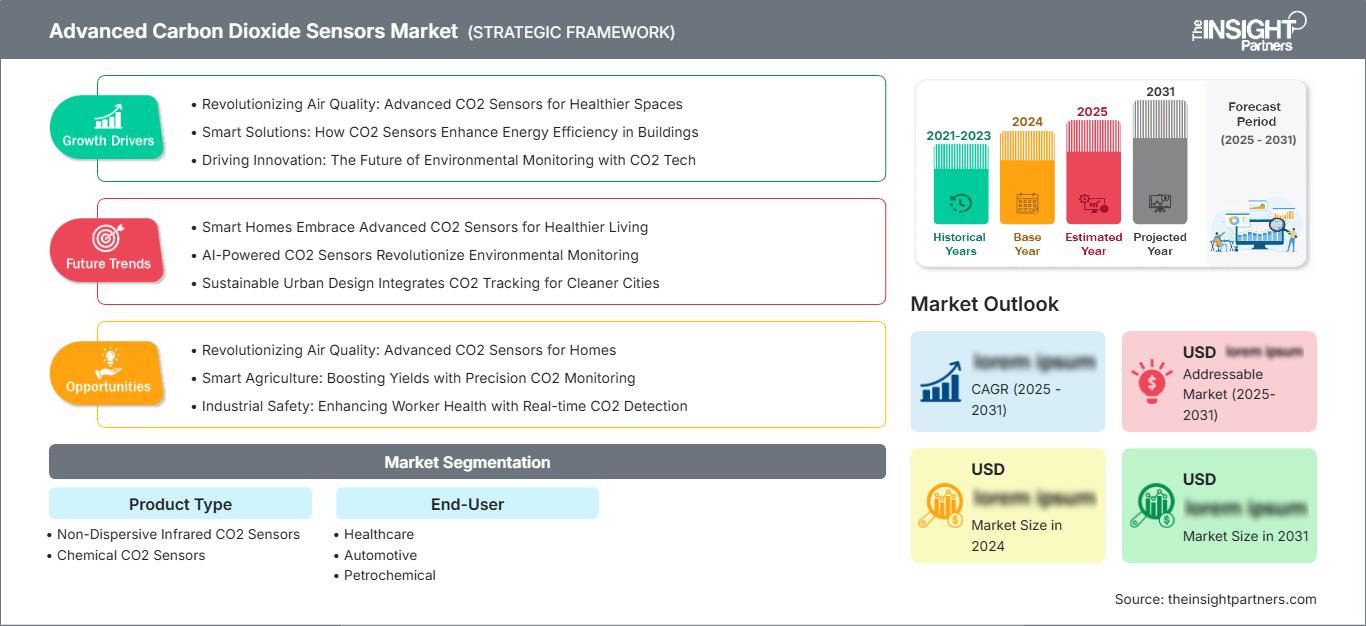
Advanced Carbon Dioxide Sensors Market: Strategic Insights
Regional Insights
North America Advanced Carbon Dioxide (CO2) Sensors Market
North America holds 28–32% share in 2025 and is projected to grow at a CAGR of 5.7–6.1% during 2026–2034. Demand is supported by commercial building automation, school ventilation upgrades, healthcare monitoring, laboratory safety, and cold-chain infrastructure. ASHRAE guidance has reinforced the need for accurate sensor placement, calibration, and interpretation, making specification quality important in procurement.
The region’s market share is strengthened by established HVAC contractors, facility management platforms, and medical technology buyers. Building owners are using CO2 data to adjust outdoor air intake, reduce wasted conditioning energy, and document air quality conditions. Industrial adoption remains steady in petrochemical plants, breweries, greenhouses, warehouses, and confined-space safety programs.
U.S. Advanced Carbon Dioxide (CO2) Sensors Market
U.S. constitutes 78-82% of North America's requirement in 2025 and will have a CAGR of 5.8-6.2%. The use of the BMS system is prominent in institutions like schools, hospitals, universities, office buildings, labs, data centers, and industries. Companies like Honeywell International Inc., Johnson Controls International plc, Amphenol Corporation, and Siemens AG cater to the local requirements for this purpose.
Application trends are moving from simple alarm points toward continuous monitoring linked with ventilation analytics and maintenance dashboards. Healthcare demand is reinforced by respiratory care, emergency rooms, surgical suites, and neonatal equipment. The Advanced Carbon Dioxide (CO2) Sensors Market size in the U.S. also benefits from public-sector retrofit spending, workplace safety programs, and customer preference for serviceable, documented sensor systems.
Europe Advanced Carbon Dioxide (CO2) Sensors Market
Europe accounts for 24–28% share in 2025 in the Advanced Carbon Dioxide (CO2) Sensors Market Forecast and is projected to grow at a CAGR of 5.3–5.7%. Germany is the leading country because industrial automation, automotive production, laboratories, and energy-efficient commercial buildings create broad demand. Suppliers benefit from strict product quality expectations, building performance policies, and procurement practices that value documented calibration and long-term sensor stability.
The UK market is shaped by education estates, healthcare infrastructure, offices, and public buildings, where indoor air quality has become a management priority. Demand is supported by retrofits, wireless monitoring, and integration with building management systems. France adds healthcare, food processing, and smart-building demand, while Italy and Spain contribute through hospitality, industrial facilities, and climate-sensitive ventilation needs.
European buyers often evaluate the Advanced Carbon Dioxide (CO2) Sensors Market trends through energy performance, sustainability reporting, and occupant comfort objectives. Siemens AG, SICK AG, E+E Elektronik Ges.m.b.H., and Vaisala Oyj are well-positioned because regional customers emphasize technical documentation, reliability, and compatibility with automation standards. Replacement demand should rise as older building stock is modernized.
APAC Advanced Carbon Dioxide (CO2) Sensors Market
Asia Pacific holds 30–34% share in 2025 and is projected to grow at a CAGR of 6.8–7.2%. China leads regional demand through electronics manufacturing, commercial buildings, hospitals, factories, and environmental monitoring infrastructure.
Japan and South Korea contribute through automotive cabins, precision manufacturing, medical devices, semiconductor facilities, and indoor environmental control. India is expanding through hospitals, IT parks, metro projects, schools, and local building automation adoption.
Australia remains important for commercial ventilation, mining safety, laboratories, and education facilities. Policy interest in energy-efficient buildings and healthier indoor environments supports the Advanced Carbon Dioxide (CO2) Sensors Market growth outlook across the region.
Middle East & Africa Advanced Carbon Dioxide (CO2) Sensors Market
CAGR for the Middle East & Africa market is projected to be 5.1%-5.5%. The Middle East & Africa market will be driven by Saudi Arabia, owing to smart city initiatives, hospitals, petrochemical plants, and large-scale commercial building projects where automation of the ventilation system is required.
UAE will contribute to growth through airports, hotels, healthcare establishments, offices, and highly efficient buildings. In South Africa, growth will be contributed by mining, industry safety, universities, and hospitals, where monitoring of gases and reliable ventilation systems is a key need.
MEA rest demand will remain project-driven in nature, and is likely to involve imports of building systems, energy infrastructure, and safety upgrades in industries.
Segmentation Analysis
Product Type
The product type segment is anticipated to register a CAGR of 5.8% to 6.2% in 2026-2034. The demand drivers for the market include the need for accuracy, speed of response, calibration stability, cost of operation, energy consumption, and environmental factors. The leading technology of choice for the mainstream market is NDIR due to its repeatability in different settings, including buildings, medical devices, and industries.
- Non-Dispersive Infrared CO2 Sensors: The sub-segment is at the most advantageous position due to its capability to offer reliable, selective, and easy-to-maintain measurement in various applications such as HVAC control, medical applications, automotive interiors, greenhouses, and industrial safety applications.
- Chemical CO2 Sensors: The sub-segment is suitable for applications requiring cost-effectiveness, compactness, or simple electronics, but suffers from problems of drift, humidity sensitivity, and limited life cycle.
End-User
The end-user segment is expected to grow at a CAGR of 6.2–6.6% during 2026–2034. Adoption varies by operating risk and economic benefit. Building automation leads volume because CO2 sensors enable occupancy-based ventilation, while healthcare, automotive, petrochemical, and industrial users prioritize precision, safety, or controlled atmospheres. The market growth is strongest where measurement data directly affects comfort, compliance, energy use, or clinical decisions.
- Health care: The demand will be driven by applications of capnography, anesthesia delivery, incubators, respiratory assistance, and hospital ventilation systems, where CO2 sensing allows clinicians to measure the status of the patients and performance of the equipment.
- Automotive: Demand will see an increase for applications of cabin air quality, passenger comfort, ventilation optimization, and electric vehicle thermal management as auto manufacturers incorporate more environmental sensors into the connected cabins.
- Petrochemicals: This sub-segment employs CO2 sensing for confined space monitoring, safety of process, gas leakages, and environmental controls within the refineries, chemical plants, storage facilities, and maintenance facilities.
- Building automation and domestic appliances: The demand in this segment will be driven by the application of smart HVAC, air purifiers, ventilation, classrooms, office, and smart thermostats using CO2 sensing to manage airflow.
- Industries: These include applications of food and beverages, cold storage, greenhouses, fermentations, manufacturing safety, and warehouses.
Opportunity Snapshot
| End-User | Revenue Contribution | Trend Tag | Adoption Stage |
| Healthcare | High | Respiratory Care | Scaling |
| Automotive | Medium | Cabin Sensing | Scaling |
| Petrochemical | Medium | Safety Monitoring | Mature |
| Building Automation and Domestic Appliances | High | Smart Ventilation | Mature |
| Industrial | High | Process Control | Scaling |
Advanced Carbon Dioxide Sensors Market Growth Drivers and Impact Analysis
Indoor Air Quality Moving into Building Operations
The quality of indoor air has changed from being a matter of comfort to an operational measure for educational institutions, office spaces, hospitals, and public buildings. The use of carbon dioxide measurements allows one to understand the level of occupancy and the efficiency of ventilation based on temperature, humidity, filtration, and system performance. The effect on the market will be an increased need for wall-mounted, duct-mounted, and wireless sensors integrated into the building management system.
Healthcare and Respiratory Monitoring Expansion
There is an increasing need for healthcare as there will be increasing needs for measuring carbon dioxide levels from breathing, as well as controlling air around the equipment at hospitals, ambulatory care settings, and manufacturers of home-care equipment. Capnography, anesthesia, neonatal care, and respiratory therapy rely on predictable response times and traceable performance. The implication for the market is the need for increased precision, partnering with Original Equipment Manufacturers (OEMs), and high standards of manufacturing processes for medical applications.
Energy-Efficient Ventilation and Smart HVAC Integration
Energy-efficiency pressure is driving facilities to ventilate based on actual occupancy rather than fixed schedules. CO2 sensors enable demand-controlled ventilation by allowing systems to increase outdoor air when occupancy rises and reduce airflow when spaces are underused. The impact is measurable because ventilation and air conditioning are major building energy loads, especially in hot or cold climates. This driver supports integration with smart thermostats, variable air volume systems, cloud dashboards, and predictive maintenance platforms. It also strengthens the Advanced Carbon Dioxide (CO2) Sensors Market share in commercial buildings.
Advanced Carbon Dioxide Sensors Market Future Trends
Multi-Parameter Indoor Environmental Sensing
Future products will be more likely to consolidate carbon dioxide levels, temperature, humidity, dust particles, VOCs, noise, light, and occupancy into one device. This will simplify the installation process and prevent organizations from relying too much on one signal type. It will allow sensors to detect overcrowding, bad ventilation, pollutant incidents, and mechanical errors using algorithms. In addition, the development provides chances for companies that have the ability to produce software, calibrate sensors, and connect devices.
Lower-Power Sensors for Wireless and Portable Devices
Small NDIR modules and firmware optimization would lead to an increased use of room monitors, portable monitors, portable safety equipment, and consumer air quality monitors in wireless form. Consumers prefer flexible placement because wiring can prove costly in old buildings, leased offices, school facilities, and temporary locations. Better battery life would allow the use of more sensors within a property, thus resulting in better information for maintenance and ventilation purposes. The market move would work to the advantage of firms that combine low drift, compact optics, and communication technology.
Advanced Carbon Dioxide Sensors Market Opportunities
Retrofit Programs for Schools and Public Buildings
The retrofits in schools, universities, city administrations, and health care campuses create an excellent chance, since the majority of these facilities continue to function with old-style systems or have no immediate visibility of their air quality status. The vendors can focus on combined packages, which involve sensors, gateways, commissioning, dashboards, and service. The path forward would be to collaborate with HVAC companies, ESCOs, and public procurement departments. Good solutions will require simple deployment, accurate calibration, clear signaling, and proven ventilation efficiency gains.
Automotive Cabin Air Quality Platforms
Automotive cabin sensing offers a growing opportunity as manufacturers differentiate vehicles through comfort, health, and energy efficiency. CO2 measurement can support recirculation control, passenger comfort, drowsiness-related ventilation strategies, and electric vehicle HVAC optimization. Suppliers should pursue design wins with compact, vibration-resistant, low-power modules that meet automotive qualification requirements. The opportunity is particularly attractive in premium vehicles, electric platforms, and shared mobility fleets where interior air monitoring can be integrated into broader digital cockpit and climate-control systems.
Recent Developments
- April 2026: Accuenergy Inc. announces the launch of the AcuCO2TM DM Series expanding its existing BAS sensors. The new carbon dioxide sensors are designed to monitor CO2 levels within the ductwork of an HVAC system, supporting improved ventilation control, Indoor Air Quality (IAQ), and energy efficiency in modern Building Automation Systems (BAS).
- January 2026: Senseair, Swedish subsidiary of Asahi Kasei Microdevices, has developed the “S12 CO2” as a next-generation CO2 sensor for demand-controlled ventilation (DCV) in zero-energy buildings and battery-powered indoor air quality (IAQ) monitoring.
- February 2025: EQUIGAS, a leading distributor of high-quality gas equipment, proudly announces its partnership with Gaslab, a CO2Meter company, who is a globally trusted provider of gas safety monitoring and analytical devices. This collaboration marks an exciting milestone as EQUIGAS expands its product portfolio to include the Gaslab industrial fixed gas detection safety line. This addition specifically strengthens EQUIGAS’ commitment to protecting its customers and partners working near hazardous gases across industrial, medical, manufacturing, and specialty gas markets.
Frequently Asked Questions

- Comprehensive Market Sizing and Forecast Analysis
- Detailed Segmentation Analysis
- In-Depth Market Dynamics Assessment
- Regional and Country-Level Insights
- Competitive Landscape and Company Benchmarking
- Strategic Business Intelligence
Recent Reports
Testimonials

The Insight Partners' SCADA System Market report is comprehensive, with valuable insights on current trends and future forecasts. The team was highly professional, responsive, and supportive throughout. We are very satisfied and highly recommend their services.
RAN KEDEM Partner, Reali Technologies LTDs
I requested a report on a very specific software market and the team produced the report in a few days. The information was very relevant and well presented. I then requested some changes and additions to the report. The team was again very responsive and I got the final report in less than a week.
JEAN-HERVE JENN Chairman, Future Analytica
We worked with The Insight Partners for an important market study and forecast. They gave us clear insights into opportunities and risks, which helped shape our plans. Their research was easy to use and based on solid data. It helped us make smart, confident decisions. We highly recommend them.
PIYUSH NAGPAL Sr. Vice President, High Beam Global
The Insight Partners delivered insightful, well-structured market research with strong domain expertise. Their team was professional and responsive throughout. The user-friendly website made accessing industry reports seamless. We highly recommend them for reliable, high-quality research services
YUKIHIKO ADACHI CEO, Deep Blue, LLC.
This is the first time I have purchased a market report from The Insight Partners.While I was unsure at first, I visited their web site and felt more comfortable to take the risk and purchase a market report.I am completely satisfied with the quality of the report and customer service. I had several questions and comments with the initial report, but after a couple of dialogs over email with their analyst I believe I have a report that I can use as input to our strategic planning process.Thank you so much for taking the extra time and making this a positive experience.I will definitely recommend your service to others and you will be my first call when we need further market data.
JOHN SUZUKI President and Chief Executive Officer, Board Director, BK Technologies
I wish to appreciate your support and the professionalism you displayed in the course of attending to my request for information regarding to infectious disease IVD market in Nigeria. I appreciate your patience, your guidance, and the fact that you were willing to offer a discount, which eventually made it possible for us to close a deal. I look forward to engaging The Insight Partners in the future, all thanks to the impression you have created in me as a result of this first encounter.
DR CHIJIOKE ONYIA MANAGING DIRECTOR, PineCrest Healthcare Ltd.Reason to Buy
- Informed Decision-Making
- Understanding Market Dynamics
- Competitive Analysis
- Identifying Emerging Markets
- Customer Insights
- Market Forecasts
- Risk Mitigation
- Boosting Operational Efficiency
- Strategic Planning
- Investment Justification
- Tracking Industry Innovations
- Aligning with Regulatory Trends





 Get Free Sample for