
Advanced Fuel Cell Market Share, Size & Demand by 2034
Coverage: by Type (Proton Exchange Membrane Fuel Cells (PEMFC), Alkaline (AFC), Phosphoric Acid (PAFC), Molten Carbonate (MCFC), Others); Application (Transportation, Stationary, Others) , and Geography (North America, Europe, Asia Pacific, and South and Central America)
- Status : Data Released
- Report Code : TIPRE00029456
- Category : Electronics and Semiconductor
- No. of Pages : 150
- Available Report Formats :


- Last update date : July 09, 2026


2025 Market Size
US$ 6.02 Bn
Base year value
2034 Forecast
US$ 16.02 Bn
Projected by 2034
CAGR 2026-2034
11.49 %
Growth rate
Addressable Market
US$ 97.05 Bn
(2026-2034)
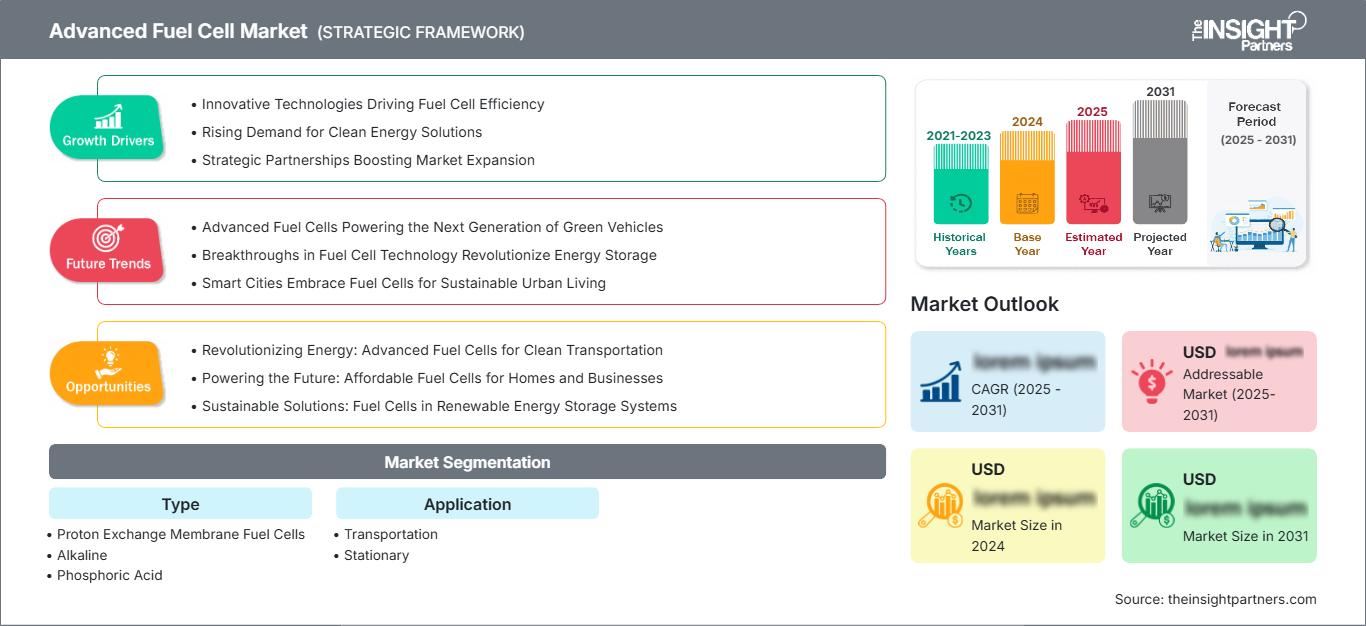
The Advanced Fuel Cell Market was valued at US$ 6.02 Billion in 2025 and is projected to reach US$ 16.02 Billion by 2034, registering a CAGR of 11.49% from 2026 to 2034. The market is moving from demonstration-led deployment toward commercial scaling across transportation and stationary power as hydrogen policy, fleet decarbonization, and resilient distributed energy requirements converge.
North America is expected to expand at a 10.2%–11.0% CAGR, supported by hydrogen production incentives, heavy-duty fleet pilots, and data center interest in low-emission backup power. US federal clean hydrogen tax credits, California refueling corridors, and Canadian zero-emission transit procurement are strengthening regional demand for proton exchange membrane systems and stationary modules, supporting the Advanced Fuel Cell Market share growth across the region.
Advanced Fuel Cell Market Assessment and Insights
- North America: The region accounted for 24%–28% share in 2025 and is growing at a 10.2%–11.0% CAGR between 2026–2034, supported by fleet decarbonization, hydrogen hubs, and stationary power resilience.
- US: The US represented 76%–82% of North America in 2025 and is growing at a 10.4%–11.2% CAGR between 2026–2034, led by transit, logistics, and backup power adoption.
- Europe: Europe held 25%–30% share in 2025 and is growing at a 9.8%–10.6% CAGR between 2026–2034, led by Germany, France, the UK, Italy, and Spain.
- Asia Pacific: Asia Pacific held 36%–41% share in 2025 and is growing at an 11.8%–12.7% CAGR between 2026–2034, led by China, Japan, South Korea, India, and Australia.
- Largest Segment: Proton Exchange Membrane Fuel Cells held 58%–64% market share in 2025 and are growing at an 11.4%–12.2% CAGR between 2026–2034 due to mobility and backup power suitability.
- High Growth Segment: Transportation held 50%–56% market share in 2025 and is growing at a 12.1%–13.0% CAGR between 2026–2034, driven by buses, trucks, rail, and marine pilots.
- Key companies analyzed in detail: Plug Power Inc., Ballard Power Systems Inc., Nuvera Fuel Cells, LLC, Panasonic Holdings Corporation, Nedstack Fuel Cell Technology B.V., Shanghai Shenli Technology Co., Ltd., Altergy Systems, Horizon Fuel Cell Technologies Pte. Ltd., Sunrise Power Co., Ltd., Vision Group, Bloom Energy Corporation, Doosan Fuel Cell Co., Ltd.
Source: The Insight Partners' analysis based on proprietary research, government publications, company annual reports, investor presentations, industry databases, and expert interviews.
The Advanced Fuel Cell Market has evolved from laboratory validation and subsidy-led pilots into a more disciplined commercialization phase shaped by stack durability, hydrogen purity, thermal management, and balance-of-plant integration. PEM systems dominate mobility because they start quickly and operate at lower temperatures, while phosphoric acid and molten carbonate systems remain relevant for continuous stationary power. Production dynamics increasingly emphasize automated stack assembly, membrane cost reduction, catalyst loading optimization, and service models that reduce total ownership cost.
Forward demand will be shaped by hydrogen corridors, industrial decarbonization policies, and resilient electricity needs in markets with constrained grids. The Advanced Fuel Cell Market report highlights how the market scope is widening as transport operators, utilities, data centers, ports, and remote industries test systems that reduce diesel dependence. Investment is expected to concentrate in Asia Pacific manufacturing clusters, European hydrogen valleys, and North American clean hydrogen hubs where policy support and end-use demand are aligned.
Advanced Fuel Cell Market Report Scope
| Report Attribute | Details |
|---|---|
| Market size in 2025 | US$ 6.02 Billion |
| Market Size by 2034 | US$ 16.02 Billion |
| Global CAGR (2026 - 2034) | 11.49% |
| Historical Data | 2021-2024 |
| Forecast period | 2026-2034 |
Advanced Fuel Cell Market Analysis
Demand is anchored in zero-emission heavy mobility, distributed power, and backup systems for sites where diesel replacement has measurable environmental and operational value. The Advanced Fuel Cell Market benefits from hydrogen strategies tracked by the International Energy Agency, which reported more than 200 committed low-emissions hydrogen investments in 2025, although cost and infrastructure barriers remain important.
Membrane suppliers, catalyst companies, stack makers, hydrogen storage, power electronics companies, integrators, refuelers, and service partners constitute the value chain. While improved dynamics in the value chain are becoming possible due to module-based designs, localization, and automation, there are other factors, such as exposure to platinum group metals, hydrogen, and certifications, that affect the cost and deployment of fuel cells. According to the Advanced Fuel Cell Market forecast, further progress in manufacturing efficiencies, value chain localization, and hydrogen infrastructures will lead to increased commercialization and deployment of advanced fuel cells.
The competitive environment is defined by specialization as opposed to domination by one model. The association between Plug Power Inc., fuel cells, hydrogen generation, and hydrogen delivery, Ballard Power Systems Inc. with heavy duty PEM, Panasonic Holdings Corporation with residential and stationary uses, and Bloom Energy Corporation and Doosan Fuel Cell Co., Ltd. with stationary power.
Investment trends favor platforms that can move from pilots to repeatable deployments. Nuvera Fuel Cells, LLC, Nedstack Fuel Cell Technology B.V., Shanghai Shenli Technology Co., Ltd., Altergy Systems, Horizon Fuel Cell Technologies Pte. Ltd., Sunrise Power Co., Ltd., and Vision Group are positioning around stack reliability, application-specific integration, and partnerships. The advanced fuel cell market size growth is supported by buyers prioritizing lifecycle assurance, hydrogen access, and service responsiveness.
● REPORT CUSTOMIZATION
Tailor This Report To Align With Your Specific Business Requirements
This report can be customized to align precisely with your business objectives, scope, and target markets. Customization options include tailored segmentation, geography, competitive analysis, and strategic insights to support informed decision-making.
Customize This Report →WHAT YOU CAN ADJUST
- ● Segmentations
- ● Geography
- ● Competitive Analysis
- ● Language Preferences
Advanced Fuel Cell Market: Strategic Insights
Regional Insights
North America Advanced Fuel Cell
North America held 24%–28% share in 2025 and is growing at a 10.2%–11.0% CAGR between 2026–2034. The Advanced Fuel Cell Market benefits from hydrogen hub funding, state zero-emission vehicle rules, airport ground support electrification, warehouse material handling, and growing interest in fuel cells for backup power at critical facilities.
The level of policy visibility is high for the United States, while Canada is involved in transit procurement, clean fuel standards, and hydrogen production initiatives. Stationary applications are growing in areas where resiliency and emissions regulations are important considerations, while transportation applications are limited to buses, heavy-duty trucks, ports, and logistics corridors.
U.S. Advanced Fuel Cell Market
The US represented 76%–82% of North America in 2025 and is growing at a 10.4%–11.2% CAGR between 2026–2034. Demand is supported by clean hydrogen production incentives, transit fleet replacement, port decarbonization, material handling, and standby power for facilities that need long-duration reliability.
Company presence is broad across hydrogen supply, PEM stacks, stationary systems, and integration. Plug Power Inc., Ballard Power Systems Inc., Nuvera Fuel Cells, LLC, Altergy Systems, and Bloom Energy Corporation support different use cases. Transportation leads early revenue, while stationary applications are gaining attention from data centers, telecom, hospitals, and utility microgrids. Advanced Fuel Cell Market trends indicate growing interest in reliable, low-emission power solutions, supported by expanding hydrogen infrastructure, technological advancements, and increasing adoption across critical backup and distributed energy applications.
Europe Advanced Fuel Cell Market
Europe held 25%–30% share in 2025 and is growing at a 9.8%–10.6% CAGR between 2026–2034. Germany is the leading country because automotive suppliers, bus programs, rail trials, and industrial hydrogen clusters create stronger links between fuel cell manufacturing, system integration, and end-use demand.
The United Kingdom builds demand with buses, backup power, and industrial clusters, whereas Germany stays at the center of stack technology and mobility systems. Funding, emission standards, and hydrogen valleys drive more repeatable projects than demonstration projects.
France, Italy, and Spain contribute via rail, ports, stationary power, and hydrogen corridors. France capitalizes on a hydrogen strategy, Italy on industrial and transport use of hydrogen, and Spain on renewable hydrogen production, logistics corridors, and port pilot projects.
APAC Advanced Fuel Cell Market
Asia Pacific held 36%–41% share in 2025 and is growing at an 11.8%–12.7% CAGR between 2026–2034. China is the leading country because bus fleets, heavy trucks, industrial parks, and domestic stack manufacturing create scale advantages.
Japan and South Korea support residential, stationary, and mobility deployment through long-running hydrogen roadmaps. India is moving from pilots toward bus, rail, and industrial hydrogen programs, while Australia connects fuel cells with mining, remote power, and renewable hydrogen export strategies. The Advanced Fuel Cell Market continues to benefit from these regional initiatives, which are accelerating commercialization and deployment across diverse end-use sectors.
Industrial policy, local manufacturing, and air-quality regulation make APAC the strongest volume opportunity. Advanced Fuel Cell growth is reinforced by public procurement, port logistics, and power resilience needs, where diesel displacement is financially and environmentally measurable.
Middle East & Africa Advanced Fuel Cell Market
Middle East & Africa is growing at a 10.8%–11.7% CAGR between 2026–2034. Saudi Arabia is the leading country, supported by green hydrogen megaprojects, industrial diversification, and power needs across remote energy, logistics, and infrastructure sites. The Advanced Fuel Cell Market is benefiting from these initiatives, which are accelerating hydrogen adoption and fuel cell deployment across the region.
While the UAE is exploring hydrogen mobility, ports, and energy, Saudi Arabia is the focus for the region in terms of exports and hydrogen strategy. Fuel cell applications in stationary settings include telecom, industrial areas, and critical infrastructure that have challenges with the grid or logistical limitations using diesel.
Demand from South Africa and the other MEA nations comes from mining operations, remote energy supply, telecom backup power, and public transport demonstrations. The Advanced Fuel Cell Market is moving forward within these applications, although the ability to source hydrogen, funding, and local maintenance partnerships are key to success.
Segmentation Analysis
Type
The Type segment is growing at a 10.9%–11.8% CAGR between 2026–2034. Demand is led by PEM systems because mobility users require fast start, high power density, and compact integration. Alkaline systems remain relevant where cost-sensitive hydrogen purity conditions are manageable, while phosphoric acid and molten carbonate units address stationary power applications requiring continuous operation, heat recovery, and grid support. The Advanced Fuel Cell Market continues to benefit from the expanding adoption of these technologies across transportation and stationary power applications.
- Proton Exchange Membrane Fuel Cells: PEM fuel cell systems have the most prominent place in the market owing to their need for compact stacks, fast response, and versatility in buses, trucks, forklifts, backup power, and marine pilots.
- Alkaline: Alkaline fuel cell systems are ideal for special uses in stationary applications and environments with low catalyst costs and efficient electrochemistry, making up for their sensitivity to carbon dioxide and fuel purity.
- Phosphoric Acid: Phosphoric acid fuel cell systems have an essential strategic importance for use in commercial facilities, hospitals, and combined heat and power plants.
- Molten Carbonate: Molten carbonate fuel cells are needed for bigger stationary applications with fuel flexibility and higher temperatures.
Application
The Application segment is growing at an 11.5%–12.4% CAGR between 2026–2034. Transportation leads because fleets can aggregate hydrogen demand, schedule refueling, and justify infrastructure investment through high utilization. Stationary applications are expanding where long-duration backup, clean baseload, microgrid resilience, and combined heat and power provide economic value beyond emissions reduction. The Advanced Fuel Cell Market is supported by rising adoption across both transportation and stationary applications as organizations seek reliable, low-emission energy solutions.
- Transportation: Transportation demand is concentrated in buses, heavy trucks, forklifts, rail, marine, and port equipment, where batteries face payload, charging-time, or utilization constraints.
- Stationary: Stationary demand is strongest in data centers, telecom, hospitals, commercial buildings, industrial sites, and microgrids requiring reliable power with lower emissions and reduced diesel dependence.
Opportunity Snapshot
| Application | Revenue Contribution | Trend Tag | Adoption Stage |
| Transportation | High | Fleet Hydrogen | Scaling |
| Stationary | Medium | Resilient Power | Scaling |
Advanced Fuel Cell Market Growth Drivers and Impact Analysis
Hydrogen Policy and Infrastructure Funding
Hydrogen policy is a central driver because fuel cell adoption depends on coordinated supply, refueling, certification, and end-use demand. The Advanced Fuel Cell Market is benefiting from supportive hydrogen strategies and investment frameworks. The International Energy Agency observed in 2025 that low-carbon hydrogen was transitioning from its demonstration phase to having more than 200 investment commitments, although not without stressing how uneven deployment continues to be. And this means that, from a market perspective, developments that can align the hydrogen supply and the fleet demand are going much faster than any isolated pilot project will, since the latter is faced with financial constraints and a lack of usage. Hence, the penetration rate of the Advanced Fuel Cell into the markets for clean transportation and distributed power generation is fastest where incentives for hydrogen production coincide with fleets.
Heavy-Duty Transport Decarbonization
The need for heavy transport is driving growth, since fuel cells can be used in situations in which battery technologies struggle with the time needed to charge, the distance covered, and weight. Transit buses, long-distance trucks, port trucking, trains, and marine transport form consistent fueling habits that make station profitability more likely. The industry impact consists of increased purchases of proton exchange membranes, hydrogen storage, thermal management, and services related to fleet operations. Fleet owners will consider the costs of using facilities, maintenance cycles, and meeting regulations for emissions.
Demand for Resilient Low-Emission Stationary Power
The stationary power market is growing as data centers, hospitals, telecommunications networks, campuses, and industries look for alternatives to diesel backup generators and unreliable grid electricity supply. Fuel cells may supply clean, quieter, and modular power, especially when combined with hydrogen, renewable gas, or CHP solutions. The advanced fuel cell market implications include a wider customer portfolio outside the transportation industry, thus diversifying revenue streams for the players. Customers consider parameters such as availability, permits, fuel availability, heat recovery, and services. This increases demand for phosphoric acid and molten carbonate fuel cell technology, along with PEM cells used for backup or microgrid applications.
Advanced Fuel Cell Market Future Trends
Lower Catalyst Loading and Longer Stack Life
One of the upcoming trends is the move towards lower catalyst loadings, extended stack lifetime, and standardization of the modules. With increased pressure on suppliers to deliver commercial warranties, rather than just pilot performance promises, there will be a need to enhance membrane longevity, water handling, and degradation detection. This will change the Advanced Fuel Cell trends by shifting the focus of competition away from efficiency and onto the economics of the process throughout the whole lifecycle.
Integrated Hydrogen Ecosystems Around Anchor Customers
Fuel cell deployment will increasingly cluster around anchor customers that can justify hydrogen production, storage, and refueling infrastructure. Ports, logistics parks, bus depots, airports, industrial estates, and data center campuses provide repeat demand and easier operational control. This trend reduces the risk of underused refueling assets and supports multi-application hydrogen hubs. Advanced Fuel Cell Market participants will need to offer more than stacks, including fuel contracts, maintenance, monitoring, and financing support. Integrated ecosystems should accelerate commercialization by improving utilization and lowering customer adoption friction.
Advanced Fuel Cell Market Opportunities
Fleet-Based Hydrogen Mobility Corridors
Fleet-based hydrogen mobility corridors offer a clear opportunity because they connect predictable vehicle routes with refueling demand. Bus agencies, port operators, logistics fleets, and rail users can aggregate volume and support bankable infrastructure. Suppliers should target customers with high daily utilization, depot refueling, emissions mandates, and limited charging downtime. The opportunity is strongest where public funding reduces initial station risk and fleet operators sign long-term service agreements. Companies that integrate fuel supply, maintenance, stack monitoring, and training can capture more value than hardware-only providers. The Advanced Fuel Cell Market is expected to benefit from these developments as hydrogen mobility ecosystems continue to expand.
Stationary Power for Data Centers and Critical Facilities
Data centers and critical facilities create an investment opportunity because uptime, emissions, and permitting constraints are becoming more important. Fuel cells can provide modular backup or primary power with lower local pollutants than diesel generators and quieter operation for urban sites. Buyers will evaluate fuel availability, redundancy design, service response, and compatibility with microgrids. Vendors should prioritize standardized stationary modules, long-term service contracts, and partnerships with hydrogen suppliers or renewable gas providers. This opportunity can diversify revenue beyond mobility and improve resilience-focused procurement pipelines.
Recent Developments
- April 2025: Hyundai Motor unveiled the all-new Hyundai NEXO fuel cell electric SUV with a bold “Art of Steel” design and improved hydrogen technology. The vehicle features a next-generation fuel cell system with higher output, improved efficiency, and better cold-weather performance. It targets an over 700 km driving range and faster acceleration compared to the previous model. The launch highlights Hyundai’s continued push to expand hydrogen mobility globally.
- April 2025: Hyundai introduced the next-generation Hyundai NEXO FCEV at the Seoul Mobility Show with an enhanced design and upgraded hydrogen powertrain.
It is built on a redesigned fuel cell stack with increased durability and improved energy density. The SUV includes advanced driver assistance systems and improved interior space and comfort. Hyundai emphasized its long-term commitment to hydrogen alongside BEV development. - April 2026: A new fuel cell system for heavy-duty vehicles was launched to advance hydrogen-powered commercial transport. The system focuses on higher efficiency, durability, and scalability for trucks and industrial vehicles. It aims to reduce emissions in sectors that are difficult to electrify using batteries alone. The launch supports wider adoption of hydrogen technology in logistics and freight applications.
Frequently Asked Questions

- Comprehensive Market Sizing and Forecast Analysis
- Detailed Segmentation Analysis
- In-Depth Market Dynamics Assessment
- Regional and Country-Level Insights
- Competitive Landscape and Company Benchmarking
- Strategic Business Intelligence
Recent Reports
Testimonials

The Insight Partners' SCADA System Market report is comprehensive, with valuable insights on current trends and future forecasts. The team was highly professional, responsive, and supportive throughout. We are very satisfied and highly recommend their services.
RAN KEDEM Partner, Reali Technologies LTDs
I requested a report on a very specific software market and the team produced the report in a few days. The information was very relevant and well presented. I then requested some changes and additions to the report. The team was again very responsive and I got the final report in less than a week.
JEAN-HERVE JENN Chairman, Future Analytica
We worked with The Insight Partners for an important market study and forecast. They gave us clear insights into opportunities and risks, which helped shape our plans. Their research was easy to use and based on solid data. It helped us make smart, confident decisions. We highly recommend them.
PIYUSH NAGPAL Sr. Vice President, High Beam Global
The Insight Partners delivered insightful, well-structured market research with strong domain expertise. Their team was professional and responsive throughout. The user-friendly website made accessing industry reports seamless. We highly recommend them for reliable, high-quality research services
YUKIHIKO ADACHI CEO, Deep Blue, LLC.
This is the first time I have purchased a market report from The Insight Partners.While I was unsure at first, I visited their web site and felt more comfortable to take the risk and purchase a market report.I am completely satisfied with the quality of the report and customer service. I had several questions and comments with the initial report, but after a couple of dialogs over email with their analyst I believe I have a report that I can use as input to our strategic planning process.Thank you so much for taking the extra time and making this a positive experience.I will definitely recommend your service to others and you will be my first call when we need further market data.
JOHN SUZUKI President and Chief Executive Officer, Board Director, BK Technologies
I wish to appreciate your support and the professionalism you displayed in the course of attending to my request for information regarding to infectious disease IVD market in Nigeria. I appreciate your patience, your guidance, and the fact that you were willing to offer a discount, which eventually made it possible for us to close a deal. I look forward to engaging The Insight Partners in the future, all thanks to the impression you have created in me as a result of this first encounter.
DR CHIJIOKE ONYIA MANAGING DIRECTOR, PineCrest Healthcare Ltd.Reason to Buy
- Informed Decision-Making
- Understanding Market Dynamics
- Competitive Analysis
- Identifying Emerging Markets
- Customer Insights
- Market Forecasts
- Risk Mitigation
- Boosting Operational Efficiency
- Strategic Planning
- Investment Justification
- Tracking Industry Innovations
- Aligning with Regulatory Trends





 Get Free Sample for