
Aerated Candy Market Size, Trends & Growth by 2034
Coverage: By Category (Sugar-Free, Conventional); Flavor (Plain, Flavored); Distribution Channel (Supermarkets and Hypermarkets, Convenience Stores, Online Retail, Others) , and Geography (North America, Europe, Asia Pacific, and South and Central America)
- Status : Data Released
- Report Code : TIPRE00011260
- Category : Food and Beverages
- No. of Pages : 150
- Available Report Formats :


- Last update date : August 04, 2026


2025 Market Size
US$ 746.38 Mn
Base year value
2034 Forecast
US$ 1,010.24 Mn
Projected by 2034
CAGR 2026-2034
3.86 %
Growth rate
Addressable Market
US$ 8,156.78 Mn
(2026-2034)
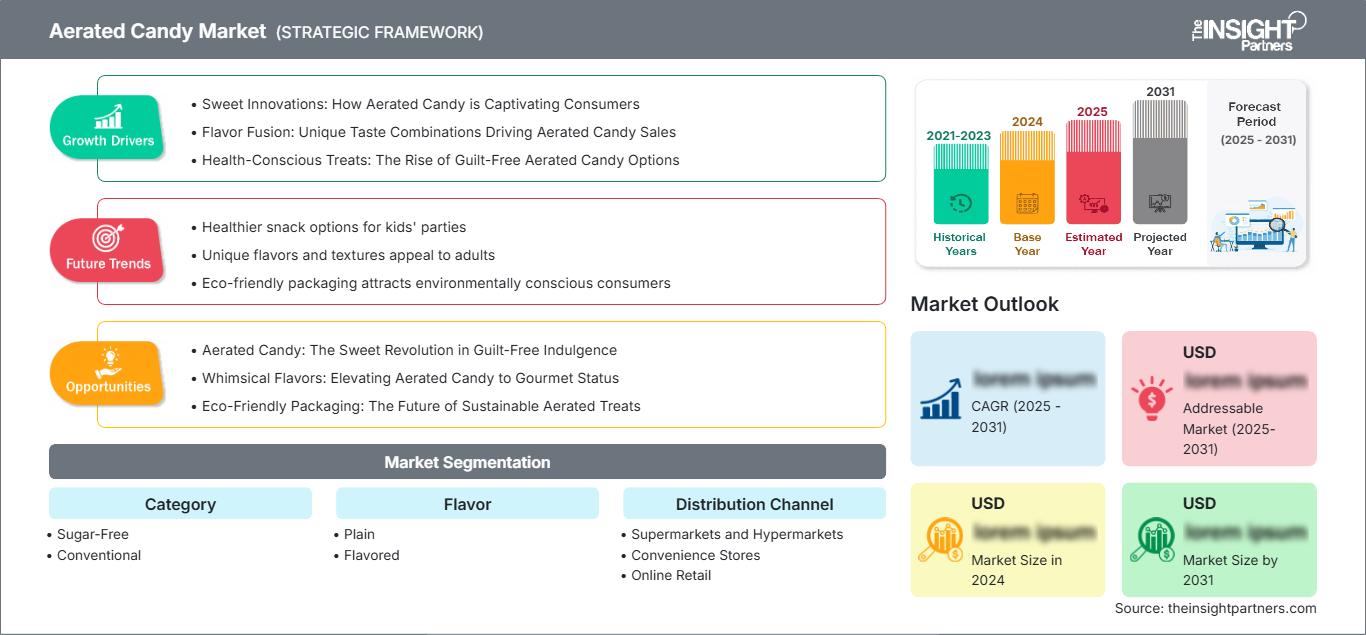
The aerated candy market was valued at US$ 746.38 Million in 2025 and is projected to reach US$ 1,010.24 Million by 2034, registering a CAGR of 3.86% during 2026–2034. The market continues to benefit from sustained consumer demand for texture-driven confectionery products that combine visual appeal, unique mouthfeel, and flavor variety. Manufacturers are expanding product portfolios through innovative aeration processes, premium ingredients, and evolving packaging technologies that preserve product quality during distribution.
Within North America, the aerated candy market size is supported by high per-capita confectionery consumption, strong retail penetration, and continuous product innovation. The regional market is anticipated to expand at a CAGR ranging between 3.4% and 4.2% through 2034. Growth is reinforced by increasing consumer interest in premium confectionery experiences, strategic product launches, and expanding availability of reduced-sugar variants across organized retail networks.
Aerated Candy Market Assessment and Insights
- North America: Accounted for 34%–38% share in 2025 and is projected to grow at a CAGR of 3.4%–4.2% during 2026–2034. Strong confectionery consumption patterns, advanced food manufacturing capabilities, and extensive retail distribution networks support sustained market demand.
- US: Represented 72%–76% of North America revenue in 2025 and is expected to register a CAGR of 3.5%–4.3% during 2026–2034. Consumer preference for innovative confectionery products and premium offerings continues to drive category expansion.
- Europe: Held 27%–31% share in 2025 and is anticipated to expand at a CAGR of 3.1%–3.9% during 2026–2034. Germany, the United Kingdom, and France remain leading regional markets owing to strong confectionery traditions and manufacturing investments.
- Asia Pacific: Captured 24%–28% share in 2025 and is forecast to advance at a CAGR of 4.3%–5.1% during 2026–2034. China, India, Japan, and South Korea continue to generate significant demand through urbanization and rising disposable income levels.
- Largest Segment: Conventional category accounted for 70%–74% market share in 2025 and is anticipated to grow at a CAGR of 3.3%–4.1% during 2026–2034 due to affordability, established consumer familiarity, and broad retail availability.
- High Growth Segment: Sugar-Free category represented 26%–30% market share in 2025 and is projected to register a CAGR of 5.0%–5.8% during 2026–2034, supported by increasing health-conscious consumer purchasing behavior.
- Key companies analyzed in detail: Keventer Group, Hancock Cash and Carry Ltd, Gumlink Confectionery Company A/S, Kraft Heinz Company, Ford Gum, Inc., Nestlé S.A., Morinaga & Co., Ltd., Emsland Group, CP Kelco, Tereos S.A.
Source: The Insight Partners' analysis based on proprietary research, government publications, company annual reports, investor presentations, industry databases, and expert interviews.
The aerated candy market has undergone significant transformation as manufacturers transition from traditional production techniques toward precision-controlled aeration systems capable of delivering consistent texture, shelf stability, and product differentiation. Improvements in process automation, ingredient management, and packaging preservation technologies have enabled producers to optimize manufacturing efficiency while maintaining product quality. Concurrently, consumers are increasingly seeking unique sensory experiences, encouraging companies to introduce new flavors, textures, and premium product formats across multiple retail channels.
Future industry development is expected to be influenced by expanding confectionery demand in emerging economies, increasing investments in healthier formulations, and advancements in ingredient technologies. Market participants are also exploring opportunities in digital retail, personalized confectionery offerings, and sustainable packaging innovations. Regulatory support for sugar reduction initiatives, combined with rising consumer awareness regarding ingredient transparency, is likely to encourage continued innovation across both established and emerging regional markets.
Aerated Candy Market Report Scope
| Report Attribute | Details |
|---|---|
| Market size in 2025 | US$ 746.38 Million |
| Market Size by 2034 | US$ 1,010.24 Million |
| Global CAGR (2026 - 2034) | 3.86% |
| Historical Data | 2021-2024 |
| Forecast period | 2026-2034 |
Aerated Candy Market Analysis
The primary factor supporting aerated candy market growth is the increasing consumer preference for differentiated confectionery experiences that combine light texture, enhanced mouthfeel, and innovative flavors. Aerated candies occupy a distinctive position within the broader confectionery industry due to their ability to provide premium sensory characteristics while remaining accessible through mainstream distribution channels. Demand remains particularly strong among younger consumers who demonstrate high willingness to experiment with novel confectionery products.
The value chain encompasses sugar processors, specialty ingredient suppliers, formulation experts, manufacturing facilities, packaging providers, logistics partners, retailers, and digital commerce platforms. Reliable sourcing of sweeteners, stabilizers, flavoring compounds, and texture-enhancing ingredients remains essential to maintaining consistent production quality. Advances in manufacturing systems have facilitated improved production efficiency while reducing waste and supporting greater product customization.
Current aerated candy market analysis reveals a competitive environment characterized by both multinational confectionery corporations and specialized regional manufacturers. Competitive differentiation increasingly depends on product innovation, flavor diversity, pricing strategies, retail relationships, packaging performance, and brand recognition. Companies continue to invest in research and development programs aimed at improving product stability, extending shelf life, and addressing evolving consumer preferences.
Industry participants are strengthening market positions through strategic partnerships, manufacturing upgrades, distribution expansion initiatives, and portfolio diversification. Nestlé S.A. and Morinaga & Co., Ltd. leverage established global confectionery expertise to maintain competitive advantages, while Ford Gum, Inc. and Kraft Heinz Company continue focusing on product innovation and retail penetration. Ingredient-focused organizations such as CP Kelco, Tereos S.A., and Emsland Group support industry advancement through innovations in sweetening systems, texture stabilization, and formulation optimization.
● REPORT CUSTOMIZATION
Tailor This Report To Align With Your Specific Business Requirements
This report can be customized to align precisely with your business objectives, scope, and target markets. Customization options include tailored segmentation, geography, competitive analysis, and strategic insights to support informed decision-making.
Customize This Report →WHAT YOU CAN ADJUST
- ● Segmentations
- ● Geography
- ● Competitive Analysis
- ● Language Preferences
Aerated Candy Market: Strategic Insights
Regional Insights
North America Aerated Candy Market
North America accounted for 34%–38% aerated candy market share in 2025 and is projected to expand at a CAGR of 3.4%–4.2% between 2026 and 2034. The region benefits from high levels of confectionery consumption, strong product awareness, and advanced manufacturing infrastructure. Large-scale retail chains continue to provide extensive shelf visibility for confectionery brands, supporting stable market demand across both traditional and innovative product categories.
Consumer purchasing behavior increasingly favors premium candies offering distinctive flavors and textures. Product launches featuring limited-edition formulations, seasonal themes, and enhanced packaging contribute to category competitiveness. Strong investment in product development, combined with stable distribution capabilities across supermarkets, convenience stores, and online platforms, continues to reinforce North America's leadership position within the global industry.
U.S. Aerated Candy Market
The United States represents approximately 72%–76% of North American market revenue and is forecast to grow at a CAGR of 3.5%–4.3% during the Aerated Candy Market period. High levels of product innovation, extensive retailer participation, and strong consumer engagement with novelty confectionery products support steady market expansion. The country remains a major destination for both domestic production and international confectionery brands.
Manufacturers operating within the United States increasingly emphasize premiumization strategies, innovative flavor offerings, and sugar-reduced product formats. Convenience-driven purchasing patterns further support sales growth through impulse purchases across multiple retail environments. The presence of major confectionery producers and extensive distribution networks strengthens market accessibility and contributes to consistent demand generation throughout the forecast horizon.
Europe Aerated Candy Market
Europe accounted for 27%–31% of global revenue in 2025 and is anticipated to register a CAGR of 3.1%–3.9% through 2034. Germany remains the region's leading market due to its well-established confectionery manufacturing base, advanced production technologies, and export capabilities. The European marketplace is characterized by strong consumer familiarity with confectionery products and continuous innovation in premium formulations.
The United Kingdom continues to maintain stable consumption supported by premium confectionery demand, seasonal product purchasing patterns, and strong retail distribution networks. Germany retains leadership through manufacturing efficiency and ongoing investments in production modernization. Meanwhile, France, Italy, and Spain collectively contribute substantial market demand through flavor innovation, growing premium confectionery consumption, and increasing availability of differentiated product offerings across organized retail channels.
APAC Aerated Candy Market
Asia Pacific captured 24%–28% share of global revenue in 2025 and is forecast to expand at a CAGR of 4.3%–5.1%, making it the fastest-growing major regional market. China, India, Japan, and South Korea collectively drive substantial production and consumption activity across the region.
Rising urbanization, increasing disposable incomes, and expanding modern retail infrastructure continue to stimulate demand. Regional manufacturers are introducing locally inspired flavors and innovative product formats designed to attract younger consumers while strengthening overall category participation.
Middle East & Africa Aerated Candy Market
The Middle East & Africa Aerated Candy Market is expected to achieve a CAGR of 3.8%–4.6% during the forecast period. Saudi Arabia and the United Arab Emirates remain key growth centers due to expanding retail infrastructure, increasing packaged food consumption, and rising brand visibility among consumers.
South Africa continues to serve as an important regional consumption hub. Growing urban populations, improving logistics infrastructure, and increasing investment in retail development are enhancing confectionery accessibility and supporting gradual market expansion across the broader region.
Segmentation Analysis
Category
The Category segment is projected to expand at a CAGR of 3.8%–4.6% during 2026–2034. Consumer purchasing patterns increasingly reflect a balance between indulgence and wellness considerations, encouraging manufacturers to diversify their product portfolios. Demand across this segment is supported by growing product availability, innovation in sweetening technologies, and the increasing influence of health-conscious consumption trends. Producers continue investing in formulation improvements to maintain texture and flavor quality while addressing evolving nutritional expectations from consumers across developed and emerging economies.
- Sugar-Free: This sub-segment continues gaining traction among consumers seeking reduced calorie intake and lower sugar consumption. Advances in sweetener technology and flavor optimization are improving product acceptance while maintaining the characteristic aerated texture expected by consumers.
- Conventional: The conventional sub-segment remains the dominant revenue contributor due to long-standing consumer familiarity, affordable pricing structures, and extensive product availability across supermarkets, convenience stores, and mass-market confectionery outlets.
Flavor
The Flavor segment is expected to register a CAGR of 3.6%–4.4% during 2026–2034. Flavor innovation remains a crucial competitive factor as confectionery producers seek differentiation through unique taste profiles and seasonal product launches. Consumer interest in both traditional and experimental flavor combinations continues to support category development while allowing manufacturers to target diverse demographic groups and regional taste preferences.
- Plain: Plain aerated candies maintain a stable Aerated Candy Market position owing to their broad consumer appeal, simplified ingredient composition, and cost-efficient manufacturing processes that support large-scale distribution and consistent demand.
- Flavored: Flavored variants benefit from continuous innovation, premium positioning strategies, and greater marketing appeal. Manufacturers leverage fruit, mint, chocolate, caramel, and hybrid flavor concepts to stimulate consumer engagement and encourage repeat purchases.
Distribution Channel
The Distribution Channel segment is anticipated to grow at a CAGR of 3.9%–4.7% from 2026 to 2034. Expanding omnichannel retail strategies, greater product accessibility, and changing shopping preferences are supporting growth across distribution formats. Manufacturers increasingly integrate physical and digital sales approaches to enhance consumer reach, improve product visibility, and strengthen brand engagement.
- Supermarkets and Hypermarkets: This channel represents the largest distribution platform due to extensive shelf visibility, broad product assortment, promotional activities, and strong consumer footfall that supports high-volume confectionery sales.
- Convenience Stores: Convenience stores remain strategically important because of their ability to capture impulse purchases. Their accessibility and focus on immediate-consumption products make them a significant contributor to category demand.
- Online Retail: Online retail continues gaining importance as digital commerce adoption expands globally. The channel offers enhanced product discovery, broader assortment availability, and direct-to-consumer engagement opportunities for confectionery manufacturers.
Opportunity Snapshot
| Distribution Channel | Revenue Contribution | Trend Tag | Adoption Stage |
|---|---|---|---|
| Supermarkets and Hypermarkets | High | Shelf Premiumization | Mature |
| Convenience Stores | Medium | Impulse Snacks | Mature |
| Online Retail | Medium | Digital Commerce | Scaling |
Aerated Candy Market Growth Drivers and Impact Analysis
Premium Texture-Based Confectionery Experiences
Consumer demand for distinctive confectionery products that offer more than just taste as part of the experience is on the rise. Aerated candies bring a unique experience of being lightweight, visually pleasing, and mouth-feeling that allows confectionery producers to differentiate themselves from others. Younger generations, in particular, tend to be interested in trying something new. As premium confectionery continues gaining traction globally, manufacturers are investing in advanced aeration technologies and flavor innovation to strengthen product differentiation. Such a premiumization trend ensures higher value for the products, brand loyalty, and profitability and promotes further investments in research and development programs.
Expansion of Organized Retail Infrastructure
The ongoing growth of organized retailing networks is one of the key drivers of market expansion. The supermarket format, hypermarket, and convenience stores provide increased visibility on shelves for manufacturers and offer a chance to promote directly through point-of-sale interaction with consumers. Increasing allocation of shelf space to the new confectionery products gives an opportunity to develop premium positioning and introduce new products. Merchandising activities, promotions by seasons, and increased geographical presence result in increased category recognition. The presence of supermarkets in the developing nations ensures improved accessibility of packed confectionery goods, whereas omnichannel retailing in developed nations further improves accessibility of products. All these factors cumulatively contribute to the rising demand trend in the Aerated Candy Market forecast period.
Advances in Health-Oriented Formulations
The growing concerns surrounding sugar intake and nutrition are increasingly impacting candy buying decisions across the globe. Companies have been reacting to such concerns through investing in low-sugar offerings, new sweetener formulations, and better formulation systems that ensure flavor and texture are maintained. In addition, with more sugar-free carbonated candies on the market, consumers have more choices, and this allows the companies to meet the needs of the health-conscious consumer without sacrificing taste. In addition, new developments in the field of sweeteners help overcome the problems that low-sugar candies used to face. As nutritional awareness continues increasing across multiple regions, health-oriented innovation is expected to remain a major driver of product development, portfolio diversification, and long-term Aerated Candy Market competitiveness.
Aerated Candy Market Future Trends
Growing Adoption of Clean-Label Ingredients
Among the most influential aerated candy market trends, clean-label development is expected to gain substantial momentum through the forecast period. Consumers are increasingly evaluating products based on ingredient transparency, label simplicity, and perceived naturalness. As a result, it is expected that there will be an increase in the use of natural colors, flavor systems derived from natural sources, and sweetening agents, all while keeping the quality and aerated texture of products intact. Companies that succeed in meeting the demands of clean labels, while simultaneously ensuring flavor and shelf-life, will find more consumers drawn to their products. In the future, the transparency of ingredients is expected to be an important aspect of competition, especially in premium confectionery categories.
Digital Commerce and Personalized Product Engagement
The future of the market is likely to be shaped by digital engagement strategies that strengthen direct relationships between brands and consumers. Online retail channels provide opportunities for personalized product recommendations, limited-edition launches, and targeted marketing initiatives that support higher consumer participation. The manufacturers are required to use consumer data analysis to know the buying pattern and maximize product development and commercialization results. The digital platforms also allow for quick testing of flavor ideas, packaging design and promotions. With the increased e-commerce adoption around the world, it is important to embrace digital engagement capabilities in order to remain competitive and responsive to consumers.
Aerated Candy Market Opportunities
Expansion Through Emerging Urban Retail Markets
Geographical expansion in view of rapid urbanization in Asia Pacific, the Middle East, and selected economies in Africa poses great prospects for manufacturers. Increasing disposable income, greater brand awareness, and growing presence of organized retail outlets are making the right environment for category growth. Those manufacturers who develop local distribution systems and partner with regional retailers will have an easier access to the market. Product localization strategies, including region-specific flavors and culturally relevant packaging designs, can further strengthen consumer engagement. As the retail infrastructure keeps expanding in the developing cities, the manufactures get an opportunity to make their brand names more visible and make more money through increased market presence.
Innovation in Reduced-Sugar and Functional Confectionery
An increased emphasis on health-conscious consumption leads to investment possibilities in reduced-sugar and functional-added sweets. There is an increase in consumers' interest in indulgence through health-consciousness. Those manufacturers who can balance flavor, texture, and nutritional benefits stand a chance of capitalizing on the growing market needs. Innovation in terms of ingredient selection, which includes innovations in sweetening systems and functional ingredients, offers the chance of developing unique products for new consumer segments. Partnership with ingredients suppliers would hasten the process of product development and bring the products into the market much earlier. With the rise in nutrition knowledge worldwide, the brands that can offer both high-quality sensory experiences and nutritional benefits will gain an advantage.
Frequently Asked Questions

- Comprehensive Market Sizing and Forecast Analysis
- Detailed Segmentation Analysis
- In-Depth Market Dynamics Assessment
- Regional and Country-Level Insights
- Competitive Landscape and Company Benchmarking
- Strategic Business Intelligence
Recent Reports
Testimonials

The Insight Partners' SCADA System Market report is comprehensive, with valuable insights on current trends and future forecasts. The team was highly professional, responsive, and supportive throughout. We are very satisfied and highly recommend their services.
RAN KEDEM Partner, Reali Technologies LTDs
I requested a report on a very specific software market and the team produced the report in a few days. The information was very relevant and well presented. I then requested some changes and additions to the report. The team was again very responsive and I got the final report in less than a week.
JEAN-HERVE JENN Chairman, Future Analytica
We worked with The Insight Partners for an important market study and forecast. They gave us clear insights into opportunities and risks, which helped shape our plans. Their research was easy to use and based on solid data. It helped us make smart, confident decisions. We highly recommend them.
PIYUSH NAGPAL Sr. Vice President, High Beam Global
The Insight Partners delivered insightful, well-structured market research with strong domain expertise. Their team was professional and responsive throughout. The user-friendly website made accessing industry reports seamless. We highly recommend them for reliable, high-quality research services
YUKIHIKO ADACHI CEO, Deep Blue, LLC.
This is the first time I have purchased a market report from The Insight Partners.While I was unsure at first, I visited their web site and felt more comfortable to take the risk and purchase a market report.I am completely satisfied with the quality of the report and customer service. I had several questions and comments with the initial report, but after a couple of dialogs over email with their analyst I believe I have a report that I can use as input to our strategic planning process.Thank you so much for taking the extra time and making this a positive experience.I will definitely recommend your service to others and you will be my first call when we need further market data.
JOHN SUZUKI President and Chief Executive Officer, Board Director, BK Technologies
I wish to appreciate your support and the professionalism you displayed in the course of attending to my request for information regarding to infectious disease IVD market in Nigeria. I appreciate your patience, your guidance, and the fact that you were willing to offer a discount, which eventually made it possible for us to close a deal. I look forward to engaging The Insight Partners in the future, all thanks to the impression you have created in me as a result of this first encounter.
DR CHIJIOKE ONYIA MANAGING DIRECTOR, PineCrest Healthcare Ltd.Reason to Buy
- Informed Decision-Making
- Understanding Market Dynamics
- Competitive Analysis
- Identifying Emerging Markets
- Customer Insights
- Market Forecasts
- Risk Mitigation
- Boosting Operational Efficiency
- Strategic Planning
- Investment Justification
- Tracking Industry Innovations
- Aligning with Regulatory Trends





 Get Free Sample for