
Aftermarket Fuel Additives Market Growth, Trends & Demand by 2034
Coverage: By Product (Octane Booster, Cetane Improver, Corrosion Inhibitor, Antioxidants, Deposit Control, Cold Flow Improver, Others); Fuel Type (Gasoline, Diesel, Others); End-Use-Industry (Automotive, Oil and Gas, Others) , and Geography (North America, Europe, Asia Pacific, and South and Central America)
- Status : Data Released
- Report Code : TIPRE00022219
- Category : Chemicals and Materials
- No. of Pages : 150
- Available Report Formats :


- Last update date : July 20, 2026


2025 Market Size
US$ 1,227.98 Bn
Base year value
2034 Forecast
US$ 3,643.54 Bn
Projected by 2034
CAGR 2026-2034
12.84 %
Growth rate
Addressable Market
US$ 21,216.20 Bn
(2026-2034)
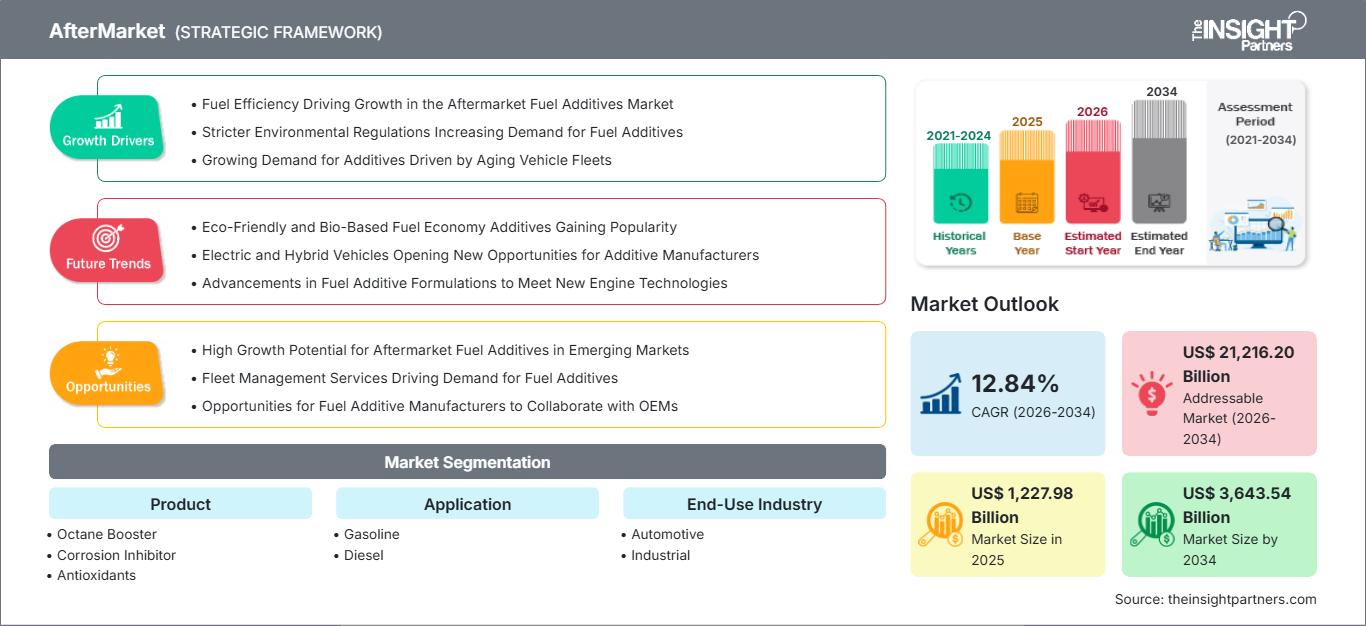
The aftermarket fuel additives market size had a value of US$ 1,227.98 Billion in 2025, and it is estimated to grow up to US$ 3,643.54 Billion by 2034 at a CAGR of 12.84% during the period 2026-2034. Factors driving the growth of the market include the rising global number of vehicles, rising awareness among consumers about fuel economy and engine maintenance and growing adoption of premium fuel additives, which enhance fuel economy, reduce deposits, and increase the lifetime of the engines.
North America is one of the dominant regional markets for aftermarket fuel additives due to its large passenger and commercial vehicle fleets, a developed automotive aftermarket segment, and a high consumer inclination towards preventive vehicle maintenance. It is expected to register a CAGR of 11.9-12.5% in the forecast period. Growth in the trend of DIY vehicle maintenance and rise in the demand for premium fuel system cleaners have led to continued growth of the aftermarket fuel additives market.
Aftermarket Fuel Additives Market Assessment and Insights
- North America: Accounted for 33–37% share in 2025 and is expected to grow at a CAGR of 11.9–12.5% during 2026–2034. Strong automotive aftermarket distribution networks, high vehicle ownership, and increasing maintenance expenditure continue supporting demand for aftermarket fuel additives.
- US: Represented 76–80% of the North American market in 2025 and is projected to expand at a CAGR of 12.0–12.6% during 2026–2034, supported by high vehicle utilization, widespread retail availability, and increasing adoption of premium fuel treatment products.
- Europe: Held 24–28% share in 2025 while advancing at a CAGR of 11.4–12.0% during 2026–2034. Germany, the United Kingdom, France, and Italy remain major contributors owing to aging vehicle fleets, stringent emission standards, and strong aftermarket service infrastructure.
- Asia Pacific: Captured 27–31% share in 2025 and is forecast to record the highest CAGR of 13.6–14.2% during 2026–2034, driven by rapid vehicle ownership growth, expanding automotive aftermarket channels, and rising awareness regarding preventive engine maintenance across China, India, Japan, and Southeast Asia.
- Largest Segment: Gasoline accounted for 56–60% market share in 2025 and is expected to register a CAGR of 12.5–13.0% during 2026–2034, supported by the large global passenger vehicle fleet and increasing use of injector cleaning and octane-enhancing additives.
- High Growth Segment: Octane Booster represented 38–42% market share in 2025 and is projected to expand at a CAGR of 13.4–14.0% during 2026–2034, reflecting growing consumer demand for enhanced engine performance, combustion efficiency, and fuel economy.
- Key companies analyzed in detail: Afton Chemical Corporation, Ashland Inc., BASF SE, BG Products, Inc., Chevron Corporation, Evonik Industries AG, Innospec Inc., The Lubrizol Corporation, Lucas Oil Products, Inc., TotalEnergies SE.
Source: The Insight Partners' analysis based on proprietary research, government publications, company annual reports, investor presentations, industry databases, and expert interviews.
The current trends in automobile maintenance have shifted towards preventative measures aimed at improving fuel efficiency, engine cleanliness and reducing maintenance costs over time. The fuel additives have undergone great developments in the areas of detergents, corrosion inhibitor, antioxidant, and multipurpose additives for addressing injectors, fuel oxidation and moisture contamination problems. Efforts by fuel additive producers are ongoing to develop additives compatible with the GDI and common rail diesel engine designs as well as the changing fuel quality and emission standards. These developments will continue fostering continued growth of the aftermarket fuel additives market within mature and emerging markets of automobiles.
Going forward, growth of the market will be driven by growing numbers of vehicles in the emerging markets, increased e-retailing and growing consumer awareness of the importance of preventative maintenance. Regulations calling for clean combustion processes and reduced emissions have spurred development of more environmental friendly additive chemistries. Investment in high-end maintenance products together with increasing network of independent garages and e-commerce platforms will provide additional growth prospects in the coming years.
Aftermarket Fuel Additives Market Report Scope
| Report Attribute | Details |
|---|---|
| Market size in 2025 | US$ 1,227.98 Billion |
| Market Size by 2034 | US$ 3,643.54 Billion |
| Global CAGR (2026 - 2034) | 12.84% |
| Historical Data | 2021-2024 |
| Forecast period | 2026-2034 |
Aftermarket Fuel Additives Market Analysis
The factors that are increasing the global aftermarket fuel treatment product demand include aging of the vehicle fleet, high mileage per year, and the increasing awareness regarding the prevention of the engine maintenance. The growth of the aftermarket fuel additives industry is being driven by consumers who need effective solutions to optimize their fuel consumption, improve engine efficiency, remove injector deposits and prolong the life of their vehicles without the need to perform any engine repairs. The growth in the number of gasoline direct injection engines, along with the tightening emission standards, is also driving the demand for high-end detergents and combustion additives.
The value chain consists of producers of petrochemical raw materials, specialty chemical companies, additive formulators, lubricant companies, distributors, auto parts stores, service shops, dealers, and end-users. Innovation in additive chemistry and packaging continues to provide manufacturers with an opportunity to serve various engine types. Growth of the online auto parts retailing increases product availability and market penetration.
Competition within the aftermarket fuel additives market analysis framework can be defined by product differentiation, high brand loyalty, and product formulation innovation. Major players such as Afton Chemical Corporation, The Lubrizol Corporation, BASF SE, Chevron Corporation, Evonik Industries AG, Ashland Inc., BG Products, Inc., Lucas Oil Products, Inc., Innospec Inc., and TotalEnergies SE keep on making efforts in the direction of investment in advanced additive technology, effective distribution network, and superior product lines in order to increase their competitive advantage in the automotive aftermarket. Investment trends tend to center on sustainable additive chemistry, multifunctional formulations, bio-based ingredients, and digital customer engagement solutions. In addition, regional blending plants are being built by major manufacturers to enhance the effectiveness of logistics chains.
● REPORT CUSTOMIZATION
Tailor This Report To Align With Your Specific Business Requirements
This report can be customized to align precisely with your business objectives, scope, and target markets. Customization options include tailored segmentation, geography, competitive analysis, and strategic insights to support informed decision-making.
Customize This Report →WHAT YOU CAN ADJUST
- ● Segmentations
- ● Geography
- ● Competitive Analysis
- ● Language Preferences
Aftermarket Fuel Additives Market: Strategic Insights
Regional Insights
North America Aftermarket Fuel Additives Market
North America is contributing a share of 33–37% in the global aftermarket fuel additives market share in 2025 and expected to grow with a CAGR of 11.9–12.5% during 2026–2034. Factors driving the market include the presence of one of the largest vehicle fleet sizes, rising average age of vehicles, and increased awareness among consumers about preventive maintenance. The region is characterized by a developed automotive aftermarket, availability of high-quality fuel additives, and well-established distribution networks comprising specialty automotive outlets, mass retailers, workshops, and e-commerce channels.
The US and Canada continue their efforts towards green transport solutions yet are still running substantial numbers of internal combustion engine vehicles requiring maintenance at regular intervals. The growth of gasoline direct injection engines, stringent emission compliance standards, and higher preference for high-quality engine care products contribute to the increased demand for injector cleaners, corrosion inhibitors, and octane boosters.
U.S. Aftermarket Fuel Additives Market
The US accounted for 76-80% of North American market share in 2025 and is forecast to grow at a CAGR of 12.0-12.6% through 2026-2034. The USA's huge passenger car population, high light truck ownership, and DIY servicing habits will keep demand going for fuel additives on the US market. Major manufacturers have wide distribution agreements with automobile retail outlets, independent service stations, dealerships, and online sales channels.
The demand for fuel additives is created by fuel injection cleaners, combustion enhancers, additives for diesel fuel, and additive kits with multiple functions that cater to new direct-injection engines. Premium additives are used by commercial vehicle owners for higher fuel efficiency and less maintenance work. Innovation in products from such manufacturers as Chevron Corporation, BG Products, Inc., and Lucas Oil Products, Inc. continues.
Europe Aftermarket Fuel Additives Market
In Europe, the market had 24% to 28% share of the total world market in 2025 and is expected to post a CAGR of 11.4% to 12.0% between 2026 and 2034, driven by Germany. Europe enjoys the advantage of strict emissions standards, superior automotive engineering, and consumer concern for maintenance of their vehicles. Rising usage of premium fuel treatments in passenger cars and commercial fleets will help maintain demand in light of increasing electric vehicles.
Germany emerges as the largest market in Europe due to a strong automotive industry, a high prevalence of premium vehicles, and broad acceptance of preventive engine maintenance products. Germany is also home to many chemical companies developing innovative technologies for detergents and additives to boost combustion.
The United Kingdom shows positive demand because of the development of its independent aftermarket and e-commerce for automotive products. In addition, the countries of France, Italy, and Spain make a significant contribution, driven by growing automotive services, older vehicle ages, and fuel economy improvements from additives.
APAC Aftermarket Fuel Additives Market
Asia Pacific accounted for 27–31% of the global market in 2025 and is forecast to record the highest CAGR of 13.6–14.2% during 2026–2034. Rising passenger vehicle ownership, expanding automotive service infrastructure, and increasing disposable income continue driving aftermarket fuel additive adoption across emerging economies.
China leads regional demand, followed by Japan, India, South Korea, and Australia. Expanding automotive production, rapid urbanization, government initiatives supporting cleaner vehicle emissions, and growing awareness regarding engine efficiency are encouraging wider adoption of premium gasoline and diesel fuel treatment products throughout the region.
Middle East & Africa Aftermarket Fuel Additives Market
The Middle East & Africa market is projected to expand at a CAGR of 11.2–11.8% during 2026–2034. Growing vehicle ownership, increasing commercial transportation activity, and expanding automotive service networks continue creating opportunities for aftermarket fuel additive suppliers throughout the region.
Saudi Arabia remains the leading market, supported by high passenger vehicle ownership and substantial fuel consumption. The UAE benefits from premium automotive maintenance spending, while South Africa continues generating demand through its established automotive aftermarket. Infrastructure expansion and increasing industrial transportation activities across the Rest of MEA further support regional growth.
Segmentation Analysis
Product
The Product segment accounts for a substantial share of the market as manufacturers continue developing advanced additive chemistries that improve combustion efficiency, minimize deposit formation, and enhance fuel stability. The aftermarket fuel additives market scope continues expanding with innovations targeting modern gasoline direct injection and diesel engine technologies. The segment is projected to register a CAGR of 13.0–13.6% during 2026–2034.
- Octane Booster: Widely adopted by passenger vehicle owners seeking improved combustion efficiency, engine responsiveness, and knocking resistance. Growing demand for performance-oriented maintenance products continues strengthening its position across premium gasoline vehicle applications.
- Corrosion Inhibitor: Increasingly utilized to protect fuel systems against moisture-induced corrosion, extending component lifespan while improving long-term engine reliability in passenger, commercial, and industrial vehicles operating under varying environmental conditions.
- Antioxidants: Play a critical role in improving fuel storage stability by reducing oxidation and gum formation, making them valuable for seasonal vehicle use, commercial fleets, and industrial fuel storage applications.
Application
The Application segment represents the primary source of demand because additive formulations are specifically designed according to fuel chemistry and engine requirements. Continuous innovation in gasoline and diesel treatment technologies supports wider adoption across passenger vehicles, heavy-duty transportation, agriculture, marine equipment, and industrial machinery. The segment is expected to register a CAGR of 12.6–13.2% during 2026–2034.
- Gasoline: Represents the dominant application owing to the extensive global passenger vehicle fleet, increasing use of gasoline direct injection engines, and strong consumer preference for injector cleaners and octane enhancement products.
- Diesel: Demand remains supported by commercial transportation, logistics, mining, agriculture, and construction industries where injector cleanliness, lubrication improvement, and fuel stability directly influence operational efficiency and maintenance costs.
End-Use Industry
The End-Use Industry segment reflects diverse demand across transportation and industrial operations where maintaining engine performance and fuel efficiency remains operationally important. Increasing preventive maintenance practices and longer equipment operating cycles continue supporting market expansion. The segment is projected to grow at a CAGR of 12.1–12.7% during 2026–2034.
- Automotive: Accounts for the largest consumption due to the vast global passenger and commercial vehicle population, increasing vehicle age, and expanding retail availability of premium fuel treatment products through workshops and e-commerce platforms.
- Industrial: Adoption continues increasing across generators, construction equipment, mining machinery, agricultural equipment, and stationary engines requiring fuel stabilization, corrosion protection, and optimized combustion efficiency for reliable long-term operation.
Opportunity Snapshot
| Application | Revenue Contribution | Trend Tag | Adoption Stage |
|---|---|---|---|
| Gasoline | High | GDI Cleaning | Mature |
| Diesel | Medium | Fleet Efficiency | Scaling |
Aftermarket Fuel Additives Market Growth Drivers and Impact Analysis
Growing Global Vehicle Parc and Aging Vehicle Fleet
The expanding global vehicle parc and increasing average vehicle age are major contributors to aftermarket fuel additive demand. Vehicle owners are increasingly choosing preventive maintenance solutions that improve combustion efficiency, remove injector deposits, reduce engine knocking, and enhance fuel economy without expensive repairs. According to international transportation statistics, the average age of passenger vehicles continues increasing across North America and Europe, creating sustained demand for maintenance chemicals. Independent workshops, dealerships, and automotive retailers continue recommending fuel system cleaners and multifunctional additives as part of routine maintenance programs. This long-term shift toward vehicle life extension is expected to generate recurring demand across both passenger and commercial vehicle segments throughout the forecast period.
Stringent Emission Standards Encouraging Cleaner Combustion
Governments worldwide continue implementing stricter emission regulations to reduce particulate matter, carbon monoxide, and hydrocarbon emissions from internal combustion engines. As modern engines become more sophisticated, fuel quality and combustion efficiency play increasingly important roles in meeting regulatory requirements. Advanced detergent additives, corrosion inhibitors, and combustion improvers help maintain injector cleanliness, optimize fuel atomization, and reduce harmful deposits that negatively affect engine performance. Fleet operators also utilize premium additive formulations to maintain engine efficiency while reducing maintenance intervals and operational costs. Consequently, regulatory compliance continues encouraging the development and adoption of higher-performance aftermarket fuel additive technologies across gasoline and diesel applications.
Expansion of Automotive Aftermarket Distribution Channels
Rapid growth in automotive e-commerce, organized retail chains, and independent service networks is significantly improving accessibility to aftermarket fuel additives. Consumers can now purchase specialized formulations through online marketplaces, automotive retailers, service centers, and dealership networks with greater product transparency and technical information. Manufacturers are simultaneously investing in digital marketing, educational campaigns, and product certification to increase consumer confidence. Subscription maintenance services and fleet management programs are also creating recurring demand for premium fuel treatment products. These distribution improvements continue expanding market penetration across developed economies while accelerating adoption in emerging automotive markets where organized aftermarket channels are evolving rapidly.
Aftermarket Fuel Additives Market Future Trends
Development of Multifunctional and Sustainable Fuel Additives
Manufacturers are increasingly focusing on multifunctional additive packages capable of simultaneously improving combustion efficiency, injector cleanliness, corrosion protection, and fuel stability. Aftermarket fuel additives market trends also indicate growing investment in environmentally compatible formulations using lower-toxicity chemistries and renewable raw materials. Companies are developing additive technologies compatible with advanced gasoline direct injection engines, hybrid powertrains, biodiesel blends, and renewable fuels. Product differentiation through multifunctional performance and sustainability credentials is expected to become an important competitive advantage over the coming decade.
Increasing Integration with Digital Vehicle Maintenance Ecosystems
Digital vehicle diagnostics, connected maintenance platforms, and predictive service applications are expected to reshape the aftermarket fuel additive industry. Vehicle owners increasingly rely on connected service reminders and maintenance applications that recommend preventive products based on mileage, driving conditions, and engine health. Manufacturers are integrating digital customer engagement strategies with loyalty programs and maintenance tracking systems, enabling personalized product recommendations while strengthening long-term customer retention. These digital ecosystems are expected to accelerate premium product adoption across global automotive aftermarket channels.
Aftermarket Fuel Additives Market Opportunities
Expanding Demand Across Emerging Automotive Markets
Rapid motorization across Asia Pacific, Latin America, the Middle East, and Africa presents significant long-term investment opportunities for additive manufacturers. Increasing disposable incomes, expanding automotive service infrastructure, and improving consumer awareness regarding preventive maintenance continue creating favorable market conditions. Aftermarket fuel additives market Forecasts indicate that localized manufacturing, regional distribution partnerships, and affordable premium formulations will enable suppliers to strengthen their presence in high-growth emerging economies while improving supply chain resilience and customer accessibility.
Premium Product Innovation for Modern Engine Technologies
Advanced gasoline direct injection engines, turbocharged powertrains, hybrid vehicles with combustion engines, and high-pressure diesel injection systems require increasingly sophisticated fuel treatment solutions. Manufacturers investing in premium multifunctional formulations capable of improving injector performance, combustion efficiency, corrosion protection, and fuel stability are well positioned to capture higher-value market segments. Strategic collaborations with OEM-approved service networks, fleet operators, lubricant distributors, and digital automotive platforms will further expand commercialization opportunities while supporting long-term product differentiation.
Recent Developments
- September 24, 2025: Afton Chemical Corporation launched HiTEC 12582, the world's first commercially available additive specifically developed for hydrogen heavy-duty internal combustion engines. The new additive expands Afton's advanced fuel additive portfolio and demonstrates the industry's increasing focus on low-carbon fuels while leveraging expertise in fuel performance chemistry.
- April 1, 2025: Puma Energy introduced its CLEANTEC fuel additive technology across Latin America to improve engine cleanliness, combustion efficiency, and fuel economy for gasoline and diesel vehicles. Although Puma Energy is not listed among the profiled companies, the launch is highly relevant as it reflects growing investment in premium aftermarket fuel additive technologies and increased competition in the parent fuel additives market.
Frequently Asked Questions

- Comprehensive Market Sizing and Forecast Analysis
- Detailed Segmentation Analysis
- In-Depth Market Dynamics Assessment
- Regional and Country-Level Insights
- Competitive Landscape and Company Benchmarking
- Strategic Business Intelligence
Recent Reports
Testimonials

The Insight Partners' SCADA System Market report is comprehensive, with valuable insights on current trends and future forecasts. The team was highly professional, responsive, and supportive throughout. We are very satisfied and highly recommend their services.
RAN KEDEM Partner, Reali Technologies LTDs
I requested a report on a very specific software market and the team produced the report in a few days. The information was very relevant and well presented. I then requested some changes and additions to the report. The team was again very responsive and I got the final report in less than a week.
JEAN-HERVE JENN Chairman, Future Analytica
We worked with The Insight Partners for an important market study and forecast. They gave us clear insights into opportunities and risks, which helped shape our plans. Their research was easy to use and based on solid data. It helped us make smart, confident decisions. We highly recommend them.
PIYUSH NAGPAL Sr. Vice President, High Beam Global
The Insight Partners delivered insightful, well-structured market research with strong domain expertise. Their team was professional and responsive throughout. The user-friendly website made accessing industry reports seamless. We highly recommend them for reliable, high-quality research services
YUKIHIKO ADACHI CEO, Deep Blue, LLC.
This is the first time I have purchased a market report from The Insight Partners.While I was unsure at first, I visited their web site and felt more comfortable to take the risk and purchase a market report.I am completely satisfied with the quality of the report and customer service. I had several questions and comments with the initial report, but after a couple of dialogs over email with their analyst I believe I have a report that I can use as input to our strategic planning process.Thank you so much for taking the extra time and making this a positive experience.I will definitely recommend your service to others and you will be my first call when we need further market data.
JOHN SUZUKI President and Chief Executive Officer, Board Director, BK Technologies
I wish to appreciate your support and the professionalism you displayed in the course of attending to my request for information regarding to infectious disease IVD market in Nigeria. I appreciate your patience, your guidance, and the fact that you were willing to offer a discount, which eventually made it possible for us to close a deal. I look forward to engaging The Insight Partners in the future, all thanks to the impression you have created in me as a result of this first encounter.
DR CHIJIOKE ONYIA MANAGING DIRECTOR, PineCrest Healthcare Ltd.Reason to Buy
- Informed Decision-Making
- Understanding Market Dynamics
- Competitive Analysis
- Identifying Emerging Markets
- Customer Insights
- Market Forecasts
- Risk Mitigation
- Boosting Operational Efficiency
- Strategic Planning
- Investment Justification
- Tracking Industry Innovations
- Aligning with Regulatory Trends





 Get Free Sample for