
Aerosol Propellants Market Trends, Share & Demand by 2034
Coverage: By Propellant Type (Hydrocarbon Propellants [Propane, n-Butane, Isobutane, Hydrocarbon Blends], Dimethyl Ether, Compressed Gas Propellants [Nitrogen, Carbon Dioxide, Compressed Air, Other Compressed Gas Propellants], Fluorocarbon Propellants [HFC-134a, HFC-152a, Other Fluorocarbon Propellants], and Other Propellants) and Application (Personal Care [Deodorants, Antiperspirants, Hair Sprays, Dry Shampoos, Shaving Creams, Other Personal Care Applications], Household Products [Air Fresheners, Furniture Polish, Cleaning Sprays, Other Household Applications], Pharmaceuticals, [Topical Sprays, Wound Care Aerosols, Other Pharmaceutical Applications], Food Products [Whipped Cream, Cooking Sprays, Other Food Applications], Industrial [Lubricants, Paint Sprays, Other Industrial Applications], and Others)
- Status : Published
- Report Code : TIPRE00014770
- Category : Chemicals and Materials
- No. of Pages : 538
- Available Report Formats :


- Last update date : August 12, 2026


2025 Market Size
US$ 4.61 Bn
Base year value
2034 Forecast
US$ 6.83 Bn
Projected by 2034
CAGR 2026-2034
4.5 %
Growth rate
Addressable Market
US$ 52.04 Bn
(2026-2034)
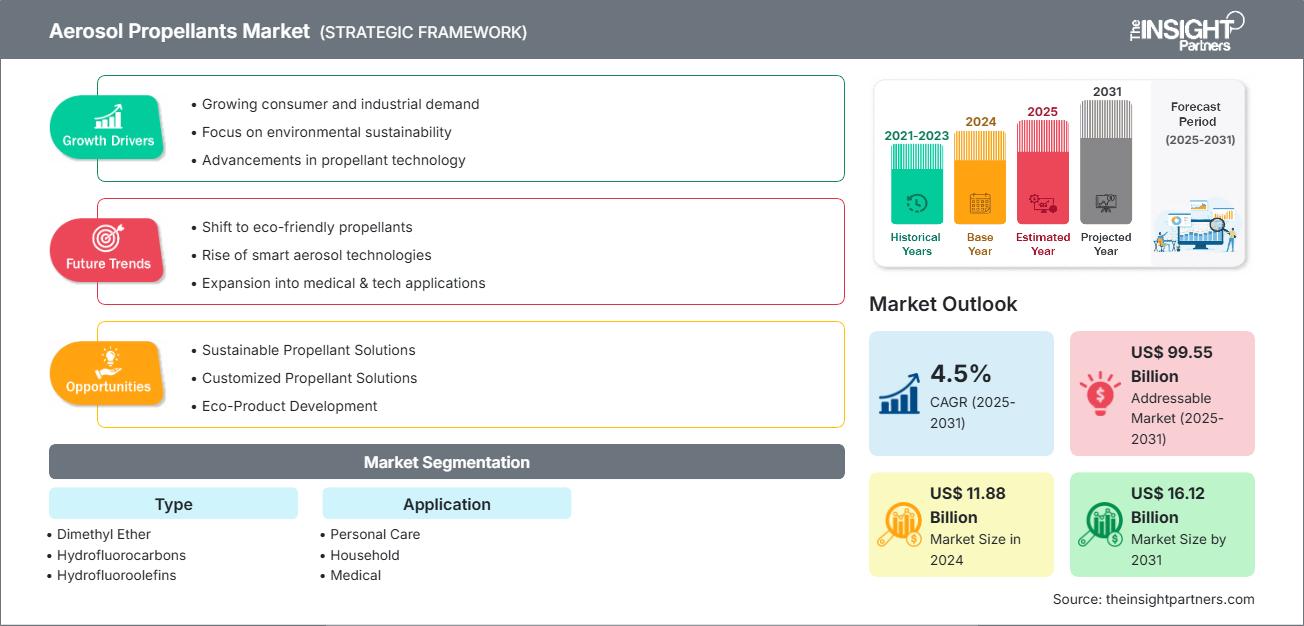
The aerosol propellants market was valued at US$ 4.61 Billion in 2025 and is projected to reach US$ 6.83 Billion by 2034; it is expected to register a CAGR of 4.5% during 2026–2034. Rising use of personal care products, pharmaceutical aerosols, household cleaners, and industrial spray formulations is driving demand. Advancements in aerosol propellants, alongside sustainability measures and regulations, have been instrumental in pushing manufactures to develop formulations that emit less pollution and perform better within different industries. Product quality regulations in North America and the high demand from consumer packaged goods manufacturers are driving industry growth in the region. Market size for aerosol propellants in the North American region is supported by the presence of well-established industries within the personal care and pharmaceutical sectors, investments in environment-friendly propellant technology, and advancements in aerosol filling facilities. These are expected to drive regional growth at a CAGR of 3.9%.
Aerosol Propellants Market Assessment and Insights
- North America: The region accounted for 23.71% share in 2025 and is projected to expand at a CAGR of 3.9% during 2026–2034, supported by advanced aerosol manufacturing capabilities, regulatory innovation, and sustained demand from healthcare and personal care applications.
- U.S.: The country represented 74.76% of the North American market in 2025 and is expected to grow at a CAGR of 3.8% owing to strong consumer goods production and continuous innovation in aerosol packaging.
- Europe: Europe held 20.95% share in 2025 and is anticipated to register a CAGR of 4.6% during 2026–2034. Germany, the UK, France, Italy, and Spain remain leading contributors because of established chemical manufacturing and stringent sustainability regulations.
- Asia Pacific: Asia Pacific captured 42.06% share in 2025 and is forecast to grow at a CAGR of 4.9% during 2026–2034. China, India, Japan, and South Korea continue to benefit from expanding consumer markets, industrial production, and pharmaceutical manufacturing.
- Largest Segment: Hydrocarbon Propellants accounted for 70.08% market share in 2025 and are expected to expand at a CAGR of 4.5% during 2026–2034 owing to cost efficiency, formulation versatility, and broad compatibility with aerosol products.
- High Growth Segment: Pharmaceuticals represented 4.8% market share in 2025 and are projected to record a CAGR of 4.1% during 2026–2034, supported by increasing adoption of inhalation therapies and topical aerosol drug delivery systems.
- Key companies analyzed in detail: Aeropres Corporation, Arkema SA, Bharat Petroleum Corporation Limited (BPCL), Diversified CPC International, DME Aerosol LLC, Evonik Industries AG, GTS S.p.A., Harp International Ltd., Solstice Advanced Materials Inc., Mitsubishi Gas Chemical Company, Inc., Nouryon Chemicals Holding B.V., Orbia Fluor & Energy Materials, Shell plc, and The Chemours Company.
Source: The Insight Partners' analysis based on proprietary research, government publications, company annual reports, investor presentations, industry databases, and expert interviews.
Rapid advances in aerosol package technologies, regulations, and formulation chemistry have radically changed manufacturing processes along the entire value chain. In parallel, manufacturers have been striving for a combination of product performance, safety, and sustainability while substituting global-warming gases with greener propellants. Improvements in production processes, logistics, and recycling systems have enhanced the competitive advantages of the industry. Further advancements in delivery systems are expected to increase efficiency and usability of the products in end-use applications. Favorable environmental laws, local production plants, and collaboration between chemical producers and aerosol packers can enhance supply reliability. They will also promote the development of new generations of propellant technology.
Aerosol Propellants Market Report Scope
| Report Attribute | Details |
|---|---|
| Market size in 2025 | US$ 4.61 Billion |
| Market Size by 2034 | US$ 6.83 Billion |
| Global CAGR (2026 - 2034) | 4.5% |
| Historical Data | 2021-2024 |
| Forecast period | 2026-2034 |
Aerosol Propellants Market Analysis
Growing consumer preference for convenient, hygienic, and easy-to-use packaged products continues to drive the aerosol propellants market growth across personal care, pharmaceuticals, household products, and industrial applications. Expanding urban populations and rising disposable incomes have increased the use of deodorants, hair sprays, disinfectants, air fresheners, and medical inhalers. At the same time, healthcare providers are adopting aerosol-based drug delivery systems that improve dosage accuracy and patient compliance. These trends create ongoing demand for dependable propellant systems that deliver consistent spray performance while meeting stricter environmental and safety regulations. The industry ecosystem includes feedstock suppliers, specialty chemical manufacturers, propellant producers, aerosol can manufacturers, valve suppliers, contract fillers, brand owners, and distribution networks.
Consistent availability of hydrocarbons, dimethyl ether, compressed gas, and fluorinated alternatives is crucial in ensuring a smooth operation of the production process. Manufacturers are also working on implementing local sourcing plans that will minimize their supply chain risks caused by geopolitical tensions, transport costs, and rising prices for raw materials. The competition within the aerosol propellants market implies continuous investment into sustainable chemistry, manufacturing processes, and differentiation of products. Companies are collaborating with package suppliers and consumer goods companies to ensure compatibility of propellants and dispenser technologies.
Leading players such as Arkema SA, The Chemours Company, Orbia Fluor & Energy Materials, Nouryon Chemicals Holding B.V., Evonik Industries AG, Shell plc, Bharat Petroleum Corporation Limited, Aeropres Corporation, Diversified CPC International, GTS S.p.A., Harp International Ltd., Mitsubishi Gas Chemical Company, Inc., DME Aerosol LLC, and Solstice Advanced Materials Inc. continue to strengthen their positions through product innovation, regional expansion, and supply agreements. Increased investment in low-carbon production technologies, specialty propellant formulations, and advanced logistics capabilities is expected to enhance long-term competitiveness while fostering resilient market growth.
● REPORT CUSTOMIZATION
Tailor This Report To Align With Your Specific Business Requirements
This report can be customized to align precisely with your business objectives, scope, and target markets. Customization options include tailored segmentation, geography, competitive analysis, and strategic insights to support informed decision-making.
Customize This Report →WHAT YOU CAN ADJUST
- ● Segmentations
- ● Geography
- ● Competitive Analysis
- ● Language Preferences
Aerosol Propellants Market: Strategic Insights
Regional Insights
North America Aerosol Propellants Market
North America accounted for 23.71% of the global market in 2025 and is anticipated to register a CAGR of 3.9% during 2026–2034. The aerosol propellants market share in the region is strong because of a well-developed aerosol packaging industry, established chemical manufacturers, and high use of personal care, pharmaceutical, and household products. The scrutiny of regulatory bodies such as the EPA of the United States and Health Canada ensures that low emission propellant systems are adopted without any sacrifice of product functionality. The regional value chain takes advantage of an abundance of hydrocarbon raw materials, efficient filling stations, and constant research efforts to develop environmentally friendly aerosols. The increased requirement for metered dose inhalers, disinfectants, auto care products, and high-end cosmetics is what motivates the manufacture of aerosol cans.
U.S. Aerosol Propellants Market
The U.S. represented 74.76% of the North American market in 2025 and is projected to expand at a CAGR of 3.8% during 2026–2034. It continues to dominate the production processes in the region owing to the huge consumer goods industry, pharmaceutical industry and aerosol packaging infrastructure present there. The high domestic consumption of deodorants, hair care products, spray cleaners, industrial lubricants and respiratory inhalers continues to maintain the domestic consumption of hydrocarbon, compressed gas and dimethyl ether propellants. Major producers in the industry have plants and labs situated in the country. This helps to ensure that the company has adequate supply for their consumer packaged goods. The increased investment in the development of environmentally friendly propellants, filling process and formulations is increasing the competitiveness of the industry. The demand from the health care industry, mainly inhalation drug delivery and industrial maintenance products will play a major role in future growth.
Europe Aerosol Propellants Market
Europe captured 20.95% of the global market in 2025 and is expected to record a CAGR of 4.6% during 2026–2034. Germany is the leading market because it has a strong chemical manufacturing base, a solid automotive sector, and a large production of personal care products. Ongoing investment in sustainable chemicals and adherence to European environmental laws are pushing manufacturers to introduce lower-impact aerosol propellants while keeping product performance high for both consumer and industrial uses.
The United Kingdom has a well-established personal care industry and strong pharmaceutical manufacturing capabilities. This supports steady demand for high-quality aerosol products. The increasing preference for environmentally-friendly consumer goods and innovations in medical aerosol delivery systems are boosting local consumption.
France, Italy, and Spain form a crucial manufacturing and consumption hub. France excels in premium cosmetics production, Italy has a strong demand for industrial aerosols, and Spain fosters growth with its expanding household and personal care manufacturing. Together, these countries enhance Europe's varied aerosol market and help ensure stable long-term demand in the region.
APAC Aerosol Propellants Market
Asia Pacific accounted for 42.06% of the global market in 2025 and is projected to grow at a CAGR of 4.9% during 2026–2034. China is still the largest regional market due to its vast manufacturing capacity and significant production of consumer goods. Meanwhile, India is rapidly growing because of urbanization and increased demand for packaged personal care products. Japan and South Korea keep focusing on high-performance specialty aerosols, while Australia boosts demand through healthcare and industrial uses. Supportive manufacturing policies, growing pharmaceutical production, and investments in chemical processing infrastructure should maintain regional growth during the forecast period.
Middle East & Africa Aerosol Propellants Market
The Middle East & Africa is anticipated to witness a CAGR of 3.4% during 2026–2034, supported by expanding petrochemical production, industrial diversification, and increasing consumer goods manufacturing. Saudi Arabia is the top regional market because of its combined hydrocarbon resources. The UAE is also building up its investments in aerosol packaging and specialty chemicals. South Africa has steady demand for household and industrial aerosol applications. Meanwhile, the Rest of the Middle East and Africa is improving its retail distribution and infrastructure. Ongoing investment in chemical industries and regional manufacturing is likely to help the market grow steadily.
Segmentation Analysis
Propellant Type
The propellant type segment is projected to register a CAGR of 4.5% during 2026–2034. The aerosol propellants market scope continues to expand as manufacturers balance cost efficiency, spray performance, regulatory compliance, and environmental sustainability. Continuous innovation in hydrocarbon blends, compressed gases, and alternative low-global-warming propellants is supporting product diversification across personal care, pharmaceutical, industrial, and household aerosol formulations.
- Hydrocarbon Propellants – The largest product category owing to excellent spray characteristics, affordability, and compatibility with numerous consumer and industrial aerosol formulations. Continuous improvements in safety standards further support widespread commercial adoption.
- Dimethyl Ether – Widely utilized because of its favorable solvency, efficient atomization, and compatibility with water-based formulations. Demand remains particularly strong across household cleaners, cosmetics, and selected industrial aerosol products.
- Compressed Gas Propellants – Preferred for environmentally conscious formulations where non-flammable characteristics and lower environmental impact are priorities. Healthcare, food products, and specialty industrial applications continue driving steady utilization.
- Fluorocarbon Propellants – Primarily used in specialized pharmaceutical, refrigeration, and technical applications requiring superior performance, stability, and formulation compatibility despite increasing environmental regulations governing fluorinated substances.
Application
The application segment is anticipated to expand at a CAGR of 4.8% during 2026–2034 as aerosol technologies become increasingly integrated across consumer and industrial value chains. Rising demand for hygiene products, respiratory therapies, food-grade sprays, and industrial maintenance solutions continues to broaden commercial opportunities while encouraging innovation in dispensing efficiency and formulation performance.
- Personal Care – Represents the largest application owing to sustained consumption of deodorants, hair sprays, shaving foams, and cosmetic products requiring consistent spray performance and reliable dispensing characteristics.
- Household Products – Strong demand for air fresheners, disinfectants, insecticides, furniture care products, and cleaning sprays continues supporting stable propellant consumption across residential and commercial applications.
- Pharmaceuticals – Increasing adoption of metered-dose inhalers, topical aerosol medications, and advanced respiratory therapies is strengthening demand for high-purity propellant systems meeting stringent healthcare quality standards.
- Food Products – Aerosol dispensing is gaining wider acceptance for whipped creams, edible oils, bakery ingredients, and specialty food preparations that require precise, hygienic, and convenient product delivery.
- Industrial – Industrial aerosols remain essential for lubricants, anti-corrosion coatings, mold release agents, cleaners, and maintenance chemicals used across manufacturing, automotive, aerospace, and engineering operations.
Opportunity Snapshot
| Application | Revenue Contribution | Trend Tag | Adoption Stage |
|---|---|---|---|
| Personal Care | High | Premium Beauty | Mature |
| Household Products | High | Hygiene Focus | Mature |
| Pharmaceuticals | High | Inhalation Therapy | Scaling |
| Food Products | Medium | Food Dispensing | Scaling |
| Industrial | Medium | Maintenance Spray | Mature |
| Others | Low | Specialty Uses | Emerging |
Aerosol Propellants Market Growth Drivers and Impact Analysis
Expansion of Personal Care and Household Aerosol Consumption
Rising use of personal care and household aerosol products remains a key factor driving demand in both developed and emerging economies. More people are moving to cities, lifestyles are evolving, and there is a growing preference for easy-to-use packaging. These changes are leading to higher consumption of deodorants, hair sprays, dry shampoos, air fresheners, disinfectants, and cleaning products. Companies that produce packaged goods are broadening their aerosol product lines to meet premium trends and enhance product performance. The World Bank and IMF note an increase in middle-income populations in Asia and parts of Africa, which creates a bigger market for packaged goods. As brands launch unique formulas and premium aerosol products, the demand for propellants rises across the supply chain. This trend is likely to support steady volume growth for hydrocarbon, dimethyl ether, and compressed gas propellants during the forecast period.
Growing Demand for Aerosol-Based Pharmaceutical Delivery Systems
Healthcare applications are becoming more important for the aerosol industry as respiratory diseases, allergies, and chronic lung conditions affect millions of patients worldwide. Metered-dose inhalers and topical aerosol therapies need specialized propellant systems that can deliver precise dosages while keeping the formulation stable. Regulatory agencies focus on patient safety, product consistency, and manufacturing quality. This pushes investments in new pharmaceutical aerosol technologies. Aging populations in North America, Europe, Japan, and other developed regions are also driving up the consumption of healthcare products. Pharmaceutical manufacturers are increasing production capacities and investing in innovative drug delivery technologies that boost treatment effectiveness and patient compliance. As a result, the rising demand for high-purity propellants is creating long-term opportunities for suppliers in the healthcare sector.
Technological Advancements in Sustainable Propellant Formulations
Environmental regulations are pushing manufacturers to speed up the development of propellants that produce lower emissions and less global warming. Chemical companies are putting money into research programs that aim to improve environmental performance while ensuring spray quality, storage stability, and product safety. Global sustainability efforts and corporate emissions goals are shaping buying choices in consumer goods and industrial sectors. Manufacturers that successfully launch innovative formulations can gain an edge through meeting regulations and winning customer acceptance. Meanwhile, improvements in aerosol valves, dispensing systems, and packaging design are making propellant use more efficient, cutting down on waste and enhancing product performance. These innovations are helping modernize the industry and create new revenue opportunities in specialty and premium application areas.
Aerosol Propellants Market Future Trends
Acceleration of Low-Global-Warming Propellant Adoption
One of the major aerosol propellants market trends over the next decade is the shift towards propellant solutions that cause less global warming. Rules in Europe, North America, and some parts of Asia are pushing for older formulations to be replaced with better options for the environment. Manufacturers are paying more attention to lifecycle emissions, energy use, and product sustainability when choosing aerosol ingredients. Future investments are likely to focus on meeting environmental regulations while maintaining performance standards. As production technologies develop and costs go down, more industries are expected to adopt low-emission propellants. This change will support ongoing transformation and competitiveness in personal care, pharmaceutical, and industrial applications.
Integration of Smart Manufacturing Across Aerosol Production
Digitalization is set to change aerosol manufacturing operations as companies adopt more automation, predictive maintenance, artificial intelligence, and real-time quality monitoring. Manufacturers are putting more money into smart production facilities to improve efficiency, reduce downtime, and optimize resource use. Data analysis can help producers track propellant consumption, improve formulation consistency, and strengthen supply chain visibility. During the forecast period, digital manufacturing technologies will likely give large-scale producers a competitive edge as they look for cost savings and operational resilience. The integration of automated filling systems and data-driven production planning should support higher productivity while improving product quality and compliance with regulations.
Aerosol Propellants Market Opportunities
Expansion Opportunities in Emerging Asian Manufacturing Hubs
Emerging economies in Asia offer important growth prospects for manufacturers, distributors, and technology providers in the sector. Rapid urbanization, industrial growth, and increasing disposable incomes are driving higher demand for aerosol products in personal care, healthcare, household, and industrial categories. Governments in several countries are investing in manufacturing infrastructure and chemical production capabilities. This creates good conditions for local production. The aerosol propellants market forecasts show that the Asia Pacific region will continue to be the fastest-growing market through 2034. This encourages companies to create regional supply chains, set up production facilities, and form strategic partnerships. Businesses that position themselves early in these high-growth economies can take advantage of rising domestic demand and better export competitiveness.
Development of Specialty Solutions for Healthcare Applications
Healthcare is an appealing investment area due to the rising demand for better respiratory therapies and precise drug delivery systems. Pharmaceutical companies are looking for new propellant technologies that improve treatment outcomes, ensure formulation stability, and meet regulatory standards. Suppliers that can provide high-purity products, technical knowledge, and tailored formulation support can boost their market position. There are also future opportunities in topical aerosol therapies, veterinary healthcare products, and specialized medical applications that need controlled dispensing features. Partnerships between pharmaceutical manufacturers, chemical producers, and packaging companies are likely to speed up innovation and help bring next-generation aerosol healthcare solutions to market.
Recent Developments
- Jan 2026: Diversified CPC which is a subsidiary of Sumitomo Corporation, opened the Innovation Center named Power of Purity in Illinois, strengthening its specialty gas R&D capabilities. The facility is equipped with advanced testing, custom formulation development, and customer collaboration, supporting high-purity gas solutions for industries including semiconductors, refrigeration, and aerosols.
- August 2025: Arkema SA completed its new Forane 1233zd production unit at Calvert City, Kentucky, increasing North American output to 15 kilotons annually. Forene 1233zd is a low-GWP, non-ozone-depleting foam blowing agent which serves the construction, roofing, and appliance industries, offering excellent thermal performance and safety. The facility also produces Forane HTS 1233zd for cooling applications like high-temperature heat pumps and data center immersion cooling.
Frequently Asked Questions

- Comprehensive Market Sizing and Forecast Analysis
- Detailed Segmentation Analysis
- In-Depth Market Dynamics Assessment
- Regional and Country-Level Insights
- Competitive Landscape and Company Benchmarking
- Strategic Business Intelligence
Recent Reports
Testimonials

The Insight Partners' SCADA System Market report is comprehensive, with valuable insights on current trends and future forecasts. The team was highly professional, responsive, and supportive throughout. We are very satisfied and highly recommend their services.
RAN KEDEM Partner, Reali Technologies LTDs
I requested a report on a very specific software market and the team produced the report in a few days. The information was very relevant and well presented. I then requested some changes and additions to the report. The team was again very responsive and I got the final report in less than a week.
JEAN-HERVE JENN Chairman, Future Analytica
We worked with The Insight Partners for an important market study and forecast. They gave us clear insights into opportunities and risks, which helped shape our plans. Their research was easy to use and based on solid data. It helped us make smart, confident decisions. We highly recommend them.
PIYUSH NAGPAL Sr. Vice President, High Beam Global
The Insight Partners delivered insightful, well-structured market research with strong domain expertise. Their team was professional and responsive throughout. The user-friendly website made accessing industry reports seamless. We highly recommend them for reliable, high-quality research services
YUKIHIKO ADACHI CEO, Deep Blue, LLC.
This is the first time I have purchased a market report from The Insight Partners.While I was unsure at first, I visited their web site and felt more comfortable to take the risk and purchase a market report.I am completely satisfied with the quality of the report and customer service. I had several questions and comments with the initial report, but after a couple of dialogs over email with their analyst I believe I have a report that I can use as input to our strategic planning process.Thank you so much for taking the extra time and making this a positive experience.I will definitely recommend your service to others and you will be my first call when we need further market data.
JOHN SUZUKI President and Chief Executive Officer, Board Director, BK Technologies
I wish to appreciate your support and the professionalism you displayed in the course of attending to my request for information regarding to infectious disease IVD market in Nigeria. I appreciate your patience, your guidance, and the fact that you were willing to offer a discount, which eventually made it possible for us to close a deal. I look forward to engaging The Insight Partners in the future, all thanks to the impression you have created in me as a result of this first encounter.
DR CHIJIOKE ONYIA MANAGING DIRECTOR, PineCrest Healthcare Ltd.Reason to Buy
- Informed Decision-Making
- Understanding Market Dynamics
- Competitive Analysis
- Identifying Emerging Markets
- Customer Insights
- Market Forecasts
- Risk Mitigation
- Boosting Operational Efficiency
- Strategic Planning
- Investment Justification
- Tracking Industry Innovations
- Aligning with Regulatory Trends





 Get Free Sample for