
Agricultural Packaging Market Size, Trends & Demand by 2034
Agricultural Packaging Market Size and Forecasts (2021 - 2034), Global and Regional Share, Trends, and Growth Opportunity Analysis Report Coverage : by Material (Plastics, Paper & Paperboard, Molded Pulp); Application (Horticulture, Poultry, Mushroom); and Geography (North America, Europe, Asia Pacific, and South and Central America)
- Status : Data Released
- Report Code : TIPRE00040475
- Category : Chemicals and Materials
- No. of Pages : 150
- Available Report Formats :


- Last update date : July 28, 2026


2025 Market Size
US$ 9.69 Bn
Base year value
2034 Forecast
US$ 17.03 Bn
Projected by 2034
CAGR 2026-2034
6.46 %
Growth rate
Addressable Market
US$ 120.82 Bn
(2026-2034)
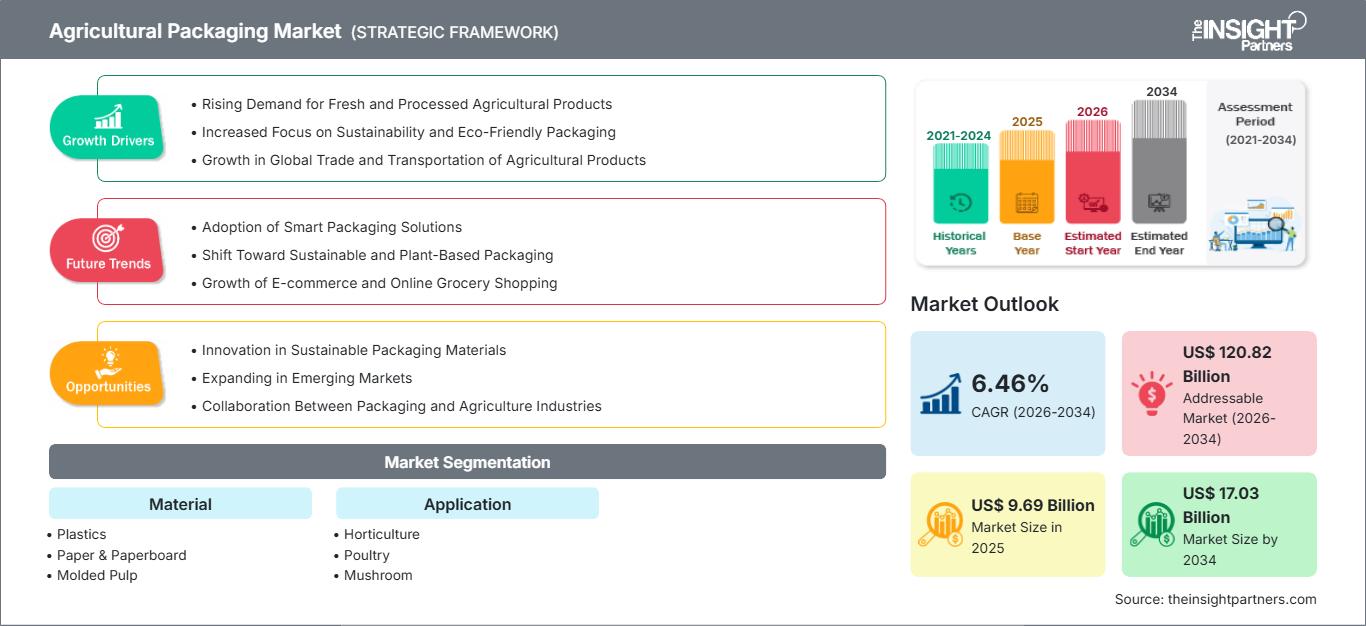
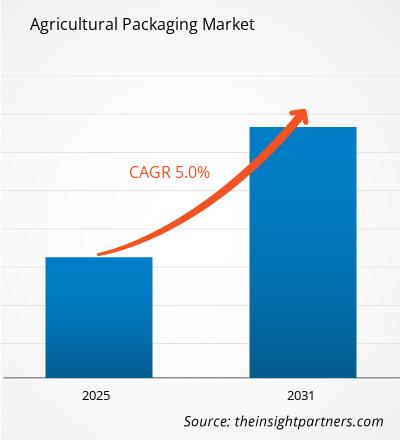
The agricultural packaging market size was US$ 9.69 Billion in 2025 and is expected to reach US$ 17.03 Billion in 2034, registering a CAGR of 6.46% from 2026 to 2034. Growing significance towards efficient harvesting, packaging, storage, and transportation of agricultural products, along with the need for protective and sustainable packaging materials, drives the market growth. Innovation in packaging technologies, including flexible and rigid packaging options, helps extend the shelf life of products, reduce post-harvest losses, and optimize the supply chain process.
In North America, there is consistent growth in demand because of the highly mechanized system of agriculture, strict safety regulations of food products, and growing use of recyclable packaging materials. The market size of agricultural packaging in the region is driven by increasing investments in the logistics of fresh produce, controlled environment agriculture, and packaging technologies. The regional market is expected to grow at a CAGR of 5.6% to 6.2% from 2026 to 2034.
Agricultural Packaging Market Assessment and Insights
- North America: Supported by advanced agricultural logistics and strong adoption of sustainable packaging, North America accounted for 29–31% share in 2025 and is projected to expand at a CAGR of 5.6–6.2% during 2026–2034, driven by modernization of produce distribution networks and regulatory focus on recyclable materials.
- U.S.: The U.S. represented 82–85% of the North American market in 2025 and is expected to grow at a CAGR of 5.8–6.4% during 2026–2034, supported by high-value horticulture production and continued investments in agricultural packaging automation.
- Europe: Europe held 25–27% share in 2025 and is anticipated to register a CAGR of 5.8–6.5% during 2026–2034. Germany, France, Italy, Spain, and the UK continue to lead demand owing to sustainability regulations and modern agricultural supply chains.
- Asia Pacific: Asia Pacific accounted for 33–35% share in 2025 and is forecast to expand at a CAGR of 7.2–7.9% during 2026–2034, led by China, India, Japan, and Australia through agricultural modernization and expanding exports of fresh produce.
- Largest Segment: Plastics remained the leading material segment with a market share of 56–60% in 2025 and is projected to grow at a CAGR of 5.8–6.4% during 2026–2034, supported by durability, moisture resistance, and cost efficiency.
- High Growth Segment: Horticulture emerged as the fastest-growing application with a market share of 42–46% in 2025 and is expected to register a CAGR of 7.1–7.8% during 2026–2034, reflecting increasing exports of fruits, vegetables, flowers, and greenhouse produce.
- Key companies analyzed in detail: Amcor plc, FormTight, Inc., DS Smith Plc, Mondi plc, Atlantic Packaging Products Ltd., FLAIR Flexible Packaging Corporation, PPC Flexible Packaging LLC, Flex-Pack, Transcontinental Inc., Tekni-Plex, Inc., Smurfit Westrock plc
Source: The Insight Partners' analysis based on proprietary research, government publications, company annual reports, investor presentations, industry databases, and expert interviews.
Constant improvements in barrier materials, light-weight polymers, molding fiber materials, and digital printing have revolutionized the sector of agricultural packaging in global supply chains. Agricultural packagers are adopting more of automation in their converting operations in addition to development of recyclable and monomaterial packaging structures that meet evolving regulations. Increased efficiency in transportations, tracing of produces, and increasing shelf life of agricultural products have increased the pace of innovation in the packaging industry allowing agricultural packaging companies to achieve operational excellence and sustainability.
Future growth is anticipated to be driven by investments in precision agriculture, cold-chain logistics, and environmentally friendly packaging products. The emerging nations have developed their capabilities in food processing and export and therefore the need for efficient packaging products will remain in place. Circulatory economy policies along with use of recycled and renewable raw materials are likely to drive innovation and capacity expansion within the agricultural packaging industry.
Agricultural Packaging Market Report Scope
| Report Attribute | Details |
|---|---|
| Market size in 2025 | US$ 9.69 Billion |
| Market Size by 2034 | US$ 17.03 Billion |
| Global CAGR (2026 - 2034) | 6.46% |
| Historical Data | 2021-2024 |
| Forecast period | 2026-2034 |
Agricultural Packaging Market Analysis
Increasing demands for fresh fruits and vegetables, processed farm produce, and export-oriented farming will continue driving the growth of the agricultural packaging market. Increasing demands for the agricultural products have made it necessary that the packaging should be such that it can help in retaining the freshness and quality of the product during transport and storage and should meet the food safety norms. The increased use of the greenhouse farming, precision farming, and controlled environment farming technologies is adding to the need for more sophisticated types of packaging to reduce contamination, regulate moisture levels, and prevent post-harvest losses.
The value chain has moved past the simple packaging production stage and into an ecosystem of material development, conversion, printing, logistics, and recycling processes. Resin makers, paper producers, molded pulp providers, converters, agriculture cooperatives, distributors, and recyclers are working together to enhance packaging effectiveness during the entire lifecycle of products. Digital supply chain management, smart label technology, and enhanced traceability technology also help to increase visibility in operations and comply with tougher regulations for environmental protection and food safety.
According to the global agricultural packaging market analysis, competitive advantages are based not only on prices but also on sustainability abilities, innovative technologies, manufacturing flexibilities, and regional production capabilities. Such global players as Amcor plc, Mondi plc, DS Smith Plc, Tekni-Plex, Inc., PPC Flexible Packaging LLC, and Transcontinental Inc. keep developing their range of recyclable packaging and invest in modern technologies of converting. The regional players like FormTight, Inc., Atlantic Packaging Products Ltd., FLAIR Flexible Packaging Corporation, and Flex-Pack increase their market share by offering custom agricultural packaging solutions for certain types of crops.
The investments are in the field of recyclable mono-material films, molded fiber packaging solutions, automation techniques, digital printing, and closed-loop recycling system technology. Additionally, companies are moving their production units closer to agricultural zones to decrease logistic expenses and become more responsive. The collaboration among agricultural producers, retailers, and packaging companies is speeding up commercialization of the sustainable packaging solution that will combine environment-oriented goals with packaging requirements for product protection, efficient transportation, and cost effectiveness.
● REPORT CUSTOMIZATION
Tailor This Report To Align With Your Specific Business Requirements
This report can be customized to align precisely with your business objectives, scope, and target markets. Customization options include tailored segmentation, geography, competitive analysis, and strategic insights to support informed decision-making.
Customize This Report →WHAT YOU CAN ADJUST
- ● Segmentations
- ● Geography
- ● Competitive Analysis
- ● Language Preferences
Agricultural Packaging Market: Strategic Insights
Regional Insights
North America Agricultural Packaging Market
North America has held a market share of 29-31% in the global agriculture packaging market during 2025 and is expected to experience growth with a CAGR of 5.6-6.2% in 2026-2034. Advanced agriculture farms, well-established cold-chain logistics systems, and packaging policies are some factors that will continue to drive the demand for agriculture packaging solutions in the region.
The rise in usage of recyclable plastics, molded pulp containers, and fiber packaging has encouraged manufacturers to develop new product ranges. The development of efficient packaging systems for fruits, vegetables, poultry, and specialty crops will also encourage more efficient packaging solutions.
Producers are using automated packaging lines and technologies to track packaging and reduce the wastage of harvested products. The influence of regulatory policies for implementing circular economy policies and retailers demanding sustainable packaging have further impacted the procurement policy for agriculture producers in the region.
U.S. Agricultural Packaging Market
The share of the U.S. in the North American market was estimated at 82-85%, with an anticipated CAGR of 5.8-6.4% over 2026-2034. Abundance of fruits, vegetables, grains, poultry, and greenhouses necessitates constant demand for high-quality packaging material. Agricultural products exported on a large scale need packaging solutions that would secure their quality during long-distance transportation while meeting all the retailer and food safety demands. Increase in automation of packing plants also facilitates the use of highly effective packaging options.
The region sees active development and manufacturing activities by such players as Amcor plc, Tekni-Plex, Inc., PPC Flexible Packaging LLC, and FormTight, Inc., thus enhancing the availability of product solutions for various agricultural uses. The growing need for recyclable film, molded pulp trays, and lightweight paperboard packaging motivates regular investments in environmentally-friendly material solutions. Expansion of fresh produce delivery systems and grocery delivery platforms can be expected to foster further market growth.
Europe Agricultural Packaging Market
Europe is estimated to hold 25–27% share of the market in 2025 and is expected to record a CAGR of 5.8–6.5% during 2026–2034. It will be boosted by strict environmental regulations, presence of strong agricultural export products, and usage of recyclable packaging materials. Germany is expected to lead due to its highly developed packaging industry and good food processing industry, whereas the region is innovating in paper based and recyclable flexible packaging.
In the UK, fiber based agricultural packaging is increasingly adopted by retailers due to use of recyclable materials and efforts towards reduction in plastics. Germany will be leading the market due to investments in sustainable converting processes and premium agricultural products that require good protective packaging. France, Italy, and Spain combined together make a significant demand for agricultural packaging due to large production of fruits, vegetables, grapes for wine, and horticulture products.
APAC Agricultural Packaging Market
Asia Pacific held 33–35% of the global market in 2025 and is projected to record the fastest regional expansion at a CAGR of 7.2–7.9% during 2026–2034. China remains the leading contributor, followed by India, Japan, Australia, and South Korea, supported by expanding agricultural exports, modernization initiatives, and investments in cold-chain infrastructure.
Increased government support towards agricultural development, food security, and export competitiveness is leading to greater utilization of packaging technologies within the region. The increasing need for packaged fruits and vegetables, use of greenhouses, and effective logistic systems is making it necessary for manufacturers to invest more into packaging technologies that would meet the needs of the region’s agriculture sector.
Middle East & Africa Agricultural Packaging Market
Middle East & Africa is anticipated to grow at a CAGR of 6.3–6.9% in 2026–2034 due to increased investments in food security, protected agriculture, and agricultural logistics. The leading country contributing to the demand in this region is Saudi Arabia, followed by UAE and South Africa.
Growth in greenhouse cultivation, export of fresh produce, and investments in cold storage facilities are some of the factors that will contribute to packaging demand. Increased sustainability measures, improvements in logistics capabilities, and use of recyclable packaging material will boost future demands as the governments invest more in developing their agricultural industries.
Segmentation Analysis
Material
The Material segment is projected to expand at a CAGR of 6.1–6.7% during 2026–2034. Material selection is increasingly influenced by sustainability regulations, product protection requirements, transportation efficiency, and cost optimization. The agricultural packaging market scope continues to broaden as manufacturers develop recyclable plastics, lightweight paperboard solutions, and molded pulp alternatives capable of balancing environmental performance with mechanical strength and moisture resistance.
- Plastics: The largest material category due to excellent barrier performance, durability, flexibility, and cost efficiency. Plastic packaging remains widely used for produce bags, liners, films, pouches, and protective packaging across diverse agricultural supply chains.
- Paper & Paperboard: Growing adoption reflects increasing demand for recyclable and renewable packaging solutions. Corrugated boxes, cartons, and paper-based containers are extensively utilized for transporting fruits, vegetables, and agricultural products through organized retail and export channels.
- Molded Pulp: Demand continues to increase owing to improved sustainability credentials and cushioning performance. Molded pulp packaging is gaining preference for fresh produce and delicate agricultural products where product protection and environmental compliance are equally important.
Application
The Application segment is anticipated to register a CAGR of 6.7–7.3% during 2026–2034 as agricultural producers increasingly prioritize packaging that enhances shelf life, minimizes waste, and improves supply chain efficiency. Growing international trade in fresh agricultural commodities, combined with investments in modern farming and food distribution infrastructure, continues to expand application-specific packaging requirements across multiple agricultural industries.
- Horticulture: The leading and fastest-growing application, supported by expanding production of fruits, vegetables, flowers, and greenhouse crops. High-quality packaging improves freshness, reduces transit damage, and supports export compliance across domestic and international markets.
- Poultry: Packaging demand remains steady due to strict hygiene standards, temperature-controlled logistics, and increasing consumption of poultry products. Manufacturers continue developing protective packaging formats that enhance food safety, traceability, and operational efficiency.
- Mushroom: Specialized packaging solutions are increasingly adopted to preserve moisture balance, product freshness, and shelf life. Lightweight trays, breathable films, and recyclable packaging materials continue gaining acceptance among commercial mushroom producers and distributors.
Opportunity Snapshot
| Application | Revenue Contribution | Trend Tag | Adoption Stage |
|---|---|---|---|
| Horticulture | High | Fresh Export | Mature |
| Poultry | Medium | Cold Chain | Scaling |
| Mushroom | Low | Breathable Packs | Emerging |
Agricultural Packaging Market Growth Drivers and Impact Analysis
Expansion of global fresh produce trade and cold-chain logistics
International trade in fruits, vegetables, flowers, and specialty crops continues to increase, creating stronger demand for packaging capable of maintaining product quality throughout extended transportation. Organizations including the Food and Agriculture Organization (FAO) have consistently highlighted the importance of reducing post-harvest losses, which remain significant across developing agricultural economies. Export-oriented producers increasingly require packaging that provides moisture control, ventilation, impact resistance, and traceability while complying with destination-country regulations. Investments in refrigerated transportation, automated sorting facilities, and modern distribution centers are further strengthening demand for innovative agricultural packaging. Packaging manufacturers are therefore expanding recyclable flexible packaging, corrugated solutions, and molded fiber products that improve logistics efficiency while supporting sustainability goals. These developments are expected to reinforce long-term market expansion across both developed and emerging agricultural economies.
Growing regulatory emphasis on sustainable and recyclable packaging
Governments worldwide are introducing policies that encourage circular economy practices, responsible material use, and reductions in single-use plastic waste. Packaging suppliers are responding by increasing investments in recyclable mono-material structures, paper-based solutions, bio-based polymers, and molded pulp packaging designed for agricultural applications. Agricultural producers and food retailers are simultaneously strengthening sustainability commitments across procurement strategies, creating additional commercial opportunities for environmentally responsible packaging manufacturers. Continuous improvements in recycling infrastructure and material science are enabling companies to maintain product protection while reducing environmental impact. Regulatory compliance has consequently become an important competitive differentiator, encouraging innovation throughout the agricultural packaging value chain and accelerating commercialization of sustainable packaging technologies.
Mechanization and automation across agricultural packaging operations
Large agricultural producers increasingly deploy automated grading, sorting, filling, sealing, labeling, and palletizing systems to improve productivity and reduce labor dependence. These technologies require standardized packaging formats that deliver consistent dimensions, structural integrity, and compatibility with high-speed packaging equipment. Growing investment in precision agriculture and digital supply chain management further supports adoption of packaging solutions equipped with advanced printing, traceability, and identification features. Packaging manufacturers continue introducing stronger lightweight materials that optimize equipment performance while minimizing transportation costs. As agricultural businesses modernize processing facilities and logistics operations, demand for technologically advanced packaging products is expected to accelerate across multiple agricultural applications.
Agricultural Packaging Market Future Trends
Rapid commercialization of recyclable mono-material packaging
The most influential agricultural packaging market trends are centered on replacing complex multi-layer structures with recyclable mono-material alternatives that simplify recycling while maintaining durability and barrier performance. Packaging manufacturers continue investing in advanced polyethylene and polypropylene technologies, fiber-based composites, and recyclable flexible packaging capable of meeting food safety and transportation requirements. These developments are expected to accelerate collaboration between resin producers, converters, agricultural cooperatives, and retailers. Continued regulatory pressure and corporate sustainability commitments will encourage broader commercial adoption of recyclable packaging across horticulture, poultry, and mushroom applications throughout the forecast period.
Integration of smart packaging and digital traceability technologies
Digital transformation is expected to reshape agricultural packaging through broader adoption of QR codes, RFID labels, intelligent sensors, and cloud-connected traceability platforms. These technologies improve supply chain visibility, facilitate inventory management, strengthen regulatory compliance, and provide real-time information regarding product origin and handling conditions. Agricultural exporters increasingly recognize smart packaging as a value-added solution that improves customer confidence while reducing operational inefficiencies. Continued advances in digital printing, automation, and data analytics are likely to make intelligent agricultural packaging commercially viable across a wider range of agricultural products and regional markets.
Agricultural Packaging Market Opportunities
Investment in fiber-based packaging manufacturing capacity
Increasing regulatory restrictions on conventional plastics are encouraging substantial investments in paperboard and molded pulp manufacturing. New production facilities located close to agricultural regions can reduce transportation costs while improving responsiveness to seasonal demand fluctuations. Packaging manufacturers capable of developing high-strength fiber solutions with moisture resistance and operational efficiency are positioned to capture expanding opportunities across fresh produce supply chains. Strategic partnerships between agricultural cooperatives, converters, and recycling organizations will further strengthen circular material ecosystems. Companies investing in advanced fiber processing technologies are expected to gain competitive advantages through differentiated product portfolios and stronger alignment with evolving sustainability regulations.
Expansion into high-growth agricultural export markets
Emerging agricultural economies continue expanding exports of fruits, vegetables, flowers, mushrooms, and poultry products, creating attractive opportunities for packaging manufacturers seeking geographic diversification. Investments in localized converting facilities, technical support centers, and distribution partnerships can improve responsiveness while reducing supply chain complexity. Companies introducing customized packaging solutions designed for regional crop varieties, climatic conditions, and export requirements are likely to strengthen long-term customer relationships. Growing government investment in agricultural infrastructure, food processing, and logistics modernization further enhances commercial potential, making emerging export-oriented agricultural markets an attractive destination for future capital allocation and product innovation.
Recent Developments
- March 4, 2026: Innovia Films launched P2G, a high gas transmission biaxially oriented polypropylene (BOPP) film specifically developed for flow-wrap packaging of fresh produce, including pre-prepared vegetables. The mono-material polypropylene film is fully recyclable within existing PP recycling streams and is designed to optimize gas transmission, helping extend produce shelf life, reduce food waste, and maintain product quality during transportation and storage.
- November 18, 2025: Mondi plc – Mondi launched an expanded corrugated and solid board packaging portfolio for the food packaging industry following the integration of Schumacher Packaging's Western European assets. The expanded offering includes corrugated boxes, solid board packaging, and digital printing capabilities that strengthen packaging solutions for fresh fruits, vegetables, and other agricultural produce requiring durable transport and retail-ready packaging.
Frequently Asked Questions

- Comprehensive Market Sizing and Forecast Analysis
- Detailed Segmentation Analysis
- In-Depth Market Dynamics Assessment
- Regional and Country-Level Insights
- Competitive Landscape and Company Benchmarking
- Strategic Business Intelligence
Recent Reports
Testimonials

The Insight Partners' SCADA System Market report is comprehensive, with valuable insights on current trends and future forecasts. The team was highly professional, responsive, and supportive throughout. We are very satisfied and highly recommend their services.
RAN KEDEM Partner, Reali Technologies LTDs
I requested a report on a very specific software market and the team produced the report in a few days. The information was very relevant and well presented. I then requested some changes and additions to the report. The team was again very responsive and I got the final report in less than a week.
JEAN-HERVE JENN Chairman, Future Analytica
We worked with The Insight Partners for an important market study and forecast. They gave us clear insights into opportunities and risks, which helped shape our plans. Their research was easy to use and based on solid data. It helped us make smart, confident decisions. We highly recommend them.
PIYUSH NAGPAL Sr. Vice President, High Beam Global
The Insight Partners delivered insightful, well-structured market research with strong domain expertise. Their team was professional and responsive throughout. The user-friendly website made accessing industry reports seamless. We highly recommend them for reliable, high-quality research services
YUKIHIKO ADACHI CEO, Deep Blue, LLC.
This is the first time I have purchased a market report from The Insight Partners.While I was unsure at first, I visited their web site and felt more comfortable to take the risk and purchase a market report.I am completely satisfied with the quality of the report and customer service. I had several questions and comments with the initial report, but after a couple of dialogs over email with their analyst I believe I have a report that I can use as input to our strategic planning process.Thank you so much for taking the extra time and making this a positive experience.I will definitely recommend your service to others and you will be my first call when we need further market data.
JOHN SUZUKI President and Chief Executive Officer, Board Director, BK Technologies
I wish to appreciate your support and the professionalism you displayed in the course of attending to my request for information regarding to infectious disease IVD market in Nigeria. I appreciate your patience, your guidance, and the fact that you were willing to offer a discount, which eventually made it possible for us to close a deal. I look forward to engaging The Insight Partners in the future, all thanks to the impression you have created in me as a result of this first encounter.
DR CHIJIOKE ONYIA MANAGING DIRECTOR, PineCrest Healthcare Ltd.Reason to Buy
- Informed Decision-Making
- Understanding Market Dynamics
- Competitive Analysis
- Identifying Emerging Markets
- Customer Insights
- Market Forecasts
- Risk Mitigation
- Boosting Operational Efficiency
- Strategic Planning
- Investment Justification
- Tracking Industry Innovations
- Aligning with Regulatory Trends





 Get Free Sample for