
Agriculture Sensors Market Trends, Share & Demand by 2034
Coverage: By Type (Humidity Sensor, Electrochemical Sensor, Mechanical Sensor, Airflow Sensor, Optical Sensor, Pressure Sensor, Water Sensor, Soil Sensor, Livestock Sensor); Application (Dairy Management, Soil Management, Climate Management, Water Management, Others) , and Geography (North America, Europe, Asia Pacific, and South and Central America)
- Status : Data Released
- Report Code : TIPRE00026893
- Category : Electronics and Semiconductor
- No. of Pages : 150
- Available Report Formats :


- Last update date : July 10, 2026


2025 Market Size
US$ 2.66 Bn
Base year value
2034 Forecast
US$ 6.61 Bn
Projected by 2034
CAGR 2026-2034
10.64 %
Growth rate
Addressable Market
US$ 41.06 Bn
(2026-2034)
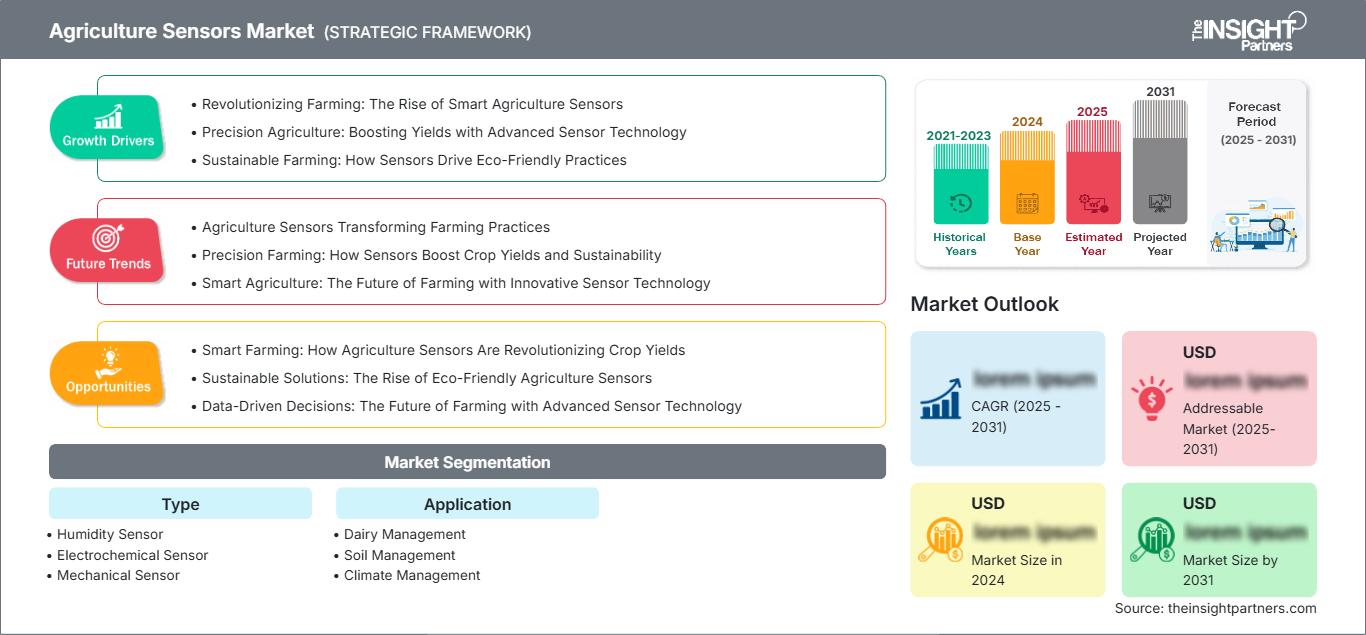
The Agriculture Sensors market was valued at US$ 2.66 billion in 2025 and is expected to reach US$ 6.61 billion by 2034; it is estimated to record a CAGR of 10.64% during 2026-2034.
Agriculture Sensors Market Assessment and Insights
- North America: The region held 34–37% share in 2025 and is growing at a CAGR between 10.8–11.6% during 2026–2034, driven by precision irrigation, fleet connectivity, and high-value dairy automation.
- US: The U.S. represented 74–78% of North America in 2025 and is growing at a CAGR between 10.6–11.4%, supported by large-scale row crops and connected equipment ecosystems.
- Europe: Europe accounted for 24–27% share in 2025 and is growing at a CAGR between 10.2–11.0%, led by Germany, France, the UK, Italy, and Spain through CAP-linked digitalization.
- Asia Pacific: Asia Pacific held 23–26% share in 2025 and is growing at a CAGR between 13.4–14.2%, with China, India, Japan, South Korea, and Australia scaling smart irrigation and protected farming.
- Largest Segment: Soil management held 38–42% market share in 2025 and is growing at a CAGR between 11.5–12.3%, as moisture and nutrient monitoring anchor input efficiency.
- High Growth Segment: Water management held 22–26% market share in 2025 and is growing at a CAGR between 13.6–14.4%, reflecting drought risk and irrigation automation demand.
- Key companies analyzed in detail: Texas Instruments Incorporated, Auroras s.r.l., Robert Bosch GmbH, Ag Leader Technology, Avidor High Tech Ltd., Pycno Agriculture, Trimble Inc., CropX Inc., The Yield Technology Solutions Pty Ltd, METER Group, Inc. USA, Libelium Comunicaciones Distribuidas S.L., and Deere & Company.
Source: The Insight Partners' analysis based on proprietary research, government publications, company annual reports, investor presentations, industry databases, and expert interviews.
The Agriculture Sensors market has advanced from isolated field probes to an integration of edge devices, wireless networks, cloud-based analysis, and farm management software. Early implementations concentrated on soil moisture and weather stations, whereas present-day technologies tend to integrate electrochemical, optical, livestock, and water sensors along with predictive modeling tools. The production process is changing as well due to the introduction of ruggedized parts by semiconductor companies, agriculture experts, and machinery manufacturers.
Moving forward, growth in the Agriculture Sensors Market is forecasted to be influenced by factors such as water stress, digital farming subsidy, and climate-resilient agricultural production policy in the emerging geographies. It is anticipated that irrigation intelligence would receive more focus in the Asia Pacific and Middle East regions, while traceability and environmental compliance would receive more importance in Europe.
Agriculture Sensors Market Report Scope
| Report Attribute | Details |
|---|---|
| Market size in 2025 | US$ 2.66 Billion |
| Market Size by 2034 | US$ 6.61 Billion |
| Global CAGR (2026 - 2034) | 10.64% |
| Historical Data | 2021-2024 |
| Forecast period | 2026-2034 |
Agriculture Sensors Market Analysis
The driver for demand comes from the need for increased production, while lowering consumption of water, fertilizers, labor, and animal health. According to FAO, production needs to increase 70% until 2050 to feed everyone. As such, the incorporation of sensors into efficient resource utilization is an integral part of climate-smart agriculture.
Supply factors include semiconductor availability, quality of calibration, battery life, and interoperability. Subscription services that provide analytics are a key factor for increasing market share in the Agriculture Sensors Market.
The market structure continues to be fragmented, although it is trending towards being more platform-centric. Texas Instruments Incorporated and Robert Bosch GmbH provide sensing and electronics capabilities, while CropX Inc., METER Group, Inc. USA, Pycno Agriculture, and The Yield Technology Solutions Pty Ltd are involved in field intelligence. Trimble Inc., Deere & Company, and Ag Leader Technology enhance their distribution channels through machine-centric business processes.
The investments in agricultural sensors will shift towards sensor fusion, decision-making automation, and low-cost implementations for mid-size farms. In terms of strategic positioning, companies with validated hardware, agronomy, and services have a distinct advantage, since farmers are looking at their Agricultural Sensors Market analysis in terms of return on water savings, yield stabilization, and reduced labor costs.
● REPORT CUSTOMIZATION
Tailor This Report To Align With Your Specific Business Requirements
This report can be customized to align precisely with your business objectives, scope, and target markets. Customization options include tailored segmentation, geography, competitive analysis, and strategic insights to support informed decision-making.
Customize This Report →WHAT YOU CAN ADJUST
- ● Segmentations
- ● Geography
- ● Competitive Analysis
- ● Language Preferences
Agriculture Sensors Market: Strategic Insights
Regional Insights
North America Agriculture Sensors Market
Share of North America was at 34-37% in 2025, registering growth at a CAGR of 10.8-11.6% in 2026-2034. High adoption rates have been observed in large row crop farms, specialty crops, and dairies through the use of moisture, weather, and livestock sensors connected to decrease manual scouting and enhance input timings.
The region has already seen advantages in the form of a robust dealer network, telematics, and digital agronomy services. According to the USDA Economic Research Service, in 2023 guidance autosteering was utilized on 70% of large-scale crop farming operations in US.
U.S. Agriculture Sensors Market
The U.S. represented 74–78% of North America in 2025 and is growing at a CAGR between 10.6–11.4% through 2034. Corn, soybean, almond, vineyard, and dairy producers use soil, optical, pressure, and livestock sensors to manage irrigation scheduling, animal welfare, nutrient plans, and equipment utilization.
Company presence is broad, with Texas Instruments Incorporated, Trimble Inc., Deere & Company, METER Group, Inc. USA, CropX Inc., and Ag Leader Technology supporting components, platforms, and channel access. Application demand is strongest in soil management and water management, where drought exposure and high-value crops sharpen payback expectations. The Agriculture Sensors Market report highlights the growing importance of sensor-based decision-making in optimizing resource use, improving crop productivity, and supporting precision agriculture strategies.
Europe Agriculture Sensors Market
Europe held 24–27% share in 2025 and is growing at a CAGR between 10.2–11.0%, with Germany the leading country. The UK market is shaped by labor scarcity, horticulture automation, and livestock productivity needs, encouraging uptake of climate, optical, and dairy management sensors. The Agriculture Sensors Market forecast indicates continued growth across the region as precision agriculture adoption, sustainability goals, and farm digitalization initiatives drive demand for advanced sensing technologies.
There is consistent demand for pressure, airflow, soil, and water sensors in Germany because of machinery engineering, milk intensity, and reporting obligations regarding the environment. There is reliability of components through Robert Bosch GmbH and technology providers associated with the equipment, while digital farm pilots promote the use of sensors among cooperatives and large farms.
France, Italy, and Spain expand the reach of the Agriculture Sensors Market through vineyards, orchards, greenhouse vegetables, and irrigation districts. 79% of participants in the 2025 European Commission's farm survey in nine member states used one or more technologies specific to crops.
APAC Agriculture Sensors Market
The APAC region constitutes a 23-26% share in 2025 and is growing at a CAGR of 13.4-14.2%. China leads in the APAC region. The application of sensors includes crop protection farming, rice irrigation, orchards, and livestock.
The industrial drivers are electronics manufacturing capability, decreasing cost of IoT modules, and integration with mobile advisory platforms. Policies for water conservation, food security, and digital village help in adoption, especially when small farmers' consolidation reduces device and service costs.
India and Australia have strong demands for water management, whereas Japan and South Korea stress greenhouse automation.
Middle East & Africa Agriculture Sensors Market
The Middle East & Africa region is expanding at a CAGR of 12.7–13.5%. Saudi Arabia is the frontrunner in terms of sensor deployment. Controlled-environment agriculture, water desalination efficiency, and greenhouse environmental sensors have gained priority in their food security measures.
South Africa utilizes soil and water sensors in orchards, vineyards, and commercial grain farms. The Rest of MEA is still in the nascent stages of adopting IoT. Irrigation requires energy consumption, and unpredictable climatic conditions make scheduling critical in terms of saving costs.
Segmentation Analysis
Type
The CAGR for Type will be in the range of 11.7–12.5% over 2026–2034 as farmers deploy various types of sensors to measure parameters of soil, water, micro-climate, farm equipment, and livestock. The choice of hardware is becoming more dependent on their ability to work with analytics, durability, calibration requirements, and connectivity than on standalone measurements.
- Humidity Sensor demand is strongest in greenhouses, storage areas, and dairy sheds, where microclimate control affects disease pressure, animal comfort, and product quality.
- Electrochemical Sensor adoption supports nutrient, pH, and salinity monitoring, making it strategically important for fertigation programs and precision soil health management.
- Mechanical Sensor use remains relevant in machinery, load, and movement monitoring, especially where equipment condition and automated controls influence field productivity.
- Airflow Sensor deployment is tied to controlled environments, grain storage, and livestock housing, where ventilation accuracy supports quality, welfare, and energy efficiency.
- Optical sensors are increasing in demand in crop health analysis, canopy monitoring, and image-based systems, offering contact-free information for disease analysis, stress, and yield analysis.
- The applications of pressure sensors include irrigation networks, spray nozzles, pumps, and fluid-based systems, allowing users to monitor leakages and deliver fluid reliably.
- Water sensors are of strategic significance in drought-prone regions, where users can monitor water level, water flow, and water quality for irrigation planning and conservation.
- Demand for soil sensors is highest amongst crop farms since moisture, temperature, and nutrient measurement are essential for irrigation and fertilization planning and scouting.
- Livestock sensors are gaining traction in the dairy farm industry through activity, rumination, temperature, and location-based measurements.
Application
Application is growing at a CAGR between 12.0–12.8% during 2026–2034 as sensor data becomes operationally embedded in dairy, soil, climate, and water workflows. Buyers increasingly prioritize measurable outcomes such as lower irrigation volume, improved feed efficiency, fewer crop stress events, and faster intervention decisions.
- Dairy Management relies on animal and environmental sensors to monitor the animal’s behavior, heat stress, rumination, and the environment in the barn, enabling better preventative medicine and more productive herds.
- Soil Management is the biggest implementation since moisture and nutrient sensing enable farmers to save on inputs, plan their irrigation, and keep the crops healthy.
- Climate Management implementation is most prevalent in greenhouses, orchards, and other high-value crops because the data about temperature, humidity, radiation, and air flows enables automation.
- Water Management is the most rapidly scaling implementation due to the need to show the impact of drought and the cost of pumping water.
Opportunity Snapshot
| Segment Name | Revenue Contribution | Trend Tag | Adoption Stage |
| Dairy Management | Medium | Herd Alerts | Scaling |
| Soil Management | High | Moisture Maps | Mature |
| Climate Management | Medium | Microclimate Control | Scaling |
| Water Management | High | Irrigation Automation | Scaling |
Agriculture Sensors Market Growth Drivers and Impact Analysis
Water Scarcity Accelerating Sensor-Based Irrigation
Agriculture is responsible for more than 70% of the world’s water withdrawals for any use, as stated by the World Economic Forum’s 2025 water management study, which makes it crucial from a commercial as well as policy point of view. Sensors for measuring soil moisture content, pressure, water flow rate, and quality make the scarce water resources available to farmers in terms of efficient scheduling information. These sensors will have maximum impact on orchards, vineyards, greenhouses, and drought-resistant crop fields.
Precision Agriculture Adoption Creating Installed-Base Pull
The presence of monitoring, mapping, navigation, and prescriptions in existing precision agriculture systems makes an immediate avenue for sensor upgrades, as they already exist in these systems. The U.S. GAO stated that 27% of farms or ranches were practicing precision agriculture in 2023, whereas, according to USDA ERS, it was highly adopted by large farms. This helps overcome training difficulties and fosters compatibility of data in addition to package sales in the Agriculture Sensors Market.
Climate Volatility Increasing Need for Real-Time Field Data
Increased heat waves, droughts, and variations in rainfall make it more important than ever to have local monitoring. The climate-smart agricultural approach from FAO focuses on adaptation, productivity, and mitigation, and this is highly consistent with the use of sensors in decision-making. Weather stations, humidity sensors, optical systems, and livestock monitors enable farmers to recognize problems before there are any impacts on production or the health of the animals.
Agriculture Sensors Market Future Trends
Sensor Fusion Moving from Monitoring to Recommendation Engines
Future platforms will increasingly combine soil, water, climate, optical, machinery, and livestock readings into recommendation engines rather than separate dashboards. This shift will make the Agriculture Sensors Market growth more dependent on analytics quality, agronomic validation, and integration with irrigation controllers, sprayers, and herd systems. Suppliers that can translate mixed data streams into clear actions, alerts, and prescriptions will capture higher recurring revenue and reduce customer churn compared with hardware-only models.
Low-Power Connectivity Expanding Remote Farm Coverage
Low-power wide-area networks, satellite IoT, and edge processing will expand sensor deployment beyond farms with reliable broadband. This is particularly important for rangelands, irrigation districts, and dispersed smallholder clusters. As battery life improves and devices transmit only exception-based alerts, maintenance costs should decline. The trend will widen the Agriculture Sensors Market size opportunity by making recurring monitoring practical in locations where manual inspection and cellular coverage are costly or inconsistent.
Agriculture Sensors Market Opportunities
Bundled Irrigation Intelligence for Water-Stressed Crops
Vendors can capture value by bundling soil moisture probes, flow meters, pressure sensors, weather data, and irrigation scheduling software for high-value crops. The strongest opportunities are in almonds, grapes, greenhouse vegetables, citrus, and water-intensive field crops, where avoided stress and reduced pumping costs support measurable returns. Partnerships with irrigation installers, water districts, and agronomy consultants can shorten sales cycles and make the Agriculture Sensors Market analysis easier for growers evaluating capital budgets.
Dairy Sensor Platforms Linking Welfare and Productivity
Dairy management offers an opportunity for integrated livestock and barn-environment monitoring. Activity, rumination, temperature, humidity, and airflow sensors can identify heat stress, illness, and reproductive events earlier than visual inspection. Solutions that connect alerts to herd management software, veterinary workflows, and feed strategies can deliver measurable labor and productivity benefits. This opportunity is attractive in North America and Europe, while APAC dairy modernization creates a longer-term scaling pathway.
Recent Developments
- April 2026: CropX Technologies, a global leader in digital agronomy solutions, today announced the addition of Apex to its sensor portfolio: a multi-depth soil sensor with configurable depth options and continuous, high-resolution root zone sensing, fully integrated into the CropX digital agronomy platform.
- August 2025: OMRON Electronic Components, a global leader in innovative component solutions, has announced the release of its next-generation Weather Sensor designed to meet the growing demand for reliable environmental data across agriculture, meteorology, and smart city applications. OMRON’s new Weather Sensor delivers robust, real-time insights—empowering more responsive and resilient infrastructure and operations.
- November 2025: Internet Initiative Japan Inc. (IIJ) and Sony Semiconductor Solutions Corporation (Sony) today announced the signing of an agreement to establish a joint venture that will offer soil moisture sensors and irrigation navigation services for smart agriculture. The new company is scheduled to begin operations in April 2026. By combining IIJ’s expertise in communication technologies and smart agriculture with Sony’s technological capabilities in sensor development and other areas, the company aims to support improvements in work quality and efficiency in agricultural practices, while contributing to sustainable agriculture that is resilient to climate change.
Frequently Asked Questions

- Comprehensive Market Sizing and Forecast Analysis
- Detailed Segmentation Analysis
- In-Depth Market Dynamics Assessment
- Regional and Country-Level Insights
- Competitive Landscape and Company Benchmarking
- Strategic Business Intelligence
Recent Reports
Testimonials

The Insight Partners provided valuable market intelligence that supported our global go-to-market strategy. Their team was professional, responsive, and attentive to our feedback, providing thoughtful analysis and helpful methodological clarifications throughout the project.
Junmo Kim Chief Financial Officer (CFO), Enertech Co., Ltd.
The Insight Partners' SCADA System Market report is comprehensive, with valuable insights on current trends and future forecasts. The team was highly professional, responsive, and supportive throughout. We are very satisfied and highly recommend their services.
RAN KEDEM Partner, Reali Technologies LTDs
I requested a report on a very specific software market and the team produced the report in a few days. The information was very relevant and well presented. I then requested some changes and additions to the report. The team was again very responsive and I got the final report in less than a week.
JEAN-HERVE JENN Chairman, Future Analytica
We worked with The Insight Partners for an important market study and forecast. They gave us clear insights into opportunities and risks, which helped shape our plans. Their research was easy to use and based on solid data. It helped us make smart, confident decisions. We highly recommend them.
PIYUSH NAGPAL Sr. Vice President, High Beam Global
The Insight Partners delivered insightful, well-structured market research with strong domain expertise. Their team was professional and responsive throughout. The user-friendly website made accessing industry reports seamless. We highly recommend them for reliable, high-quality research services
YUKIHIKO ADACHI CEO, Deep Blue, LLC.
This is the first time I have purchased a market report from The Insight Partners.While I was unsure at first, I visited their web site and felt more comfortable to take the risk and purchase a market report.I am completely satisfied with the quality of the report and customer service. I had several questions and comments with the initial report, but after a couple of dialogs over email with their analyst I believe I have a report that I can use as input to our strategic planning process.Thank you so much for taking the extra time and making this a positive experience.I will definitely recommend your service to others and you will be my first call when we need further market data.
JOHN SUZUKI President and Chief Executive Officer, Board Director, BK Technologies
I wish to appreciate your support and the professionalism you displayed in the course of attending to my request for information regarding to infectious disease IVD market in Nigeria. I appreciate your patience, your guidance, and the fact that you were willing to offer a discount, which eventually made it possible for us to close a deal. I look forward to engaging The Insight Partners in the future, all thanks to the impression you have created in me as a result of this first encounter.
DR CHIJIOKE ONYIA MANAGING DIRECTOR, PineCrest Healthcare Ltd.Reason to Buy
- Informed Decision-Making
- Understanding Market Dynamics
- Competitive Analysis
- Identifying Emerging Markets
- Customer Insights
- Market Forecasts
- Risk Mitigation
- Boosting Operational Efficiency
- Strategic Planning
- Investment Justification
- Tracking Industry Innovations
- Aligning with Regulatory Trends





 Get Free Sample for