
Air Independent Propulsion for Submarine Market Growth, Share & Trends by 2034
Coverage: By Type (Stirling, MESMA, Fuel Cells, Others); Fit (Line Fit, Retro Fit) , and Geography (North America, Europe, Asia Pacific, and South and Central America)
- Status : Data Released
- Report Code : TIPRE00023775
- Category : Aerospace and Defense
- No. of Pages : 150
- Available Report Formats :


- Last update date : October 30, 2026


2025 Market Size
US$ 429.41 Mn
Base year value
2034 Forecast
US$ 555.33 Mn
Projected by 2034
CAGR 2026-2034
2.9 %
Growth rate
Addressable Market
US$ 4,470.68 Mn
(2026-2034)
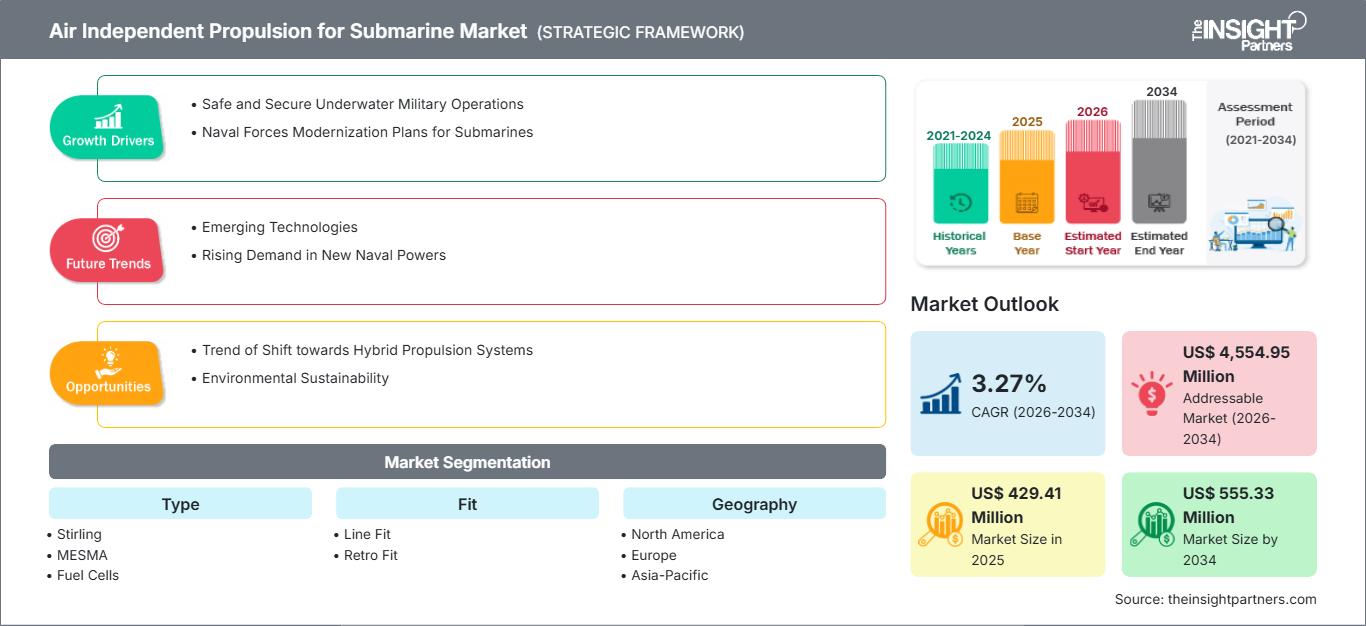
The air independent propulsion for submarine market is projected to expand from US$ 429.41 Million in 2025 to US$ 555.33 Million by 2034, reflecting a CAGR of 2.90% during 2026–2034. The market covers propulsion systems that enable conventional submarines to generate or sustain electrical power while submerged without relying on atmospheric air, with Stirling, MESMA, fuel cells, and other technologies forming the core type segmentation and line-fit and retrofit configurations defining installation pathways.
North America is supported by sustained submarine industrial investment, modernization programs, and technology development across conventional and undersea platforms. The air independent propulsion for submarine market size is influenced by demand for longer submerged endurance, reduced snorkeling exposure, and integration of advanced energy systems with existing diesel-electric architectures. Regional procurement is also shaped by allied interoperability, specialized engineering capabilities, and the availability of mature naval shipbuilding infrastructure.
Air Independent Propulsion for Submarine Market Assessment and Insights
Regional Outlook
- North America: ~32% of the global market in 2025 | ~2% CAGR through 2034. Market position: North America maintains a substantial position because of its deep submarine engineering base, defense research ecosystem, and modernization expenditure. Demand is concentrated around specialized conventional-submarine requirements, allied technology cooperation, and sustainment-oriented integration capabilities.
- US: ~82% of North American market revenue in 2025 | ~2% CAGR through 2034. Market position: The US represents the principal demand center within North America, supported by extensive submarine engineering, component development, and undersea technology capabilities. Conventional AIP remains more specialized than nuclear propulsion, limiting broad domestic platform adoption.
- Europe: ~38% of the global market in 2025 | ~2% CAGR through 2034. Market position: Europe has a mature AIP ecosystem supported by established conventional-submarine programs. Germany, Sweden, France, Spain, the UK, Italy, and other naval powers sustain technology development, with Germany representing a leading country in Europe through fuel-cell expertise and export-oriented submarine programs.
- Asia Pacific: ~23% of the global market in 2025 | ~4% CAGR through 2034. Market position: Asia Pacific is the fastest-growing region as China, Japan, South Korea, India, and Australia expand or modernize undersea capabilities. Large maritime theaters, fleet renewal, indigenous shipbuilding, and investments in submerged endurance support regional adoption.
Segment Outlook
- Stirling: ~48% Share in 2025 | ~2% CAGR through 2034. Market position: Stirling holds the largest position because it has a long operational record on conventional submarines and established integration pathways. Its mature engineering, low acoustic output, and compatibility with diesel-electric architectures support continued procurement and modernization.
- Fuel Cells: ~34% Share in 2025 | ~4% CAGR through 2034. Market position: Fuel cells provide the highest growth trajectory among the principal technologies because they generate electrical power electrochemically with low acoustic and thermal signatures. Their suitability for long-duration submerged operation supports increasing adoption in newer submarine designs.
Competitive Coverage
Saab AB, thyssenkrupp AG, United Shipbuilding Corporation, Naval Group, Navantia, China Shipbuilding Industry Co., Ltd., General Dynamics Corporation, Kongsberg Gruppen ASA, Lockheed Martin Corporation, Siemens AG
Methodology
The Insight Partners follows Data Collection & Secondary Research, Primary Research, Data Analysis, and Data Triangulation & Final Review to validate market estimates and insights.
Source: The Insight Partners' analysis based on proprietary research, government publications, company annual reports, investor presentations, industry databases, and expert interviews.
The development of the AIP system has involved enhancing submerged endurance without the need for the nuclear system’s logistics and infrastructure footprint. The Stirling engine developed a significant operational approach using closed-cycle combustion to develop energy quietly, while the MESMA created a closed-cycle steam turbine configuration. The fuel cell system, on the other hand, shifted the focus to electrochemical production, where hydrogen and oxygen react to produce electricity and water. Current AIP systems increasingly see the technology as part of a hybrid energy architecture involving batteries, diesel generators, and power controls.
The future outlook is guided by the ongoing naval modernization in the Asia Pacific region, the European submarine replacement plans, and the local defense manufacturing capabilities. The Indian Navy is currently designing a domestic integrated fuel cell AIP for its conventional submarines, while Spain is advancing the bioethanol reforming technology through the S-80 program. The European suppliers are continuously improving the fuel cell technology regarding efficiency, modularity, and safety. The procurement and regulatory regimes increasingly favor the lifecycle support, local industrial involvement, energy system safety, and technology sovereignty.
Air Independent Propulsion for Submarine Market Report Scope
| Report Attribute | Details |
|---|---|
| Market size in 2025 | US$ 429.41 Million |
| Market Size by 2034 | US$ 555.33 Million |
| Global CAGR (2026 - 2034) | 2.9% |
| Historical Data | 2021-2024 |
| Forecast period | 2026-2034 |
Air Independent Propulsion for Submarine Market Analysis
The air independent propulsion for submarine market is based on the need to enhance submarine endurance time and limit the number of times the submarine uses snorkel. The AIP propulsion system operates in an extensively integrated value chain that encompasses submarine designs, propulsion systems developers, fuel cell/Stirling engine developers, energy storage companies, oxygen/fuel storage companies, shipyards, combat systems integrators, and naval departments. Thus, demand will be driven more by submarine construction cycles and modernization cycles, rather than by equipment replacement needs and technology qualification and national need for sovereign maintenance.
Supply dynamics will be largely technology-based due to the fact that the AIP system must survive pressure, shock, vibrations, thermal conditions and naval safety specifications. Fuel cell producers must consider the handling of hydrogen, oxygen, water, power control, and heat control. On the other hand, Stirling suppliers will have to maximize their efficiency in combustion, cooling, mechanics and acoustics. Retrofits will be additional difficult due to constraints from hull design, batteries, cooling systems, and auxiliary equipment limiting the space for installation.
Competitive involvement in the air independent propulsion for submarine market report depends on the heritage of technology used and the relationship between the submarine and the platform. Saab AB has a tradition of being involved in Stirling AIP technology; thyssenkrupp AG produces fuel cell systems for conventionally powered submarines. Naval Group integrates AIP systems into French submarines, while Navantia is developing the use of bioethanol fuel cell power generation via S-80. Siemens AG provides fuel cell technology, and Kongsberg Gruppen ASA and Lockheed Martin Corporation have undersea technologies. United Shipbuilding Corporation and China Shipbuilding Industry Co., Ltd. offer the Russian and Chinese industrial capabilities.
Capital expenditure focuses on modular design, efficiency of the fuel cell system, digital power management systems, indigenous production, and integration with contemporary batteries. General Dynamics Corporation and Lockheed Martin Corporation are more concerned with nuclear and other undersea systems rather than AIP segment itself, but their submarine technology skills affect the competition. The overall result favors the integration of propulsion technology with shipyard facilities, qualifications, logistics, and sustenance of fleet capabilities.
● REPORT CUSTOMIZATION
Tailor This Report To Align With Your Specific Business Requirements
This report can be customized to align precisely with your business objectives, scope, and target markets. Customization options include tailored segmentation, geography, competitive analysis, and strategic insights to support informed decision-making.
Customize This Report →WHAT YOU CAN ADJUST
- ● Segmentations
- ● Geography
- ● Competitive Analysis
- ● Language Preferences
Air Independent Propulsion for Submarine Market: Strategic Insights
Regional Insights
North America air independent propulsion for submarine market
North America represents ~32% of the global air independent propulsion for submarine market share in 2025 and is expected to record a ~2% CAGR through 2034. The regional structure differs from Europe and Asia Pacific because the US submarine fleet is overwhelmingly nuclear-powered, making conventional AIP a specialized requirement rather than a broad fleet architecture. Nevertheless, North America retains substantial capabilities in propulsion engineering, naval systems integration, materials, batteries, controls, and undersea research.
The US accounts for ~82% of North American revenue and remains the principal regional center for submarine technology development and supplier activity. General Dynamics Corporation and Lockheed Martin Corporation contribute to the wider submarine industrial ecosystem, while specialist technologies developed by allied companies can enter North American programs through international partnerships. Canada adds potential demand through future conventional submarine modernization considerations, while regional growth is supported by interest in long-endurance underwater platforms and technologies that can complement conventional propulsion architectures.
U.S. air independent propulsion for submarine market
The US represents ~82% of North American revenue in 2025 and is expected to expand at a ~2% CAGR through 2034. Its direct AIP demand remains constrained by the dominance of nuclear propulsion in the US Navy, but the country is important as a center for submarine design, advanced batteries, power electronics, acoustic engineering, autonomy, and undersea mission systems. These capabilities can support AIP-related development even when the propulsion technology is incorporated into allied conventional submarines.
US industry participation is concentrated in broader submarine architectures. General Dynamics Corporation is a major nuclear-submarine builder, while Lockheed Martin Corporation supplies combat and mission-system technologies used across submarine platforms. The application environment therefore includes technology development, subsystem integration, testing, and allied cooperation rather than large-scale domestic AIP fleet procurement. This structure gives the US strategic importance in the supply chain despite its limited conventional-AIP platform base.
Europe air independent propulsion for submarine market
Europe accounts for ~38% of global revenue in 2025 and is projected to grow at a ~2% CAGR through 2034. Germany is a leading country in Europe because of its longstanding fuel-cell submarine expertise, export relationships, and continuing investment in conventional submarine technologies. Sweden is an important Stirling-AIP technology center, while France has contributed significantly to closed-cycle propulsion through MESMA and subsequent AIP development. Spain is expanding its position through the S-80 program and its bioethanol-based fuel-cell system.
The UK maintains advanced submarine engineering capabilities but has a stronger concentration on nuclear-powered submarines. Italy participates in conventional-submarine procurement and European naval industrial programs, while Germany combines domestic platform development with export-oriented submarine production. Across the region, AIP demand is linked to the replacement of aging conventional fleets, export competitions, modernization of existing boats, and requirements for low-signature operations in constrained maritime environments.
European suppliers increasingly focus on modularity and lifecycle upgrades. Saab AB uses Stirling technology within its submarine portfolio, while thyssenkrupp AG continues to develop fuel-cell systems. Naval Group and Navantia pursue different technological approaches, demonstrating that regional demand does not depend on a single AIP architecture. This diversity supports continued technology competition and creates opportunities for equipment suppliers, integrators, and specialized component manufacturers.
APAC air independent propulsion for submarine market
Asia Pacific represents ~23% of global revenue in 2025 and is expected to register a ~4% CAGR through 2034, making it the fastest-growing region. China is the leading country in Asia Pacific by submarine industrial scale and fleet-development activity. Japan has extensive operational experience with Stirling AIP, while South Korea continues to develop AIP-equipped conventional submarines through domestic shipbuilding programs.
India is strengthening indigenous AIP capability through DRDO and submarine integration initiatives, while Australia is moving toward nuclear-powered submarines under AUKUS rather than expanding conventional AIP procurement. Regional demand is supported by long maritime boundaries, underwater surveillance requirements, fleet renewal, domestic shipbuilding policies, and interest in increasing submerged endurance without adopting nuclear propulsion across the entire fleet.
Middle East & Africa air independent propulsion for submarine market
Middle East and Africa demand is expected to grow at a ~3% CAGR through 2034. Saudi Arabia and the UAE are strengthening maritime security capabilities and expanding naval infrastructure, while South Africa maintains a technologically sophisticated submarine operating environment. Conventional submarine procurement in the region is influenced by maritime surveillance, coastal security, strategic sea lanes, and the ability to sustain submerged operations in challenging waters.
The regional air independent propulsion for submarine market remains smaller than Europe and Asia Pacific because submarine fleet sizes and AIP production programs are limited. Nevertheless, countries with established defense procurement relationships can access European and Asian AIP technologies through new-build platforms and modernization packages. Energy infrastructure, fuel availability, technical training, and long-term maintenance support remain important considerations when selecting systems that require specialized storage and onboard energy-management equipment.
Segmentation Analysis
Type
The Type segment in the market is divided into Stirling, MESMA, Fuel Cells, and Others. The air independent propulsion for submarine market scope reflects distinct engineering approaches that convert stored chemical energy into electrical or mechanical power without atmospheric intake.
- Stirling: Stirling systems remain important because of their operational maturity, low acoustic output, and established use in conventional submarines. Their closed-cycle configuration supports prolonged submerged operation while using fuel and liquid oxygen within an integrated energy architecture.
- MESMA: MESMA uses a closed-cycle steam process and has historical relevance in French-designed conventional submarines. Its strategic importance lies in providing an alternative AIP pathway where platform architecture, supplier heritage, and existing fleet experience support continued integration.
- Fuel Cells: Fuel-cell systems convert hydrogen and oxygen into electricity with water as the principal reaction product. Demand is increasing where navies prioritize low acoustic signatures, high electrical efficiency, modular power generation, and extended submerged endurance.
Fit
The Fit segment in the air independent propulsion for submarine market comprises Line Fit and Retro Fit. Line-fit installations are incorporated during submarine construction, allowing the shipyard and propulsion supplier to optimize hull volume, fuel storage, cooling, electrical distribution, and control interfaces from the design stage.
- Line Fit: Line-fit systems are favored for new submarine programs because propulsion architecture can be optimized alongside batteries, generators, cooling systems, and machinery spaces. This approach reduces interface constraints and supports integrated qualification before fleet entry.
- Retro Fit: Retrofit demand is linked to modernization of existing conventional submarines. AIP upgrades can extend useful platform life, but integration requires careful assessment of available volume, structural changes, energy storage, safety systems, and compatibility with existing propulsion and control equipment.
Opportunity Snapshot
| Type | Revenue Contribution | Trend Tag | Adoption Stage |
| Stirling | High | Proven Endurance | Mature |
| MESMA | Low | Legacy Platforms | Mature |
| Fuel Cells | High | Silent Generation | Scaling |
| Others | Low | Niche Architectures | Emerging |
Air Independent Propulsion for Submarine Market Growth Drivers and Impact Analysis
Longer submerged endurance requirements
The principal demand driver is the operational value of extending submerged endurance without repeated snorkeling. Conventional diesel-electric submarines normally rely on batteries during submerged operations and use diesel generators when atmospheric air is available. AIP adds an auxiliary energy source that can sustain lower-power underwater missions for substantially longer periods. This changes the operating profile of the submarine by reducing exposure associated with snorkeling and increasing the time available for surveillance, patrol, intelligence collection, and other low-speed missions. The impact extends beyond the propulsion supplier because greater AIP endurance requires coordinated changes to fuel storage, oxygen storage, cooling, electrical distribution, power management, safety systems, and crew procedures. As navies increasingly emphasize persistent undersea presence, these integration requirements create demand across the wider submarine supply chain.
Modernization of conventional submarine fleets
Fleet modernization is another important driver because AIP can be incorporated into selected retrofit programs where hull design and available machinery volume permit modification. Retrofitting an AIP module can extend the operational relevance of a conventional submarine without requiring a complete replacement of the vessel. The process can also be combined with battery upgrades, combat-system modernization, sensor replacement, communication improvements, and digital control systems. This creates a broader upgrade package rather than a standalone propulsion purchase. Retrofit projects can be particularly relevant to countries seeking to preserve existing submarine capacity while new-build programs progress through lengthy procurement and construction cycles. Suppliers with modular designs, qualification records, and shipyard integration experience can therefore address both equipment demand and engineering-service requirements.
Indigenous submarine technology development
National industrial policies are increasing the strategic importance of domestic AIP development. India’s DRDO is progressing an indigenous fuel-cell AIP system and its integration architecture, while Spain’s S-80 program demonstrates the use of bioethanol reforming to generate hydrogen onboard. Such programs seek greater control over critical technologies, reduce reliance on foreign suppliers, and develop domestic expertise in submarine engineering. The market impact includes investment in fuel processing, fuel-cell stacks, storage systems, safety engineering, power electronics, control software, and qualification facilities. Indigenous programs can also create export potential after systems achieve operational maturity. As governments link naval procurement with technology transfer and local manufacturing, AIP suppliers increasingly compete on industrial participation and lifecycle support as well as propulsion performance.
Air Independent Propulsion for Submarine Market Future Trends
Fuel-cell integration with advanced energy storage
The air independent propulsion for submarine market trends are likely to include closer integration between fuel cells, lithium-ion batteries, power-management systems, and digital controls. Fuel cells provide steady low-signature electrical generation, while batteries can supply higher transient power for maneuvering and mission loads. Coordinating these sources through intelligent energy management can improve the allocation of stored energy across different operating conditions. Future systems are therefore likely to be designed as integrated energy architectures rather than isolated AIP modules. Research into hydrogen storage, reforming, humidification, thermal management, and control algorithms can further improve efficiency and system compactness. For submarine designers, the trend may reduce the distinction between propulsion equipment and onboard electrical infrastructure, increasing the importance of software, sensors, power electronics, and integrated qualification.
Modular AIP architectures for lifecycle upgrades
A second trend is the development of modular AIP architectures that can accommodate evolving batteries, fuel systems, controls, and submarine mission requirements. Modularization can reduce the engineering burden associated with platform upgrades because individual power-generation or support modules can be replaced without redesigning the complete energy architecture. This approach is particularly relevant to long-life submarines that may remain operational for decades and require multiple modernization cycles. Digital twins, condition monitoring, predictive maintenance, and standardized interfaces can support this evolution by improving equipment diagnostics and simplifying lifecycle planning. Suppliers able to demonstrate modular integration across different hull configurations may gain access to both new-build and retrofit programs, particularly where navies seek incremental capability improvements rather than complete platform replacement.
Air Independent Propulsion for Submarine Market Opportunities
Retrofit packages for aging conventional fleets
The air independent propulsion for submarine market Forecasts indicate an opportunity for suppliers that can package AIP technology with batteries, power management, safety systems, cooling equipment, and shipyard engineering for modernization programs. Retrofit demand requires more than a propulsion module because existing submarines were not always designed with sufficient machinery volume or compatible interfaces. Suppliers can differentiate through modular equipment, installation engineering, digital modeling, qualification support, and through-life maintenance. A standardized retrofit architecture could reduce integration time and make AIP upgrades more feasible across related submarine classes. The commercial opportunity is therefore concentrated in integrated modernization packages that allow navies to extend platform utility while improving submerged endurance and reducing dependence on frequent snorkeling.
Domestic production and technology-transfer partnerships
Another opportunity lies in partnerships that combine foreign AIP expertise with domestic submarine construction and component manufacturing. Governments increasingly seek local engineering capability, secure supply chains, and long-term access to critical naval technologies. Suppliers can respond through licensing, joint ventures, local assembly, training, technology-transfer agreements, and co-development programs. Fuel-cell systems are particularly suited to this model because their value chain includes stacks, reformers or hydrogen-storage systems, oxygen handling, power electronics, controls, and safety equipment. The commercial opportunity extends into testing, certification, maintenance, and future upgrades. Partnerships that establish local capability while preserving system-level quality controls can support repeat procurement and improve supplier access to emerging conventional-submarine programs.
Recent Developments
- July 2026: Navantia — Navantia reported the first dive of the S-82 submarine, following the program's continuing development of its S-80 conventional-submarine architecture. The program incorporates the BEST AIP concept, which uses bioethanol reforming to produce hydrogen for fuel-cell power generation. The milestone demonstrates continued progress in Spain's indigenous submarine program and supports the qualification pathway for a third-generation AIP system designed to extend submerged endurance.
- May 2025: thyssenkrupp AG — thyssenkrupp Marine Systems signed a contract with Singapore's Defence Science and Technology Agency for two additional Type 218SG submarines. The order strengthens the company's conventional-submarine production pipeline and is relevant to the AIP ecosystem because the Type 218SG platform uses fuel-cell technology derived from TKMS submarine propulsion expertise. The contract also reinforces the importance of established fuel-cell architectures in export-oriented submarine programs.
- December 2024: Defence Research and Development Organisation — India's Ministry of Defence signed a contract with Mazagon Dock Shipbuilders for construction of the AIP plug and its integration with the DRDO AIP system for conventional submarines. The program is intended to increase submerged endurance and represents a major step in integrating India's indigenous fuel-cell AIP technology into the P-75 submarine architecture.
Frequently Asked Questions

- Comprehensive Market Sizing and Forecast Analysis
- Detailed Segmentation Analysis
- In-Depth Market Dynamics Assessment
- Regional and Country-Level Insights
- Competitive Landscape and Company Benchmarking
- Strategic Business Intelligence
Recent Reports
Testimonials

The Insight Partners provided valuable market intelligence that supported our global go-to-market strategy. Their team was professional, responsive, and attentive to our feedback, providing thoughtful analysis and helpful methodological clarifications throughout the project.
Junmo Kim Chief Financial Officer (CFO), Enertech Co., Ltd.
The Insight Partners' SCADA System Market report is comprehensive, with valuable insights on current trends and future forecasts. The team was highly professional, responsive, and supportive throughout. We are very satisfied and highly recommend their services.
RAN KEDEM Partner, Reali Technologies LTDs
I requested a report on a very specific software market and the team produced the report in a few days. The information was very relevant and well presented. I then requested some changes and additions to the report. The team was again very responsive and I got the final report in less than a week.
JEAN-HERVE JENN Chairman, Future Analytica
We worked with The Insight Partners for an important market study and forecast. They gave us clear insights into opportunities and risks, which helped shape our plans. Their research was easy to use and based on solid data. It helped us make smart, confident decisions. We highly recommend them.
PIYUSH NAGPAL Sr. Vice President, High Beam Global
The Insight Partners delivered insightful, well-structured market research with strong domain expertise. Their team was professional and responsive throughout. The user-friendly website made accessing industry reports seamless. We highly recommend them for reliable, high-quality research services
YUKIHIKO ADACHI CEO, Deep Blue, LLC.
This is the first time I have purchased a market report from The Insight Partners.While I was unsure at first, I visited their web site and felt more comfortable to take the risk and purchase a market report.I am completely satisfied with the quality of the report and customer service. I had several questions and comments with the initial report, but after a couple of dialogs over email with their analyst I believe I have a report that I can use as input to our strategic planning process.Thank you so much for taking the extra time and making this a positive experience.I will definitely recommend your service to others and you will be my first call when we need further market data.
JOHN SUZUKI President and Chief Executive Officer, Board Director, BK Technologies
I wish to appreciate your support and the professionalism you displayed in the course of attending to my request for information regarding to infectious disease IVD market in Nigeria. I appreciate your patience, your guidance, and the fact that you were willing to offer a discount, which eventually made it possible for us to close a deal. I look forward to engaging The Insight Partners in the future, all thanks to the impression you have created in me as a result of this first encounter.
DR CHIJIOKE ONYIA MANAGING DIRECTOR, PineCrest Healthcare Ltd.Reason to Buy
- Informed Decision-Making
- Understanding Market Dynamics
- Competitive Analysis
- Identifying Emerging Markets
- Customer Insights
- Market Forecasts
- Risk Mitigation
- Boosting Operational Efficiency
- Strategic Planning
- Investment Justification
- Tracking Industry Innovations
- Aligning with Regulatory Trends





 Get Free Sample for