
Aircraft Cleaning Chemicals Market Size, Share, Growth & Forecast by 2034
Coverage: by Product (Aircraft Exterior Polish, Aircraft Solvent, Degreasers, Aircraft Paint Stripper, Heavy Duty Oil and Carbon Remover, Runway Rubber Removal, Aircraft Dry Wash Cleaners, Others); Cleaning Type (Exterior Cleaning, Interior Cleaning); End User (Defense Aircraft, Commercial Aircraft, Business Aircraft, Others) , and Geography (North America, Europe, Asia Pacific, and South and Central America)
- Status : Data Released
- Report Code : TIPRE00012656
- Category : Chemicals and Materials
- No. of Pages : 150
- Available Report Formats :


- Last update date : August 05, 2026


2025 Market Size
US$ 2.95 Bn
Base year value
2034 Forecast
US$ 4.17 Bn
Projected by 2034
CAGR 2026-2034
3.91 %
Growth rate
Addressable Market
US$ 32.32 Bn
(2026-2034)
The aircraft cleaning chemicals market was valued at US$ 2.95 billion in 2025 and is projected to reach US$ 4.17 billion by 2034, registering a CAGR of 3.91% during 2026–2034. The market is supported by increasing global aircraft fleet expansion, stringent aviation safety and maintenance standards, and growing emphasis on maintaining aircraft appearance, operational efficiency, and component longevity through specialized cleaning and surface treatment chemicals.
Driven by mature aviation infrastructure, North America remains a leading regional market with an estimated CAGR of 3.4–3.8% through 2034. Rising commercial aircraft utilization, increasing MRO activities, and stringent FAA maintenance regulations continue to stimulate demand for high-performance cleaning formulations. The aircraft cleaning chemicals market size in the region is further supported by expanding airline refurbishment programs and growing adoption of environmentally compliant, low-VOC cleaning chemicals.
Aircraft Cleaning Chemicals Market Assessment and Insights
- North America: Accounted for 34–38% share in 2025 and is expected to grow at a CAGR of 3.4–3.8% during 2026–2034. Strong airline fleets, extensive MRO infrastructure, and increasing adoption of environmentally compliant aviation chemicals continue to support regional demand.
- U.S.: Represented 81–85% of the North American market in 2025 and is anticipated to expand at a CAGR of 3.5–3.9% through 2034, supported by a large commercial fleet, defense aviation activities, and major aircraft maintenance hubs.
- Europe: Held 27–31% share in 2025 and is projected to grow at a CAGR of 3.3–3.7%. Germany, France, and the UK remain leading markets owing to established aerospace manufacturing, airline maintenance facilities, and sustainability regulations.
- Asia Pacific: Accounted for 24–28% share in 2025 and is forecast to register the fastest CAGR of 4.5–4.9%, led by China, India, Japan, and South Korea through expanding airline fleets and rapidly growing MRO capacity.
- Largest Segment: Commercial Aircraft accounted for 64–68% of the Aircraft Cleaning Chemicals Market share in 2025 and is projected to expand at a CAGR of 4.0–4.4%, supported by frequent cleaning cycles and increasing passenger traffic.
- High Growth Segment: Aircraft Dry Wash Cleaners represented 14–18% market share in 2025 and are expected to grow at a CAGR of 5.2–5.6% owing to increasing water conservation initiatives and airport sustainability programs.
- Key companies analyzed in detail: Aero-Sense, Alglas Aviation Supplies, Arrow Solutions, Callington Haven Pty Ltd, Frasers Aerospace, Illinois Tool Works Inc., McGean-Rohco, Inc., Nuvite Chemical Compounds, PPG Industries, Inc., Roovel Solutions Pvt. Ltd., Rx Marine International, Velocity Chemicals Ltd.
Source: The Insight Partners' analysis based on proprietary research, government publications, company annual reports, investor presentations, industry databases, and expert interviews.
In contemporary aircraft maintenance, there is an evident need for aircraft cleaning solutions that can provide efficient cleaning while being friendly both to materials used for construction and the environment. Manufacturers develop more biodegradable solvents, VOCs, phosphate-free degreasers, as well as water saving formulations. The rising use of aircraft, MRO facilities, and refurbishment activities positively influence demand growth within commercial and military sectors of aviation.
The long term forecast is promising since airlines are currently engaged in fleet renewal and sustainability projects. The rising demand for aircraft maintenance services and operations in emerging aviation markets of Asia Pacific, Middle East and Latin America creates additional demand for aircraft cleaning solutions. The rise of regulations and shift towards eco-friendly chemical solutions will promote innovations in the industry.
Aircraft Cleaning Chemicals Market Report Scope
| Report Attribute | Details |
|---|---|
| Market size in 2025 | US$ 2.95 Billion |
| Market Size by 2034 | US$ 4.17 Billion |
| Global CAGR (2026 - 2034) | 3.91% |
| Historical Data | 2021-2024 |
| Forecast period | 2026-2034 |
Aircraft Cleaning Chemicals Market Analysis
The growth in the aircraft cleaning chemicals market can be attributed to increased fleet operations, more MRO operations, and stricter aircraft cleanliness standards. Chemical manufacturers, specialized formulation companies, distributors, MRO service providers, airlines, and defense aviation organizations make up the value chain. The factors impacting the demand include deliveries of aircrafts, number of flights, turnaround time requirements, and the need for efficient cleaning products that increase efficiency and reduce the ecological footprint.
Chemical makers in the aircraft cleaning chemicals market are now developing chemicals that have both excellent performance levels as well as low environmental footprints. The supply chain comprises suppliers of raw materials such as surfactants, solvents, chelators, corrosion inhibitors, and specialty chemicals used to develop cleaners, interior cleaners, degreasers, disinfectants, and dry wash products. The increasing regulations regarding low-VOC formulations are driving suppliers towards sustainable product development.
The aircraft cleaning chemicals market report reveals the presence of a competition structure comprising of global chemical players, providers of specialty chemicals for the aviation industry, and regional formula manufacturers. The likes of Aero-Sense, Callington Haven Pty Ltd, Illinois Tool Works Inc., PPG Industries, Inc., and McGean-Rohco, Inc. have been consolidating their business through innovations in product offering, certification, and collaborations with airlines as well as MROs.
Growing investment trends within the market are oriented towards sustainable chemistry, digitalized maintenance, and products that meet the needs of next generation aircraft materials. There has been an increasing focus towards developing products which would work with advanced composite, lightweight alloy and other sensitive cabin material yet ensure the cleaning efficacy. Expansion of aviation infrastructure within Asia Pacific, the Middle East, and Latin America regions is also fueling this trend among the suppliers.
● REPORT CUSTOMIZATION
Tailor This Report To Align With Your Specific Business Requirements
This report can be customized to align precisely with your business objectives, scope, and target markets. Customization options include tailored segmentation, geography, competitive analysis, and strategic insights to support informed decision-making.
Customize This Report →WHAT YOU CAN ADJUST
- ● Segmentations
- ● Geography
- ● Competitive Analysis
- ● Language Preferences
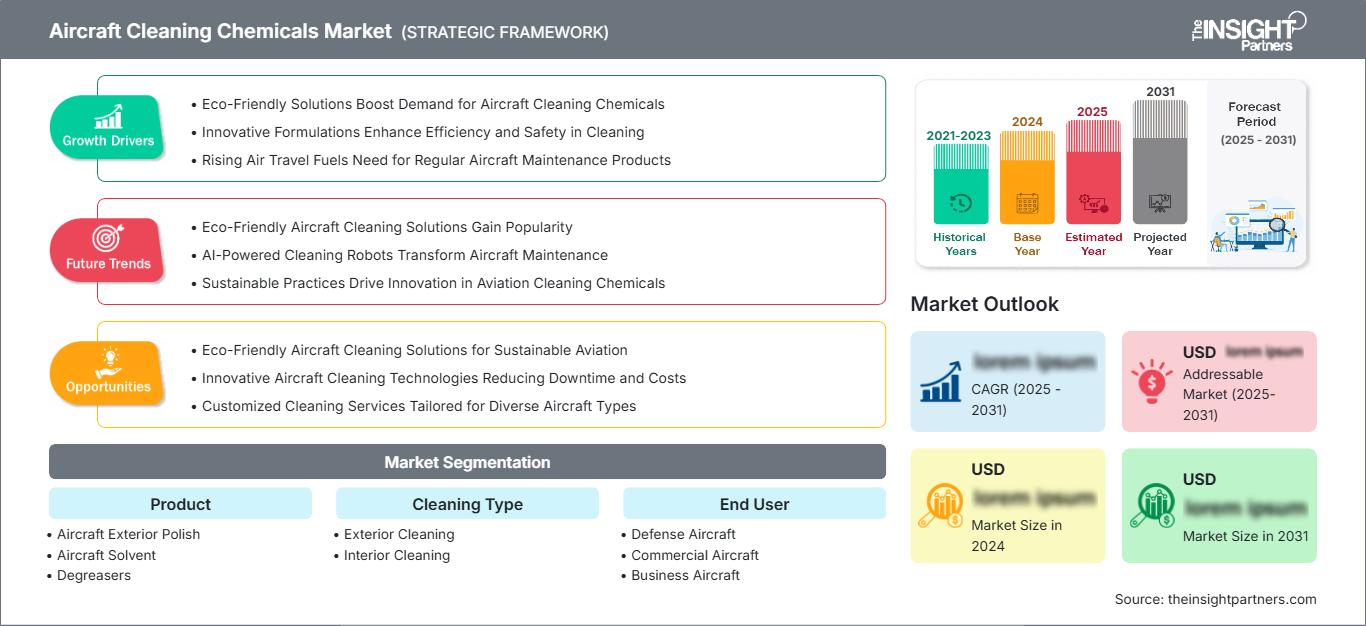
Aircraft Cleaning Chemicals Market: Strategic Insights
Regional Insights
North America Aircraft Cleaning Chemicals Market
North America held a 34–38% share in the aircraft cleaning chemicals market in 2025 and is estimated to witness growth at a CAGR of 3.8–4.2% from 2026 to 2034. The region is expected to witness favorable growth due to the presence of major commercial airlines, large-scale MRO facilities, strict FAA maintenance rules, and regular fleet upgradation. The rising preference for biodegradable and low-VOC products helps aircraft service providers in complying with environmental norms as well as minimizing maintenance downtime.
Investments in airport expansions, military fleet preparations, and advanced maintenance capabilities of next generation commercial aircraft are continuing in the US and Canada. The growth in the number of passengers, the rising use of narrow body aircrafts, and increased maintenance frequency are driving the demand for exterior cleaner, degreaser, dry wash, and specialty solvent. Efficient manufacturing operations and presence of companies like Illinois Tool Works Inc., PPG Industries, Inc., and McGean-Rohco, Inc. help to drive the regional demand, while OEM approved products will be preferred by airlines for longer lifespan and corrosion resistance.
U.S. Aircraft Cleaning Chemicals Market
The U.S. accounted for 76%-80% of the North American aircraft cleaning chemicals market in 2025 and is projected to grow at a CAGR of 3.9%-4.3% during 2026-2034. The U.S. houses one of the largest commercial airline industries along with many military aircraft facilities. The market share for aircraft cleaning chemicals is still the highest in the world due to regular maintenance, regulation compliances, and continuous fleet upgradation.
The factors that are driving demand include large airlines, defense establishments, business jets, and maintenance companies. There is an increase in the use of water-based cleaning solutions, degreasers, and aircraft exterior wash system due to lower maintenance cost and improved sustainability performance. Domestic producers continue to develop better formulations which are suitable for composite materials, new coatings, and aircraft electronics.
Europe Aircraft Cleaning Chemicals Market
The Europe captured 27-31% of the market share in 2025 and the growth is predicted to continue with the CAGR of 3.6-4.0% between 2026 and 2034. Europe region is benefiting from the presence of aerospace manufacturing, airline operations, and strict environmental laws that drive the need for sustainable cleaners. France and Germany are still dominant with the help of their robust aircraft manufacturing and maintenance operations.
The United Kingdom enjoys a good standing with the help of its sophisticated aerospace supply chain, the presence of MRO service providers, and defense aviation. The airlines continue using biodegradable products instead of solvents in accordance with European environmental laws with minimal operational downtimes.
Germany stands ahead of other countries in continental Europe with the help of its aerospace engineering capability, production of aircraft components, and technologically advanced maintenance facilities. Continuous investment in digital maintenance platforms and high-end aviation operations drive demand for specialty cleaners with better material compatibility.
France, Italy, and Spain together make up an important regional Aircraft Cleaning Chemicals market with the help of Airbus manufacturing, increasing tourism driven aviation operations, and upgrading of airports. Growing investments in sustainable operations of the aviation industry and eco-friendly maintenance operations drive the demand for advanced cleaners.
APAC Aircraft Cleaning Chemicals Market
Asia Pacific accounted for 24–28% of the market in 2025 and is forecast to register the fastest CAGR of 4.4–4.8% between 2026 and 2034. China leads regional demand, followed by India, Japan, South Korea, and Australia, supported by rapid fleet expansion, increasing passenger traffic, and growing investments in domestic MRO facilities.
Aviation infrastructure improvement projects launched by governments, in addition to higher deliveries of aircraft in both commercial and military markets, are driving the demand for premium cleaning chemicals. At the same time, regional producers are boosting their manufacturing capacities to cut reliance on imported aviation maintenance chemicals.
Middle East & Africa Aircraft Cleaning Chemicals Market
Growth is expected at a CAGR of 4.0%-4.4% until 2034 in the Middle East & Africa market, driven by the expansion of air fleets as well as investments made towards aviation infrastructure. The countries of Saudi Arabia and UAE contribute most to this market growth, whereas South Africa holds the largest share in aircraft maintenance activities in Africa.
The existence of large international airports, the increase in defense aviation spend, as well as airport expansion initiatives, keep driving the demand for superior quality aircraft cleaning products. A greater emphasis placed on sustainable aviation operations drives aircraft maintenance service providers in the region towards eco-friendly cleaning products.
Segmentation Analysis
Product
The Product segment is anticipated to expand at a CAGR of 4.0–4.3% during 2026–2034. Product innovation remains central to market competitiveness as airlines and MRO providers increasingly seek cleaning formulations that deliver superior cleaning efficiency while complying with environmental and aircraft manufacturer specifications. The aircraft cleaning chemicals market scope continues to broaden with the development of biodegradable, low-VOC, water-based, and multifunctional products capable of cleaning modern composite materials without affecting protective coatings or sensitive aircraft components.
- Aircraft Exterior Polish – Aircraft exterior polish is widely used to preserve paint quality, improve aerodynamic efficiency by reducing surface contamination, and protect fuselage surfaces from ultraviolet exposure, oxidation, and environmental pollutants, particularly among commercial and business aircraft operators.
- Aircraft Solvent – Aircraft solvents remain essential for removing grease, hydraulic fluids, adhesives, sealants, and other persistent contaminants during maintenance procedures. Advanced formulations are increasingly designed to comply with environmental regulations while maintaining compatibility with composite structures.
- Degreasers – Degreasers represent one of the most frequently used maintenance chemicals due to their effectiveness in removing lubricants, fuel residues, and heavy industrial contaminants from engines, landing gear, and mechanical assemblies while minimizing corrosion risks.
- Aircraft Paint Stripper – Aircraft paint strippers support repainting, refurbishment, and structural inspection activities by efficiently removing existing coatings without damaging aluminum alloys or composite materials, enabling longer aircraft service life and improved maintenance quality.
- Heavy Duty Oil and Carbon Remover – These specialized formulations are extensively applied during engine maintenance to eliminate baked-on carbon deposits, combustion residues, and heavy lubricants, improving inspection accuracy and maintenance efficiency for commercial and military fleets.
- Runway Rubber Removal – Runway rubber removal chemicals help airports maintain optimal runway friction by eliminating accumulated tire rubber deposits, contributing to operational safety, regulatory compliance, and consistent aircraft braking performance.
- Aircraft Dry Wash Cleaners – Aircraft dry wash cleaners are gaining popularity because they significantly reduce water consumption while delivering efficient surface cleaning. They are increasingly adopted by airlines operating in water-stressed regions and facilities emphasizing sustainable maintenance practices.
Cleaning Type
The Cleaning Type segment is projected to register a CAGR of 3.8–4.2% during 2026–2034. Growing aircraft utilization rates, increasing maintenance frequency, and stricter cleanliness standards are driving demand across both exterior and interior cleaning operations. Airlines increasingly integrate scheduled cleaning activities with preventive maintenance programs to improve aircraft appearance, passenger comfort, operational reliability, and component longevity while complying with aviation safety standards.
- Exterior Cleaning – Exterior cleaning remains the dominant sub-segment owing to regular removal of dirt, fuel residues, insects, hydraulic fluids, and atmospheric contaminants that can affect aircraft appearance, inspection quality, and aerodynamic performance.
- Interior Cleaning – Interior cleaning demand continues to rise as airlines prioritize passenger hygiene, cabin aesthetics, odor control, and infection prevention. Premium cabin services and enhanced sanitation protocols further support adoption of specialized interior cleaning chemicals.
End User
The End User segment is expected to grow at a CAGR of 4.1–4.5% between 2026 and 2034. Increasing commercial air traffic, defense fleet modernization, and expansion of business aviation continue driving chemical consumption across diverse aircraft categories. Cleaning requirements differ based on aircraft utilization rates, operational environments, maintenance schedules, and regulatory standards, encouraging manufacturers to develop application-specific formulations for each end-user category.
- Defense Aircraft – Defense aircraft require high-performance cleaning chemicals capable of operating under demanding military maintenance conditions while protecting specialized coatings, sensitive electronics, and mission-critical equipment throughout extended operational lifecycles.
- Commercial Aircraft – Commercial aircraft account for the largest demand due to frequent flight schedules, extensive maintenance cycles, high passenger turnover, and continuous emphasis on operational efficiency, regulatory compliance, and passenger experience enhancement.
- Business Aircraft – Business aircraft operators increasingly utilize premium cleaning chemicals that preserve luxury cabin interiors, exterior finishes, and advanced composite materials while minimizing maintenance downtime and maintaining aircraft asset value.
Opportunity Snapshot
| Application | Revenue Contribution | Trend Tag | Adoption Stage |
|---|---|---|---|
| Commercial Aircraft | High | Fleet Expansion | Mature |
| Defense Aircraft | Medium | Mission Readiness | Scaling |
| Business Aircraft | Medium | Premium Maintenance | Scaling |
Aircraft Cleaning Chemicals Market Growth Drivers and Impact Analysis
Expansion of Global Commercial Aircraft Fleet
Growing global air passenger traffic continues to stimulate airline fleet expansion, directly increasing aircraft maintenance frequency and demand for specialized cleaning chemicals. According to industry bodies such as IATA and aircraft manufacturers, thousands of new aircraft are expected to enter service over the coming decades, creating sustained demand for maintenance consumables. Every aircraft undergoes regular exterior washing, interior sanitation, engine cleaning, and component maintenance throughout its operational life. Airlines are also extending aircraft service life through intensive maintenance programs, further increasing chemical consumption. As fleet utilization rises across both developed and emerging aviation markets, demand for environmentally compliant cleaners, degreasers, solvents, and polishing compounds continues to strengthen across commercial aviation maintenance facilities worldwide.
Increasing Adoption of Sustainable Aviation Maintenance Practices
Environmental regulations governing volatile organic compound emissions and hazardous chemical disposal are encouraging airlines and maintenance organizations to replace conventional solvent-based products with biodegradable, water-based, and low-toxicity alternatives. Airports and MRO providers are investing in sustainable maintenance operations that reduce wastewater generation and chemical waste while maintaining cleaning efficiency. Aircraft manufacturers increasingly approve environmentally responsible formulations compatible with composite structures and modern protective coatings. This transition supports continuous innovation among chemical manufacturers, encouraging development of multifunctional cleaning products capable of delivering high performance while complying with evolving environmental regulations. Sustainability objectives are therefore becoming an important purchasing criterion across the global aviation maintenance ecosystem.
Growth of Global MRO Infrastructure
Aircraft maintenance, repair, and overhaul stations are increasingly opening up in Asia Pacific, the Middle East, and Latin America in order to serve the increasing number of fleets within those regions. Governments as well as private entities are investing in maintenance stations in order to limit their reliance on foreign servicing and ensure more efficient operations. Each and every aircraft maintenance station needs a range of aircraft cleaning chemicals in order to clean the aircraft during maintenance, major checks, component cleaning, and rust prevention. The outsourcing of maintenance services by airlines will also lead to higher demand for certified cleaning solutions from the aircraft manufacturers.
Aircraft Cleaning Chemicals Market Future Trends
Growing Preference for Bio-Based and Low-VOC Cleaning Solutions
Airlines and maintenance providers are increasingly transitioning toward biodegradable and low-VOC formulations to comply with tightening environmental regulations and corporate sustainability objectives. These aircraft cleaning chemicals market trends are accelerating research into plant-derived surfactants, water-based degreasers, and environmentally responsible solvents that maintain cleaning efficiency without compromising aircraft material compatibility. Manufacturers are also obtaining additional OEM approvals for sustainable products, enabling wider adoption across commercial, defense, and business aviation. As environmental compliance becomes a procurement priority, demand for greener cleaning technologies is expected to increase steadily throughout the forecast period.
Integration of Smart and Automated Aircraft Cleaning Technologies
Automation is gradually transforming aircraft maintenance activities through robotic exterior washing systems, automated chemical dosing equipment, and digitally monitored cleaning processes. These technologies optimize chemical consumption, improve cleaning consistency, reduce maintenance turnaround time, and enhance worker safety. Chemical manufacturers are responding by developing formulations specifically designed for automated dispensing systems and precision application equipment. The increasing adoption of digital maintenance platforms and predictive maintenance practices is expected to support greater demand for specialized aircraft cleaning chemicals market that deliver consistent performance while minimizing operational costs and environmental impact.
Aircraft Cleaning Chemicals Market Opportunities
Expansion Opportunities in Emerging Aviation Markets
Rapid aviation growth across Asia Pacific, the Middle East, and parts of Latin America is creating attractive investment opportunities for manufacturers of aircraft cleaning chemicals. Aircraft cleaning chemicals market Forecasts indicate that expanding airline fleets, airport construction projects, and newly established maintenance, repair, and overhaul facilities will significantly increase demand for advanced aviation cleaning products. Local production facilities, strategic partnerships with regional distributors, and OEM-approved product portfolios can strengthen market penetration while reducing supply chain costs. Companies capable of offering sustainable formulations alongside technical support and regulatory compliance expertise are expected to gain a competitive advantage as emerging aviation markets continue expanding over the next decade.
Development of Multi-Functional High-Performance Cleaning Products
Growing pressure to reduce maintenance downtime is encouraging airlines and MRO providers to adopt cleaning chemicals capable of performing multiple functions within a single application. Manufacturers have opportunities to develop products that simultaneously clean, polish, protect against corrosion, and preserve composite materials while remaining environmentally compliant. Such multifunctional formulations reduce chemical inventories, simplify maintenance procedures, and improve operational efficiency for fleet operators. Continued investment in research and development, coupled with close collaboration with aircraft manufacturers and maintenance organizations, will support commercialization of next-generation aviation cleaning solutions designed for increasingly advanced aircraft materials and maintenance requirements.
Recent Developments
- October 2025: PPG Industries, Inc. launched a cleaning solvent recycling project with SAIC General Motors, introducing a circular recycling process capable of recovering and reusing up to 80% of waste cleaning solvents. Although developed for automotive manufacturing, the initiative demonstrates PPG's advancement in sustainable cleaning chemistry applicable across industrial sectors, including aerospace maintenance.
- October 2025: Henkel AG & Co. KGaA introduced BONDERITE C-AK DW 805 AERO, a sustainable dry wash aircraft cleaner developed for OEM and MRO applications. The water-saving formulation eliminates the need for rinsing and wastewater treatment while providing high-gloss surface protection against corrosion, UV exposure, and oxidation. The launch supports the aviation industry's transition toward environmentally compliant, low-maintenance cleaning solutions that improve operational efficiency and reduce aircraft downtime.
Frequently Asked Questions

- Comprehensive Market Sizing and Forecast Analysis
- Detailed Segmentation Analysis
- In-Depth Market Dynamics Assessment
- Regional and Country-Level Insights
- Competitive Landscape and Company Benchmarking
- Strategic Business Intelligence
Recent Reports
Testimonials

The Insight Partners provided valuable market intelligence that supported our global go-to-market strategy. Their team was professional, responsive, and attentive to our feedback, providing thoughtful analysis and helpful methodological clarifications throughout the project.
Junmo Kim Chief Financial Officer (CFO), Enertech Co., Ltd.
The Insight Partners' SCADA System Market report is comprehensive, with valuable insights on current trends and future forecasts. The team was highly professional, responsive, and supportive throughout. We are very satisfied and highly recommend their services.
RAN KEDEM Partner, Reali Technologies LTDs
I requested a report on a very specific software market and the team produced the report in a few days. The information was very relevant and well presented. I then requested some changes and additions to the report. The team was again very responsive and I got the final report in less than a week.
JEAN-HERVE JENN Chairman, Future Analytica
We worked with The Insight Partners for an important market study and forecast. They gave us clear insights into opportunities and risks, which helped shape our plans. Their research was easy to use and based on solid data. It helped us make smart, confident decisions. We highly recommend them.
PIYUSH NAGPAL Sr. Vice President, High Beam Global
The Insight Partners delivered insightful, well-structured market research with strong domain expertise. Their team was professional and responsive throughout. The user-friendly website made accessing industry reports seamless. We highly recommend them for reliable, high-quality research services
YUKIHIKO ADACHI CEO, Deep Blue, LLC.
This is the first time I have purchased a market report from The Insight Partners.While I was unsure at first, I visited their web site and felt more comfortable to take the risk and purchase a market report.I am completely satisfied with the quality of the report and customer service. I had several questions and comments with the initial report, but after a couple of dialogs over email with their analyst I believe I have a report that I can use as input to our strategic planning process.Thank you so much for taking the extra time and making this a positive experience.I will definitely recommend your service to others and you will be my first call when we need further market data.
JOHN SUZUKI President and Chief Executive Officer, Board Director, BK Technologies
I wish to appreciate your support and the professionalism you displayed in the course of attending to my request for information regarding to infectious disease IVD market in Nigeria. I appreciate your patience, your guidance, and the fact that you were willing to offer a discount, which eventually made it possible for us to close a deal. I look forward to engaging The Insight Partners in the future, all thanks to the impression you have created in me as a result of this first encounter.
DR CHIJIOKE ONYIA MANAGING DIRECTOR, PineCrest Healthcare Ltd.Reason to Buy
- Informed Decision-Making
- Understanding Market Dynamics
- Competitive Analysis
- Identifying Emerging Markets
- Customer Insights
- Market Forecasts
- Risk Mitigation
- Boosting Operational Efficiency
- Strategic Planning
- Investment Justification
- Tracking Industry Innovations
- Aligning with Regulatory Trends





 Get Free Sample for