
Aircraft Full Authority Digital Electronic Control (FADEC) Market Growth, Demand & Size by 2034
Coverage: By Product (Electronic Engine Controller, Engine Control Unit, Accessories); End User (Commercial Aircraft, Military Aircraft), and Geography (North America, Europe, Asia Pacific, and South and Central America)
- Status : Data Released
- Report Code : TIPRE00016476
- Category : Aerospace and Defense
- No. of Pages : 150
- Available Report Formats :


- Last update date : November 02, 2026


2025 Market Size
US$ 2.73 Bn
Base year value
2034 Forecast
US$ 4.47 Bn
Projected by 2034
CAGR 2026-2034
5.64 %
Growth rate
Addressable Market
US$ 32.65 Bn
(2026-2034)
The aircraft full authority digital electronic control market was valued at US$ 2.73 Billion in 2025 and is projected to reach US$ 4.47 Billion by 2034, expanding at a CAGR of 5.64% during 2026–2034. The market covers electronic systems that digitally manage aircraft engine operation and includes Electronic Engine Controller, Engine Control Unit, and Accessories products across Commercial Aircraft and Military Aircraft end users. Increasing emphasis on propulsion efficiency, engine monitoring, safety, and digitally integrated aircraft systems supports sustained market development.
Across North America, the aircraft full authority digital electronic control market is expected to expand at a CAGR of ~5% through 2034. The region benefits from a large installed base of commercial and military aircraft, established engine-control suppliers, extensive certification capabilities, and continuous investment in propulsion modernization. Replacement demand for electronic control hardware, upgrades to digitally managed engines, and development programs for next-generation propulsion systems provide a stable foundation for regional expansion.
Aircraft Full Authority Digital Electronic Control (FADEC) Market Assessment and Insights
Regional Outlook
- North America: ~36% of the global market in 2025 | ~5% CAGR through 2034. Market position: North America represents the largest regional market, supported by major aircraft and engine programs, a substantial installed fleet, mature aerospace electronics manufacturing, military procurement, and a strong ecosystem of certification, MRO, and propulsion engineering capabilities.
- US: ~82% of North American market revenue in 2025 | ~5% CAGR through 2034. Market position: The US accounts for most North American demand because of its extensive commercial and military aircraft fleet, concentration of propulsion programs, established aerospace electronics suppliers, and recurring requirements for engine upgrades, replacement controls, and digitally integrated propulsion systems.
- Europe: ~29% of the global market in 2025 | ~5% CAGR through 2034. Market position: Europe is a mature market supported by commercial aviation production, defense aerospace programs, engine manufacturing, and established electronic-control capabilities. France, Germany, and the UK are leading countries in Europe, with Italy and Spain contributing through aircraft, engine, and defense supply chains.
- Asia Pacific: ~25% of the global market in 2025 | ~7% CAGR through 2034. Market position: Asia Pacific is the fastest-growing region as fleet expansion, indigenous aerospace manufacturing, defense modernization, and increasing MRO capacity broaden demand. China is the leading country in Asia Pacific, while India, Japan, and South Korea support additional propulsion-system and aerospace-electronics activity.
Segment Outlook
- Electronic Engine Controller: ~56% Share in 2025 | ~6% CAGR through 2034. Market position: Electronic Engine Controller leads the product structure because it directly supports flight-critical engine-management functions, including fuel scheduling, engine protection, monitoring, and performance optimization. Its integration into new engines and replacement cycles across installed fleets sustains demand.
- Military Aircraft: ~31% Share in 2025 | ~7% CAGR through 2034. Market position: Military Aircraft represents the high-growth main segment as defense modernization programs increasingly require digitally controlled propulsion, higher system availability, health monitoring, and upgraded electronic architectures. New combat aircraft, trainers, transports, and rotorcraft provide additional demand opportunities.
Competitive Coverage
BAE Systems, Inc., Collins Aerospace, Continental Aerospace Technologies GmbH, Electronic Concepts and Engineering, Inc., FADEC International, Honeywell International Inc., MEMSCAP SA., Safran, Silver Atena GmbH, Triumph Group, Inc.
Methodology
The Insight Partners follows Data Collection & Secondary Research, Primary Research, Data Analysis, and Data Triangulation & Final Review to validate market estimates and insights.
Source: The Insight Partners' analysis based on proprietary research, government publications, company annual reports, investor presentations, industry databases, and expert interviews.
The aircraft full authority digital electronic control market has evolved from basic electronic engine-management functions toward highly integrated control architectures capable of coordinating fuel flow, engine parameters, protection logic, diagnostics, and performance optimization. Current FADECs include computers, sensors, software, power electronics, and redundant engine control systems in a flight-critical system. The growing complexity of engines has added to the requirements for precision control using digital means, while the manufacture of commercial aircraft and upgrades in military aircraft has added to the numbers requiring electronic engine control. Product development efforts also increasingly incorporate considerations of health management, maintenance, cybersecurity, and processing capability.
In the future, investment will increasingly focus on digitally driven propulsion systems, domestic manufacturing of aerospace electronics, and capabilities that will allow increasingly efficient engines. Up-and-coming aerospace manufacturing facilities in the Asia Pacific region are building up their engineering, electronics, and MRO capabilities, while established regions continue to invest in new aircraft platforms. These developments are strengthening Aircraft Full Authority Digital Electronic Control Market share as regulatory requirements for safety, certification, environmental performance, and system reliability continue influencing architecture and component selection. The resulting demand is expected to favor suppliers capable of combining control hardware, embedded software, sensing, diagnostics, certification expertise, and lifecycle support.
Aircraft Full Authority Digital Electronic Control (FADEC) Market Report Scope
| Report Attribute | Details |
|---|---|
| Market size in 2025 | US$ 2.73 Billion |
| Market Size by 2034 | US$ 4.47 Billion |
| Global CAGR (2026 - 2034) | 5.64% |
| Historical Data | 2021-2024 |
| Forecast period | 2026-2034 |
Aircraft Full Authority Digital Electronic Control (FADEC) Market Analysis
The aircraft full authority digital electronic control market is driven by the increasing complexity of modern propulsion systems and the requirement to coordinate engine operation accurately under changing flight conditions. FADEC architecture enables automated control of fuel flow, engine speed, temperature limits, and other operating parameters while reducing the amount of manual engine-management activity required from flight crews. The ecosystem includes aircraft manufacturers, engine manufacturers, control-system developers, sensor suppliers, electronic-component manufacturers, software developers, certification authorities, and MRO providers. Demand therefore extends beyond initial aircraft production into replacement controls, repair, overhaul, upgrades, and long-term technical support.
Supply dynamics in the Aircraft Full Authority Digital Electronic Control Market report are shaped by stringent qualification requirements, long certification cycles, specialized manufacturing capabilities, and the need for reliable electronic components capable of operating under severe temperature, vibration, electromagnetic, and environmental conditions. BAE Systems, Inc. describes electronic engine controls as flight-critical systems that support engine operation, fuel optimization, monitoring, and failure management, while its installed-base and production activities demonstrate the scale of recurring control-system demand. Suppliers increasingly differentiate through processing capability, redundancy, diagnostics, software integration, and aftermarket support rather than through hardware alone.
Competition in the aircraft full authority digital electronic control market spans large aerospace systems companies and specialist control-engineering firms. Safran has extensive FADEC capabilities across commercial and military propulsion, including FADEC systems for LEAP, GE9X, M88, and other engine platforms, while FADEC International combines BAE Systems and Safran capabilities in commercial engine-control programs. Collins Aerospace and Honeywell participate across broader aerospace electronics, sensing, engine-management, and control ecosystems. Triumph Group, Inc. provides electronic engine controls and FADECs for helicopter and fixed-wing aircraft, including military, commercial, regional, and business-jet applications.
Investment is increasingly directed toward higher processing performance, integrated diagnostics, certification capability, manufacturing resilience, and lifecycle services. The Aircraft Full Authority Digital Electronic Control Market forecast reflects growing demand for advanced control systems with greater processing capability and enhanced health-monitoring functionality. Safran’s FADEC portfolio illustrates this direction, with newer control systems providing substantially greater processing capability and additional health-monitoring functionality. Competitive positioning consequently depends on the ability to participate early in engine and aircraft development programs while retaining aftermarket access throughout the installed lifecycle.
● REPORT CUSTOMIZATION
Tailor This Report To Align With Your Specific Business Requirements
This report can be customized to align precisely with your business objectives, scope, and target markets. Customization options include tailored segmentation, geography, competitive analysis, and strategic insights to support informed decision-making.
Customize This Report →WHAT YOU CAN ADJUST
- ● Segmentations
- ● Geography
- ● Competitive Analysis
- ● Language Preferences
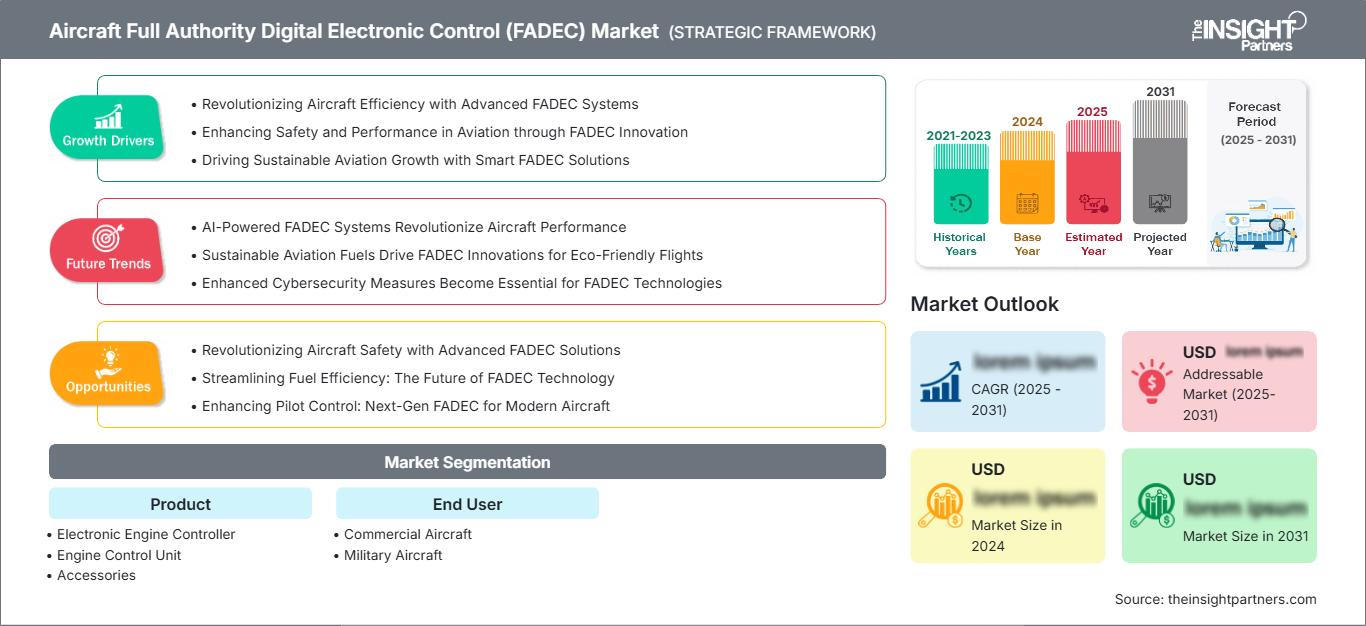
Aircraft Full Authority Digital Electronic Control (FADEC) Market: Strategic Insights
Regional Insights
North America Aircraft Full Authority Digital Electronic Control Market
North America accounted for ~36% of the global market in 2025 and is expected to register a ~5% CAGR through 2034. Aircraft Full Authority Digital Electronic Control Market trends in the region are supported by a large commercial and military aircraft fleet, deep aerospace engineering capabilities, and extensive participation in engine-development and aircraft-production programs. The US represents the principal demand center because major propulsion, avionics, defense, and MRO activities are concentrated there.
The regional ecosystem would further benefit from the presence of existing suppliers of electronic engine controls, sensors, computing, fuel management, and control system integration. There is a widespread application of FADEC systems within various aircraft categories like commercial, military, business, cargo, and others, thus generating the need to produce and install replacement systems time and again. The longevity of an aircraft increases replacement needs. At the same time, military modernization efforts are likely to help invest in digitally controlled engines and better control architecture.
U.S. Aircraft Full Authority Digital Electronic Control Market
The US represented ~82% of the North American aircraft full authority digital electronic control market revenue in 2025 and is projected to grow at a ~5% CAGR through 2034. The prominence of this country within the North American region is due to its commercial and military aviation sector, aerospace manufacturing, and propulsion development. BAE Systems, Inc., Honeywell International Inc., Collins Aerospace, among others, which are leading suppliers in the aerospace industry, are involved in a variety of control system ecosystems.
Demand for commercial aviation includes sustained aircraft manufacturing along with the requirement to maintain and upgrade existing aircraft fleet sizes, and military applications include fighter aircrafts, trainers, transports, helicopters, and other propulsion applications. Certification and testing infrastructure available in the United States helps in the adoption of new control architectures. FADEC technology monitors the engine continuously and can ease the load on the pilots.
Europe Aircraft Full Authority Digital Electronic Control Market
Europe held ~29% of the global aircraft full authority digital electronic control market in 2025 and is expected to expand at a ~5% CAGR through 2034. France is the leading country in Europe, supported by its aircraft-engine, defense, avionics, and aerospace-electronics capabilities. There are other major markets like Germany and the UK, which have their own manufacturing base for aircraft, propulsion systems, defense projects, and specialized electronics manufacturing companies. There are contributions made by Italy and Spain due to aerospace manufacturing, military aviation, aircraft systems, and European supply chain contributions.
The characteristics of the European market include a mature commercial aerospace industry and major defense modernizations. France has a mature FADEC industry for commercial and military applications from Safran, and examples include Airbus A320 family aircraft, Boeing aircraft, and the A400M with M88 controls for Rafale engines.
Investment in Europe is becoming more concentrated in digital propulsion, manufacturing robustness, and defense. Cross-border aerospace projects demand standard certification and high reliability and thus promote suppliers to maintain an integrated design, manufacturing, test, and after-sales support capability. The presence of existing fleets and the ongoing development of aircraft and defense equipment create a fairly stable base of demand.
APAC Aircraft Full Authority Digital Electronic Control Market
Asia Pacific represented ~25% of the global aircraft full authority digital electronic control market in 2025 and is expected to record a ~7% CAGR through 2034, making it the fastest-growing region. China is the dominant nation in the Asia Pacific region, thanks to its development of commercial aircraft, indigenous aerospace manufacturing, and an increasing aviation industry. Japan and South Korea provide their contribution through their aerospace manufacturing and defense programs. India is developing itself in terms of aircraft, engines, electronics, and maintenance, repair and overhaul services.
Growth in aircraft production, an increase in the number of aircraft, indigenous development of defense equipment, and localization efforts are contributing to growth in regional demand. Growth in electronics manufacturing and research and development activities in Bengaluru, India, for Safran is just one example of an increasing trend towards regional capability in aerospace-electronics.
Middle East & Africa Aircraft Full Authority Digital Electronic Control Market
The Middle East & Africa aircraft full authority digital electronic control market is projected to grow at a ~6% CAGR through 2034. These countries serve as important demand centers within the region owing to investments in aviation infrastructure, commercial fleets, defense and MRO. South Africa helps with the existing capabilities in aerospace and defense, whereas the Rest of the MEA market relies on fleet modernization and aviation investments from the government.
UAE is the key country in the Middle East & Africa market where commercial aviation and aerospace infrastructure generate demands for digital propulsion systems and related MRO services. Defense modernization in Saudi Arabia and other regional markets acts as an alternate route. The strategic significance of the region makes it important as an international aviation hub and generates demand for aircraft availability, engine and electronic control MRO services.
Segmentation Analysis
Product
Product segmentation covers Electronic Engine Controller, Engine Control Unit, and Accessories. Electronic Engine Controller is the largest main segment, with a modeled ~6% CAGR from 2026 to 2034 and a ~56% share in 2025. Demand is supported by its central role in regulating propulsion parameters, protecting engines, and coordinating digital control functions. Increasing engine complexity and integration of monitoring capabilities reinforce its importance in both new aircraft and replacement programs.
- Electronic Engine Controller: This product addresses the core digital management requirements of aircraft propulsion systems. Demand follows new engine production, platform upgrades, and replacement cycles, while higher computing requirements and integrated monitoring increase the technical value of controller architectures.
- Engine Control Unit: Engine Control Units provide the computational and control interface between sensors, engine systems, and aircraft commands. Their strategic importance increases as propulsion platforms require greater processing capability, redundancy, diagnostics, and software-enabled management functions.
- Accessories: Accessories include supporting components required for installation, operation, interfacing, and maintenance of electronic engine-control systems. Demand is influenced by system configuration, aircraft integration requirements, replacement activity, and the need to maintain control-system reliability throughout the aircraft lifecycle.
End User
End User segmentation comprises Commercial Aircraft and Military Aircraft. Military Aircraft is the high-growth main segment, with a modeled ~7% CAGR from 2026 to 2034 and a ~31% share in 2025. Defense modernization, propulsion upgrades, higher availability requirements, and increasing integration of digital diagnostics support stronger expansion than the mature commercial installed base.
- Commercial Aircraft: Commercial aircraft represent the largest end-user base because FADEC systems are integrated into modern civil propulsion platforms and supported over long operating lifecycles. New aircraft production, engine replacement, MRO, and fleet modernization create recurring demand.
- Military Aircraft: Military aircraft demand is supported by fighter, trainer, transport, and rotorcraft modernization programs. Requirements for redundancy, mission readiness, harsh-environment performance, diagnostics, cybersecurity, and propulsion upgrades make advanced electronic engine control increasingly important.
Opportunity Snapshot
| End User | Revenue Contribution | Trend Tag | Adoption Stage |
| Commercial Aircraft | High | Fleet Renewal | Mature |
| Military Aircraft | Medium | Defense Modernization | Scaling |
Aircraft Full Authority Digital Electronic Control (FADEC) Market Growth Drivers and Impact Analysis
Increasing Aircraft Production and Propulsion System Complexity
Aircraft production and propulsion-system development are creating sustained requirements for advanced electronic engine controls. Modern engines operate across increasingly complex operating envelopes, requiring accurate management of fuel flow, temperature, pressure, speed, and protection limits. FADEC systems centralize these functions and provide digital control logic that can respond continuously to engine and environmental conditions. Increasing aircraft production therefore creates direct original-equipment demand, while the expansion of installed fleets generates future replacement and support requirements. The impact extends across controllers, sensors, computing hardware, software, testing equipment, and specialized accessories. As engine architectures become more sophisticated, control-system suppliers that can integrate hardware, software, diagnostics, and certification capabilities are positioned to participate across more stages of the propulsion value chain.
Growing Focus on Fuel Efficiency, Monitoring, and Emissions Management
Fuel efficiency and engine health monitoring are strengthening the functional requirements placed on electronic engine controls. FADEC architectures can continuously adjust engine operation according to flight conditions and control limits, allowing propulsion systems to operate closer to optimized performance parameters. BAE Systems notes that its electronic engine controls support fuel optimization, engine monitoring, failure detection, and mitigation functions. These capabilities are increasingly relevant as aircraft manufacturers and engine developers pursue lower fuel consumption and improved operational efficiency. The market impact includes greater demand for processing capability, sensor integration, built-in testing, and software functionality. Suppliers that can combine control with diagnostic and health-monitoring capabilities can address a broader portion of the value chain and support longer lifecycle relationships with aircraft and engine operators.
Defense Modernization and Digitally Controlled Propulsion
Defense modernization is expanding the addressable requirement for advanced engine-control systems across fighters, trainers, transport aircraft, and helicopters. Military platforms operate under demanding environmental and mission conditions, making redundancy, fault tolerance, rapid diagnostics, and reliable power management important design requirements. Modernization programs also create opportunities to replace legacy control architectures without necessarily replacing the complete aircraft platform. Triumph Group, Inc. provides FADEC systems for military and commercial applications, including helicopter platforms requiring dual-channel control and backup functionality. The market impact is strongest where governments are extending aircraft service lives while upgrading propulsion and mission systems. This creates demand for specialized engineering, certification, retrofit integration, and long-term sustainment services.
Aircraft Full Authority Digital Electronic Control (FADEC) Market Future Trends
Higher Processing Power and Integrated Engine Health Monitoring
Future FADEC architectures are expected to combine higher processing performance with increasingly integrated engine health-monitoring capabilities. Control units will increasingly process larger volumes of sensor information while supporting more sophisticated diagnostics, fault detection, and maintenance functions. Safran's FADEC portfolio illustrates this direction, with its FADEC 4 architecture providing substantially greater processing power than earlier generations and additional functionality for health monitoring and maintenance optimization. The trend could shift competitive differentiation toward software capability, processing architecture, cybersecurity, data management, and diagnostic algorithms. Suppliers may increasingly need to demonstrate not only control performance but also how their systems support predictive maintenance, fleet analytics, and lifecycle decision-making.
FADEC Architectures Supporting More-Electric and Next-Generation Engines
Future propulsion programs are likely to require control architectures capable of interfacing with more-electric systems, advanced engine configurations, and new energy-management functions. The FADEC Alliance has previously worked on control-system architecture for advanced propulsion demonstrations involving new interfaces associated with open-fan concepts, illustrating how engine-control requirements evolve alongside propulsion technology. As aircraft architectures become more electrically integrated, control systems may need to coordinate additional interfaces and manage increasingly complex interactions between propulsion, electrical power, and aircraft systems. This trend creates opportunities for modular architectures, higher-speed communications, scalable computing, and control software designed for future certification requirements.
Aircraft Full Authority Digital Electronic Control (FADEC) Market Opportunities
Localized Aerospace Electronics Manufacturing in Emerging Hubs
Expansion of aerospace-electronics manufacturing in emerging markets creates opportunities for suppliers to establish localized production, engineering, repair, and support capabilities. India is an example of this development, with Safran Electronics & Defense announcing a new electronics production site and R&D center in Bengaluru and subsequently expanding its industrial footprint in the country. Localization can reduce supply-chain dependence, improve customer support, and align suppliers with government aerospace-manufacturing initiatives. For FADEC suppliers, the opportunity extends beyond assembly into testing, repair, engineering services, software support, and component qualification. Companies able to establish partnerships with domestic aerospace manufacturers and MRO organizations can strengthen access to emerging aircraft and defense programs while building regional lifecycle-support capabilities.
Lifecycle Services for Installed FADEC Fleets
The installed base of digitally controlled aircraft engines creates opportunities beyond original equipment sales. FADEC systems require inspection, repair, overhaul, replacement, software support, configuration management, and component availability throughout long aircraft operating lifecycles. As fleets age, operators increasingly need reliable access to replacement controls and specialized maintenance expertise while avoiding unnecessary aircraft downtime. Suppliers can expand value capture through exchange pools, repair networks, diagnostics, upgrades, and long-term support agreements. The opportunity is particularly relevant for platforms with large installed fleets, where common control architectures can generate recurring aftermarket demand. A stronger lifecycle-services model can also provide suppliers with operational data and customer relationships that support future controller upgrades and next-generation propulsion programs.
Frequently Asked Questions

- Comprehensive Market Sizing and Forecast Analysis
- Detailed Segmentation Analysis
- In-Depth Market Dynamics Assessment
- Regional and Country-Level Insights
- Competitive Landscape and Company Benchmarking
- Strategic Business Intelligence
Recent Reports
Testimonials

The Insight Partners provided valuable market intelligence that supported our global go-to-market strategy. Their team was professional, responsive, and attentive to our feedback, providing thoughtful analysis and helpful methodological clarifications throughout the project.
Junmo Kim Chief Financial Officer (CFO), Enertech Co., Ltd.
The Insight Partners' SCADA System Market report is comprehensive, with valuable insights on current trends and future forecasts. The team was highly professional, responsive, and supportive throughout. We are very satisfied and highly recommend their services.
RAN KEDEM Partner, Reali Technologies LTDs
I requested a report on a very specific software market and the team produced the report in a few days. The information was very relevant and well presented. I then requested some changes and additions to the report. The team was again very responsive and I got the final report in less than a week.
JEAN-HERVE JENN Chairman, Future Analytica
We worked with The Insight Partners for an important market study and forecast. They gave us clear insights into opportunities and risks, which helped shape our plans. Their research was easy to use and based on solid data. It helped us make smart, confident decisions. We highly recommend them.
PIYUSH NAGPAL Sr. Vice President, High Beam Global
The Insight Partners delivered insightful, well-structured market research with strong domain expertise. Their team was professional and responsive throughout. The user-friendly website made accessing industry reports seamless. We highly recommend them for reliable, high-quality research services
YUKIHIKO ADACHI CEO, Deep Blue, LLC.
This is the first time I have purchased a market report from The Insight Partners.While I was unsure at first, I visited their web site and felt more comfortable to take the risk and purchase a market report.I am completely satisfied with the quality of the report and customer service. I had several questions and comments with the initial report, but after a couple of dialogs over email with their analyst I believe I have a report that I can use as input to our strategic planning process.Thank you so much for taking the extra time and making this a positive experience.I will definitely recommend your service to others and you will be my first call when we need further market data.
JOHN SUZUKI President and Chief Executive Officer, Board Director, BK Technologies
I wish to appreciate your support and the professionalism you displayed in the course of attending to my request for information regarding to infectious disease IVD market in Nigeria. I appreciate your patience, your guidance, and the fact that you were willing to offer a discount, which eventually made it possible for us to close a deal. I look forward to engaging The Insight Partners in the future, all thanks to the impression you have created in me as a result of this first encounter.
DR CHIJIOKE ONYIA MANAGING DIRECTOR, PineCrest Healthcare Ltd.Reason to Buy
- Informed Decision-Making
- Understanding Market Dynamics
- Competitive Analysis
- Identifying Emerging Markets
- Customer Insights
- Market Forecasts
- Risk Mitigation
- Boosting Operational Efficiency
- Strategic Planning
- Investment Justification
- Tracking Industry Innovations
- Aligning with Regulatory Trends





 Get Free Sample for