
Airport and Marine Port Security Market Growth, Demand & Size by 2034
Coverage: by Infrastructure (Airport, Marine port); Technology (Surveillance Systems, Physical Access Control Systems, Screening and Scanning Systems, Perimeter Intrusion Detection System, Network Access Control and Security, Real-Time Location Systems); Services (Facility and Asset Management, System Integration, Training and Consulting) , and Geography (North America, Europe, Asia Pacific, and South and Central America)
- Status : Data Released
- Report Code : TIPRE00011343
- Category : Electronics and Semiconductor
- No. of Pages : 150
- Available Report Formats :


- Last update date : July 17, 2026


2025 Market Size
US$ 14.44 Bn
Base year value
2034 Forecast
US$ 26.58 Bn
Projected by 2034
CAGR 2026-2034
7.01 %
Growth rate
Addressable Market
US$ 185.16 Bn
(2026-2034)
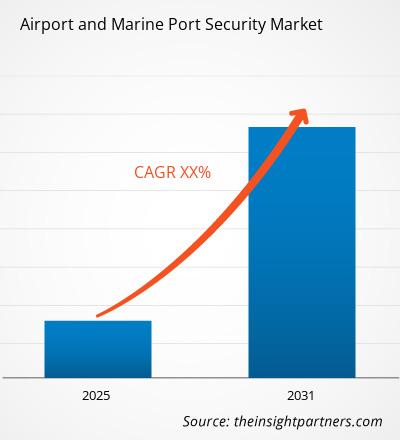
The global Airport and Marine Port Security market was valued at US$ 14.44 billion in 2025 and is expected to reach US$ 26.58 billion by 2034; it is estimated to record a CAGR of 7.01% during 2026-2034.
Airport and Marine Port Security Market Assessment and Insights
- North America North America holds a significant position in the market, accounting for a 31–36% share in 2025 and expanding at a CAGR of 7.3%–7.9% between 2026–2034. The region benefits from airport modernization programs, marine port infrastructure upgrades, and investments in advanced security frameworks.
- US The US represents 78–84% of the North American market share in 2025 and is projected to grow at a CAGR of 7.4%–8.0% during 2026–2034, supported by terminal enhancements, port security initiatives, and integrated surveillance adoption.
- Europe contributes a 24–29% market share in 2025 and is expected to register a CAGR of 7.0%–7.6% from 2026–2034. Germany, the UK, and France remain leading contributors due to certified screening solutions, regulatory compliance, and privacy-aware security analytics.
- Asia Pacific Asia Pacific accounts for a 27–33% share in 2025 and is anticipated to expand at a CAGR of 8.5%–9.2% between 2026–2034. China, India, and Japan are major growth contributors due to airport expansion projects, port automation, and smart infrastructure investments.
- Largest Segment Airport infrastructure represents the largest segment, with a CAGR of 7.6%–8.2% between 2026–2034, supported by passenger screening, identity verification systems, and terminal modernization initiatives.
- High Growth Segment Network Access Control and Security is the high growth segment, with a CAGR of 8.8%–9.6% from 2026–2034, driven by IT-OT convergence, connected infrastructure, and cybersecurity requirements.
- Key companies analyzed in detail: Robert Bosch GmbH, Teledyne FLIR LLC, HCL Infosystems Limited, Honeywell International Inc., Motorola Solutions, Inc., RTX Corporation, Saab AB, Siemens AG, Johnson Controls International plc, Unisys Corporation.
Source: The Insight Partners' analysis based on proprietary research, government publications, company annual reports, investor presentations, industry databases, and expert interviews.
This market is moving from an equipment purchase-based approach to a comprehensive security system. Authorities of airports and ports are looking for detection performance, efficiency, cybersecurity, adaptability, and sustainability of service delivery in the process of system procurement. Security planning is increasingly being regarded in terms of integration of surveillance, scanning, access control, perimeter detection, situation awareness, and network security environment.
Positive market outlook in view of aviation revival, increasing automation in ports, geopolitics, and trade route exposure necessitating secure infrastructure protection is strengthening the Airport and Marine Port Security Market Forecast. Market players such as Bosch Security Systems, FLIR Systems, Inc., HCL Infosystems Limited, Honeywell International Inc., Motorola Solutions, Inc., Raytheon Company, Saab AB, Siemens AG, Tyco International, and Unisys Corporation leverage domain know-how, systems integration, sensors, and security platforms to capitalize on growth opportunities and enhance their competitive positioning.
Airport and Marine Port Security Market Report Scope
| Report Attribute | Details |
|---|---|
| Market size in 2025 | US$ 14.44 Billion |
| Market Size by 2034 | US$ 26.58 Billion |
| Global CAGR (2026 - 2034) | 7.01% |
| Historical Data | 2021-2024 |
| Forecast period | 2026-2034 |
Airport and Marine Port Security Market Analysis
These demand factors involve an increase in the number of passengers, cargo, containers, the possibility of smuggling, uncrewed aircraft, and the need to protect the assets within the high throughput environment without limiting mobility. The airports require faster identification and screening processes. At the same time, the marine ports will need ship monitoring, visibility of the cargo, perimeter monitoring, and protected access for the people and their associates.
The ecosystem consists of sensor manufacturers, camera vendors, radar vendors, biometric vendors, baggage screening technology vendors, cyber security vendors, command center software vendors, system integrators, and managed service providers. As stated in the Airport and Marine Port Security Market Report, the value proposition can be achieved through the integration of detection technologies, workflow management, identity management, emergency response solutions, and networks, among others.
In terms of competition, the market is characterized by a range of industrial conglomerates, defense technologies, public security agencies, IT services firms, and access control firms. Companies such as Honeywell International Inc., Bosch Security Systems, Motorola Solutions, Inc., Saab AB, Siemens AG, Raytheon Company, and FLIR Systems, Inc. have a competitive advantage in fields such as surveillance, sensors, command and control, and critical infrastructure protection.
Concerning investments, there will be increased spending on AI-based analytics, software-defined radar technologies, automated inspection technologies, secure network access, and business models that will ensure the continuous modernization of systems. The positioning strategy will be based on reducing false alarms, increasing throughput, national security considerations, and operator support through training and maintenance.
● REPORT CUSTOMIZATION
Tailor This Report To Align With Your Specific Business Requirements
This report can be customized to align precisely with your business objectives, scope, and target markets. Customization options include tailored segmentation, geography, competitive analysis, and strategic insights to support informed decision-making.
Customize This Report →WHAT YOU CAN ADJUST
- ● Segmentations
- ● Geography
- ● Competitive Analysis
- ● Language Preferences
Airport and Marine Port Security Market: Strategic Insights
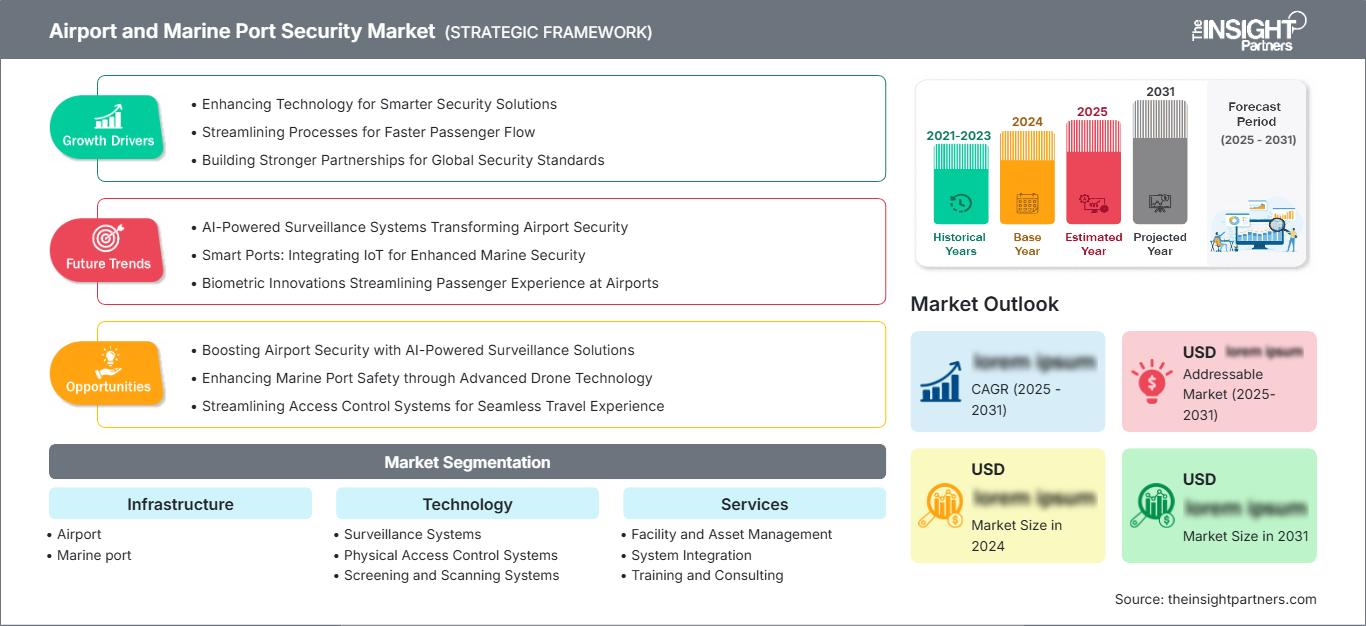
Regional Insights
North America Airport and Marine Port Security
North America Airport & Marine Port Security Market to grow at a CAGR of 7.3%-7.9%, driven by increased airport capacity, automated port services, cyber security spending, and upgrades in the transport infrastructure of federal and municipal authorities. Integrative Command Center facilities, advanced screening processes, perimeter security, and identification systems are needed to handle large numbers of customers.
The factors contributing to this growth include cross-border trades, situational awareness of the maritime environment from a military perspective, resuming air passenger traffic, and ensuring cargo movement is not hindered. The companies leading this market include Honeywell International Inc., Motorola Solutions Inc., Raytheon Company, Bosch Security Systems, and Unisys Corporation.
U.S. Airport and Marine Port Security Market
Approximately 78% to 84% of demand comes from the U.S. market and has been forecast to experience a growth rate of around 7.4% to 8%. There are large airports, seaports, inland transport hubs, and transport corridors that have made investments in screening checkpoints, video analytics, physical access control, and a cyber-safe operational network.
The company's presence consists of Motorola Solutions, Inc., Raytheon Company, Honeywell International Inc., Bosch Security Systems, FLIR Systems, Inc., and Unisys Corporation. Trends in applications include terminal surveillance, access control to restricted areas, container scanning, coastal surveillance, emergency management, and integrated security systems for the airport and port community systems.
Europe Airport and Marine Port Security Market
Europe accounts for about 24-29% of the Airport and Marine Port Security Market share and is set to grow at about 7.0-7.6%. Germany would dominate owing to its elaborate logistics corridors, export-oriented industries, operational airports, and well-equipped ports. Customers require accredited screening, data security analysis, cyber governance, and interoperable solutions with transport security.
The UK Airport and Marine Port Security Market is dependent on international air transport, container handling ports, ferry ports, and border management issues. It entails biometrics processing, CCTV system enhancements, perimeter systems, and network access control.
The countries France, Italy, and Spain generate demand via tourism airports, Mediterranean ports, naval bases and logistics ports for energy, food and industrial chains. France requires airport identity management systems, Italy uses port monitoring and cargo scanning systems, whereas Spain gains via the improvement of their airport and marine ports.
APAC Airport and Marine Port Security Market
APAC region is the fastest growing, with a CAGR estimated at 8.5%–9.2% and a market share of 27%–33%. The leading nation would be China due to huge volumes in ports, airport expansion projects, security programs in smart cities, and transport infrastructure resilience strategies. The aforementioned aspects are responsible for driving Airport and Marine Port Security Market Trends in the region.
For Japan and South Korea, compact yet effective solutions can be considered in airports, container terminals, and coast guard security solutions. Automation, quality of passenger experience, and safety culture would be the drivers behind demand. Screening and scanning solutions, access controls, and real-time location systems can be found in digital processes.
The role played by India and Australia includes new airport construction, industry clusters around ports, maritime security, and cargo security. The increase in infrastructural development and flights will lead to growth in India, while border and coast security will be of significance to Australia. The companies with regional representation include HCL Infosystems Limited, Siemens AG, and Honeywell International Inc.
Middle East & Africa Airport and Marine Port Security Market
The Middle East & Africa Airport and Marine Port Security Market is expected to grow at about 7.6%–8.3%, with Saudi Arabia as the leading country. The demand is linked to airport mega-projects, energy export ports, tourism-related infrastructure development and safeguarding of strategic maritime chokepoints from smuggling, disruption and asymmetric threat.
Both Saudi Arabia and UAE are exploring the development of surveillance and access control solutions along with perimeter and command and control centers in terms of aviation security, ports and logistic centers and energy assets. The harsh climatic conditions necessitate rugged cameras, radar, thermal imaging and low maintenance sensors that will perform well in such harsh environmental conditions.
While South Africa and the rest of MEA region have selective demands for port and mining related logistics, airport security and public safety applications, changing budgetary constraints may slow down implementation of security measures; nevertheless, investments in energy assets, trade security and aviation infrastructures are likely to support growth of the Airport and Marine Port Security Market.
Segmentation Analysis
Infrastructure
Growth in the Infrastructure segment will be 7.4% to 8.0% from 2026 to 2034, owing to investments made by operators in upgrading terminals, berths, gates, warehouses, and restricted areas. The scope of the Airport and Marine Port Security solution is expanding from equipment purchase to comprehensive site resiliency planning.
- Airport: An airport requires multiple screening mechanisms, identification systems, surveillance systems, and access controls to ensure passenger, baggage, aircraft, personnel-only areas, cargo and terminal safety while not impeding throughput.
- Marine port: A marine port requires perimeter monitoring, vessel tracking, cargo inspection, automated gates and network security to ensure maritime traffic, hazardous cargo, logistic assets, and waterborne infrastructure.
Technology
Expected technology growth rate for 2026-2034 will be between 8.0%–8.6%, driven by greater use of analytics, biometric access control, automatic scanning, radar systems, and cyber security-enabled command facilities. Tendencies in Airport & Marine Port Security market are increasingly pointing towards integrated systems that minimize blind spots and coordinate reactions.
- Surveillance Systems: Surveillance systems include the use of stationary, mobile, thermal, and AI-based cameras to observe terminals, yards, berths, restricted areas, parking lots, and access from waterways.
- Physical Access Control Systems: Physical access control systems include the access control of employees, contractors, vehicles, crew members, and service providers through credentials, biometrics, barriers, and identity processes in secure areas.
- Screening and Scanning Systems: Screening and scanning systems scan passengers, baggage, cargo, parcels, containers, and vehicles to detect any prohibited objects and suspicious activities.
- Perimeter Intrusion Detection System: Perimeter intrusion detection systems combine sensors, radar, fencing, video analytics, and alarms to detect unauthorized movement around runways, terminals, warehouses, berths, and critical boundaries.
- Network Access Control and Security: Network access control and security prevent unauthorized access by people, software and cyber attacks to operation technology, surveillance systems, access control, cargo handling systems, and command systems.
- Real Time Location Systems: Real-time location systems keep track of assets, vehicles, people, baggage and emergency equipment in order to provide situational awareness and incident response coordination.
Services
The services will be growing within the range of 7.1% to 7.7% in 2026-2034, owing to the complexity of the system, which demands higher maintenance, integration, training, and support in the lifecycle of the system. The facility owners require partners who can provide them with a cyber-governance framework that suits the changing threat landscape.
- Facility and Asset Management: Facility and asset management is responsible for the maintenance of cameras, scanners, barriers, sensors, networks and control room equipment. The maintenance ensures uptime, readiness, lifecycle information and coordinated security operations.
- System Integration: System integration combines surveillance, screening, access control, intrusion detection, location, cyber security and command systems into integrated workflows that are appropriate for a specific airport or seaport environment.
- Training and Consulting: Training and consulting assist operators in assessing threat levels, developing appropriate procedures and improving response and readiness to incidents, as well as meeting regulatory expectations.
Opportunity Snapshot
| Infrastructure | Revenue Contribution | Trend Tag | Adoption Stage |
| Airport | High | Smart Screening | Scaling |
| Marine Port | Medium | Coastal Surveillance | Scaling |
Airport and Marine Port Security Market Growth Drivers and Impact Analysis
Critical Transport Infrastructure Faces More Complex Threats
The physical penetration, cyber security, cargo tampering, insider threat, unmanned aerial vehicle and sea lines of communication geopolitics are some of the threats facing airports and ports. This has led to the creation of the need for security architecture in addition to equipment procurement. In the market context, there has been more focus on surveillance, perimeter penetration detection, network access control, screening and real time location systems in order to build a common operational picture. Facilities resilience becomes important for security due to the fact that any lapse in security may have repercussions on passengers, logistics, customs and critical national infrastructure continuity. It becomes important in the market context for vendors who have the capability of mitigating vulnerabilities, making use of existing infrastructures and providing incident response. Multi-domain capabilities of companies become very important in the light of this market driver and examples include Motorola Solutions, Inc., Honeywell International Inc., Bosch Security Systems, Raytheon Company, Saab AB and Unisys Corporation.
Automation and Throughput Pressure Reshape Screening Investment
Growing traffic is forcing airports and ports to enhance their security posture without causing operational inefficiencies. Manual screening will continue, but there is a need for automation of screening procedures and lane optimization using biometrics, container inspection, advanced analytics and other technologies that enable efficient processing of individuals and items. From a practical standpoint, the result of this is a change in the purchase criteria from single devices to re-engineered work processes, in which the performance of detection accuracy, queue management, image analysis and alarm resolution is assessed jointly. At airports, these solutions are deployed for screening baggage, passengers, airport personnel, and restricted area access. For ports, the deployment of solutions takes place for cargo, vehicles, port personnel, and ship activities. In this case, system integrators and technology vendors have the competitive edge due to their ability to deliver lower rates of false alarms, higher efficiency of operators, and conformity to current safety standards.
Cybersecurity Becomes Integral to Port and Airport Protection
Security of airports and ports is rapidly becoming reliant on network cameras, access control panels, baggage handling systems, cargo handling platforms, vessel tracking, and command center applications. As the components are being connected, cybersecurity becomes an inseparable element of physical security. Real market effects of the driver include the increased demand for network access control, device security authentication, encryption, vulnerability scanning, and incident recovery capability. Cybersecurity protection of both customer-facing and operational technology that facilitates gates, yards, cranes, fueling stations, warehouses, and emergency facilities is required. The impact of the driver on vendors is that cybersecurity credentials, patch management procedures, data policies, and secure integration capabilities are among the criteria for evaluating vendors, along with hardware capabilities. Unisys Corporation, Siemens AG, Honeywell International Inc., HCL Infosystems Limited, and Bosch Security Systems will be capable of competing when IT, OT, and physical security convergence plays a pivotal role in the procurement process.
Airport and Marine Port Security Market Future Trends
AI-Enabled Surveillance Moves Toward Operational Decision Support
AI-enabled surveillance is moving beyond passive video recording toward operational decision support for airport and port security teams. In the Airport and Marine Port Security Market, future systems will identify unusual movement, unattended objects, perimeter anomalies, restricted-zone access, vessel behavior, and crowd-flow changes while helping personnel prioritize alerts. Forward-looking adoption will depend on accuracy, explainability, privacy controls, and the ability to integrate with access control, incident management, and command-center platforms. This development is especially important for large terminals, cargo yards, cruise ports, and multimodal logistics areas where human monitoring alone cannot scale. Motorola Solutions, Inc., Bosch Security Systems, FLIR Systems, Inc., Honeywell International Inc., and Siemens AG are positioned to benefit when analytics improve response speed without creating excessive false alarms. The strongest demand in the Airport and Marine Port Security Market will come from facilities seeking measurable reductions in monitoring workload, investigation time, and security blind spots.
Integrated Maritime Awareness Expands Beyond Traditional Port Boundaries
Port Security for Marine Ports is moving away from fencing and terminals to a greater awareness of maritime domain awareness. The future system will integrate coastal radar, thermal imagery, vessel tracking, UAV detection, weather-resistant sensors, and command software to detect threats before reaching the port facilities. It is an indication of the significance of uninterrupted trade, energy transports, cruise ship operations, and sovereignty in strategic water passages. Forward-thinking buyers will be on the lookout for a modular system that will be able to protect bridges, towers, breakwaters, off-shore approaches, and port corridor within inland ports without having too much maintenance cost. Saab AB and Raytheon Company will come into consideration when radar and sensor system along with defense-level surveillance, are needed. The potential will become bigger as the port regards its waterside security as part of critical infrastructure protection and not marine safety.
Airport and Marine Port Security Market Opportunities
Retrofit Programs Create Demand for Integration-Led Security Upgrades
Many airports and marine ports operate mixed generations of cameras, card readers, scanners, alarms, servers, and communication systems that were deployed through separate projects. As identified in the Airport and Marine Port Security Market, retrofit programs create a strong opportunity because operators want to improve performance without replacing entire estates at once. Action-oriented suppliers should lead with audits, integration roadmaps, cybersecurity assessments, phased migration plans, and training packages that preserve operational continuity. The investment case is strongest where facilities can reduce blind spots, centralize alarms, improve maintenance visibility, and extend the useful life of existing assets. Bosch Security Systems, Honeywell International Inc., Siemens AG, Motorola Solutions, Inc., Tyco International, and Unisys Corporation can capture value by combining hardware refresh with open architecture, command integration, and managed services. This opportunity rewards vendors that help buyers modernize incrementally while still achieving measurable risk reduction in the Airport and Marine Port Security Market.
Emerging Aviation and Port Corridors Need Scalable Security Models
Emerging aviation and port corridors in APAC, the Middle East, and parts of Africa offer high-potential opportunities because new infrastructure can embed security by design. Airports, logistics parks, free trade zones, and energy-export terminals can adopt scalable architectures that combine screening, surveillance, access control, perimeter detection, and network protection from the planning stage. Investors should prioritize modular systems, local service capability, operator training, and interoperability with customs, border, and emergency agencies. The opportunity is not limited to premium megaprojects; secondary airports and regional ports also need cost-effective security models that can expand with traffic. HCL Infosystems Limited, Honeywell International Inc., Siemens AG, Saab AB, Raytheon Company, and Motorola Solutions, Inc. can participate where government modernization, industrial development, and transport connectivity converge. Early engagement with planners and integrators can influence standards for years to come.
Recent Developments
- January, 2025: Motorola Solutions, Inc. expanded video and physical security innovations at Intersec 2025, including long-range thermal cameras designed to support aviation, maritime, border, and critical-infrastructure operations. The portfolio also included AI-powered video analytics, access-control updates, and incident reporting tools for enterprise security teams.
- February, 2025: Saab AB launched its Coast Control Radar, a software-defined, phased-array coastal surveillance system developed in the UAE. The radar is designed to track smaller and fast-moving vessels in demanding maritime environments and can be integrated on buildings, towers, bridges, and waterway infrastructure for flexible 360-degree coverage.
- October, 2025: Raytheon Company, an RTX business, began initial production of SharpSight multi-domain surveillance radar for land and maritime missions. The system combines capabilities from established radar families and supports high-resolution imaging, wide-area search, and real-time tracking for coastal monitoring, border protection, search and rescue, and surveillance applications.
Frequently Asked Questions

- Comprehensive Market Sizing and Forecast Analysis
- Detailed Segmentation Analysis
- In-Depth Market Dynamics Assessment
- Regional and Country-Level Insights
- Competitive Landscape and Company Benchmarking
- Strategic Business Intelligence
Recent Reports
Testimonials

The Insight Partners provided valuable market intelligence that supported our global go-to-market strategy. Their team was professional, responsive, and attentive to our feedback, providing thoughtful analysis and helpful methodological clarifications throughout the project.
Junmo Kim Chief Financial Officer (CFO), Enertech Co., Ltd.
The Insight Partners' SCADA System Market report is comprehensive, with valuable insights on current trends and future forecasts. The team was highly professional, responsive, and supportive throughout. We are very satisfied and highly recommend their services.
RAN KEDEM Partner, Reali Technologies LTDs
I requested a report on a very specific software market and the team produced the report in a few days. The information was very relevant and well presented. I then requested some changes and additions to the report. The team was again very responsive and I got the final report in less than a week.
JEAN-HERVE JENN Chairman, Future Analytica
We worked with The Insight Partners for an important market study and forecast. They gave us clear insights into opportunities and risks, which helped shape our plans. Their research was easy to use and based on solid data. It helped us make smart, confident decisions. We highly recommend them.
PIYUSH NAGPAL Sr. Vice President, High Beam Global
The Insight Partners delivered insightful, well-structured market research with strong domain expertise. Their team was professional and responsive throughout. The user-friendly website made accessing industry reports seamless. We highly recommend them for reliable, high-quality research services
YUKIHIKO ADACHI CEO, Deep Blue, LLC.
This is the first time I have purchased a market report from The Insight Partners.While I was unsure at first, I visited their web site and felt more comfortable to take the risk and purchase a market report.I am completely satisfied with the quality of the report and customer service. I had several questions and comments with the initial report, but after a couple of dialogs over email with their analyst I believe I have a report that I can use as input to our strategic planning process.Thank you so much for taking the extra time and making this a positive experience.I will definitely recommend your service to others and you will be my first call when we need further market data.
JOHN SUZUKI President and Chief Executive Officer, Board Director, BK Technologies
I wish to appreciate your support and the professionalism you displayed in the course of attending to my request for information regarding to infectious disease IVD market in Nigeria. I appreciate your patience, your guidance, and the fact that you were willing to offer a discount, which eventually made it possible for us to close a deal. I look forward to engaging The Insight Partners in the future, all thanks to the impression you have created in me as a result of this first encounter.
DR CHIJIOKE ONYIA MANAGING DIRECTOR, PineCrest Healthcare Ltd.Reason to Buy
- Informed Decision-Making
- Understanding Market Dynamics
- Competitive Analysis
- Identifying Emerging Markets
- Customer Insights
- Market Forecasts
- Risk Mitigation
- Boosting Operational Efficiency
- Strategic Planning
- Investment Justification
- Tracking Industry Innovations
- Aligning with Regulatory Trends





 Get Free Sample for