
Airport E-gate Market Growth, Size & Forecast by 2034
Coverage: By Type (Automated, Semi-Automated); Application (Validity and Eligibility Check, Iris Verification, Fingerprint Verification, Data Authentication, Facial Verification, Others); Component Type (Hardware, Software, Service) , and Geography (North America, Europe, Asia Pacific, and South and Central America)
- Status : Data Released
- Report Code : TIPRE00016920
- Category : Aerospace and Defense
- No. of Pages : 150
- Available Report Formats :


- Last update date : November 11, 2026


2025 Market Size
US$ 1.41 Bn
Base year value
2034 Forecast
US$ 5.46 Bn
Projected by 2034
CAGR 2026-2034
16.25 %
Growth rate
Addressable Market
US$ 29.02 Bn
(2026-2034)
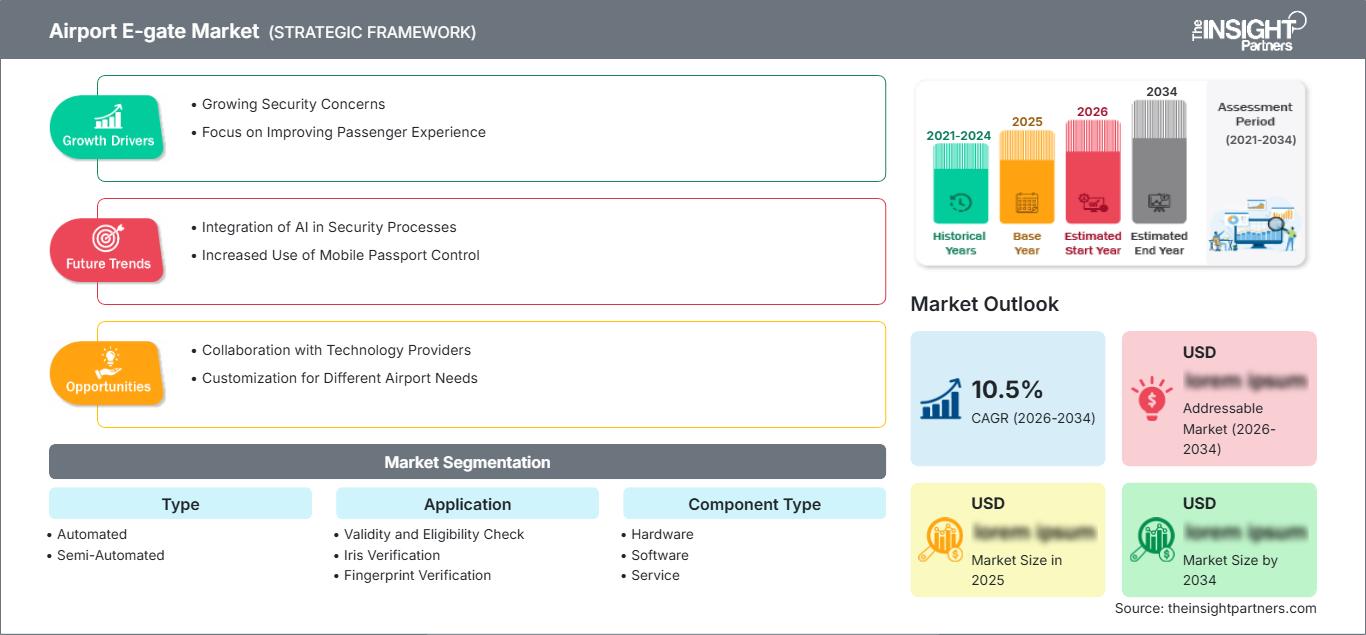
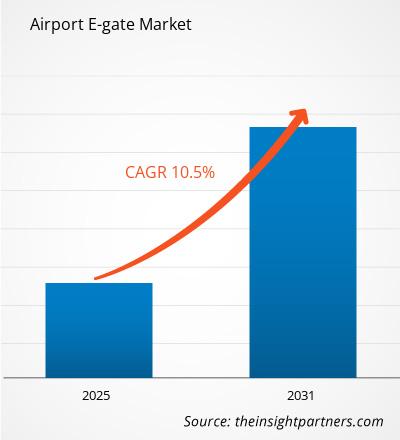
The airport e-gate market was valued at US$ 1.41 Billion in 2025 and is projected to reach US$ 5.46 Billion by 2034, registering a CAGR of 16.25% during 2026–2034. Expansion is backed by growing numbers of passengers, government spending on automated border controls, biometrics usage, and the necessity for secure handling of travelers without corresponding growth of manual border-control capabilities.
North America is making progress with airport modernization, use of biometrics for identification of travelers, and incorporation of border-control automation equipment into government data systems. The airport e-gate market size in North America is set to grow at a ~15% CAGR until 2034.
Airport E-gate Market Assessment and Insights
Regional Outlook
- North America: ~34% of the global market in 2025 | ~15% CAGR through 2034. Market position: North America represents the largest regional market, supported by extensive international airport infrastructure, biometric border programs, mature technology procurement, and strong integration between airport operators, airlines, and government agencies.
- US: ~82% of North American market revenue in 2025 | ~15% CAGR through 2034. Market position: The US accounts for most North American demand because of its extensive international airport network, biometric exit initiatives, customs modernization, and growing deployment of automated passenger processing across major gateways.
- Europe: ~28% of the global market in 2025 | ~16% CAGR through 2034. Market position: Europe has a mature automated border-control ecosystem, with the UK, Germany, France, Italy, and Spain representing important deployment markets. Entry-Exit System implementation is reinforcing demand for biometric enrollment and automated clearance.
- Asia Pacific: ~27% of the global market in 2025 | ~18% CAGR through 2034. Market position: Asia Pacific is the fastest-growing region as large passenger populations, airport construction, biometric identity programs, and national digitalization initiatives accelerate deployments across China, Japan, South Korea, India, and Australia.
Segment Outlook
- Automated: ~72% Share in 2025 | ~16% CAGR through 2034. Market position: Automated systems lead because airports and border authorities increasingly favor self-service processing that combines document authentication and biometrics. High passenger throughput, limited staffing capacity, and demand for consistent processing reinforce adoption.
- Facial Verification: ~29% Share in 2025 | ~19% CAGR through 2034. Market position: Facial verification is the high-growth application because contactless identity matching can connect enrollment, immigration, security, and boarding processes while reducing repeated document presentation and supporting digital identity programs.
Competitive Coverage
Atos SE, Ayonix Corp., COMINFO, a.s., DERMALOG Identification Systems GmbH, IER, Josanti Infoimaging Ltd., NEC Corporation, SITA, Thales Group, Vision-Box, IDEMIA, Veridos GmbH, Gunnebo AB
Methodology
The Insight Partners follows Data Collection & Secondary Research, Primary Research, Data Analysis, and Data Triangulation & Final Review to validate market estimates and insights.
Source: The Insight Partners' analysis based on proprietary research, government publications, company annual reports, investor presentations, industry databases, and expert interviews.
Border checkpoint processes have advanced beyond basic passport examination to an integrated automated checkpoint process, incorporating document reader technology, biometric sensor technology, decision making software, and connections to government system(s). Gates and other forms of passenger-processing architecture are becoming common among airports instead of immigration machines. In particular, facial recognition has become relevant since it provides the means of identity verification without the need to handle documents repeatedly. In addition, modular hardware and software architecture allows for the enhancement of the biometric capacity, database, and interface without installing entire systems.
The future is expected to revolve around the concept of digital identity and interoperable credentials. Regulatory programs requiring systematic biometric and biographic data collection create procurement opportunities for gates, kiosks, enrollment systems, and associated services. The Asia Pacific and the Middle East regions also include investment in high-capacity airports where automated processes will facilitate growth in passengers. Interoperability between airline systems, airport systems, and government systems will become more important for the value of new deployments.
Airport E-gate Market Report Scope
| Report Attribute | Details |
|---|---|
| Market size in 2025 | US$ 1.41 Billion |
| Market Size by 2034 | US$ 5.46 Billion |
| Global CAGR (2026 - 2034) | 16.25% |
| Historical Data | 2021-2024 |
| Forecast period | 2026-2034 |
Airport E-gate Market Analysis
The increase in passenger numbers is driving an increased need for the use of gates that process passengers through immigration and identity screening without adding additional manned channels. Ecosystems are made up of airports, immigration organizations, airlines, integrators, biometric vendors, and identity management platforms. Gates provide value by performing automated processes and freeing the authorities to focus on exceptional cases. The whole ecosystem is being driven towards digital identity verification before or during the process at the airport.
The airport e-gate market ecosystem dynamics depend on hardware dependability, biometric accuracy, government interoperability, cybersecurity, and certification. Increasingly, vendors of gates compete through integrated architecture and not just hardware. There is software for managing identity verification, workflow management, exception management, and reporting which is strategically valuable. Service agreements for maintenance, software updates, biometric algorithm updates, and integration add more value after the hardware sale.
According to the airport e-gate market report, competition involves firms specializing in airport technology solutions, biometric identification firms, border control firms, and large IT firms. NEC Corporation and SITA provide technology for biometric identification and passenger processing, while Thales Group, IDEMIA, DERMALOG Identification Systems GmbH, and Veridos GmbH operate in the realm of identity and border control technologies. Vision-Box, Atos SE, IER, Ayonix Corp., and COMINFO, a.s. offer specializations within the industry. Competitive positioning will be increasingly dependent on interoperability, scale, security, regulation, and multi-biometric integration.
As investments are being geared towards complete passenger experience rather than individual gates, firms have been positioning themselves based on digital identity, mobile enrollment, automated border control kiosks, biometric matching, and centralization management. Partnership can help reduce integration time required when airports need to link technology to immigration databases and national ID system. This will work well for vendors that have experience working with governments and in different airports, while the specialized biometric providers may compete on algorithms and integration.
● REPORT CUSTOMIZATION
Tailor This Report To Align With Your Specific Business Requirements
This report can be customized to align precisely with your business objectives, scope, and target markets. Customization options include tailored segmentation, geography, competitive analysis, and strategic insights to support informed decision-making.
Customize This Report →WHAT YOU CAN ADJUST
- ● Segmentations
- ● Geography
- ● Competitive Analysis
- ● Language Preferences
Airport E-gate Market: Strategic Insights
Regional Insights
North America airport e-gate market
North America represented around 34% of the total global airport e-gate market in 2025 and will continue to grow at a ~15% CAGR during the forecast period of 2025-2034. This is due to the significant installed base of international airports in the region, along with investments in automated border control systems. The major demand center in North America continues to be the US, with Canada providing regional support through airport modernization and biometric passenger processing systems.
US airports are now integrating identity verification solutions into their passenger flow management systems, which include security, boarding, and border control systems. The government's mandate for secure travel identification provides a strong procurement base, along with the airports' desire to manage growing passenger numbers through predictably manned systems.
U.S. airport e-gate market
Approximately 82% of North American airport e-gate market size originated from the United States in 2025, and it is projected to exhibit around 15% CAGR up to 2034. The demand is centered around major international entry points, where the large volume of passengers makes it financially viable to perform automated ID processing. There is an increasing need for a system that will be able to process travelers without exception handling.
There is a growing trend of transitioning from simple passport processing to biometric ID verification and integration into digital processing. Among the technology providers involved in the wider US biometric airport market are NEC Corporation, SITA, Thales Group, IDEMIA, and other vendors. Airport spending and government initiatives for identity management are driving the adoption.
Europe airport e-gate market
Europe represented ~28% of the global airport e-gate market size in 2025 and is projected to register a ~16% CAGR through 2034. The region has a mature installed base of automated border-control systems, but modernization requirements are generating additional demand. The UK maintains extensive automated passenger processing, while Germany and France continue to invest in biometric and digital border infrastructure. Italy and Spain are also important deployment markets because of high international passenger flows and major tourism gateways.
It is a significant structural catalyst since systematic registration of passenger data raises the need for enrollment of biometrics, identity verification, and automation. Germany is a country that has high importance due to its vast network of international airports and technologically advanced border checkpoints. France also has high importance due to its international hubs, whereas Italy and Spain have persistent requirements due to tourism.
Interoperability, data protection, cybersecurity, and capability to upgrade systems depending on changing border policies become the drivers for European procurement of border security solutions. Thus, apart from gate equipment, vendors compete in providing lifecycle support. It is expected that due to mature infrastructure and modernization driven by regulations, there will be ongoing investments in automated border processing until 2034.
APAC airport e-gate market
Asia Pacific represented ~27% of the global market in 2025 and is expected to expand at a ~18% CAGR through 2034, making it the fastest-growing regional market. China is the leading country in Asia Pacific, supported by extensive airport investment and deployment of facial recognition across passenger touchpoints. Japan and South Korea also maintain advanced biometric airport programs.
India is using digital passenger processing technology via its DigiYatra initiative, whereas Australia has developed automatic passport control systems in its major international airports. Digital government, increased airport capacity, increasing passenger traffic, and need for contactless processing technologies form a wide base for adoption. South Korea and Japan bring in mature technological demand, whereas China brings in size.
Middle East & Africa airport e-gate market
Middle East and Africa is expected to register a ~17% CAGR through 2034. The Middle East represents the stronger deployment center, supported by large international hubs, airport expansion programs, and government investment in digital identity and smart-border infrastructure. The UAE has particularly strong adoption conditions because major airports process large international passenger flows.
Airport Infrastructure and Government Digitization investments are being made in Saudi Arabia, whereas South Africa still is an important market for AP systems in Africa. In the Rest of MEA, however, the adoption will depend on the budget available at the airport for its upgrade, as well as government digitization plans.
Segmentation Analysis
Type
Type segmentation in the airport e-gate market reflects the degree of automation embedded in passenger identity and border-processing workflows. Automated systems represent the core deployment model because high-volume airports increasingly require repeatable processing with limited manual intervention. Procurement decisions depend on passenger throughput, integration requirements, security controls, and available infrastructure. The automated category is expected to remain central as airports modernize existing lanes and add capacity. Facial Verification is expected to record a ~19% CAGR within the application landscape as contactless identity becomes more widely integrated into passenger journeys.
- Automated: Fully automated processing connects document authentication, biometric matching, gate control, and government-system verification with limited officer intervention. It is particularly relevant at high-volume international airports where consistent throughput and reduced routine workload are priorities.
- Semi-Automated: Semi-automated configurations retain a stronger role for border officers while using machines for document capture, identity matching, or workflow assistance. They suit airports balancing automation with operational flexibility and differing traveler eligibility requirements.
Application
Application segmentation in the airport e-gate market captures the verification functions performed within automated airport identity workflows. Demand is moving toward multimodal, software-driven processing because authorities increasingly want to establish a trusted traveler identity across multiple checkpoints. The category is strategically important as airports connect immigration, passenger processing, and digital identity systems. Adoption is influenced by regulatory requirements, biometric quality, privacy controls, and interoperability with national databases. Suppliers able to combine multiple verification functions can participate in broader modernization programs.
- Validity and Eligibility Check: This function determines whether a travel document and traveler meet defined processing requirements. It provides an initial control layer before biometric or identity matching and supports consistent handling of eligible and exception cases.
- Iris Verification: Iris-based authentication provides a biometric modality suited to environments requiring high identity assurance. It can complement facial or fingerprint technologies where authorities seek additional verification capability or where specific national programs favor iris recognition.
- Fingerprint Verification: Fingerprint verification supports identity matching where fingerprint records are already incorporated into government or border databases. It remains relevant for specific traveler categories and jurisdictions requiring established biometric identifiers.
- Data Authentication: Data authentication validates traveler information against trusted records and connected systems. Its importance increases as airports move toward digital credentials and require reliable exchange of identity information between airlines, airports, and government agencies.
- Facial Verification: Facial verification enables contactless identity matching and is increasingly embedded across airport touchpoints. It supports rapid processing because travelers can often be authenticated without repeatedly presenting physical documents, making it central to digital identity programs.
- Others: Other applications encompass supplementary verification and workflow functions that support airport identity processing. Their importance depends on national border policies, traveler categories, infrastructure configuration, and integration requirements.
Component Type
Component Type segment in the airport e-gate market determines how airport operators acquire and operate the technology stack supporting automated identity processing. Integrated procurement increasingly combines physical gates with biometric software and lifecycle services. Hardware remains essential because gates require secure sensing and controlled physical access, while software determines verification and workflow performance. Service capabilities support deployment, integration, maintenance, cybersecurity, and upgrades. Buyers increasingly assess total lifecycle requirements rather than selecting components solely on initial acquisition cost.
- Hardware: Hardware includes physical gate structures, document readers, cameras, biometric sensors, control systems, and associated access mechanisms. Reliability, throughput, environmental performance, and upgradeability influence procurement decisions.
- Software: Software manages identity matching, document authentication, workflow orchestration, exception handling, data exchange, and operational monitoring. Interoperability with government systems is a major determinant of deployment suitability.
- Service: Services cover system integration, installation, maintenance, technical support, software updates, and lifecycle management. They help airports sustain system performance as regulations, biometric technologies, and connected databases evolve.
Opportunity Snapshot
| Application | Revenue Contribution | Trend Tag | Adoption Stage |
| Validity and Eligibility Check | High | Eligibility Automation | Mature |
| Iris Verification | Medium | Iris Biometrics | Scaling |
| Fingerprint Verification | Medium | Fingerprint Matching | Mature |
| Data Authentication | High | Data Interoperability | Scaling |
| Facial Verification | High | Face Biometrics | Scaling |
| Others | Low | Auxiliary Verification | Emerging |
Airport E-gate Market Growth Drivers and Impact Analysis
Rising Passenger Volumes and Airport Processing Constraints
Growing passenger throughput is increasing the operational importance of automated identity processing. Airports must accommodate more travelers without expanding staffed immigration infrastructure at the same rate, particularly at major international gateways where peak-period congestion can become a recurring constraint. Automated gates transfer routine document and biometric checks from officers to machines, allowing personnel to focus on exceptions and risk-sensitive cases. The resulting value proposition extends beyond shorter queues because airports can use terminal space more efficiently and improve predictability of passenger flows. SITA's airport technology research indicates that biometric and touchless border control is already implemented by a majority of surveyed airports, while further adoption is planned through 2028. This expanding deployment base supports continued procurement of gates and associated systems.
Government Digital Identity and Border Modernization Programs
Government adoption of digital identity and biometric border systems is strengthening demand for automated airport processing infrastructure. Programs increasingly seek to authenticate travelers using trusted digital credentials and biometric identifiers while maintaining security and privacy controls. The shift changes procurement requirements because airports need systems that can exchange information securely with government databases rather than operate as independent checkpoints. Entry-Exit System implementation in Europe and digital identity programs in Asia provide examples of regulatory and administrative changes that can stimulate investment. For suppliers, this environment increases the importance of interoperability, data governance, cybersecurity, and lifecycle support. For airports, investments can create infrastructure capable of supporting multiple traveler categories and evolving border policies without requiring complete replacement of installed systems.
Expansion of Contactless Passenger Processing
Contactless processing is extending biometric identification beyond immigration to other airport touchpoints, increasing the addressable role of identity technology. Travelers can increasingly use a biometric identity across check-in, bag drop, security, immigration, and boarding instead of repeatedly presenting documents. This creates demand for systems capable of maintaining identity continuity across multiple operational environments. The commercial impact is particularly significant where airports are developing integrated passenger-processing architectures, because a gate can become one component of a broader identity ecosystem. Airlines and airports can also seek operational consistency across different terminals and locations. As interoperability improves, suppliers with reusable identity and biometric platforms can address multiple touchpoints through common software and credentials, potentially increasing the scope and duration of technology contracts.
Airport E-gate Market Future Trends
Convergence of E-Gates with Digital Travel Credentials
The next phase of automated airport processing is likely to connect physical gates more closely with digital travel credentials stored on mobile devices or managed through interoperable identity ecosystems. Instead of treating passport inspection as an isolated transaction, airports and border agencies are moving toward identity verification that begins before arrival and continues across multiple airport touchpoints. This model can reduce repeated document presentation and support more consistent traveler recognition. The transition will require strong interoperability among governments, airlines, airports, identity providers, and technology vendors. Privacy-by-design architecture will also become increasingly important because digital credentials can contain sensitive personal information. As these systems mature, e-gates are likely to function as verification endpoints within broader digital identity networks rather than as standalone border-control machines.
AI-Assisted Verification and Adaptive Border Workflows
Artificial intelligence and advanced analytics in the in the airport e-gate market trends are expected to influence how automated gates manage routine and exceptional travelers. Future systems can combine document data, biometric matching, traveler credentials, and contextual information to support more adaptive processing while preserving officer oversight for cases requiring intervention. The emphasis is likely to shift from simple pass-or-refer decisions toward workflow systems that prioritize exceptions and provide richer operational information to border personnel. Improved algorithms may also enhance biometric matching under varied lighting, traveler positioning, or document conditions. However, wider AI deployment will increase requirements for transparency, cybersecurity, testing, and governance. Airports and governments are therefore likely to favor systems where automated decision support can be audited and integrated into established border-control procedures.
Airport E-gate Market Opportunities
Integrated Digital Identity Infrastructure for Emerging Airport Hubs
Emerging airport hubs in the in the airport e-gate market forecast provide opportunities for suppliers that can deliver complete automated identity architectures rather than individual gate units. New terminals and major airport expansions can incorporate biometric enrollment, digital credentials, automated border control, passenger-flow management, and centralized monitoring during initial infrastructure design. This approach reduces the constraints associated with retrofitting older facilities and allows airports to establish standardized identity workflows across terminals. Asia Pacific and the Middle East offer particularly relevant investment environments because airport expansion is occurring alongside national digitalization initiatives. Vendors can differentiate through modular platforms that accommodate local identity databases and regulatory requirements while retaining interoperability with international travel standards. Long-term service, software, and cybersecurity contracts can further broaden the commercial opportunity beyond initial equipment deployment.
Lifecycle Modernization and Multimodal Biometric Upgrades
A substantial opportunity exists in upgrading installed airport border-control infrastructure rather than relying solely on greenfield projects. Existing gates can require new biometric sensors, software, document readers, connectivity layers, and cybersecurity capabilities as traveler programs and regulatory requirements evolve. Modular modernization allows airport operators to extend asset life while introducing facial recognition, stronger authentication, and improved integration with digital identity platforms. Suppliers can develop retrofit packages that minimize terminal disruption and preserve compatible physical infrastructure. Service providers can also support periodic algorithm updates, security assessments, database integration, and performance optimization. This lifecycle model is particularly relevant in mature markets where a large installed base already exists. The opportunity therefore spans replacement components, software enhancements, integration, and recurring technical support.
Frequently Asked Questions

- Comprehensive Market Sizing and Forecast Analysis
- Detailed Segmentation Analysis
- In-Depth Market Dynamics Assessment
- Regional and Country-Level Insights
- Competitive Landscape and Company Benchmarking
- Strategic Business Intelligence
Recent Reports
Testimonials

The Insight Partners provided valuable market intelligence that supported our global go-to-market strategy. Their team was professional, responsive, and attentive to our feedback, providing thoughtful analysis and helpful methodological clarifications throughout the project.
Junmo Kim Chief Financial Officer (CFO), Enertech Co., Ltd.
The Insight Partners' SCADA System Market report is comprehensive, with valuable insights on current trends and future forecasts. The team was highly professional, responsive, and supportive throughout. We are very satisfied and highly recommend their services.
RAN KEDEM Partner, Reali Technologies LTDs
I requested a report on a very specific software market and the team produced the report in a few days. The information was very relevant and well presented. I then requested some changes and additions to the report. The team was again very responsive and I got the final report in less than a week.
JEAN-HERVE JENN Chairman, Future Analytica
We worked with The Insight Partners for an important market study and forecast. They gave us clear insights into opportunities and risks, which helped shape our plans. Their research was easy to use and based on solid data. It helped us make smart, confident decisions. We highly recommend them.
PIYUSH NAGPAL Sr. Vice President, High Beam Global
The Insight Partners delivered insightful, well-structured market research with strong domain expertise. Their team was professional and responsive throughout. The user-friendly website made accessing industry reports seamless. We highly recommend them for reliable, high-quality research services
YUKIHIKO ADACHI CEO, Deep Blue, LLC.
This is the first time I have purchased a market report from The Insight Partners.While I was unsure at first, I visited their web site and felt more comfortable to take the risk and purchase a market report.I am completely satisfied with the quality of the report and customer service. I had several questions and comments with the initial report, but after a couple of dialogs over email with their analyst I believe I have a report that I can use as input to our strategic planning process.Thank you so much for taking the extra time and making this a positive experience.I will definitely recommend your service to others and you will be my first call when we need further market data.
JOHN SUZUKI President and Chief Executive Officer, Board Director, BK Technologies
I wish to appreciate your support and the professionalism you displayed in the course of attending to my request for information regarding to infectious disease IVD market in Nigeria. I appreciate your patience, your guidance, and the fact that you were willing to offer a discount, which eventually made it possible for us to close a deal. I look forward to engaging The Insight Partners in the future, all thanks to the impression you have created in me as a result of this first encounter.
DR CHIJIOKE ONYIA MANAGING DIRECTOR, PineCrest Healthcare Ltd.Reason to Buy
- Informed Decision-Making
- Understanding Market Dynamics
- Competitive Analysis
- Identifying Emerging Markets
- Customer Insights
- Market Forecasts
- Risk Mitigation
- Boosting Operational Efficiency
- Strategic Planning
- Investment Justification
- Tracking Industry Innovations
- Aligning with Regulatory Trends





 Get Free Sample for