
Airport Security Equipment Market Demand, Size & Forecast by 2034
Coverage: By Platforms (Hardware, Software); Type (Surveillance Systems, Access Control Systems, Screening and Scanning Systems, Perimeter Intrusion Detection Systems, Cybersecurity, Others), and Geography (North America, Europe, Asia Pacific, and South and Central America)
- Status : Data Released
- Report Code : TIPRE00016470
- Category : Aerospace and Defense
- No. of Pages : 150
- Available Report Formats :


- Last update date : November 03, 2026


2025 Market Size
US$ 11.12 Bn
Base year value
2034 Forecast
US$ 21.6 Bn
Projected by 2034
CAGR 2026-2034
7.66 %
Growth rate
Addressable Market
US$ 147.39 Bn
(2026-2034)
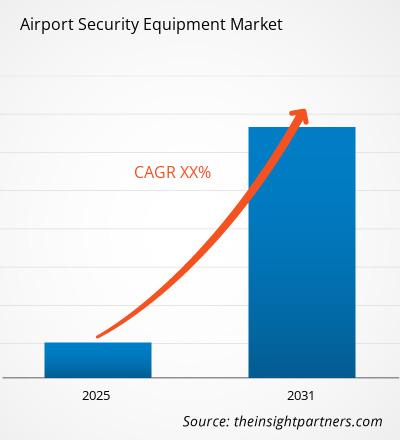
The airport security equipment market was valued at US$ 11.12 Billion in 2025 and is projected to reach US$ 21.6 Billion by 2034, registering a CAGR of 7.66% during 2026–2034. Growth is supported by airport modernization, rising passenger volumes, stricter aviation security requirements, adoption of advanced screening technologies, and increasing integration of physical and digital security systems. Investment is also shifting toward automated threat detection, biometric identity verification, intelligent surveillance, and cybersecurity capabilities that can improve security effectiveness while supporting passenger throughput.
The North American airport security equipment market size is expected to expand at a modeled CAGR of ~7% through 2034, supported by replacement of legacy screening infrastructure, technology upgrades at major airports, and continued demand for integrated passenger and baggage security. Procurement increasingly emphasizes interoperability, automated detection, remote screening, and lifecycle support, creating opportunities for vendors capable of combining hardware, software, analytics, and managed security services within existing airport environments.
Airport Security Equipment Market Assessment and Insights
Regional Outlook
- North America: ~34% of the global market in 2025 | ~7% CAGR through 2034. Market position: North America holds the largest regional position, supported by mature airport infrastructure, recurring equipment replacement, advanced security standards, and sustained investment in automated screening, passenger verification, surveillance, and cybersecurity technologies.
- US: ~78% of North American market revenue in 2025 | ~7% CAGR through 2034. Market position: The US represents the principal demand center within North America, supported by extensive airport infrastructure, technology replacement programs, federal security requirements, and deployment of computed tomography, biometric, surveillance, and integrated screening systems.
- Europe: ~27% of the global market in 2025 | ~7% CAGR through 2034. Market position: Europe is a mature security market with substantial replacement demand. Germany is the leading country in Europe, while the UK, France, Italy, and Spain contribute through airport modernization, regulatory compliance, and deployment of advanced checkpoint technologies.
- Asia Pacific: ~29% of the global market in 2025 | ~9% CAGR through 2034. Market position: Asia Pacific is the fastest-growing region, supported by expanding airport capacity, rising passenger traffic, modernization of security checkpoints, and investment in advanced screening and identity technologies. China is the leading country in Asia Pacific.
Segment Outlook
- Screening and Scanning Systems: ~42% Share in 2025 | ~9% CAGR through 2034. Market position: Screening and scanning systems represent the largest demand area because airports require continuous inspection of passengers, cabin baggage, hold baggage, and cargo. Replacement of conventional equipment with CT-enabled systems supports sustained procurement.
- Cybersecurity: ~14% Share in 2025 | ~11% CAGR through 2034. Market position: Cybersecurity has the strongest growth profile as airport operations become increasingly interconnected. Protection of passenger processing, surveillance, communications, operational technology, and cloud-connected systems expands the addressable equipment and software opportunity.
Competitive Coverage
Analogic Corporation, Autoclear LLC, Ayonix Corporation, Brijot Imaging Systems, Collins Aerospace, an RTX business, Honeywell International Inc., IDEMIA, Leidos, Rapiscan Systems, Smiths Detection Group Ltd, OSI Systems, Inc., Thales
Methodology
The Insight Partners follows Data Collection & Secondary Research, Primary Research, Data Analysis, and Data Triangulation & Final Review to validate market estimates and insights.
Source: The Insight Partners' analysis based on proprietary research, government publications, company annual reports, investor presentations, industry databases, and expert interviews.
Airport security technology architecture has advanced from predominantly standalone inspection systems to integrated security environments made up of detection, identity, surveillance, access control, and information systems. CT scanning, automated threat detection, biometric authentication, centralized monitoring, and remote screening have been disrupting airport security resource allocation. Production dynamics are thus advancing towards modular platforms, software-based solutions, subscription services, and upgradeable systems. Competitiveness among vendors is becoming based on capabilities in terms of detection accuracy, processing capacity, integrability, compliance with regulatory standards, and lifecycle management.
Market dynamics going forward will be affected by airport growth in new aviation markets and modernization in mature markets. Airport development in Asia Pacific and certain Middle Eastern markets, as well as systems renewal in Europe and North America, will continue driving the market for airport security equipment. Regulatory standards will also drive the need for more effective and efficient screening equipment and better information security solutions. All these trends form a market dynamic within which equipment vendors with scalable architectures, regional services, and cybersecurity skills can cater to new and existing projects until 2034.
Airport Security Equipment Market Report Scope
| Report Attribute | Details |
|---|---|
| Market size in 2025 | US$ 11.12 Billion |
| Market Size by 2034 | US$ 21.6 Billion |
| Global CAGR (2026 - 2034) | 7.66% |
| Historical Data | 2021-2024 |
| Forecast period | 2026-2034 |
Airport Security Equipment Market Analysis
The relationship between demand and passenger handling capacity, volume of luggage and cargo handled, expansion and replacement is evident from the fact that airports need to be efficient in security screening without causing checkpoints to become congested. This increases the significance of systems that perform automatic image recognition to increase the throughput at checkpoints. Supply chain participants include imaging equipment producers, hardware and software companies, solution integrators, airlines, government agencies, and maintenance providers.
Dynamics of supply are affected by specialized imaging technologies, detectors, artificial intelligence, software, cybersecurity, certification, and services networks around the world. Long qualification periods act as entry barriers for new firms, whereas airport clients normally demand interoperability with their existing checkpoint and operational systems. Demand is generated through replacement because screening technology, access control technology, surveillance technology needs to be updated.
According to the airport security equipment market report, competition is present between specialized screening firms and diversified aerospace, technology, identity and security firms. The focus of Analogic Corporation and Rapiscan Systems is detection and imaging technologies, while Smiths Detection Group Ltd provides a comprehensive screening portfolio. Leidos focuses on security technology, government, and critical infrastructure sectors, while Collins Aerospace covers passenger processing and airport cybersecurity. IDEMIA and Ayonix Corporation have identity and biometrics capabilities, while Honeywell International Inc. and Thales are involved in broader security and infrastructure networks.
The emphasis of investments is shifting towards AI technology, 3D-imaging technology, automated decision-making, remote screening, biometric identity and cybersecurity. As such, positioning will rely heavily on the combination of specialized equipment and software, analytics, services and integration capabilities. Strategic alliances can provide an opportunity for a fast connection with airport clients, and local production and services capacity will be important in responding to the needs of large regional markets.
● REPORT CUSTOMIZATION
Tailor This Report To Align With Your Specific Business Requirements
This report can be customized to align precisely with your business objectives, scope, and target markets. Customization options include tailored segmentation, geography, competitive analysis, and strategic insights to support informed decision-making.
Customize This Report →WHAT YOU CAN ADJUST
- ● Segmentations
- ● Geography
- ● Competitive Analysis
- ● Language Preferences
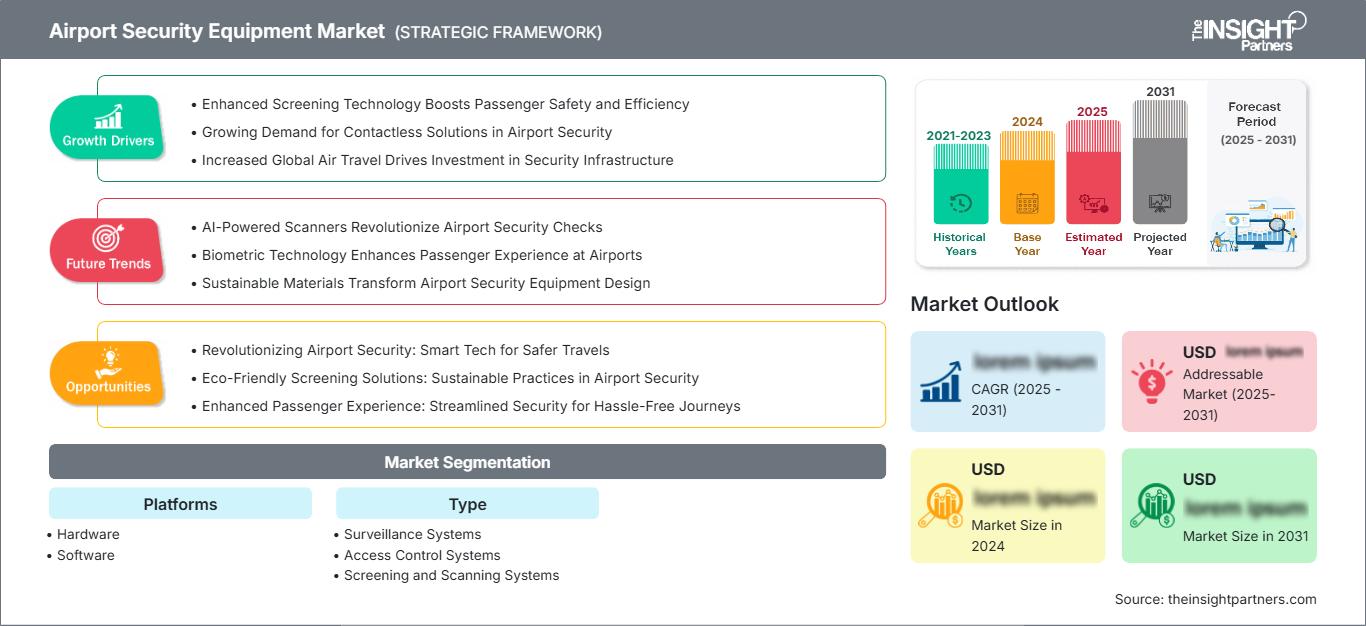
Airport Security Equipment Market: Strategic Insights
Regional Insights
North America Airport security equipment market
North America held ~34% of the global airport security equipment market share in 2025 and is projected to grow at ~7% CAGR over 2026-34. The region has a considerable installed base of airport security systems along with the need to upgrade the existing systems regularly. The key drivers in the market will be passenger screening, baggage screening, access control, surveillance systems, and cybersecurity.
The US will be the central driver of demand due to the presence of many commercial airports and investment in modernizing screening facilities. Canada also has an influence on demand, driven by security enhancements and adoption of technology at its large passenger airports. Procurement is increasingly favoring systems that integrate detection, analytics, identity, and operations management technologies. System suppliers with existing certifications, maintenance and integration capabilities have an opportunity to participate.
U.S. Airport security equipment market
The US accounted for ~78% of the North American airport security equipment market revenue in 2025 and is forecast to record a ~7% CAGR till 2034. The demand includes checkpoint screening, hold baggage inspection, access management, surveillance, and cybersecurity. Airports need solutions that can handle large passenger volume and baggage screening and can be integrated with existing security processes to enable investment in imaging technologies and biometric authentication.
Competitive landscape includes Analogic Corporation, Collins Aerospace, Honeywell International Inc., IDEMIA, Leidos, Rapiscan Systems, Smiths Detection Group Ltd, and others. Application-wise, the demand is shifting towards CT-based inspection, automated imaging, remote screening, and passenger processing. Cybersecurity is another area of growing significance in airports owing to their increased connectivity through operational technology, passenger services, communications, and cloud applications.
Europe Airport security equipment market
Europe constituted 27% of the global market in 2025 and is projected to grow at a CAGR of around 7% till 2034. Europe has mature airport infrastructure and requires upgrading along with regulation-led modernization. Germany is the leading country in Europe because of its large international airports and screening infrastructure. The UK continues to be an important market as airports modernize their checkpoint and baggage screening capabilities, whereas France gets benefit from major international gateways and high volume of passengers requiring security screening facilities.
Italy and Spain help with terminal expansion, tourism-related passenger volumes, and modernization of security infrastructure at airports. In Europe, the procurement of systems favors CT based screening, automatic threat detection systems, remote screening architectures, and integrated checkpoint lanes. These systems help satisfy the security needs as well as passenger flow management objectives. European airports also have the challenge of integrating security solutions into their infrastructure, offering chances for vendors with compact systems, interoperable software solutions, and life-cycle services.
Requirements from regulatory authorities will continue to be significant due to the necessity of equipment compliance with specific standards in order for wide-scale deployment. As a result, the developed infrastructure together with its further modernization makes the competition among vendors focus on such aspects as certification, detection, efficiency, energy consumption, and integration. Therefore, Germany, the United Kingdom, France, Italy, and Spain can be considered unique markets in terms of procurement.
APAC Airport security equipment market
Asia Pacific represented ~29% of the global market in 2025 and is modeled to grow at ~9% CAGR through 2034, making it the fastest-growing region. China is the leading country in Asia Pacific, supported by extensive airport infrastructure, passenger growth, and continued modernization. Japan and South Korea emphasize technologically advanced security and efficient passenger processing, while India is expanding airport capacity and upgrading security infrastructure.
Australia contributes through modernization of established airports and stringent security requirements. Across the region, new terminal construction creates opportunities for integrated surveillance, access control, screening, and cybersecurity platforms. Government investment, airport expansion, and technology localization support adoption of advanced equipment, particularly where new facilities can incorporate modern security architectures without the constraints of legacy infrastructure.
Middle East & Africa Airport security equipment market
Middle East & Africa is modeled to grow at ~8% CAGR through 2034. Saudi Arabia and the UAE represent major demand centers in the Middle East because large airport development programs, international passenger connectivity, and infrastructure investment require advanced screening and surveillance capabilities. Airport expansion also creates opportunities to deploy integrated security architectures at the design stage.
South Africa remains an important African market, while the Rest of MEA presents opportunities linked to airport modernization and infrastructure development. Energy-rich economies can support capital-intensive technology programs, including automated screening, biometric identity, perimeter monitoring, and cybersecurity. Procurement priorities increasingly emphasize scalable systems that can support growing passenger flows while maintaining high security performance and operational resilience.
Segmentation Analysis
Platforms
Platforms form a foundational layer of the airport security equipment market because airports require coordinated physical equipment and digital applications to operate security checkpoints and broader protective infrastructure. Adoption is increasingly shaped by interoperability, software integration, remote management, and upgradeability. Hardware remains the largest platform sub-segment and is modeled to grow at ~7% CAGR through 2034 as airports replace aging equipment and expand capacity. Platform-level procurement increasingly evaluates lifecycle performance and integration rather than isolated device specifications.
- Hardware: Physical screening, surveillance, access, detection, and security infrastructure remains essential for airport operations, with demand linked to new installations, replacement cycles, terminal expansion, and technology modernization.
- Software: Software enables monitoring, analytics, identity management, configuration, workflow orchestration, and system integration, making it increasingly important as airports connect previously separate security technologies.
Type
Type segmentation in the airport security equipment market reflects the different operational functions that airport security equipment performs across passenger, baggage, perimeter, and digital environments. Screening and scanning systems represent the largest sub-segment and are modeled to expand at ~9% CAGR through 2034 as airports migrate toward more capable imaging and automated detection. The broader category is increasingly defined by integrated security workflows that connect detection, access, surveillance, and digital protection.
- Surveillance Systems: Surveillance systems support continuous observation across terminals, restricted areas, airside zones, and critical infrastructure, with analytics improving incident detection and situational awareness.
- Access Control Systems: Access control technologies regulate movement into restricted airport areas and increasingly integrate credentials, biometrics, authentication, and centralized permissions management.
- Screening and Scanning Systems: Screening and scanning technologies inspect passengers, cabin baggage, hold baggage, and cargo, with advanced imaging improving threat detection while supporting higher processing efficiency.
- Perimeter Intrusion Detection Systems: Perimeter systems protect airport boundaries and sensitive external areas by identifying unauthorized movement and supporting rapid security response across large physical environments.
- Cybersecurity: Cybersecurity solutions protect connected airport systems, data, networks, and operational technologies from disruption or unauthorized access as digital integration expands across airport infrastructure.
Opportunity Snapshot
| Type | Revenue Contribution | Trend Tag | Adoption Stage |
| Surveillance Systems | Medium | AI Analytics | Scaling |
| Access Control Systems | Medium | Biometric Access | Scaling |
| Screening and Scanning Systems | High | CT Screening | Mature |
| Perimeter Intrusion Detection Systems | Medium | Smart Perimeter | Scaling |
| Cybersecurity | Low | Airport Cyber Defense | Emerging |
Airport Security Equipment Market Growth Drivers and Impact Analysis
Expansion of Airport Infrastructure and Passenger Processing Capacity
Airport expansion directly increases demand for security equipment because new terminals, additional checkpoints, baggage systems, and restricted operational areas require dedicated security infrastructure. Capacity expansion also creates an opportunity to deploy newer technologies rather than replicate legacy systems. Airports in Asia Pacific and the Middle East are particularly relevant because new infrastructure can incorporate integrated screening, access control, surveillance, and cybersecurity architectures during the design phase. In mature markets, passenger growth produces a different mechanism through replacement and capacity upgrades. Higher throughput requirements encourage airports to evaluate automated detection and workflow technologies that can improve processing efficiency without proportional increases in staffing. The result is a sustained equipment demand cycle combining greenfield installations, capacity additions, and modernization.
Migration Toward Automated Threat Detection and Advanced Imaging
The migration from conventional inspection equipment toward three-dimensional imaging and automated threat recognition is increasing the technology intensity of airport security procurement. Advanced imaging can generate more detailed representations of baggage contents, while software-assisted analysis can help security personnel identify potential threats more efficiently. This changes the purchasing decision from simple equipment replacement toward integrated technology investment involving scanners, detection algorithms, networking, operator interfaces, and maintenance. Airports also seek systems that can accommodate evolving regulatory requirements without repeated infrastructure replacement. Vendors able to combine imaging hardware with software intelligence can therefore address a larger portion of project value. The market impact extends across equipment manufacturing, integration, service, certification, and technology upgrades.
Rising Need for Integrated Physical and Digital Security
Airport operations depend on interconnected systems covering passenger processing, baggage handling, surveillance, communications, access control, and operational technology. As these systems exchange more data, security requirements increasingly extend beyond physical inspection to network protection, identity management, monitoring, and incident response. This broadens procurement from individual security devices to integrated architectures. Airports are consequently assessing how equipment communicates with centralized management platforms and how security events can be detected across multiple systems. The commercial effect is an expanding role for software, cybersecurity, analytics, and managed services alongside traditional hardware. Vendors that can demonstrate interoperability and lifecycle security can address airport requirements that span both physical and digital environments.
Airport Security Equipment Market Future Trends
AI-Assisted Security Decision Support
Artificial intelligence in the airport security equipment market trends is likely to become more deeply embedded in airport security workflows, particularly in image analysis, anomaly detection, biometric matching, video analytics, and operator decision support. The future opportunity is not simply greater automation, but better allocation of human attention. Systems can increasingly prioritize alarms, identify recurring patterns, and combine information from different security layers. This could change checkpoint design by shifting personnel from routine image interpretation toward exception management and intervention. Adoption will depend on regulatory acceptance, measurable detection performance, explainability, data governance, and integration with existing equipment. Vendors that design AI capabilities as upgradeable software layers can potentially extend the useful life of installed hardware while creating recurring technology and service opportunities.
Remote and Centralized Security Operations
Remote screening and centralized security operations are likely to become more common as airports seek flexible staffing models and consistent security decision-making. Networked imaging systems can transmit screening information to centralized locations where trained personnel support multiple lanes or facilities. The approach can reduce duplication of specialized resources and create opportunities for standardized operating procedures across an airport network. Future architectures are likely to combine remote screening with automated image analysis, secure communications, centralized logging, and resilient data infrastructure. Implementation will require careful attention to cybersecurity, network availability, latency, redundancy, and regulatory requirements. These conditions favor suppliers capable of delivering complete architectures rather than isolated screening devices.
Airport Security Equipment Market Opportunities
Integrated Security Platforms for Airport Modernization
Airport modernization programs provide opportunities in the airport security equipment market forecast for suppliers to package screening, access control, surveillance, identity, and cybersecurity capabilities into interoperable platforms. Many airports operate mixed generations of equipment, creating demand for integration layers that can connect new technologies with existing infrastructure without requiring immediate replacement of every system. Investment opportunities therefore extend beyond individual scanners or cameras into system integration, software orchestration, data management, remote monitoring, and lifecycle services. Suppliers can strengthen their position by offering modular architectures that allow airports to add capabilities progressively. This model can reduce upfront disruption while creating recurring upgrade and service opportunities as security requirements and technology capabilities evolve.
Localized Manufacturing and Lifecycle Service Networks
Regional manufacturing, integration, maintenance, and technical support can become increasingly important as airport operators seek shorter deployment timelines and stronger equipment availability. Asia Pacific and the Middle East offer opportunities for suppliers to establish local service capabilities alongside global technology portfolios. Localization can cover assembly, testing, spare-parts distribution, field maintenance, software support, and training. A stronger regional footprint can also improve alignment with local procurement requirements and airport operating conditions. Investment in lifecycle support may provide a more durable commercial relationship than one-time equipment sales because security systems require calibration, certification, upgrades, maintenance, and periodic technology refreshes throughout their operating lives.
Frequently Asked Questions

- Comprehensive Market Sizing and Forecast Analysis
- Detailed Segmentation Analysis
- In-Depth Market Dynamics Assessment
- Regional and Country-Level Insights
- Competitive Landscape and Company Benchmarking
- Strategic Business Intelligence
Recent Reports
Testimonials

The Insight Partners provided valuable market intelligence that supported our global go-to-market strategy. Their team was professional, responsive, and attentive to our feedback, providing thoughtful analysis and helpful methodological clarifications throughout the project.
Junmo Kim Chief Financial Officer (CFO), Enertech Co., Ltd.
The Insight Partners' SCADA System Market report is comprehensive, with valuable insights on current trends and future forecasts. The team was highly professional, responsive, and supportive throughout. We are very satisfied and highly recommend their services.
RAN KEDEM Partner, Reali Technologies LTDs
I requested a report on a very specific software market and the team produced the report in a few days. The information was very relevant and well presented. I then requested some changes and additions to the report. The team was again very responsive and I got the final report in less than a week.
JEAN-HERVE JENN Chairman, Future Analytica
We worked with The Insight Partners for an important market study and forecast. They gave us clear insights into opportunities and risks, which helped shape our plans. Their research was easy to use and based on solid data. It helped us make smart, confident decisions. We highly recommend them.
PIYUSH NAGPAL Sr. Vice President, High Beam Global
The Insight Partners delivered insightful, well-structured market research with strong domain expertise. Their team was professional and responsive throughout. The user-friendly website made accessing industry reports seamless. We highly recommend them for reliable, high-quality research services
YUKIHIKO ADACHI CEO, Deep Blue, LLC.
This is the first time I have purchased a market report from The Insight Partners.While I was unsure at first, I visited their web site and felt more comfortable to take the risk and purchase a market report.I am completely satisfied with the quality of the report and customer service. I had several questions and comments with the initial report, but after a couple of dialogs over email with their analyst I believe I have a report that I can use as input to our strategic planning process.Thank you so much for taking the extra time and making this a positive experience.I will definitely recommend your service to others and you will be my first call when we need further market data.
JOHN SUZUKI President and Chief Executive Officer, Board Director, BK Technologies
I wish to appreciate your support and the professionalism you displayed in the course of attending to my request for information regarding to infectious disease IVD market in Nigeria. I appreciate your patience, your guidance, and the fact that you were willing to offer a discount, which eventually made it possible for us to close a deal. I look forward to engaging The Insight Partners in the future, all thanks to the impression you have created in me as a result of this first encounter.
DR CHIJIOKE ONYIA MANAGING DIRECTOR, PineCrest Healthcare Ltd.Reason to Buy
- Informed Decision-Making
- Understanding Market Dynamics
- Competitive Analysis
- Identifying Emerging Markets
- Customer Insights
- Market Forecasts
- Risk Mitigation
- Boosting Operational Efficiency
- Strategic Planning
- Investment Justification
- Tracking Industry Innovations
- Aligning with Regulatory Trends





 Get Free Sample for