
Algorithmic Trading Market Demand, Share & Growth by 2034
Coverage: By Solution (Software and Services); By Services (Professional Services and Managed Services); By Deployment Outlook (Cloud and On-premise); Trading Types (Stock Markets, Foreign Exchange (FOREX), Exchange-Traded Fund (ETF), Bonds, Cryptocurrencies, Others); Type of Traders (Institutional Investors, Long-term Traders, Short-term Traders, Retail Investors) and Geography
- Status : Data Released
- Report Code : TIPTE100000699
- Category : Banking, Financial Services, and Insurance
- No. of Pages : 150
- Available Report Formats :


- Last update date : November 03, 2026


2025 Market Size
US$ 24.06 Bn
Base year value
2034 Forecast
US$ 71.59 Bn
Projected by 2034
CAGR 2026-2034
12.88 %
Growth rate
Addressable Market
US$ 416.55 Bn
(2026-2034)
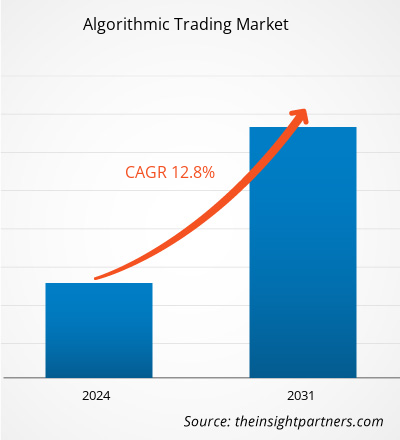
The algorithmic trading market was valued at US$ 24.06 Billion in 2025 and is projected to reach US$ 71.59 Billion by 2034, registering a CAGR of 12.88% from 2026 to 2034. Expansion is supported by faster electronic execution, automated strategies, low-latency infrastructure, and broader access to market data and computing resources. Demand is also shifting toward integrated execution, analytics, risk controls, and multi-venue connectivity.
The algorithmic trading market size is being influenced by the migration from fragmented execution tools toward integrated platforms and managed workflows. North America is expected to expand at a ~11% CAGR through 2034, supported by deep electronic liquidity, institutional participation, mature exchange infrastructure, and continued investment in execution technology. Adoption is reinforced by automation across equities, ETFs, foreign exchange, and fixed-income trading.
Algorithmic Trading Market Assessment and Insights
Regional Outlook
- North America: ~39% of the global market in 2025 | ~11% CAGR through 2034. Market position: North America holds the largest regional position, supported by established electronic markets, institutional trading activity, sophisticated broker infrastructure, high demand for execution analytics, and extensive deployment of automated strategies.
- US: ~78% of North American market revenue in 2025 | ~11% CAGR through 2034. Market position: The US is the leading country in North America, with extensive institutional participation, mature exchange connectivity, high-frequency execution capabilities, and broad application of automated strategies across equities, ETFs, and derivatives.
- Europe: ~27% of the global market in 2025 | ~12% CAGR through 2034. Market position: Europe represents a mature market supported by fragmented trading venues, MiFID II requirements, electronic execution, and institutional demand. The UK is the leading country in Europe, followed by Germany and France.
- Asia Pacific: ~24% of the global market in 2025 | ~15% CAGR through 2034. Market position: Asia Pacific is the fastest-growing region, driven by digital brokerage expansion, exchange modernization, rising institutional participation, and technology investment. China is the leading country in Asia Pacific, with Japan, South Korea, and India also contributing strongly.
Segment Outlook
- Solution: ~68% Share in 2025 | ~12% CAGR through 2034. Market position: Solution remains the largest main segment because institutional traders prioritize scalable execution platforms, analytics, connectivity, and automated order management. Its position reflects recurring technology investment and increasing requirements for integrated trading infrastructure.
- Services: ~32% Share in 2025 | ~14% CAGR through 2034. Market position: Services is the high-growth main segment as financial institutions increasingly require implementation, customization, integration, optimization, and outsourced technology capabilities to deploy sophisticated trading environments efficiently.
Competitive Coverage
63 moons technologies limited, AlgoTrader, Argo Software Engineering, InfoReach, Inc., Kuberre Systems, Inc., MetaQuotes Ltd., Refinitiv, Symphony, Tata Consultancy Services Limited, VIRTU Financial Inc.
Methodology
The Insight Partners follows Data Collection & Secondary Research, Primary Research, Data Analysis, and Data Triangulation & Final Review to validate market estimates and insights.
Source: The Insight Partners' analysis based on proprietary research, government publications, company annual reports, investor presentations, industry databases, and expert interviews.
The development of algorithmic trading has occurred in tandem with the growing digitization and fragmentation of financial markets. The technology involved has shifted from rule-based execution to an integrated system of real-time data processing, order routing, risk management, and optimization of execution. Advances in cloud architecture, high-performance computing, APIs, and machine learning are enabling new kinds of strategies to be employed. Meanwhile, faster settlement periods and narrower operational windows make automation of the link between pre-trade analysis and execution more valuable than ever.
By the year 2034, the adoption is anticipated to be wider among new trading hubs as the exchanges themselves become more advanced, digital brokerage firms grow and institutions look for scalable access to a number of different types of assets. Regulation in the area of resilience, governance, testing, outsourcing, and automated decision-making is making the technology demands on trading firms higher. These requirements create opportunities for vendors that can combine low-latency execution with flexible deployment and controlled automation, supporting Algorithmic Trading Market share.
Algorithmic Trading Market Report Scope
| Report Attribute | Details |
|---|---|
| Market size in 2025 | US$ 24.06 Billion |
| Market Size by 2034 | US$ 71.59 Billion |
| Global CAGR (2026 - 2034) | 12.88% |
| Historical Data | 2021-2024 |
| Forecast period | 2026-2034 |
Algorithmic Trading Market Analysis
The algorithmic trading market growth is closely connected to the need to process larger volumes of market information while reducing execution friction. The rise in the use of automation in placing orders, smart routing, portfolio rebalancing, and execution optimization for institutional investors who have fragmented liquidity is notable. The supply chain consists of the trading platform, data provider, exchange, broker, connectivity provider, cloud infrastructure provider, analytics provider, and professional services firm. There is an increase in demand in situations of high volume of transactions, multiple venues, a small execution time window, and compliance issues.
The dynamics of the supply chain are becoming increasingly affected by the modular approach. In the financial world, it is possible to integrate proprietary algorithms for trading with third-party execution management, market data, analytics, and risk management. This approach can be executed through cloud computing or on-premises, where it is crucial for specific reasons. This creates room for vendors to differentiate through interoperability, resilient infrastructure, configurable workflows, and access to multiple asset classes, supporting Algorithmic Trading Market growth beyond execution speed alone.
The algorithmic trading market analysis indicates a competitive environment spanning specialist technology companies, financial technology providers, IT services firms, and market-making organizations. AlgoTrader and Argo Software Engineering meet technology-focused trading needs, while InfoReach and Kuberre Systems have workflow and investment technology solutions. MetaQuotes has comprehensive electronic trading solutions, and Symphony is involved in communications and workflow integration. Refinitiv has comprehensive financial data and market infrastructure solutions, while Tata Consultancy Services Limited offers trading technology and implementation solutions.
Positioning becomes increasingly dependent on the integration of execution, analytics, risk management, and workflow solutions. 63 Moons Technologies Limited is involved in exchange and trading infrastructures, while VIRTU Financial Inc. combines execution expertise with technology-based market access solutions. Investment in the Algorithmic Trading Market is consequently moving toward cloud-native architecture, data engineering, artificial intelligence, automated controls, and multi-asset connectivity. Vendors that can demonstrate resilience while reducing integration complexity are positioned to capture enterprise technology budgets as trading organizations modernize legacy systems.
● REPORT CUSTOMIZATION
Tailor This Report To Align With Your Specific Business Requirements
This report can be customized to align precisely with your business objectives, scope, and target markets. Customization options include tailored segmentation, geography, competitive analysis, and strategic insights to support informed decision-making.
Customize This Report →WHAT YOU CAN ADJUST
- ● Segmentations
- ● Geography
- ● Competitive Analysis
- ● Language Preferences
Algorithmic Trading Market: Strategic Insights

Regional Insights
North America Algorithmic Trading Market
North America accounted for ~39% of the global Algorithmic Trading Market in 2025 and is projected to grow at a ~11% CAGR through 2034. The area boasts high levels of electronic liquidity, developed exchanges, a developed prime brokerage network, and a significant amount of institutional trading activity. The aggregation of asset managers, hedge funds, proprietary trading shops, and broker-dealers ensures a good number of potential users of automated trading and analytics. There is a high demand for low-latency connectivity, smart order routing, execution management, and real-time risk monitoring.
The US is considered the main country market in North America, owing to the well-developed securities market and high penetration of electronic trading by the institutions. Canada also contributes to the market with its developed capital market and technology adoption by financial organizations. Growing investments into the region will concentrate on scalable infrastructure, cloud computing, strategy building based on data and better automation controls of the trade.
U.S. Algorithmic Trading Market
The U.S. accounted for ~78% of North American Algorithmic Trading Market revenue in 2025 and is expected to expand at a ~11% CAGR through 2034. The size of the nation is driven by the presence of equity, ETFs, options, futures, and fixed income trading, which creates a huge need for automation at several venues. Institutional traders continue to drive the usage of automation, while brokers and technology vendors are increasingly automating retail customers who use digital technologies.
Competitive players include specialist technology companies that deal with trading technologies, execution technology providers, market makers, and large technology service providers. VIRTU Financial Inc. integrates market connectivity and execution technology, whereas Tata Consultancy Services Limited is working on the modernization of trading through multi-market platforms. Applications go beyond speed improvements and cover areas like transaction cost analysis, routing algorithms, portfolio execution, compliance management, and data-based strategies.
Europe Algorithmic Trading Market
Europe represented ~27% of the global Algorithmic Trading Market in 2025 and is expected to expand at a ~12% CAGR through 2034. There is an established electronic trading environment in the region that is backed by significant financial centers, institutional participation, and market connectivity across borders. The UK leads in Europe, with London being home to institutional trading and financial technology activity. Germany and France offer extra demand via their banking, asset management, and exchanges' ecosystems.
There is deep penetration of investment firms and providers of technologies in the UK market, while Germany combines robust institutional participation with an exchange infrastructure that is technologically advanced. France continues to be significant due to its financial institutions and cross-border trading activities. Italy and Spain participate by developing electronic brokerage and asset management, as well as workflow automation. There is also development within European organizations that are implementing risk management tools, testing procedures, governance, and outsourcing management due to rising demands for automation. This is an environment where technologies with capabilities in audibility, resiliency, and interoperability have an edge over execution performance.
APAC Algorithmic Trading Market
APAC represented ~24% of the global Algorithmic Trading Market in 2025 and is projected to grow at a ~15% CAGR through 2034, making it the fastest-growing region. China is the dominant player in Asia Pacific, backed by growing electronic marketplace and financial technology investments. Japan and South Korea provide their input with well-developed exchanges, whereas India gains from the fast proliferation of digital brokerage platforms and more advanced retail and institutional markets for trading.
Australia provides additional demand with its developed capital market environment and institutional investments. The regional trend of exchange modernization, mobile brokerage, cloud computing, and market access through technology will extend the addressable customer base. The policy measures that encourage digital financial infrastructure and capital market development in countries will drive the need for upgrading of execution platforms from institutions. Growth will be achieved by penetrating mature markets and fast adoption in markets with a growing electronic trading infrastructure.
Middle East & Africa Algorithmic Trading Market
The Middle East & Africa Algorithmic Trading Market is expected to record a ~10% CAGR through 2034. Saudi Arabia stands out as the top market in the Middle East and Africa due to the presence of robust evidence that the country has the best market positioning based on capital market development, exchange modernization, institutional investment, and the deepening of financial market infrastructure. The UAE is another country that has been developing advanced financial centers in terms of electronic execution, market connectivity, and multi-asset technology.
South Africa is still an important African market owing to its well-developed exchange and institutional investment system. For other countries in the region, adoption will be influenced by financial market modernization, investment in infrastructure, electronic brokerage, and the creation of new trading venues. Investments in the energy sector and diversification of economies could drive capital market activity, while regulatory modernization is inspiring financial institutions to invest in technology and risk management systems.
Segmentation Analysis
Solution
The solution segment represents the largest portion of the market because trading organizations increasingly require integrated technology for strategy execution, order management, analytics, connectivity, and risk controls. Adoption is strongest among institutional users with complex workflows and high transaction volumes. The Platforms sub-segment is expected to expand at a ~13% CAGR through 2034 as firms consolidate fragmented tools into scalable environments supporting multiple assets, venues, and execution strategies.
- Platforms: Platforms provide the core environment for configuring strategies, connecting liquidity venues, managing orders, and monitoring execution. Their importance increases as institutions seek centralized control over increasingly complex multi-asset trading operations.
- Software Tools: Software tools support specialized analytics, strategy development, testing, monitoring, and optimization. They allow trading organizations to augment existing infrastructure without replacing the complete technology stack.
Services
The services segment is gaining strategic importance as financial institutions require specialist expertise to implement, customize, integrate, and manage algorithmic trading infrastructure. Adoption is particularly relevant where internal teams lack the resources to maintain complex technology or migrate legacy environments. Professional Services is expected to record a ~12% CAGR through 2034 as implementation, integration, and modernization requirements increase across institutional trading organizations.
- Professional Services: Professional services help institutions design architectures, integrate trading applications, migrate legacy systems, customize workflows, and establish governance frameworks suited to specific operating models.
- Managed Services: Managed services provide ongoing technology administration, monitoring, support, and operational expertise. They can reduce internal infrastructure burdens while helping organizations maintain continuity across complex trading environments.
Deployment Outlook
Deployment outlook is shaped by the balance between scalability and infrastructure control. Financial institutions increasingly evaluate cloud environments for faster deployment, elastic computing, and integration with modern analytics, while sensitive or latency-critical operations may retain dedicated infrastructure. Cloud is therefore positioned for broader adoption as trading organizations modernize technology stacks, although on-premise infrastructure remains strategically relevant for specific institutional requirements.
- Cloud: Cloud deployment supports elastic capacity, modular architecture, faster technology upgrades, and integration with data and analytics services. Its appeal is strongest among institutions prioritizing scalable modernization.
- On-premise: On-premise deployment remains relevant where institutions prioritize direct infrastructure control, specialized latency requirements, internal governance, or established technology environments that are costly to migrate.
Trading Types
Trading type diversification expands the addressable market because algorithms can be adapted to different liquidity structures, execution conventions, and volatility profiles. Institutions increasingly seek technology that can operate across several asset classes from common workflows. The breadth of instruments also encourages vendors to develop flexible connectivity, analytics, and risk controls that can accommodate different market structures without duplicating infrastructure.
- Foreign Exchange: FX applications benefit from fragmented liquidity and continuous global trading, creating demand for automated execution, liquidity aggregation, pricing analysis, and transaction-cost optimization.
- Stock Markets: Equity trading remains a major application because high transaction volumes and fragmented venues support automated execution, smart routing, portfolio rebalancing, and liquidity-seeking strategies.
- Exchange-Traded Fund: ETF trading requires efficient handling of market liquidity, basket relationships, and execution timing. Automated tools support institutional execution while controlling transaction costs and market impact.
- Bonds: Bond-market automation is expanding as electronic liquidity and standardized workflows improve. Algorithms can support pricing, execution, liquidity discovery, and portfolio rebalancing across increasingly digital fixed-income markets.
- Cryptocurrencies: Cryptocurrency trading is suited to automated execution because markets operate continuously across fragmented venues. Technology adoption is supported by the need for rapid monitoring, liquidity management, and automated risk controls.
Type of Traders
Trader type influences the complexity, infrastructure requirements, and level of automation deployed. Institutional investors generally require the broadest combination of execution, risk, analytics, and governance capabilities, while individual traders increasingly access automated functions through digital brokerage platforms. The market therefore spans highly sophisticated enterprise environments and simplified interfaces designed to make algorithmic functionality accessible to smaller participants.
- Institutional Investors: Institutional investors use automated strategies to manage large portfolios, reduce market impact, optimize execution, and coordinate trading across venues and asset classes.
- Long-term Traders: Long-term traders can use algorithmic systems for scheduled execution, portfolio rebalancing, systematic entry and exit rules, and disciplined implementation of investment strategies.
- Short-term Traders: Short-term traders place greater emphasis on execution timing, automated signals, liquidity conditions, and rapid order handling where small price movements can materially affect outcomes.
- Retail Investors: Retail investors increasingly access algorithmic functions through digital brokerage platforms, automated portfolio tools, rule-based execution, and simplified strategy interfaces.
Opportunity Snapshot
| Trading Types | Revenue Contribution | Trend Tag | Adoption Stage |
|---|---|---|---|
| Foreign Exchange | High | Electronic FX | Mature |
| Stock Markets | High | Smart Routing | Mature |
| Exchange-Traded Fund | Medium | ETF Automation | Scaling |
| Bonds | Medium | Electronic Bonds | Scaling |
| Cryptocurrencies | Low | 24/7 Execution | Emerging |
Algorithmic Trading Market Growth Drivers and Impact Analysis
Expansion of Electronic and Multi-Venue Execution
The continued fragmentation of liquidity across exchanges, alternative venues, dealer platforms, and electronic communication channels increases the value of automated execution. Trading firms need systems capable of comparing liquidity, routing orders, monitoring fills, and adjusting execution tactics without relying entirely on manual intervention. This requirement is particularly relevant for institutional portfolios where transaction costs can materially influence realized returns. Multi-venue connectivity also creates demand for standardized interfaces and real-time analytics that can operate across different market structures. Vendors that combine execution management with data normalization and transaction-cost analysis can therefore capture a larger share of technology budgets. The impact extends beyond high-frequency environments because portfolio managers, asset managers, and brokers increasingly use automation for routine execution and rebalancing activities.
Demand for Low-Latency Infrastructure and Real-Time Analytics
Trading organizations continue to invest in computing, networking, data processing, and analytics capabilities that reduce delays between market observation and order execution. Low-latency infrastructure is especially valuable when liquidity changes quickly or strategies depend on short-lived pricing relationships. At the same time, algorithmic trading is becoming more data intensive as firms incorporate historical prices, order-book information, news, macroeconomic indicators, and alternative datasets. This increases demand for architectures capable of processing information in real time while maintaining resilience and auditability. The commercial effect is a shift from standalone execution software toward broader technology stacks encompassing data management, analytics, strategy development, risk controls, and monitoring. Infrastructure providers and specialist vendors can benefit as financial institutions modernize systems that were originally designed for lower data volumes.
Regulatory Emphasis on Resilience, Testing, and Governance
Regulatory requirements are increasing the importance of controls surrounding automated trading. Financial institutions must demonstrate that trading systems have appropriate limits, testing procedures, monitoring mechanisms, business continuity arrangements, and governance. These requirements influence purchasing decisions because firms increasingly evaluate technology according to its ability to document decisions, control automated orders, identify system failures, and support supervisory review. The effect is particularly important as artificial intelligence and more adaptive models enter trading workflows. Technology providers therefore need to incorporate governance, access controls, testing environments, audit trails, and real-time monitoring into products rather than treating compliance as a separate function. Institutions that modernize their infrastructure to meet these requirements can simultaneously improve operational resilience and reduce the risks associated with fragmented legacy systems.
Algorithmic Trading Market Future Trends
AI-Assisted Strategy Development and Execution
The algorithmic trading market trends are increasingly moving toward AI-assisted research, strategy development, execution optimization, and monitoring. Over the forecast period, machine learning and generative AI are likely to become more deeply integrated into workflows that previously depended on manually designed rules. AI can help identify patterns across large datasets, summarize market information, generate candidate signals, and support adaptive execution decisions. However, institutional deployment will depend on explainability, model validation, data quality, and governance. This means the strongest commercial opportunities are likely to emerge from controlled AI capabilities embedded within established execution and risk frameworks rather than unrestricted autonomous trading. Vendors that combine advanced analytics with robust oversight can address both innovation requirements and institutional concerns around model risk.
Convergence of Trading, Digital Assets, and Programmable Markets
Financial-market infrastructure is moving toward more programmable workflows as tokenized assets, digital instruments, and automated settlement models develop. Over time, algorithmic systems may increasingly need to connect execution with real-time settlement information, digital asset custody, collateral management, and compliance controls. This trend can reduce the separation between front-office trading and post-trade processing by creating more continuous transaction workflows. It also expands the technology requirements for interoperability because firms may need to operate across conventional exchanges, electronic dealer networks, and emerging digital market infrastructures. The opportunity is not limited to cryptocurrency trading. Tokenization of conventional financial assets could introduce new execution venues and settlement mechanisms, encouraging algorithmic technology providers to design systems that can support different asset representations and operating models.
Algorithmic Trading Market Opportunities
Cloud-Native Modernization for Institutional Trading
The algorithmic trading market forecasts point toward continued investment in flexible infrastructure as financial institutions replace fragmented legacy environments. Cloud-native architecture offers an opportunity to separate computing, data, analytics, execution, and monitoring functions into modular components that can be scaled independently. Technology providers can capture demand by supporting controlled migration rather than requiring immediate replacement of established systems. Hybrid deployment models can address institutions that need cloud elasticity for analytics while retaining dedicated infrastructure for latency-sensitive execution. Vendors can also differentiate through prebuilt connectivity, migration tools, testing environments, and governance features. Investment opportunities are strongest where modernization directly addresses operational constraints, including slow release cycles, duplicated infrastructure, fragmented data, and difficulty integrating new trading venues or asset classes.
Integrated Multi-Asset Trading and Managed Technology
A second opportunity lies in integrated multi-asset technology that allows financial institutions to manage different trading workflows through a common architecture. Consolidation can reduce duplicated connectivity, simplify monitoring, and create consistent controls across foreign exchange, equities, ETFs, bonds, and digital instruments. Managed services can further expand adoption among organizations that want sophisticated technology without building large internal engineering and operations teams. Vendors can develop recurring revenue streams through platform subscriptions, support, analytics, and managed infrastructure while institutions gain access to specialist capabilities. The opportunity is particularly relevant in emerging markets, where expanding electronic trading activity may allow firms to adopt modern architectures without carrying the technical debt associated with older systems.
Frequently Asked Questions

- Comprehensive Market Sizing and Forecast Analysis
- Detailed Segmentation Analysis
- In-Depth Market Dynamics Assessment
- Regional and Country-Level Insights
- Competitive Landscape and Company Benchmarking
- Strategic Business Intelligence
Recent Reports
Testimonials

The Insight Partners provided valuable market intelligence that supported our global go-to-market strategy. Their team was professional, responsive, and attentive to our feedback, providing thoughtful analysis and helpful methodological clarifications throughout the project.
Junmo Kim Chief Financial Officer (CFO), Enertech Co., Ltd.
The Insight Partners' SCADA System Market report is comprehensive, with valuable insights on current trends and future forecasts. The team was highly professional, responsive, and supportive throughout. We are very satisfied and highly recommend their services.
RAN KEDEM Partner, Reali Technologies LTDs
I requested a report on a very specific software market and the team produced the report in a few days. The information was very relevant and well presented. I then requested some changes and additions to the report. The team was again very responsive and I got the final report in less than a week.
JEAN-HERVE JENN Chairman, Future Analytica
We worked with The Insight Partners for an important market study and forecast. They gave us clear insights into opportunities and risks, which helped shape our plans. Their research was easy to use and based on solid data. It helped us make smart, confident decisions. We highly recommend them.
PIYUSH NAGPAL Sr. Vice President, High Beam Global
The Insight Partners delivered insightful, well-structured market research with strong domain expertise. Their team was professional and responsive throughout. The user-friendly website made accessing industry reports seamless. We highly recommend them for reliable, high-quality research services
YUKIHIKO ADACHI CEO, Deep Blue, LLC.
This is the first time I have purchased a market report from The Insight Partners.While I was unsure at first, I visited their web site and felt more comfortable to take the risk and purchase a market report.I am completely satisfied with the quality of the report and customer service. I had several questions and comments with the initial report, but after a couple of dialogs over email with their analyst I believe I have a report that I can use as input to our strategic planning process.Thank you so much for taking the extra time and making this a positive experience.I will definitely recommend your service to others and you will be my first call when we need further market data.
JOHN SUZUKI President and Chief Executive Officer, Board Director, BK Technologies
I wish to appreciate your support and the professionalism you displayed in the course of attending to my request for information regarding to infectious disease IVD market in Nigeria. I appreciate your patience, your guidance, and the fact that you were willing to offer a discount, which eventually made it possible for us to close a deal. I look forward to engaging The Insight Partners in the future, all thanks to the impression you have created in me as a result of this first encounter.
DR CHIJIOKE ONYIA MANAGING DIRECTOR, PineCrest Healthcare Ltd.Reason to Buy
- Informed Decision-Making
- Understanding Market Dynamics
- Competitive Analysis
- Identifying Emerging Markets
- Customer Insights
- Market Forecasts
- Risk Mitigation
- Boosting Operational Efficiency
- Strategic Planning
- Investment Justification
- Tracking Industry Innovations
- Aligning with Regulatory Trends






 Get Free Sample for