
Alkaline Fuel Cells Market Size, Share & Forecast by 2034
Coverage: by Type (Circulating Electrolyte Alkaline Fuel Cell, Fixed Electrolyte Alkaline Fuel Cell, Dissolved Fuel Alkaline Fuel Cell); Application (Telecommunications, Military, Transportation, Others) , and Geography (North America, Europe, Asia Pacific, and South and Central America)
- Status : Data Released
- Report Code : TIPRE00029569
- Category : Energy and Power
- No. of Pages : 150
- Available Report Formats :


- Last update date : November 03, 2026


2025 Market Size
US$ 1.84 Bn
Base year value
2034 Forecast
US$ 4.83 Bn
Projected by 2034
CAGR 2026-2034
11.29 %
Growth rate
Addressable Market
US$ 29.36 Bn
(2026-2034)
The alkaline fuel cells market was valued at US$ 1.84 Billion in 2025 and is projected to reach US$ 4.83 Billion by 2034, registering a CAGR of 11.29% from 2026 to 2034. Expansion is supported by advances in alkaline electrolytes, lower-cost catalyst pathways, hydrogen availability, and increasing demand for reliable low-emission power. Development of anion exchange membranes and improved system integration is also broadening the technology base beyond traditional stationary applications.
North America is expected to remain a major demand center, with the alkaline fuel cells market size supported by hydrogen infrastructure development, defense requirements, backup power needs, and research programs targeting lower-cost fuel cell systems. The region is estimated to register a ~10% CAGR through 2034 as public and private investment strengthens hydrogen supply chains and creates opportunities for distributed, portable, and transportation-oriented power systems.
Alkaline Fuel Cells Market Assessment and Insights
Regional Outlook
- North America: ~34% of the global market in 2025 | ~10% CAGR through 2034. Market position: North America holds the largest regional position, supported by hydrogen technology development, defense and space applications, distributed backup power, and established fuel cell research capabilities across the US and Canada.
- US: ~78% of North American market revenue in 2025 | ~10% CAGR through 2034. Market position: The US accounts for the largest national contribution within North America, supported by federal hydrogen programs, military applications, critical infrastructure requirements, and expanding interest in fuel cell power for heavy-duty transportation.
- Europe: ~29% of the global market in 2025 | ~9% CAGR through 2034. Market position: Europe represents a mature technology and demonstration base, with Germany leading the region, followed by the UK, France, Italy, and Spain through hydrogen mobility, distributed power, and industrial decarbonization initiatives.
- Asia Pacific: ~24% of the global market in 2025 | ~14% CAGR through 2034. Market position: Asia Pacific is the fastest-growing region as Japan, South Korea, China, India, and Australia expand hydrogen programs, fuel cell manufacturing capabilities, distributed power projects, and clean transportation infrastructure.
Segment Outlook
- Fixed Electrolyte Alkaline Fuel Cell: ~48% Share in 2025 | ~11% CAGR through 2034. Market position: This segment leads because fixed electrolyte configurations offer established system architectures for stationary and backup applications, where controlled operating environments allow developers to manage electrolyte circulation, gas purity, water balance, and carbon dioxide exposure.
- Transportation: ~21% Share in 2025 | ~15% CAGR through 2034. Market position: Transportation is the high-growth segment as fuel cell developers target heavy-duty mobility, marine systems, rail applications, and specialized vehicles where hydrogen can provide longer operating duration and faster refueling than some battery configurations.
Competitive Coverage
AFC Energy plc, Bloom Energy Corporation, Toshiba Corporation, Samsung SDI Co., Ltd., Ballard Power Systems Inc., Hitachi, Ltd., Panasonic Corporation, Doosan Corporation, GS Yuasa Corporation, GenCell Ltd.
Methodology
The Insight Partners follows Data Collection & Secondary Research, Primary Research, Data Analysis, and Data Triangulation & Final Review to validate market estimates and insights.
Source: The Insight Partners' analysis based on proprietary research, government publications, company annual reports, investor presentations, industry databases, and expert interviews.
The alkaline fuel cells market has evolved from a technology associated primarily with space missions and specialized power systems into a broader platform for stationary, backup, off-grid, and emerging mobility applications. Conventional aqueous alkaline systems use alkaline electrolytes that support non-precious catalyst options, while newer membrane-based architectures seek higher power density and simpler balance-of-plant requirements. Development is increasingly centered on carbon dioxide tolerance, membrane durability, water management, electrode engineering, and scalable stack manufacturing. These improvements are important because carbon dioxide contamination can form carbonates in alkaline electrolytes and reduce conductivity and operating stability.
Looking ahead, the alkaline fuel cells market is positioned to benefit from investment in hydrogen production, localized energy systems, and applications requiring resilient electricity where grid expansion is costly or slow. Japan and South Korea retain strong hydrogen technology capabilities, while China and India are expanding domestic clean-energy manufacturing and demonstration activity. Europe is strengthening alternative-fuel infrastructure and hydrogen mobility support, and North America continues to fund hydrogen and fuel cell research. Regulatory support, industrial decarbonization objectives, and demand for low-emission backup systems should create additional commercialization pathways through 2034.
Alkaline Fuel Cells Market Report Scope
| Report Attribute | Details |
|---|---|
| Market size in 2025 | US$ 1.84 Billion |
| Market Size by 2034 | US$ 4.83 Billion |
| Global CAGR (2026 - 2034) | 11.29% |
| Historical Data | 2021-2024 |
| Forecast period | 2026-2034 |
Alkaline Fuel Cells Market Analysis
The alkaline fuel cells market growth is linked to demand for clean and reliable electricity across applications where operating resilience, low local emissions, and fuel flexibility are important. Stationary systems can support telecom infrastructure, remote facilities, industrial sites, and backup installations, while transportation programs create opportunities for heavier vehicles and other applications where battery weight or charging time can become constraints. The value chain spans hydrogen production and conditioning, electrolyte and membrane materials, catalysts, electrodes, bipolar plates, stack assembly, power electronics, thermal and water management, system integration, installation, and maintenance.
Supply dynamics in the Alkaline Fuel Cells Market are expected to remain closely connected to stack manufacturing scale and the availability of cost-effective components over the forecast period. There is scope for using alkaline chemistry as an alternative to platinum-group catalysts, and this will bring cost savings in the process, but at the same time, one should consider carbon dioxide sensitivity, gas conditioning, electrolyte handling, and durability. Manufacturers will have to emphasize modular stacks, membrane development, electrode structure, and streamlined balance-of-plant design. The integration with batteries, renewable sources, and hydrogen storage will gain prominence because of the advantages of hybrid systems.
The competitive structure of the Alkaline Fuel Cells Market includes specialist alkaline developers as well as diversified fuel cell and energy technology companies. The companies AFC Energy and GenCell directly benefit from alkaline systems, while Ballard Power Systems, Bloom Energy, Panasonic, Doosan, Toshiba, Hitachi, Samsung SDI, and GS Yuasa have broader experience in fuel cells, energy, power electronics, or batteries. The diversity of expertise provides competition in terms of stack efficiency and durability as well as system integration, project delivery, customer support services, hydrogen supply chain management, and capacity to cater to specific operational needs.
Funding flows towards technologies that can reduce the costs of the overall system, not just improve the efficiency of the stack. Companies work on integrated solutions with the combination of fuel cells and batteries, microgrids, hydrogen storage, ammonia-to-hydrogen technology, and digitalization. Strategic positioning in the alkaline fuel cells market share is consequently shifting toward complete power systems and recurring service models. Partnerships with utilities, industrial users, transport operators, and infrastructure providers can accelerate deployment by sharing project risk and connecting technology developers with established distribution and maintenance channels.
● REPORT CUSTOMIZATION
Tailor This Report To Align With Your Specific Business Requirements
This report can be customized to align precisely with your business objectives, scope, and target markets. Customization options include tailored segmentation, geography, competitive analysis, and strategic insights to support informed decision-making.
Customize This Report →WHAT YOU CAN ADJUST
- ● Segmentations
- ● Geography
- ● Competitive Analysis
- ● Language Preferences
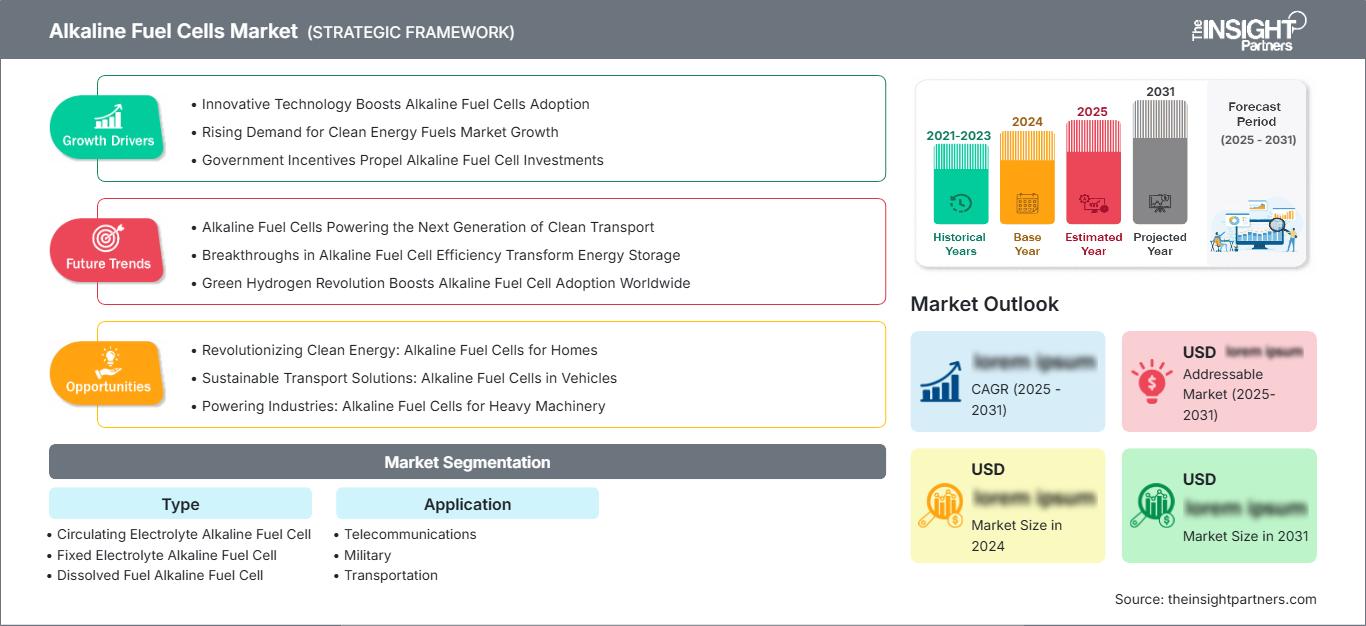
Alkaline Fuel Cells Market: Strategic Insights
Regional Insights
North America alkaline fuel cells market
North America remains the largest regional market, with a ~10% CAGR through 2034. The region is helped by the presence of developed hydrogen research capability, government funding of fuel cell and hydrogen infrastructure and the need for power resiliency in remote and critical installations. The US is the main area of demand, since there are several approaches to commercialization in the fields of transportation, defense, telecommunications, distributed generation and industrial users. Fuel cell infrastructure is an essential barrier, especially in cases when fuel cell installation requires dependable and affordable delivery of fuel.
The ecosystem of the region is also helped by fuel cell architecture innovation, which will allow developers of alkaline fuel cells to take advantage of developments in areas such as membranes, catalysts, power electronics and system control. Canada helps through hydrogen and clean technology innovation, while the US helps with projects and customers. Opportunities in transportation include medium- and heavy-duty vehicles, while opportunities in the stationary field include backup power, off-grid applications and critical infrastructure. Research funding, industrial demand and need for power resiliency should ensure growth until 2034.
U.S. alkaline fuel cells market
The US accounts for ~78% of North American alkaline fuel cells market revenue in 2025 and is projected to expand at a ~10% CAGR through 2034. Federal programs targeting hydrogen production, delivery, storage, fueling, and fuel cell systems create a broad development ecosystem. Moreover, there is a considerable need for power storage and distributed power where hydrogen systems can be used in combination with batteries and renewables if extended operation is needed.
Commercials range from transportation, telecommunication, defense, industrial plants, and portable power. Fuel cell applications are being developed by Ballard Power Systems in transport and stationary sectors, and GenCell in mission-critical and off-grid power in alkaline form. Also, research organizations and energy providers are advancing hydrogen supply and delivery infrastructure. The adoption would depend on hydrogen costs, equipment life-cycle, permitting, and economic justification of the customers; however, the variety of end-users in the US ensures multiple ways for alkaline technology to transition from demonstration projects to commercial success.
Europe alkaline fuel cells market
Europe represents ~29% of the global alkaline fuel cells market in 2025 and is expected to register a ~9% CAGR through 2034. Germany has the leading position among European countries because of its programs in industrial hydrogen, engineering, mobility, and diverse clean energy technologies. The UK provides opportunities in fuel cell development and distributed power, whereas France uses its programs in industrial decarbonization in addition to hydrogen mobility and energy infrastructures. Italy and Spain provide opportunities in renewable hydrogen, distributed power, and transport applications.
There is a growing tendency toward decarbonization demands from those industries that cannot be electrified directly in the region. Hydrogen fuel cells are considered for heavy road transport, railway, maritime applications, and resilient stationary electricity. Funding for infrastructure helps develop hydrogen refueling stations; however, the level of commercial implementation is still not consistent among countries. Moreover, there is good research infrastructure in terms of membranes, catalysts, and electrochemical systems. Competition from Asian manufacturers and the decrease in costs of systems is likely to influence regional competitiveness, whereas European regulation can drive demand at an early stage.
The European market is therefore characterized by a combination of advanced research, policy support, demonstration projects, and selective commercial deployment. Germany remains the principal national market, while the UK, France, Italy, and Spain provide differentiated opportunities based on hydrogen production, industrial demand, transport infrastructure, and renewable energy availability.
APAC alkaline fuel cells market
Asia Pacific is estimated to hold ~24% of the global alkaline fuel cells market in 2025 and is forecast to expand at a ~14% CAGR through 2034, making it the fastest-growing region. Japan is the leading country in Asia Pacific, supported by long-standing fuel cell expertise, hydrogen policy, and distributed energy programs. South Korea also has strong fuel cell manufacturing capabilities, while China and India are expanding hydrogen technology development and industrial localization.
Japan and South Korea provide established corporate and policy ecosystems, whereas China offers scale in manufacturing and clean-energy investment. India is developing domestic hydrogen capabilities and industrial applications, and Australia contributes through renewable hydrogen resources and export-oriented projects. Growth will depend on reducing system costs, developing hydrogen supply chains, and adapting fuel cell configurations to local operating conditions. The combination of manufacturing scale, energy transition policies, and rising demand for resilient power gives APAC the strongest long-term expansion profile.
Middle East & Africa alkaline fuel cells market
The Middle East & Africa alkaline fuel cells market is expected to expand at a ~12% CAGR through 2034 as hydrogen investment, renewable energy development, and power reliability requirements create new opportunities. Saudi Arabia is the leading country in the Middle East & Africa region where project scale, hydrogen investment, and large energy infrastructure programs support technology adoption. The UAE is also developing hydrogen and clean-energy capabilities, while South Africa offers applications linked to mining, industrial operations, and remote power.
The regional opportunity is shaped by abundant solar resources, emerging hydrogen production projects, and the need for reliable electricity at remote industrial sites. Alkaline systems can be relevant where hydrogen is produced locally or transported through developing supply chains. High ambient temperatures, water availability, dust exposure, and maintenance requirements remain important design considerations. Commercial adoption will therefore favor systems capable of operating reliably under demanding environmental conditions and integrating with renewable generation, batteries, and local hydrogen or ammonia supply.
Segmentation Analysis
Type
Type is a core technology dimension of the alkaline fuel cells market because electrolyte configuration influences efficiency, durability, gas management, maintenance, and application suitability. Fixed-electrolyte architectures hold the strongest overall position because they can simplify system operation for controlled stationary installations and support established commercial designs. Development activity is increasingly directed toward improved electrolyte stability and lower balance-of-plant complexity. Within this category, circulating electrolyte systems are estimated to register a ~10% CAGR through 2034 as system developers address carbon dioxide management, thermal control, and longer operating cycles.
- Circulating Electrolyte Alkaline Fuel Cell: Circulating configurations continuously move electrolyte through the stack and associated conditioning equipment. Their architecture can assist thermal and water management and help maintain operating conditions, making them relevant to stationary systems requiring sustained output and controllable maintenance cycles.
- Fixed Electrolyte Alkaline Fuel Cell: Fixed-electrolyte designs emphasize simpler electrolyte handling and are suitable for installations where controlled operating conditions can limit contamination and degradation. Their relatively straightforward configuration supports adoption in backup, distributed, and specialized stationary power systems.
- Dissolved Fuel Alkaline Fuel Cell: Dissolved-fuel configurations provide an alternative pathway for applications requiring different fuel-handling arrangements. Their strategic value is linked to opportunities where fuel availability, storage convenience, or system portability can offset additional engineering requirements.
Application
Application determines how alkaline fuel cell systems are evaluated for reliability, power density, operating duration, maintenance, and fuel logistics. Alkaline Fuel Cells Market trends indicate growing interest in hybrid power architectures, long-duration backup solutions, and hydrogen-based mobility. Telecommunications remains important because backup systems require long-duration power and low maintenance, while military applications value resilience and independence from vulnerable electrical infrastructure. Transportation has the strongest expansion outlook as developers investigate hydrogen systems for heavy-duty and specialized mobility. Within the application category, transportation-related deployments are estimated to grow at a ~15% CAGR through 2034.
- Telecommunications: Telecom installations require dependable backup power at geographically dispersed sites. Alkaline fuel cells can provide long-duration electricity with low local emissions, particularly where grid reliability is limited and diesel replacement can improve maintenance and environmental performance.
- Military: Military users prioritize resilient, transportable, and fuel-efficient power for field operations, communications, surveillance, and remote facilities. Alkaline systems can provide an alternative to conventional generators where silent operation, low thermal signatures, and extended runtime are valuable.
- Transportation: Transportation applications focus on improving range, refueling speed, and operational availability for vehicle classes where battery weight can become restrictive. Commercial opportunities are strongest in heavy-duty, marine, rail, and specialized mobility segments that can use centralized hydrogen infrastructure.
Opportunity Snapshot
| Application | Revenue Contribution | Trend Tag | Adoption Stage |
| Telecommunications | High | Backup Power | Mature |
| Military | Medium | Field Power | Scaling |
| Transportation | Medium | Heavy Mobility | Scaling |
Alkaline Fuel Cells Market Growth Drivers and Impact Analysis
Lower-Cost Catalyst Pathways and Advanced Alkaline Materials
A major driver is the ability of alkaline chemistry to support catalyst systems that can use less expensive materials than some acidic fuel cell configurations. Research into anion exchange membranes, ionomers, electrode structures, and non-precious catalysts is improving the technical basis for lower-cost systems. The commercial impact is significant because catalyst expense, membrane durability, and stack replacement costs directly influence lifecycle economics. Better alkaline materials can also enable higher current density and smaller stacks, reducing balance-of-plant requirements. As developers improve carbon dioxide tolerance and water management, the technology can become more practical for applications that previously favored other fuel cell architectures. The resulting cost reduction can support wider adoption in stationary, backup, and specialized transportation systems.
Expansion of Hydrogen-Based Resilient Power Requirements
Growing demand for resilient electricity is creating another structural driver. Telecommunications networks, data-intensive facilities, remote industrial operations, utilities, and emergency services increasingly require backup systems that can operate for longer periods than conventional batteries. Hydrogen fuel cells can provide extended runtime when adequate fuel storage is available, while modular systems can be combined with batteries and renewable generation. For alkaline technology, the opportunity is particularly relevant in off-grid and poor-grid locations where conventional diesel generation creates emissions, noise, and recurring fuel logistics requirements. The market impact extends beyond individual fuel cell stacks because customers increasingly evaluate complete energy systems, including storage, controls, fueling, and maintenance. This favors suppliers capable of integrating alkaline fuel cells into resilient microgrids.
Heavy-Duty Decarbonization and Specialized Mobility
Transportation decarbonization is opening opportunities for fuel cell systems in applications where high utilization, long operating hours, and rapid refueling are important. Government and industry programs increasingly focus on medium- and heavy-duty vehicles, buses, rail, marine equipment, and specialized off-road machinery. Although battery-electric systems remain highly competitive across many vehicle categories, hydrogen fuel cells can offer operational advantages for selected duty cycles. The impact on alkaline technology will depend on improvements in power density, durability, carbon dioxide management, and onboard system packaging. Transportation customers are also likely to favor suppliers that can provide complete propulsion solutions and reliable hydrogen supply arrangements. Consequently, progress in alkaline membranes and stack architecture could determine how much of the emerging heavy-duty opportunity becomes addressable by AFC systems.
Alkaline Fuel Cells Market Future Trends
Integration of Alkaline Fuel Cells with Hybrid Energy Platforms
The alkaline fuel cells market is likely to see greater integration with batteries, renewable generation, hydrogen storage, and intelligent energy-management systems. Rather than operating as isolated generators, future installations can combine fuel cells with photovoltaic systems, wind power, batteries, and controllable loads to optimize the use of hydrogen and electricity. Hybrid architectures can allow batteries to handle rapid load changes while the fuel cell provides longer-duration energy, reducing unnecessary stack cycling. Digital controls can further coordinate hydrogen consumption, battery state of charge, renewable availability, and load requirements. This model is particularly relevant for remote facilities, telecom infrastructure, temporary power, and industrial microgrids. The trend should shift competitive differentiation from stack performance alone toward integrated system efficiency, availability, and lifecycle economics.
Greater Use of Ammonia-Derived Hydrogen and On-Site Fuel Processing
A second future trend is the development of fuel supply models that reduce dependence on compressed hydrogen distribution. Ammonia can serve as a hydrogen carrier because it is easier to store and transport at scale than hydrogen in several logistics configurations. Alkaline fuel cell developers are investigating systems that combine ammonia cracking with fuel cell generation, allowing hydrogen to be produced near the point of consumption. This approach could expand the addressable market in remote regions, telecom networks, military sites, and industrial facilities where hydrogen delivery infrastructure is limited. Commercial progress will depend on cracker efficiency, system integration, emissions control, ammonia availability, and total cost. If these elements improve together, ammonia-based architectures could become an important route for expanding alkaline fuel cell deployment beyond established hydrogen hubs.
Alkaline Fuel Cells Market Opportunities
Deploy Modular Backup Systems for Critical Infrastructure
An important commercial opportunity lies in modular alkaline fuel cell systems for critical infrastructure requiring long-duration backup power. Telecom operators, utilities, healthcare facilities, emergency-response networks, and remote industrial assets can benefit from systems that combine fuel cells with batteries and remote monitoring. Suppliers can differentiate through compact packaging, rapid installation, extended maintenance intervals, and integration with existing power architectures. The strongest opportunities are likely to emerge where diesel replacement offers measurable environmental, noise, and maintenance benefits while grid upgrades are expensive or impractical. Investment should focus on standardized system platforms that can be deployed across multiple site types rather than highly customized projects. Partnerships with infrastructure operators and energy-service providers can also reduce customer acquisition costs and create recurring maintenance and fuel-management revenue.
Build Regional Hydrogen-to-Power Platforms in Emerging Markets
Emerging markets provide an opportunity to develop integrated hydrogen-to-power platforms around renewable electricity, local hydrogen production, and distributed energy demand. Regions with abundant solar or wind resources can pair electrolysis, storage, and alkaline fuel cell generation to provide electricity when renewable output is unavailable. Such systems can serve industrial facilities, remote communities, transport depots, ports, and telecommunications infrastructure. The commercial model can be strengthened by combining power generation with hydrogen services, equipment maintenance, digital monitoring, and energy management. Investors and technology providers should prioritize locations where renewable resources, industrial demand, and infrastructure gaps overlap. Demonstration projects that establish reliable operating data and local service capabilities can lower perceived technology risk and create scalable deployment templates.
Frequently Asked Questions

- Comprehensive Market Sizing and Forecast Analysis
- Detailed Segmentation Analysis
- In-Depth Market Dynamics Assessment
- Regional and Country-Level Insights
- Competitive Landscape and Company Benchmarking
- Strategic Business Intelligence
Recent Reports
Testimonials

The Insight Partners provided valuable market intelligence that supported our global go-to-market strategy. Their team was professional, responsive, and attentive to our feedback, providing thoughtful analysis and helpful methodological clarifications throughout the project.
Junmo Kim Chief Financial Officer (CFO), Enertech Co., Ltd.
The Insight Partners' SCADA System Market report is comprehensive, with valuable insights on current trends and future forecasts. The team was highly professional, responsive, and supportive throughout. We are very satisfied and highly recommend their services.
RAN KEDEM Partner, Reali Technologies LTDs
I requested a report on a very specific software market and the team produced the report in a few days. The information was very relevant and well presented. I then requested some changes and additions to the report. The team was again very responsive and I got the final report in less than a week.
JEAN-HERVE JENN Chairman, Future Analytica
We worked with The Insight Partners for an important market study and forecast. They gave us clear insights into opportunities and risks, which helped shape our plans. Their research was easy to use and based on solid data. It helped us make smart, confident decisions. We highly recommend them.
PIYUSH NAGPAL Sr. Vice President, High Beam Global
The Insight Partners delivered insightful, well-structured market research with strong domain expertise. Their team was professional and responsive throughout. The user-friendly website made accessing industry reports seamless. We highly recommend them for reliable, high-quality research services
YUKIHIKO ADACHI CEO, Deep Blue, LLC.
This is the first time I have purchased a market report from The Insight Partners.While I was unsure at first, I visited their web site and felt more comfortable to take the risk and purchase a market report.I am completely satisfied with the quality of the report and customer service. I had several questions and comments with the initial report, but after a couple of dialogs over email with their analyst I believe I have a report that I can use as input to our strategic planning process.Thank you so much for taking the extra time and making this a positive experience.I will definitely recommend your service to others and you will be my first call when we need further market data.
JOHN SUZUKI President and Chief Executive Officer, Board Director, BK Technologies
I wish to appreciate your support and the professionalism you displayed in the course of attending to my request for information regarding to infectious disease IVD market in Nigeria. I appreciate your patience, your guidance, and the fact that you were willing to offer a discount, which eventually made it possible for us to close a deal. I look forward to engaging The Insight Partners in the future, all thanks to the impression you have created in me as a result of this first encounter.
DR CHIJIOKE ONYIA MANAGING DIRECTOR, PineCrest Healthcare Ltd.Reason to Buy
- Informed Decision-Making
- Understanding Market Dynamics
- Competitive Analysis
- Identifying Emerging Markets
- Customer Insights
- Market Forecasts
- Risk Mitigation
- Boosting Operational Efficiency
- Strategic Planning
- Investment Justification
- Tracking Industry Innovations
- Aligning with Regulatory Trends





 Get Free Sample for