
Ambulatory Infusion Centers Market Size, Growth & Demand by 2034
Ambulatory Infusion Centers Market Size and Forecasts (2021 - 2034), Global and Regional Share, Trends, and Growth Opportunity Analysis Report Coverage : by Therapy Type (Blood Product Infusion, Iron Therapy, Steroid Infusion, Immunoglobulin Therapy, Therapeutic Phlebotomy, Plasmapheresis, Clotting Factor Replacement Therapy); Application (Diabetic, Cancer, Bone Diseases, Neurodegenerative Diseases); End User (Hospitals, Specialty Clinics, Homecare Settings); and Geography (North America, Europe, Asia Pacific, and South and Central America)
- Status : Data Released
- Report Code : TIPRE00040848
- Category : Life Sciences
- No. of Pages : 150
- Available Report Formats :


- Last update date : July 14, 2026


2025 Market Size
US$ 17.64 Bn
Base year value
2034 Forecast
US$ 39.58 Bn
Projected by 2034
CAGR 2026-2034
9.39 %
Growth rate
Addressable Market
US$ 255.40 Bn
(2026-2034)
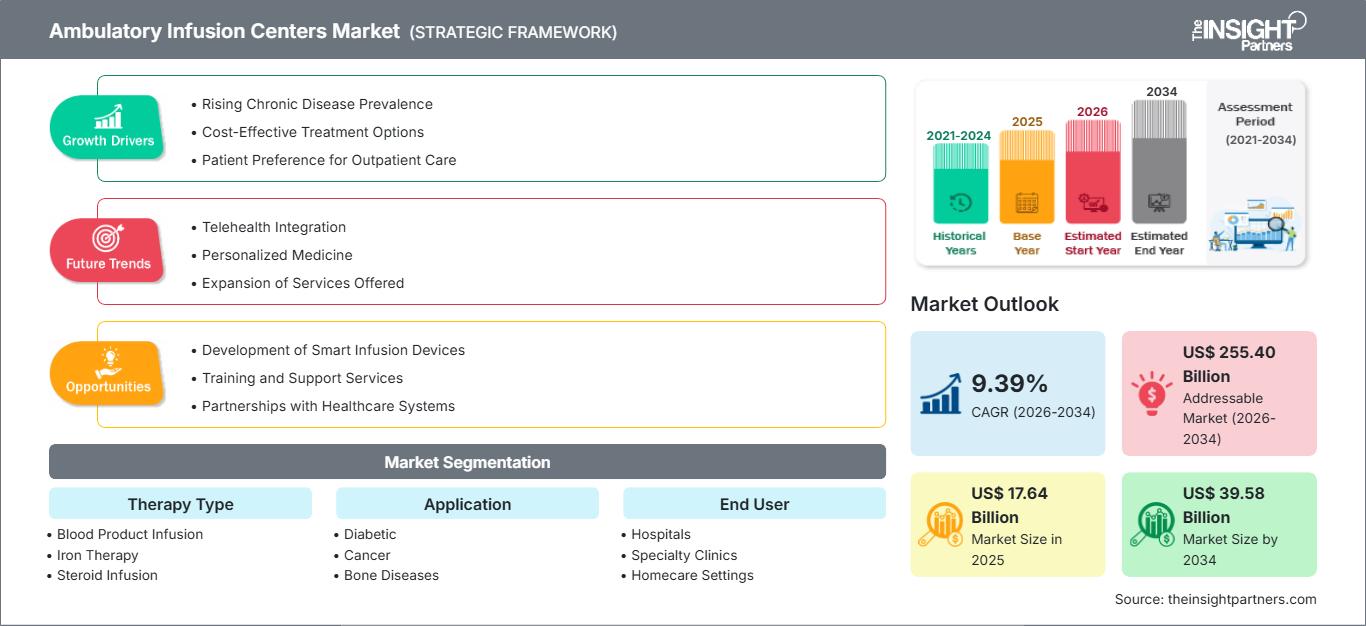
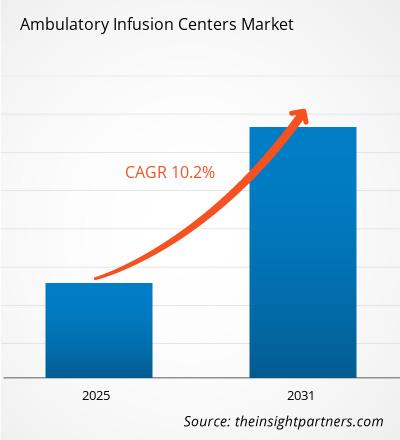
The Ambulatory Infusion Centers Market is projected to grow from US$ 17.64 Billion in 2025 to US$ 39.58 Billion by 2034, registering a CAGR of 9.39% during 2026–2034. This growth demonstrates the ongoing transition from in-patient hospital to clinically controlled out-patient settings, which is enabled by the growing consumption of biological drugs, prevalence of chronic diseases, and patient preference for a planned treatment environment.
Throughout North America, ambulatory infusion therapy services are transforming from an innovative practice into a standard out-patient healthcare delivery mechanism. The Ambulatory Infusion Centers Market size in the region is supported by an estimated CAGR range of 8.6–9.2% during 2026–2034, driven by specialty drug reimbursement management, oncology decentralization, and wider use of infusion suites by health systems, specialty clinics, and integrated pharmacy providers.
Ambulatory Infusion Centers Market Assessment and Insights
- North America holds an estimated 44–46% share in 2025 and is expected to grow at a CAGR of 8.6–9.2% during 2026–2034, supported by payer-directed site-of-care optimization and broad specialty pharmacy integration.
- US accounts for 86–88% of North America in 2025 and is projected to expand at a CAGR of 8.4–9.0% during 2026–2034 as providers scale biologic infusion access.
- Europe represents 25–27% share in 2025 and is forecast to grow at a CAGR of 8.1–8.7% during 2026–2034, led by Germany, the UK, and France.
- Asia Pacific contributes 18–20% share in 2025 and is expected to grow at a CAGR of 10.5–11.4% during 2026–2034, led by China, Japan, India, South Korea, and Australia.
- Largest Segment Immunoglobulin Therapy holds 26–29% market share in 2025 and is projected to grow at a CAGR of 9.0–9.8% during 2026–2034 due to complex immune disorder demand.
- High Growth Segment Cancer holds 20–23% market share in 2025 and is expected to expand at a CAGR of 10.2–11.0% during 2026–2034 as outpatient oncology infusion increases.
- Key companies analyzed in detail: Coram LLC, Option Care Health, Inc., UnitedHealth Group Incorporated, PharMerica Corporation, Cleveland Clinic, University of Kentucky HealthCare, Stoughton Health, CHI Mercy Health Mercy Medical Center, Hattiesburg Clinic, IVX Health, Inc., Arnot Health, Amerita, Inc., Pure Infusion Suites, and Paragon Healthcare, Inc.
Source: The Insight Partners' analysis based on proprietary research, government publications, company annual reports, investor presentations, industry databases, and expert interviews.
Clinical service has advanced from a model involving centralized infusion pharmacies in hospitals to a network system encompassing pharmacists, nursing staff, e-permissioning, cold chain logistics, and claims management. In relation to the Ambulatory Infusion Centers market, the dynamics are more influenced by specialty biologics, immunoglobulins, anti-inflammatory drugs, and injectable chemotherapy that need skilled labor although not necessarily hospital facilities. Operational initiatives include developing scheduling systems, drug use review, infusion chair efficiency, and incident handling policies among others.
In terms of market growth, the coming years will see opportunities extending from developed urban areas in the United States to secondary towns, specialty clinics, and even hospital satellite infusion facilities. Positive regulation dynamics involve increased oversight on costly hospital outpatient centers, while there is constant demand created by the health problems of diabetes, cancer, neurologic conditions, and immune disorders. Financial initiatives include regional acquisitions, strategic physician partnerships, expanding infusion suites, and referral management systems.
Ambulatory Infusion Centers Market Report Scope
| Report Attribute | Details |
|---|---|
| Market size in 2025 | US$ 17.64 Billion |
| Market Size by 2034 | US$ 39.58 Billion |
| Global CAGR (2026 - 2034) | 9.39% |
| Historical Data | 2021-2024 |
| Forecast period | 2026-2034 |
Ambulatory Infusion Centers Market Analysis
Increasing need for off-campus infusion is associated with the rate of penetration of biological therapy, an aging population, and management of chronic diseases. Factors driving the Ambulatory Infusion Centers Market include payors who guide their stable patient population to low acuity sites, thereby lowering facility costs but maintaining clinical supervision. This ecosystem is made up of prescribers, specialty pharmacies, nurses, pharma, benefits managers, and transport-friendly distributors.
The supply dynamics are tight since there is a reliance on skilled nurses, compounded medication, emergency services, and authorization. Those facilities that have partnerships with pharmacies and payors have the ability to better handle costly medications. Competitors among smaller centers do so through convenience, access to doctors, and specialty care programs, including immunology, oncology, hematology, neurology, and inflammatory disorders.
The market structure is fragmented but shows signs of consolidation. According to the Ambulatory Infusion Centers Market analysis, Option Care Health, Inc., and UnitedHealth Group Incorporated have advantages in the national pharmacy and payer networks, while IVX Health, Inc., Pure Infusion Suites, and Paragon Healthcare, Inc. focus on patient-centered ambulatory centers. The Cleveland Clinic and the University of Kentucky HealthCare have referral control through specialty campus integration.
The areas of focus for investment include density of facilities, automation of approvals, expansion of biologics treatments, and efficiency of nurses. The firms involved in promoting alternate site infusion include PharMerica Corporation and Amerita, Inc. through pharmacy-based service models and Coram LLC which has cut down some parts of its services. Strategic positioning will depend on acceptance by payers, drug mix portfolio, and clinical quality reports.
● REPORT CUSTOMIZATION
Tailor This Report To Align With Your Specific Business Requirements
This report can be customized to align precisely with your business objectives, scope, and target markets. Customization options include tailored segmentation, geography, competitive analysis, and strategic insights to support informed decision-making.
Customize This Report →WHAT YOU CAN ADJUST
- ● Segmentations
- ● Geography
- ● Competitive Analysis
- ● Language Preferences
Ambulatory Infusion Centers Market: Strategic Insights
Regional Insights
North America Ambulatory Infusion Centers Market
North America accounts for 44–46% share in 2025 and is expected to grow at a CAGR of 8.6–9.2% during 2026–2034. The Ambulatory Infusion Centers Market share in the region is supported by mature specialty pharmacy networks, insurer site-of-care programs, and strong use of biologic therapies across immunology, oncology, gastroenterology, rheumatology, and neurology.
Another advantage of this area is its high disease burden, along with the experience of physicians in using infusion therapy outside the hospital setting. The leading providers of the area are expanding their suites, developing remote intake processes, and integrating manufacturer support for their patients. There is a labor limitation, but process automation helps to overcome it.
U.S. Ambulatory Infusion Centers Market
North America consists of 86-88% of the U.S., which has an expected CAGR of 8.4-9.0% from 2026 to 2034. The demand will come from immunoglobulin therapy, oncology biological drugs, iron replacement therapies, and inflammatory disorders treatments where the commercial focus would be on the administration outside of the hospital settings for suitable patients.
Presence of players is very dense where some of the major players such as Option Care Health, Inc., UnitedHealth Group Incorporated, Coram LLC, IVX Health, Inc., Pure Infusion Suites, Paragon Healthcare, Inc., and Amerita, Inc. operate in more than one state. Application trend includes more applications in cancer, neurodegenerative disorders, and chronic immune-mediated disorders.
Europe Ambulatory Infusion Centers Market
Europe represents 25–27% market share in 2025 and is expected to witness a CAGR of 8.1–8.7% for 2026–2034 driven by density of specialists, usage of biologics and organized reimbursement routes. In the UK, the advancement of outpatients’ infusions can be attributed to the NHS capacity management and the community approach that decreases pressure on the hospital day units.
Outpatient specialty clinics and hospital-based outpatient centers in Germany enable biologic infusion services for patients with oncological, rheumatological and immunological conditions. In the UK, the strategies for decreasing the waitlist and the integrated healthcare system drive the transition of appropriate infusion services from more acute settings into less.
The markets of France, Italy, and Spain demonstrate gradual growth as oncological networks, specialty physicians, and private facilities advance their outpatient treatment channels. The adoption is determined by the issues of reimbursement rules, dominance of hospitals, nursing staff, and regional organization of care. The growth in Southern Europe is moderate and improves.
APAC Ambulatory Infusion Centers Market
The APAC region holds an 18% to 20% share in 2025 and is projected to exhibit a CAGR of 10.5% to 11.4% between 2026 and 2034, driven by China. Japan, South Korea, India, and Australia fuel the demand via their aging population, cancer treatments, and private specialty clinics.
The policy initiatives focused on reducing hospital overcrowding, increasing cancer accessibility, and building urban OPD infrastructure have encouraged the uptake of ambulatory chemotherapy centers. China dominates in terms of scale, Japan for its usage driven by aging population, Australia in terms of its organized private clinics, while India leads in its private hospitals segment.
Middle East & Africa Ambulatory Infusion Centers Market
Middle East & Africa is forecast to have a compound annual growth rate of 7.2% to 8.0% between 2026 and 2034, powered primarily by Saudi Arabia. The UAE, South Africa, and Rest of MEA are all increasing outpatient specialty treatments while renovating hospitals, oncology strategic planning, and creating infrastructure geared toward medical tourism.
Oil revenues in the Middle Eastern countries enable big hospitals and specialty clinics which may integrate infusion centers. South Africa is the most organized sub-Saharan country despite having affordability issues. Adoption in MEA will be influenced by trained nurse supply, biologics coverage, private urban care development, and decentralized oncology care.
Segmentation Analysis
Therapy Type
Therapy Type is expected to grow at a CAGR of 9.1–9.8% during 2026–2034. This segment defines the Ambulatory Infusion Centers Market scope because therapy complexity determines staffing, chair time, monitoring protocols, drug storage, and reimbursement intensity. Demand is strongest where recurring treatment schedules, specialist oversight, and biologic drug administration can be standardized without requiring inpatient admission.
- Blood Product Infusion remains important for hematology and oncology patients requiring repeat administration, with safety protocols, compatibility testing, and clinician supervision making ambulatory centers a practical alternative to hospitals.
- Iron Therapy is widely used for anemia linked to chronic kidney disease, pregnancy, gastrointestinal conditions, and oncology care, supporting predictable scheduling and efficient chair utilization in outpatient environments.
- Steroid Infusion supports neurological, inflammatory, and autoimmune indications where short treatment cycles require clinical observation but generally do not require inpatient beds or high-acuity infrastructure.
- Immunoglobulin Therapy is the largest segment, supported by primary immunodeficiency, immune neuropathies, and autoimmune disorders requiring recurring, carefully monitored administration across specialized outpatient suites.
- Therapeutic Phlebotomy serves patients with iron overload and hematologic conditions, offering procedure-driven revenue with manageable clinical complexity and repeat visits suited to ambulatory scheduling models.
- Plasmapheresis requires higher technical capability, trained staff, and equipment readiness, making it strategically relevant for centers connected to hospitals or specialist networks managing complex autoimmune conditions.
- Clotting Factor Replacement Therapy supports hemophilia and bleeding disorder management, requiring product availability, dosing precision, and coordination with hematologists to maintain continuity of care.
Application
Application is projected to grow at a CAGR of 9.3–10.1% during 2026–2034. Demand patterns are shifting as cancer, diabetes-related complications, bone diseases, and neurodegenerative conditions create recurring infusion needs. Applications with long treatment duration, high biologic use, and specialist referral density create the strongest center economics.
- Diabetic applications include infusion needs linked to complications, infection management, and comorbidity-related therapies, with demand supported by high disease prevalence and outpatient chronic care coordination.
- Cancer is the high-growth segment, as selected chemotherapy, immunotherapy, supportive iron therapy, and biologic administration move to ambulatory settings when patient acuity and payer policy allow.
- Bone Diseases support demand for osteoporosis, metabolic bone disorders, and inflammatory skeletal conditions requiring periodic injectable or infused therapies administered under professional supervision.
- Neurodegenerative Diseases are gaining importance as multiple sclerosis and other neurological conditions rely on recurring infusion therapies that benefit from specialist oversight and patient-friendly settings.
End User
End User is expected to grow at a CAGR of 8.8–9.6% during 2026–2034. Hospitals, specialty clinics, and homecare settings each play distinct roles in site-of-care migration. Hospitals manage complex and high-risk patients, specialty clinics scale condition-specific pathways, and homecare settings serve stable patients where reimbursement, nursing availability, and safety criteria align.
- Hospitals retain complex cases and often operate outpatient infusion departments to preserve referral continuity, manage higher-risk therapies, and support multidisciplinary oncology or neurology treatment models.
- Specialty Clinics are expanding quickly because rheumatologists, oncologists, neurologists, and gastroenterologists can coordinate diagnosis, prescription, infusion, and follow-up within targeted care pathways.
- Homecare Settings serve stable patients needing convenience and continuity, although therapy suitability, nurse travel time, payer rules, and emergency preparedness define adoption boundaries.
Opportunity Snapshot
| End User | Revenue Contribution | Trend Tag | Adoption Stage |
| Diabetic | Medium | Complication Care | Scaling |
| Cancer | High | Oncology Shift | Scaling |
| Bone Diseases | Medium | Bone Biologics | Emerging |
| Neurodegenerative Diseases | High | Neuro Infusion | Scaling |
Ambulatory Infusion Centers Market Growth Drivers and Impact Analysis
Shift from hospital outpatient departments to lower-cost infusion sites
Payers and employers are focusing on hospital outpatient departments' costs related to repeated use of biologics and infusions for specialty treatments. This results in significant site-of-care shift since the patients are clinically stable and the medications can be delivered using standardized monitoring procedures. The effect is seen mainly in the areas of immunology, gastroenterology, rheumatology, neurology, and some oncology programs in which repeated visits are anticipated. The Ambulatory Infusion Centers Market growth is facilitated by the ability of the centers to provide relatively low cost of the facility, convenient scheduling, and easy access to the patient while having the emergency procedure and documentation in place.
Rising chronic disease prevalence and recurring specialty therapy demand
The use of infusion therapies for chronic diseases is growing in both advanced and developing nations. Treatments for complications associated with diseases like diabetes, cancer, immune deficiency, inflammatory, bone, and nervous system conditions make the treatment cycle repetitive as opposed to a one-off treatment procedure. As such, infusions change from an in-hospital process to an out-patient activity that is schedule transparent. Important implications of the growth of the Ambulatory Infusion Centers Market are high chair usage, wide therapy options, and strengthened relationships with referring physicians. Institutions that emphasize repeat treatment cycles can improve nurse efficiency, patient education, and inventory management.
Specialty pharmacy integration and biologic drug pipeline expansion
The increased number of specialty drugs being developed has created a greater need for administration under clinical supervision that is outside of hospitals. Specialty pharmacy services can help provide improved access, benefit validation, patient assistance programs, cold chain management, and medication adherence. This is particularly helpful in cases where the medicine has expensive acquisition cost, complicated dosing regimen, or strict payer documentation requirements. In the case of the Ambulatory Infusion Centers Market, collaboration between the two models of specialty pharmacies and providers can assist in referral management, inventory management, nursing staff, and claim submission. Biosimilars may also drive volume as an inexpensive substitute to the brand name drug.
Ambulatory Infusion Centers Market Future Trends
Digitally coordinated infusion pathways
Ambulatory Infusion Centers Market trends will increasingly center on digital coordination between prescribers, payers, pharmacies, and infusion staff. Automation of intake process, benefit verification, real-time authorization, inventory management and adverse event reporting will minimize administrative lags. Predictive scheduling system which will match chairs, nurses, drugs delivery and patient preference will be the next step. Operators using an integrated platform have the ability to cut referral leakage and improve initiation time for therapy. These developments will help bigger networks and technologically enabled specialty centers to thrive, while smaller providers can rely on shared service platforms to compete.
Expansion of condition-specific infusion suites
The future focus will be on infusion suites which cater to distinct disease categories as opposed to outpatient facilities. The approach to handling drugs, patient education, timing of monitoring, and preparedness for adverse events in neurological, oncological, immunological, gastroenterological, and rheumatological disease programs differs significantly. Disease specific suites can increase confidence among physicians, patients, and payers by providing evidence of deeper protocols. The approach will affect not only the design of the facility but also nurse training and partnerships with manufacturers. This development also presents an opportunity for regional companies to distinguish themselves based on their clinical capabilities as opposed to only geographical coverage and price.
Ambulatory Infusion Centers Market Opportunities
Partnerships with oncology and neurology specialists
Partnering with specialists is one of the most direct forms of investment due to the value and recurring nature of infusions performed by oncologists and neurologists. Investments and operations can build co-location suites and referral protocols that enable care without requiring reliance on the hospital system but preserve oversight by specialists. As Ambulatory Infusion Centers Market Forecast notes, such alignment will prove key in the face of increasing complexity of treatments and demands for site-of-care justification from payers. Partnerships can also allow for more rapid treatment initiation, adherence monitoring, and patient retention.
Scaled entry into underserved secondary cities
The secondary cities are under penetrated despite the increase in chronic illness prevalence rate and the growing network of specialty physicians. Creating centers in such markets would help reach those patients that currently go to hospitals in bigger urban centers in order to receive their therapies repeatedly. Operators may be able to reduce risks by using smaller centers and utilizing flexible nurse staffing, as well as focused therapy portfolios. The most important market potential lies in such areas as immunoglobulin therapy, iron therapy, inflammatory disease biologics and some oncology support therapies.
Recent Developments
- November 2025: Cleveland Clinic opened a neurological outpatient facility in Beachwood, Ohio, including 22 outpatient exam rooms, 14 consultation rooms, 12 infusion chairs, and diagnostic capabilities. The site is designed to expand access for neurological conditions and support future integration with the organization’s main-campus Neurological Institute.
- June 2025: UnitedHealthcare issued specialty medical injectable medication program and policy updates, including review-at-launch and medication sourcing changes for selected specialty injectables and biosimilars. The update reflects continued payer management of outpatient injectable drugs and reinforces the importance of authorization readiness among infusion providers.
- January 2025: Option Care Health, Inc. completed the acquisition of Intramed Plus, Inc. for approximately US$ 120 million after signing the agreement in November 2024. The transaction strengthened advanced practitioner capabilities and supported broader alternate-site infusion expansion in the U.S. Southeast.
Frequently Asked Questions

- Comprehensive Market Sizing and Forecast Analysis
- Detailed Segmentation Analysis
- In-Depth Market Dynamics Assessment
- Regional and Country-Level Insights
- Competitive Landscape and Company Benchmarking
- Strategic Business Intelligence
Recent Reports
Testimonials

The Insight Partners' SCADA System Market report is comprehensive, with valuable insights on current trends and future forecasts. The team was highly professional, responsive, and supportive throughout. We are very satisfied and highly recommend their services.
RAN KEDEM Partner, Reali Technologies LTDs
I requested a report on a very specific software market and the team produced the report in a few days. The information was very relevant and well presented. I then requested some changes and additions to the report. The team was again very responsive and I got the final report in less than a week.
JEAN-HERVE JENN Chairman, Future Analytica
We worked with The Insight Partners for an important market study and forecast. They gave us clear insights into opportunities and risks, which helped shape our plans. Their research was easy to use and based on solid data. It helped us make smart, confident decisions. We highly recommend them.
PIYUSH NAGPAL Sr. Vice President, High Beam Global
The Insight Partners delivered insightful, well-structured market research with strong domain expertise. Their team was professional and responsive throughout. The user-friendly website made accessing industry reports seamless. We highly recommend them for reliable, high-quality research services
YUKIHIKO ADACHI CEO, Deep Blue, LLC.
This is the first time I have purchased a market report from The Insight Partners.While I was unsure at first, I visited their web site and felt more comfortable to take the risk and purchase a market report.I am completely satisfied with the quality of the report and customer service. I had several questions and comments with the initial report, but after a couple of dialogs over email with their analyst I believe I have a report that I can use as input to our strategic planning process.Thank you so much for taking the extra time and making this a positive experience.I will definitely recommend your service to others and you will be my first call when we need further market data.
JOHN SUZUKI President and Chief Executive Officer, Board Director, BK Technologies
I wish to appreciate your support and the professionalism you displayed in the course of attending to my request for information regarding to infectious disease IVD market in Nigeria. I appreciate your patience, your guidance, and the fact that you were willing to offer a discount, which eventually made it possible for us to close a deal. I look forward to engaging The Insight Partners in the future, all thanks to the impression you have created in me as a result of this first encounter.
DR CHIJIOKE ONYIA MANAGING DIRECTOR, PineCrest Healthcare Ltd.Reason to Buy
- Informed Decision-Making
- Understanding Market Dynamics
- Competitive Analysis
- Identifying Emerging Markets
- Customer Insights
- Market Forecasts
- Risk Mitigation
- Boosting Operational Efficiency
- Strategic Planning
- Investment Justification
- Tracking Industry Innovations
- Aligning with Regulatory Trends





 Get Free Sample for