
Analog Semiconductor Market Trends, Demand & Growth by 2034
Coverage: By Type (General Purpose, Application Specific); Components (Resistors, Capacitors, Inductors, Diodes, Transistors, Operational Amplifiers); Industry Vertical (Consumer, Electronics, IT and Telecommunication, Automotive, Manufacturing, Others) , and Geography (North America, Europe, Asia Pacific, and South and Central America)
- Status : Data Released
- Report Code : TIPRE00020410
- Category : Electronics and Semiconductor
- No. of Pages : 150
- Available Report Formats :


- Last update date : July 15, 2026


2025 Market Size
US$ 79.33 Bn
Base year value
2034 Forecast
US$ 146.91 Bn
Projected by 2034
CAGR 2026-2034
7.09 %
Growth rate
Addressable Market
US$ 1,021.40 Bn
(2026-2034)
The Analog Semiconductor Market was valued at US$ 79.33 Billion in 2025 and is projected to reach US$ 146.91 Billion by 2034, growing at a CAGR of 7.09% during 2026–2034. The Analog Semiconductor Market converts real-world signals into usable electrical information, supporting power management, sensing, amplification, interface, timing, and signal-conditioning functions across consumer electronics, telecommunications, automotive, and manufacturing applications.
North America remains a high-value demand center, with the Analog Semiconductor Market size supported by automotive electronics, industrial automation, data-center power infrastructure, and advanced medical and aerospace systems. The region is estimated to grow at a CAGR range of 6.2–6.6% during 2026–2034. Growth is reinforced by domestic wafer investments, resilient design ecosystems, and rising demand for precision power and mixed-signal components.
Analog Semiconductor Market Assessment and Insights
- North America: The region holds 24–28% share in 2025 and grows at a CAGR range of 6.2–6.6% during 2026–2034, supported by U.S. fab investment, EV electronics, data-center power, and defense-grade signal processing.
- US: The country represents 82–86% of North America in 2025 and grows at a CAGR range of 6.3–6.7% during 2026–2034, led by power-management design and 300mm analog capacity.
- Europe: The region accounts for 16–20% share in 2025 and grows at a CAGR range of 5.6–6.0% during 2026–2034, with Germany, France, Italy, the Netherlands, and the UK leading demand.
- Asia Pacific: The region holds 43–47% share in 2025 and grows at a CAGR range of 7.5–7.9% during 2026–2034, led by China, Japan, South Korea, Taiwan, India, and Southeast Asia.
- Largest Segment: General Purpose holds 53–57% market share in 2025 and grows at a CAGR range of 6.6–7.0% during 2026–2034 because standardized analog functions serve broad device platforms.
- High Growth Segment: Application Specific holds 43–47% market share in 2025 and grows at a CAGR range of 7.6–8.0% during 2026–2034 as automotive, AI power, and industrial systems require customized performance.
- Key companies analyzed in detail: Texas Instruments Incorporated; Qualcomm Incorporated; STMicroelectronics N.V.; Skyworks Solutions, Inc.; Infineon Technologies AG; NXP Semiconductors N.V.; Analog Devices, Inc.; onsemi; Microchip Technology Incorporated; Intel Corporation.
Source: The Insight Partners' analysis based on proprietary research, government publications, company annual reports, investor presentations, industry databases, and expert interviews.
The analog semiconductor products market is migrating from generic supporting components to enabling system capabilities. Increased electrification, greater sensing, better connectivity, and increased energy efficiency requirements are driving design considerations into accuracy, noise, thermal performance, and power integrity. Manufacturing trends include the growth of integrated device manufacturers' 300mm analog capability, increased diversity in back-end packaging, and protection of product lifecycles in use across industrial and automotive systems.
Future demand will expand as vehicle electronics, factory automation, smart meters, connected medical instruments, satellite communications, and edge devices increase the number of signal conversions and power management needs in each system. Government subsidies for semiconductor manufacturing through initiatives like the U.S. and European chip projects increase regional supply chain resilience. The Analog Semiconductor Market will be more stable than memory as most offerings qualify in application-specific design sockets.
Analog Semiconductor Market Report Scope
| Report Attribute | Details |
|---|---|
| Market size in 2025 | US$ 79.33 Billion |
| Market Size by 2034 | US$ 146.91 Billion |
| Global CAGR (2026 - 2034) | 7.09% |
| Historical Data | 2021-2024 |
| Forecast period | 2026-2034 |
Analog Semiconductor Market Analysis
The Analog Semiconductor Market growth is driven by electrification, sensor proliferation, and power-efficiency requirements. WSTS projected global semiconductor sales of US$700.9 billion in 2025, with analog contributing positively, even as growth is led by logic and memory. Analog semiconductor see the greatest demand in cases when signals need to be detected, processed, protected, converted, or controlled before being processed digitally.
The ecosystem includes wafer fabs, analog design automation tools, specialty nodes, passive components suppliers, assembly, testing, module integration, distributors, and OEM qualification engineers. The dynamics of supply are influenced by long product life cycles, high-mix production, silicon area, power semiconductor packaging, and maturity nodes access. Analog customers frequently dual source due to the complex qualification that takes time, especially in automotive and industrial safety sectors.
Competitive factors tend to be centered around firms with extensive analog process libraries, application engineering, and customer qualification expertise. Competitors, including Texas Instruments Incorporated, Analog Devices, Inc., Infineon Technologies AG, STMicroelectronics N.V., NXP Semiconductor N.V., and onsemi, will differentiate based on breadth, reliability, and manufacturing volume, while competitors like Microchip Technology Incorporated, Skyworks Solutions, Inc., Qualcomm Incorporated, and Intel Corporation will focus on narrow applications, RF, interfaces, and adjacent platforms.
Investment is directed toward 300mm analog manufacturing, power management ICs, mixed signal for automotive, RF front-end, and silicon carbide adjacent control electronics. As shown in the Analog Semiconductor Market Analysis, strategic positioning today is more focused on system-level reference designs, configuration capabilities through software, and assured long-term supply versus solely price based on the component alone.
● REPORT CUSTOMIZATION
Tailor This Report To Align With Your Specific Business Requirements
This report can be customized to align precisely with your business objectives, scope, and target markets. Customization options include tailored segmentation, geography, competitive analysis, and strategic insights to support informed decision-making.
Customize This Report →WHAT YOU CAN ADJUST
- ● Segmentations
- ● Geography
- ● Competitive Analysis
- ● Language Preferences
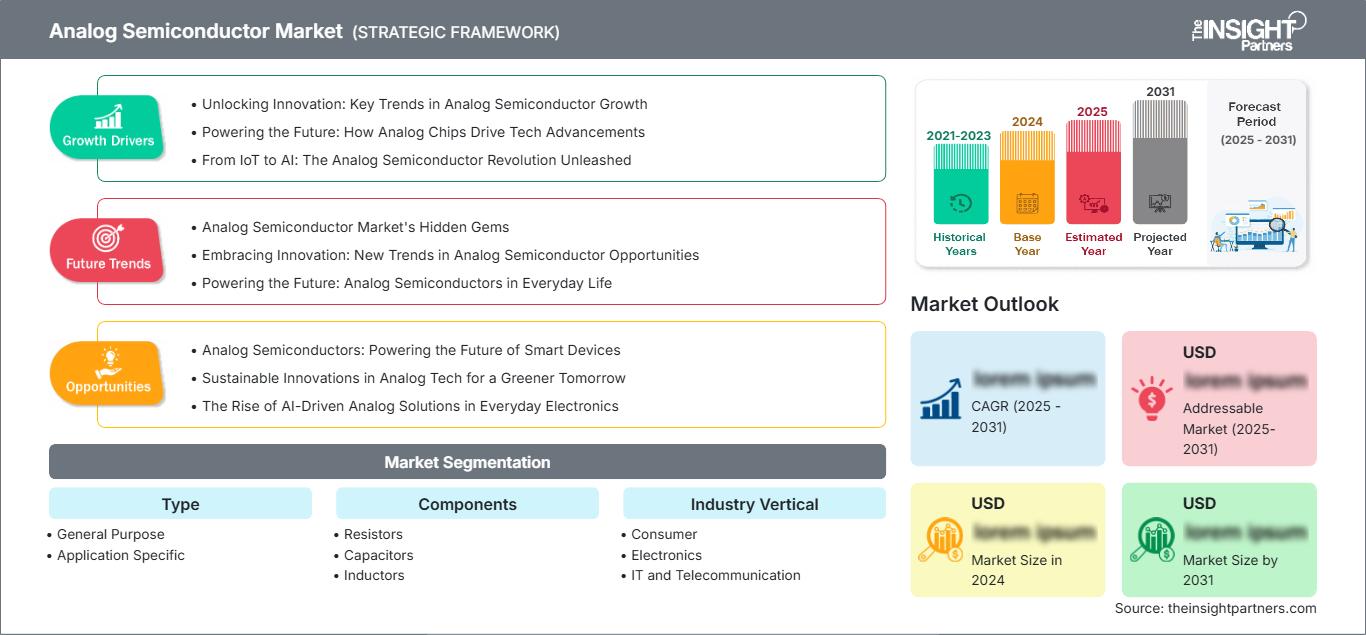
Analog Semiconductor Market: Strategic Insights
Regional Insights
North America Analog Semiconductor Market
North America holds 24–28% share in 2025 and is projected to grow at a CAGR range of 6.2–6.6% during 2026–2034. The Analog Semiconductor Market share in this region is reinforced by U.S. design leadership, defense electronics, medical devices, cloud data centers, automotive electrification, and large foundational semiconductor manufacturing commitments. Texas Instruments Inc. will invest over US$60 billion in U.S. fabs, increasing analog and embedded processing capacity.
Local demand is driven by the need for power integrity in AI servers, battery control, grid infrastructure, industrial automation, and dependable aerospace technology. Proven process technologies, long lead times, and field expertise are crucial for our clients. Canadian contribution is derived from telecommunications, energy, and industrial applications, whereas Mexican participation comes from electronics and auto production. The limiting factor is the availability of analog engineers.
U.S. Analog Semiconductor Market
The U.S. represents 82–86% of North America in 2025 and is expected to grow at a CAGR range of 6.3–6.7% during 2026–2034. The nation gains from the presence of top-notch analog design companies, mature node manufacturing growth, defense electronics initiatives, electric vehicle platforms, medical devices, and data center power requirements. Texas Instruments Incorporated, Analog Devices, Inc., onsemi, Microchip Technology Incorporated, Qualcomm Incorporated, and Intel Corporation have a strong U.S. presence.
Application drivers comprise increased usage of battery monitors, isolation technology, gate drivers, high-precision amplifiers, RF front-end control, clocking, and power management chips. The automotive industry is seeing more integration of analog circuits in batteries, charging solutions, infotainment systems, radars, and body electronics. The data centers need effective voltage regulation and thermal sensing capabilities, while the industrial segment needs durable signal chains and product longevity.
Europe Analog Semiconductor Market
Europe accounts for 16–20% share in 2025 and is forecast to grow at a CAGR range of 5.6–6.0% during 2026–2034. Germany leads as the most dominant due to its high demand for automotive electronics, factory automation, renewable energy, and industrial control applications. On the other hand, the United Kingdom helps meet RF, aerospace, instrumentation, and design services' demands while the Netherlands contributes through semiconductor equipment and high precision industrial electronics.
France, Italy, and Spain also help meet the demand through their automotive, energy, rail, defense, and smart infrastructure projects. STMicroelectronics N.V., Infineon Technologies AG, and NXP Semiconductor N.V. play an integral part in the European supply chain, where buyers focus on safety, energy efficiency, and compliance with European industrial and automotive qualifications.
APAC Analog Semiconductor Market
Asia Pacific holds 43–47% share in 2025 and is projected to grow at a CAGR range of 7.5–7.9% during 2026–2034. China continues to lead as a result of electronics assembly, electric vehicles (EVs), industrial automation, and semiconductor localization efforts. Japan and South Korea offer robust demand for automotive, robotics, display, and consumer electronics products.
Taiwan contributes through its foundries and packaging, while India provides via electronics assembly and telecom networks. Australia provides energy, mining, and defense applications. Policy support for semiconductor, increased adoption of EVs, and high consumer device production make APAC the biggest volume driver of the Analog Semiconductor Market.
Middle East & Africa Analog Semiconductor Market
The Middle East & Africa market is forecast to grow at a CAGR range of 5.9–6.3% during 2026–2034. Saudi Arabia dominates the market in terms of energy systems, smart cities, industrial automation, and telecommunication equipment, as all of these systems need sensors, power, and control devices. The UAE generates demand from data centers and logistics sites.
South Africa contributes via mining applications, power management systems, automotive assembly lines, and industrial controls. Other MEA countries' demand continues to be driven by telecommunication equipment expansion, renewable energy, water infrastructure, and security systems. Growth in the market will depend on import supply, distribution expertise, and the incorporation of analog devices into rugged systems.
Segmentation Analysis
Type
Type is projected to grow at a CAGR range of 6.9–7.3% during 2026–2034. The Analog Semiconductor Market scope by type reflects the balance between broad-function devices used across many platforms and customized chips optimized for demanding end applications. General-purpose devices support scale, availability, and design reuse, while application-specific products capture higher value where automotive, industrial, RF, and power systems need tailored performance.
- General Purpose: These devices serve recurring functions such as amplification, regulation, switching, and interface control across many electronic platforms, making availability, pricing, and cross-application reliability central to purchasing decisions.
- Application Specific: These products address defined system requirements in EVs, smartphones, factories, telecom equipment, and medical devices, where differentiated performance, qualification support, and integration outweigh standard component interchangeability.
Components
Components are expected to grow at a CAGR range of 6.8–7.2% during 2026–2034. Component demand depends on how electronic systems manage voltage, current, filtering, protection, amplification, and switching. Passive components remain essential for signal integrity, while active analog components enable controlled power flow and real-time signal interpretation. The mix is shifting toward integrated solutions that reduce board space and improve thermal performance.
- Resistors: The demand for resistors is high as all circuits need resistance control, biasing, feedback, and voltage division, while precision grades are getting increasingly significant in automotive, industrial, and measurement markets.
- Capacitors: Capacitors play an important role in terms of filtering, decoupling, energy storage, and noise suppression, as faster processors, EV power trains, and smaller products increase the need for power integrity.
- Inductors: Inductors are crucial in power conversion, RF filters, and EMI management, while higher switching frequency, miniature power sources, and wireless modules increase the demand for them.
- Diodes: The functions performed by diodes are rectification, protection, clamping, and switching in applications involving transient voltage conditions such as power supplies, automotive parts, chargers, and industrial control boards.
- Transistors: Transistors perform functions of amplification and switching and have applications in analog circuitry where their demand depends on requirements related to power management, motor control, RF circuits, and embedded systems interfacing.
- Operational Amplifiers: Operational Amplifiers play a key role in the field of sensor interfacing, instrumentation, audio applications, control systems, and medical electronics.
Industry Vertical
Industry Vertical is projected to grow at a CAGR range of 7.1–7.5% during 2026–2034. Adoption varies by system complexity and qualification requirements. Consumer and electronics applications provide volume, IT and telecommunication systems require RF and power integrity, automotive platforms drive safety-grade content, and manufacturing users demand rugged analog devices for sensors, robotics, motor drives, and predictive maintenance.
- Consumer: Consumer-driven demand is volume-based and comprises demand for products such as smartphones, wearables, appliances, audio equipment, and smart home solutions, which have a need for miniature-sized power management, sensing, charging, and signal conditioning components.
- Electronics: Analog devices are used in various board-level, module-level, embedded systems, and instruments, wherein reliability and thermal performance play a crucial role in OEM platform sustainability.
- IT and Telecommunications: Analog devices play an important role in IT and telecom platforms that have requirements for RF front-end management, timing, isolation, power management, and signal conversion components.
- Automotive: This market is very important for the automotive segment due to increasing content of analogs in electric vehicle batteries, ADAS, infotainment, lighting, body electronics, and charging systems.
- Manufacturing: Manufacturing customers require analog semiconductor for sensors, motion control, robotics, drives, process instruments, and energy management applications.
Opportunity Snapshot
| Industry Vertical | Revenue Contribution | Trend Tag | Adoption Stage |
| Consumer | High | Smart Devices | Mature |
| Electronics | High | Board Integration | Scaling |
| IT and Telecommunication | Medium | 5G Power | Scaling |
| Automotive | High | EV Control | Scaling |
| Manufacturing | Medium | Factory Sensors | Scaling |
Analog Semiconductor Market Growth Drivers and Impact Analysis
Electrification Increasing Power-Management Content
Electrification is leading to an increase in analog content in vehicles, charging equipment, renewable energy sources, industrial drives, and batteries. The IEA estimated that electric cars accounted for more than 20% of new car sales worldwide in 2024, amounting to over 17 million cars. The market impact of this development is increased value per platform, prolonged qualification periods, and increased collaboration between suppliers and OEM design engineers. Suppliers with automotive reliability, safety documentation, and manufacturing capability will be in a good position to win sockets that will last for several years.
AI Infrastructure Raising Precision Power Requirements
Power delivery, thermal management, clocking, and signaling infrastructure for AI servers and accelerated compute systems become ever more complex. While digital chips get all the glory, their ability to perform is based on how well they have voltage regulation, current sensing, protection, and power integrity on circuit boards. The driver makes an impact on the market through the need for high-density regulators, controllers, converters, isolation solutions, and monitors used in data centers and edge devices. Analog companies can leverage this by offering their customers reference designs, thermal management know-how, and longevity of supply.
Industrial Automation Expanding Sensor and Control Demand
Manufacturing, distribution centers, utility operations, and process industries are increasingly installing sensors, motor drives, robots, and networked controls to boost efficiency and maintenance planning. For analog parts, conditioning of signals coming from pressure, temperature, vibration, current, and position sensors needs to take place before data reaches the controller. Market effects include increased need for ruggedized amplifiers, converters, isolation devices, transistors, diodes, and power management devices, which are robust enough to function properly in electrically noisy environments. Companies offering application support and long-life-cycle components will win designs in manufacturing equipment where replacement costs and risks are higher.
Analog Semiconductor Market Future Trends
Software-Configurable Analog Design Adoption
Analog Semiconductor Market trends will increasingly include software-configurable signal chains that allow engineers to tune gain, filtering, diagnostics, and power modes after deployment. This approach can shorten design cycles, reduce board variants, and support field updates in industrial, medical, and automotive systems. Adoption will be strongest where OEMs manage multiple product families and need flexibility without sacrificing precision. Suppliers will differentiate through evaluation tools, reference firmware, digital interfaces, and documentation that enables faster customer validation while preserving the analog performance needed for safety-critical and noise-sensitive environments.
Localized Mature-Node Capacity Becomes Strategic
The mature-node capacity will become more important since analog products will demand specific process stability rather than the most advanced geometries. Manufacturing investments in the U.S., Europe, and Asia will diversify supply chains and help customers secure availability for applications in automotive, industrial, defense, and healthcare segments. This does not mean that global interdependence will disappear, but it means that the customers will change their buying behavior towards those suppliers who have robust fabs, capable back-end partners, and clear allocation rules. Analog portfolios with a long lifetime cycle will definitely gain from it.
Analog Semiconductor Market Opportunities
Automotive Battery and Charging Platforms
Automotive battery packs, onboard chargers, traction inverters, and fast-charging infrastructure create a clear investment opportunity for suppliers that can provide qualified analog signal chains. Analog Semiconductor Market Forecasts support product roadmaps around battery monitors, isolation amplifiers, gate drivers, current sensors, voltage references, and thermal monitoring. Companies can strengthen returns by partnering with tier suppliers during platform definition, offering evaluation kits, and supporting functional-safety audits. The opportunity is attractive because EV systems require accuracy, redundancy, and long production lifecycles, making design wins more durable than short-cycle consumer electronics sockets.
Industrial Edge Sensing and Predictive Maintenance
Analog front ends will be needed in greater quantities to sense vibrations, sound, temperature, pressure, and current measurements near the machinery. Component suppliers could look to develop optimized sensor interfaces, power amplifiers, converters, and isolators tailored to industrial applications. The business opportunity is not just limited to parts but includes reference designs, development tools, and training to aid the machine builders in deploying the solution. With predictive maintenance, energy management, and automation initiatives gaining traction within manufacturing, analog suppliers with solutions that simplify signal chain design have an opportunity.
Recent Developments
- July 2026: Analog Devices, Inc. announced the acquisition of Empower Semiconductor. The combination further strengthens ADI’s position as a leading strategic, system-level grid-to-core power partner across the entire AI ecosystem, expanding ADI’s total addressable market and capabilities in AI compute power delivery.
- July 2026: Infineon Technologies AG opened the Smart Power Fab in Dresden. The new plant, with an investment volume of five billion euros, is the largest single investment in Infineon's history and one of the largest investment projects in Germany, creating 1,000 new, direct jobs. The new fab doubles Infineon's manufacturing capacities at the Dresden site, thus creating the world's largest factory for intelligent power semiconductor and analog / mixed-signal technologies.
- September 2024: Tata Group forms a strategic alliance with Analog Devices, Inc. (ADI) to explore semiconductor manufacturing opportunities in India. Partnership includes Tata Electronics, Tata Motors, and Tejas Networks, signing a memorandum of understanding (MoU) with ADI for collaboration. This collaboration aims to enhance India’s electronics manufacturing ecosystem, targeting both domestic and global markets.
Frequently Asked Questions

- Comprehensive Market Sizing and Forecast Analysis
- Detailed Segmentation Analysis
- In-Depth Market Dynamics Assessment
- Regional and Country-Level Insights
- Competitive Landscape and Company Benchmarking
- Strategic Business Intelligence
Recent Reports
Testimonials

The Insight Partners' SCADA System Market report is comprehensive, with valuable insights on current trends and future forecasts. The team was highly professional, responsive, and supportive throughout. We are very satisfied and highly recommend their services.
RAN KEDEM Partner, Reali Technologies LTDs
I requested a report on a very specific software market and the team produced the report in a few days. The information was very relevant and well presented. I then requested some changes and additions to the report. The team was again very responsive and I got the final report in less than a week.
JEAN-HERVE JENN Chairman, Future Analytica
We worked with The Insight Partners for an important market study and forecast. They gave us clear insights into opportunities and risks, which helped shape our plans. Their research was easy to use and based on solid data. It helped us make smart, confident decisions. We highly recommend them.
PIYUSH NAGPAL Sr. Vice President, High Beam Global
The Insight Partners delivered insightful, well-structured market research with strong domain expertise. Their team was professional and responsive throughout. The user-friendly website made accessing industry reports seamless. We highly recommend them for reliable, high-quality research services
YUKIHIKO ADACHI CEO, Deep Blue, LLC.
This is the first time I have purchased a market report from The Insight Partners.While I was unsure at first, I visited their web site and felt more comfortable to take the risk and purchase a market report.I am completely satisfied with the quality of the report and customer service. I had several questions and comments with the initial report, but after a couple of dialogs over email with their analyst I believe I have a report that I can use as input to our strategic planning process.Thank you so much for taking the extra time and making this a positive experience.I will definitely recommend your service to others and you will be my first call when we need further market data.
JOHN SUZUKI President and Chief Executive Officer, Board Director, BK Technologies
I wish to appreciate your support and the professionalism you displayed in the course of attending to my request for information regarding to infectious disease IVD market in Nigeria. I appreciate your patience, your guidance, and the fact that you were willing to offer a discount, which eventually made it possible for us to close a deal. I look forward to engaging The Insight Partners in the future, all thanks to the impression you have created in me as a result of this first encounter.
DR CHIJIOKE ONYIA MANAGING DIRECTOR, PineCrest Healthcare Ltd.Reason to Buy
- Informed Decision-Making
- Understanding Market Dynamics
- Competitive Analysis
- Identifying Emerging Markets
- Customer Insights
- Market Forecasts
- Risk Mitigation
- Boosting Operational Efficiency
- Strategic Planning
- Investment Justification
- Tracking Industry Innovations
- Aligning with Regulatory Trends





 Get Free Sample for