
Anti-Jamming Market Size, Share & Demand by 2034
Coverage: By Process (Nulling, Beam Steering, Civilian); Application (Flight Control, Surveillance and Reconnaissance, Position Navigation and Timing, Targeting, Casualty Evacuation, Others); End-User (Military, Civil) , and Geography (North America, Europe, Asia Pacific, and South and Central America)
- Status : Data Released
- Report Code : TIPEL00002422
- Category : Aerospace and Defense
- No. of Pages : 150
- Available Report Formats :


- Last update date : November 11, 2026


2025 Market Size
US$ 5.28 Bn
Base year value
2034 Forecast
US$ 11.45 Bn
Projected by 2034
CAGR 2026-2034
8.98 %
Growth rate
Addressable Market
US$ 74.86 Bn
(2026-2034)
The anti-jamming market was valued at US$ 5.28 Billion in 2025 and is projected to reach US$ 11.45 Billion by 2034, registering a CAGR of 8.98% during 2026–2034. Growth is supported by rising requirements for resilient Positioning, Navigation and Timing, increasing deployment of protected navigation across military platforms, and expanding use of interference mitigation in aviation, maritime, autonomous, and critical infrastructure applications. Demand is also shifting toward compact, digitally controlled solutions that combine detection, suppression, and assured navigation.
Across North America, the anti-jamming market size is supported by sustained defense modernization, GPS modernization programs, and demand for assured PNT in contested electromagnetic environments. The region is modeled to expand at a ~8% CAGR through 2034, supported by procurement of M-Code-enabled equipment, controlled reception pattern antennas, and integrated navigation systems. Increasing requirements for resilient flight control, targeting, surveillance, and timing applications further reinforce regional demand.
Anti-Jamming Market Assessment and Insights
Regional Outlook
- North America: ~34% of the global market in 2025 | ~8% CAGR through 2034. Market position: North America holds the largest regional position, supported by defense procurement, advanced GPS infrastructure, aerospace electronics capabilities, and established suppliers serving military aircraft, precision weapons, surveillance systems, and assured PNT programs.
- US: ~79% of North American market revenue in 2025 | ~8% CAGR through 2034. Market position: The US represents the dominant country within North America because of extensive defense demand, GPS modernization, M-Code adoption, and a broad supplier ecosystem spanning anti-jam antennas, receivers, signal processing, and integrated navigation equipment.
- Europe: ~25% of the global market in 2025 | ~8% CAGR through 2034. Market position: Europe combines mature aerospace and defense capabilities with rising navigation-resilience requirements. The UK is the leading country in Europe, followed by strong technology and procurement activity in Germany, France, Italy, and Spain.
- Asia Pacific: ~27% of the global market in 2025 | ~11% CAGR through 2034. Market position: Asia Pacific is the fastest-growing region, supported by defense modernization, domestic aerospace programs, satellite-navigation development, and increased requirements for resilient navigation across China, Japan, South Korea, India, and Australia.
Segment Outlook
- Military: ~82% Share in 2025 | ~9% CAGR through 2034. Market position: Military users lead because assured PNT is integral to navigation, targeting, surveillance, reconnaissance, and precision operations. Procurement increasingly favors resilient receivers and antenna systems capable of operating in contested electromagnetic environments.
- Position Navigation and Timing: ~34% Share in 2025 | ~10% CAGR through 2034. Market position: Position Navigation and Timing represents the highest-growth application because navigation disruption can affect multiple mission functions simultaneously, encouraging investment in integrated anti-jam architectures, alternative signals, and resilient timing capabilities.
Competitive Coverage
BAE Systems, Cobham Plc, Collins Aerospace, Furuno Electric Co., Ltd., L3Harris Technologies, InfiniDome Ltd., Mayflower Communications Company, Inc., RTX Corporation (Raytheon), Thales Group, u-blox Holding AG
Methodology
The Insight Partners follows Data Collection & Secondary Research, Primary Research, Data Analysis, and Data Triangulation & Final Review to validate market estimates and insights.
Source: The Insight Partners' analysis based on proprietary research, government publications, company annual reports, investor presentations, industry databases, and expert interviews.
The anti-jamming technology field is moving away from dedicated military equipment to architectures that integrate antennas, adaptive processing, receivers, and integrated navigation system. Digital nulling and beam forming are being used along with dual and multiple constellation capabilities to help keep navigation data available in the event of interference affecting a particular frequency band. Platform-level technology trends include miniaturization, which will make it possible to use protected navigation in small unmanned systems, tactical platforms, precision munitions, and airborne systems where space is limited.
By 2034, market development will extend into Asia Pacific, Europe, and some defense programs in the Middle East, as nations emphasize resiliency in navigation systems and spectrum awareness. Investment is predicted to be made in software-defined processing, M-Code compatible receivers, controlled reception pattern antennas, and hybrid systems that combine GPS with inertial and other positioning, navigation, and timing solutions.
Anti-Jamming Market Report Scope
| Report Attribute | Details |
|---|---|
| Market size in 2025 | US$ 5.28 Billion |
| Market Size by 2034 | US$ 11.45 Billion |
| Global CAGR (2026 - 2034) | 8.98% |
| Historical Data | 2021-2024 |
| Forecast period | 2026-2034 |
Anti-Jamming Market Analysis
The main factor driving the market is the effect of the navigational system on the operations of vehicles in jamming situations. Contemporary aircraft, missiles, drones, naval, and ground systems are becoming ever more dependent on the data that can be obtained under jamming conditions. This drives acquisition from simple receivers to a multi-level approach that includes the use of antenna and beamforming, processing, and fusion with inertial data. The civilian market is characterized by a wider range of customers including civil aviation, marine navigation, time synchronization, and autonomous navigation requiring interference detection and mitigation capabilities.
The supply side is characterized by special RF designs, certification processes, secure receivers, and platform integration needs. Controlled reception pattern antennas need tight cooperation of antenna electronics and receiver architectures; in addition, signal processing becomes increasingly important for interference identification. As a result, suppliers with a proven track record of qualifications will be able to capture high-reliability programs with minimal integration risks. At the same time, small vendors target SWaP-sensitive programs, where compact size, low power consumption, and modularity of interfaces become key differentiators.
Competitors are found in large defense and aerospace players, along with specialized anti-jam technology players. BAE Systems offers an integrated solution of GPS and anti-jam receivers, whereas L3Harris Technologies offers controlled reception pattern antenna and resilient PNT technology. Collins Aerospace is involved in navigation and aircrafts, and Thales Group brings the benefit of Europe’s defense and navigation technology. Other specialized players include InfiniDome Ltd. and Mayflower Communications Company, Inc., and offer small-size interference mitigation technology, whereas Furuno Electric Co., Ltd. specializes in resilient GNSS for commercial and industrial applications.
More investments are being made in digital signal processing, miniaturization of antenna electronics, multiple constellations and inertial navigation system integration. Skills that complement one another include aerospace electronics from RTX Corporation (Raytheon), radio frequency technology from Cobham Plc, and GPS equipment from u-blox Holding AG. Competitive advantage will be based on qualifications heritage, anti-jamming capability, weight and power optimization, and platform fitment.
● REPORT CUSTOMIZATION
Tailor This Report To Align With Your Specific Business Requirements
This report can be customized to align precisely with your business objectives, scope, and target markets. Customization options include tailored segmentation, geography, competitive analysis, and strategic insights to support informed decision-making.
Customize This Report →WHAT YOU CAN ADJUST
- ● Segmentations
- ● Geography
- ● Competitive Analysis
- ● Language Preferences
Anti-Jamming Market: Strategic Insights
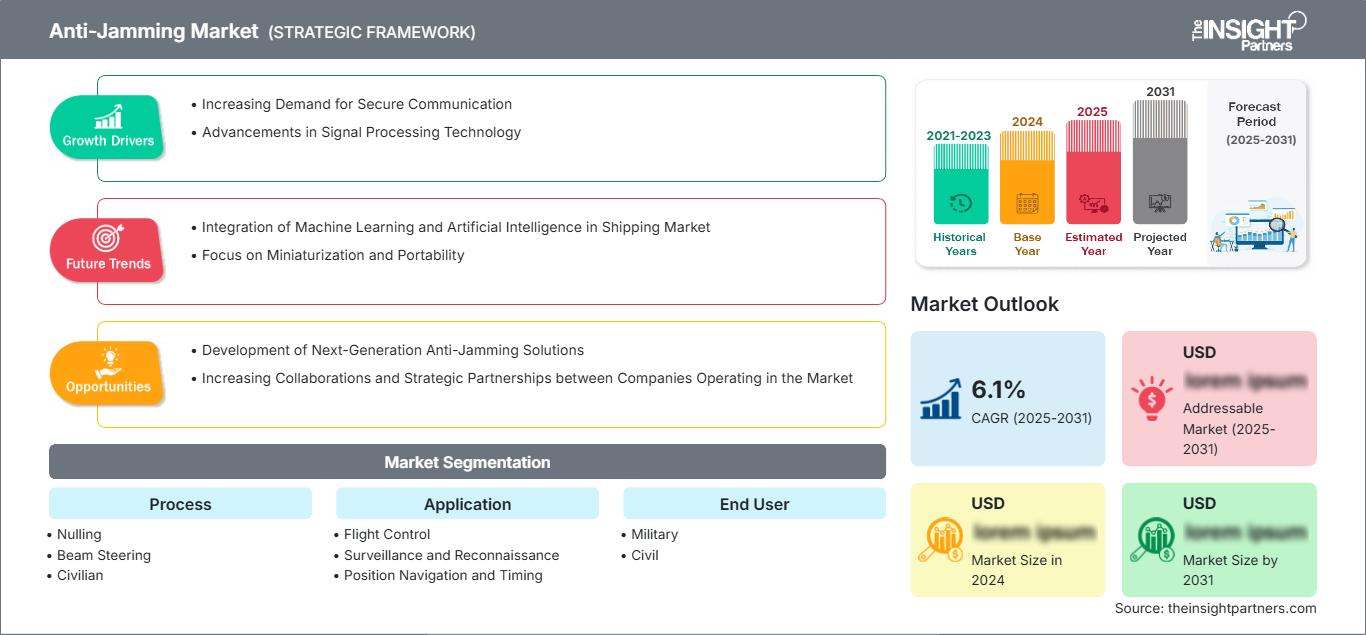
Regional Insights
North America anti-jamming market
North America is the largest regional market with ~8% CAGR till 2034. North America has significant military aviation needs for navigation, requirements for precision-guided munitions, presence of extensive GPS networks, and mature defense electronics manufacturing. Procurement in the USA increasingly focuses on resilient PNT amid increasing navigation threats that go beyond mere signal denial to interference and spoofing. Hence, the demand includes not only PNT receivers but also antenna electronics, beam-forming equipment, and navigation systems.
United States comprises ~79% of the North American market in 2025 and is the main source of demand. BAE Systems, L3Harris Technologies, Collins Aerospace, Mayflower Communications Company, Inc., and RTX Corporation (Raytheon) form a comprehensive list of domestic suppliers. The applications include navigation, targeting, surveillance, reconnaissance, precision weapons, and unmanned aircraft. Canada participates with aerospace and defense activities but has a smaller market compared to the United States.
U.S. anti-jamming market
The US accounts for nearly 79% of the North American anti-jamming market share in 2025 and is forecast to register a CAGR of ~8% during 2026-2034. These growth drivers include military GPS modernization, assured PNT efforts, aircraft survivability needs, and usage of precision-guided systems. M-Code capability is pertinent here due to the resilient nature of the signal and the fact that it ensures compatibility with modernized receivers and navigation systems.
The key companies that are present in the US include BAE Systems, L3Harris Technologies, Collins Aerospace, Mayflower Communications Company, Inc., and RTX Corporation (Raytheon). They are present at various layers of the value chain. Some applications include flight control, targeting, surveillance and reconnaissance, and positioning, navigation, and timing. The commercial aviation segment is increasingly becoming important as anti-jam solutions start certification for broader aircraft usage.
Europe anti-jamming market
Europe accounts for ~25% of the global anti-jamming market in 2025 and is projected to expand at a ~8% CAGR through 2034. The region has mature aerospace, defense, satellite-navigation, and electronic-warfare capabilities, while heightened requirements for navigation resilience are increasing procurement interest. The UK is the leading country in Europe, supported by defense modernization and investment in resilient PNT. Germany contributes through aerospace and defense electronics, while France maintains a strong position through domestic defense and navigation capabilities.
Italian and Spanish purchases are driven by military avionics, naval modernization, and aerospace programs. The European demand for GNSS anti-jam solutions is also boosted by the necessity to safeguard navigation systems against any kind of interference in regard to airplanes, unmanned aircraft, vessels, and critical infrastructure. Among the major European vendors are Thales Group, Cobham Plc, and Collins Aerospace.
There has been a shift towards architectural rather than component-based GNSS anti-jamming in Europe. Customers look for systems that can be easily integrated with the existing navigation systems, secure receivers, inertial systems, and multi-sources of PNT.
APAC anti-jamming market
Asia Pacific represents ~27% of the global anti-jamming market in 2025 and is forecast to grow at a ~11% CAGR, making it the fastest-growing region. China is the leading country in Asia Pacific, while Japan, South Korea, India, and Australia are also expanding resilient navigation capabilities through defense modernization and aerospace development.
Regional industrial growth supports demand for protected navigation in aircraft, unmanned systems, maritime platforms, and surveillance applications. India and Japan are increasing domestic aerospace and defense capabilities, while South Korea and Australia are strengthening advanced defense-electronics ecosystems. Multi-constellation GNSS adoption, satellite-navigation investment, and heightened awareness of electronic interference provide additional momentum.
Middle East & Africa anti-jamming market
The Middle East and Africa region is expected to register a ~9% CAGR through 2034. Saudi Arabia is the leading country in the Middle East and Africa based on defense procurement activity and investment in aerospace, security, and advanced infrastructure. The UAE also represents a significant technology and aviation center, creating demand for resilient navigation across defense and commercial applications.
South Africa provides an important regional aerospace and technology base, while the rest of MEA is influenced by defense modernization, aviation expansion, maritime security, and infrastructure digitization. Energy infrastructure adds relevance because reliable timing and navigation can support distributed communications and industrial systems. Procurement is likely to favor integrated and maintainable systems that can be incorporated into broader electronic-warfare and PNT architectures.
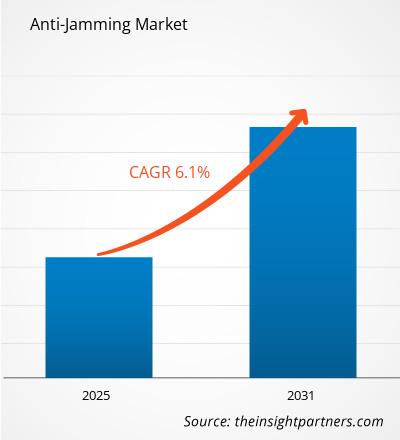
Segmentation Analysis
Process
Process is a core technology dimension because the effectiveness of interference mitigation depends on how systems detect, suppress, and manage unwanted RF energy. Adoption is strongest where buyers require reliable navigation under contested conditions and where integration with existing receivers is practical. Digital processing is increasingly important for adaptable protection and lower SWaP. The strongest sub-segment is expected to be Nulling, with a ~9% CAGR through 2034 as adaptive interference suppression becomes more important across airborne and tactical systems.
- Nulling: Nulling suppresses interference by creating spatial rejection toward jammer sources. Its importance rises in environments where multiple interference sources can disrupt navigation simultaneously, particularly for aircraft, unmanned platforms, and precision systems.
- Beam Steering: Beam steering improves reception by directing antenna sensitivity toward useful signals while limiting exposure to interference. It is valuable for platforms requiring directional control and stable reception during movement.
- Civilian: Civilian applications extend anti-jam capabilities into aviation, maritime, timing, and autonomous systems. Adoption depends strongly on certification, cost, interoperability, and the operational consequences of GNSS disruption.
Application
Application segment in the anti-jamming market demand reflects the criticality of positioning and navigation information to individual missions. Systems used for high-consequence operations generally require greater protection, redundancy, and integration than less mission-critical applications. The application category is increasingly shaped by the convergence of navigation, sensing, targeting, and communications requirements. Position Navigation and Timing is the strongest growth area, with a ~10% CAGR through 2034, as assured positioning and timing become foundational to multiple downstream functions.
- Flight Control: Flight-control applications require dependable navigation inputs for aircraft operating in environments where GNSS disruption can affect route management, stabilization, and mission execution.
- Surveillance and Reconnaissance: Surveillance and reconnaissance platforms depend on reliable positioning to correlate sensor observations, maintain mission tracks, and support accurate reporting when operating in electronically contested environments.
- Position Navigation and Timing: Position Navigation and Timing supports a wide range of mission functions and is increasingly integrated with inertial and alternative navigation sources to maintain continuity during GNSS degradation.
- Targeting: Targeting applications require highly reliable positioning information to support precision engagement and minimize navigation errors during complex military operations.
- Others: Other applications include specialized communications, timing, maritime, autonomous, and infrastructure functions where interference mitigation can protect continuity of location or synchronization services.
End User
End-user demand is strongly influenced by the operational cost of navigation disruption. Military organizations remain the principal buyers because aircraft, weapons, ships, vehicles, and unmanned systems can experience substantial mission degradation when navigation is denied. Civil users are increasingly evaluating resilience where GNSS continuity affects safety, timing, or autonomous operation. Military demand remains structurally stronger because procurement programs support higher-performance architectures and specialized certification requirements. The Military sub-segment is expected to expand at a ~9% CAGR through 2034.
- Military: Military users prioritize assured PNT, electronic-warfare resilience, and interoperability with secure navigation equipment. Procurement emphasizes high performance, ruggedization, low SWaP, and compatibility with existing platforms and mission systems.
- Civil: Civil users increasingly consider anti-jam technologies for aviation, maritime, communications timing, autonomous systems, and other applications where interference can create operational or safety consequences.
Opportunity Snapshot
| Application | Revenue Contribution | Trend Tag | Adoption Stage |
| Flight Control | High | Resilient Avionics | Mature |
| Surveillance and Reconnaissance | High | Mission Continuity | Scaling |
| Position Navigation and Timing | High | Assured PNT | Scaling |
| Targeting | High | Precision Guidance | Mature |
| Others | Low | Multi-Use Resilience | Emerging |
Anti-Jamming Market Growth Drivers and Impact Analysis
Expansion of Assured PNT Requirements
The growing operational dependence on positioning, navigation, and timing is strengthening demand for anti-jam capabilities across military and selected civilian systems. When GNSS is disrupted, consequences can extend beyond location accuracy to mission coordination, timing synchronization, targeting, flight management, and autonomous operation. This increases the value of protection at multiple points in the navigation architecture rather than relying solely on receiver-level filtering. Procurement organizations are consequently evaluating controlled reception pattern antennas, digital nulling, resilient receivers, and integration with inertial systems as complementary technologies. The commercial effect is a broader addressable market for suppliers that can package these functions into deployable platform solutions. Vendors that reduce integration effort while maintaining certification and performance requirements are positioned to capture replacement and modernization demand.
Modernization of Military Navigation Equipment
Military modernization is creating a direct demand pathway for anti-jam systems as armed forces upgrade navigation equipment across aircraft, precision weapons, unmanned platforms, ships, and ground vehicles. M-Code-compatible receivers and protected antenna systems are particularly relevant because modernization programs increasingly emphasize secure and resilient GPS access. The impact extends through the supply chain because new receivers often require compatible antenna electronics, signal-processing hardware, software, and platform interfaces. Modernization also creates recurring opportunities as older equipment reaches replacement or upgrade cycles. Suppliers with established qualification records can benefit from lower integration risk, while specialized companies can compete by delivering compact solutions for SWaP-constrained platforms. This dynamic encourages both large-system integration and niche product development.
Growth of Electronic-Warfare Resilience Investment
Investment in electronic-warfare resilience is broadening the role of anti-jamming equipment from a navigation accessory into a component of wider survivability architectures. Defense organizations increasingly consider jamming and spoofing together because disruption can deny or manipulate navigation information. This encourages system designs that combine interference detection, adaptive suppression, secure signals, inertial navigation, and alternative PNT sources. For manufacturers, the impact is a shift toward software-intensive products that can be updated as threat profiles change. For platform integrators, modular architectures can reduce the cost of incorporating new protection technologies. The resulting demand supports higher-value systems with greater processing capability and closer integration between antennas, receivers, navigation computers, and mission systems.
Anti-Jamming Market Future Trends
Convergence of Anti-Jam and Multi-Source PNT
Future systems are likely to combine anti-jam GNSS protection with inertial navigation, alternative RF signals, timing references, and other sources of positioning information. This approach changes the design objective from simply preserving a satellite signal to maintaining useful navigation when one or more sources are degraded. Such architectures can dynamically select or weight available inputs according to interference conditions and mission requirements. Advances in digital processing should support greater adaptability while miniaturization enables deployment on smaller platforms. The trend could also expand civilian adoption because operators may prefer resilient navigation architectures that address both accidental interference and deliberate disruption. Suppliers able to integrate multiple PNT technologies within common interfaces will have an advantage in future platform programs.
Software-Defined Interference Mitigation
Software-defined processing is expected to become increasingly important as interference techniques evolve faster than hardware replacement cycles. Programmable receivers and digital signal-processing architectures can allow mitigation algorithms to be updated without replacing the entire navigation subsystem. This can improve lifecycle economics while giving operators greater flexibility to respond to emerging jammer characteristics. Future products are therefore likely to emphasize processing capacity, open interfaces, cybersecurity, and updateability alongside traditional antenna performance. The approach may also facilitate closer integration between anti-jam functions and navigation-management software. As system architectures become more software intensive, suppliers will need to demonstrate reliable performance under certification and cybersecurity requirements rather than relying solely on hardware specifications.
Anti-Jamming Market Opportunities
Compact Systems for Unmanned and SWaP-Constrained Platforms
The expansion of unmanned aircraft, tactical autonomous systems, small maritime platforms, and precision weapons creates an opportunity for compact anti-jam equipment. These platforms cannot always accommodate large antenna arrays, high-power electronics, or complex cooling systems, making size, weight, power, and cost central purchasing criteria. Vendors that combine antenna electronics and processing into compact modules can address a growing class of platforms without requiring major architecture changes. Commercial opportunities can emerge through standardized interfaces and scalable product families covering multiple platform sizes. Strategic investment should focus on miniaturized RF electronics, efficient digital processing, rugged packaging, and repeatable integration processes that reduce qualification time. Such capabilities can support both defense procurement and selected civilian applications.
Certified Resilience for Aviation and Critical Infrastructure
Certification creates a significant opportunity for suppliers capable of translating anti-jam performance into approved operational systems. Aviation is particularly relevant because navigation disruption can affect aircraft operations, while critical infrastructure depends on reliable timing for communications and distributed digital systems. Products that satisfy established certification, interoperability, and safety requirements can move beyond specialized demonstrations into recurring procurement. Mayflower Communications Company, Inc.'s FAA-authorized anti-jam aviation work illustrates the commercial importance of certification pathways, while Furuno Electric Co., Ltd. demonstrates the relevance of anti-jamming for timing applications. Strategic investment should therefore target certification engineering, system validation, and integration partnerships rather than focusing only on raw interference-suppression performance.
Frequently Asked Questions

- Comprehensive Market Sizing and Forecast Analysis
- Detailed Segmentation Analysis
- In-Depth Market Dynamics Assessment
- Regional and Country-Level Insights
- Competitive Landscape and Company Benchmarking
- Strategic Business Intelligence
Recent Reports
Testimonials

The Insight Partners provided valuable market intelligence that supported our global go-to-market strategy. Their team was professional, responsive, and attentive to our feedback, providing thoughtful analysis and helpful methodological clarifications throughout the project.
Junmo Kim Chief Financial Officer (CFO), Enertech Co., Ltd.
The Insight Partners' SCADA System Market report is comprehensive, with valuable insights on current trends and future forecasts. The team was highly professional, responsive, and supportive throughout. We are very satisfied and highly recommend their services.
RAN KEDEM Partner, Reali Technologies LTDs
I requested a report on a very specific software market and the team produced the report in a few days. The information was very relevant and well presented. I then requested some changes and additions to the report. The team was again very responsive and I got the final report in less than a week.
JEAN-HERVE JENN Chairman, Future Analytica
We worked with The Insight Partners for an important market study and forecast. They gave us clear insights into opportunities and risks, which helped shape our plans. Their research was easy to use and based on solid data. It helped us make smart, confident decisions. We highly recommend them.
PIYUSH NAGPAL Sr. Vice President, High Beam Global
The Insight Partners delivered insightful, well-structured market research with strong domain expertise. Their team was professional and responsive throughout. The user-friendly website made accessing industry reports seamless. We highly recommend them for reliable, high-quality research services
YUKIHIKO ADACHI CEO, Deep Blue, LLC.
This is the first time I have purchased a market report from The Insight Partners.While I was unsure at first, I visited their web site and felt more comfortable to take the risk and purchase a market report.I am completely satisfied with the quality of the report and customer service. I had several questions and comments with the initial report, but after a couple of dialogs over email with their analyst I believe I have a report that I can use as input to our strategic planning process.Thank you so much for taking the extra time and making this a positive experience.I will definitely recommend your service to others and you will be my first call when we need further market data.
JOHN SUZUKI President and Chief Executive Officer, Board Director, BK Technologies
I wish to appreciate your support and the professionalism you displayed in the course of attending to my request for information regarding to infectious disease IVD market in Nigeria. I appreciate your patience, your guidance, and the fact that you were willing to offer a discount, which eventually made it possible for us to close a deal. I look forward to engaging The Insight Partners in the future, all thanks to the impression you have created in me as a result of this first encounter.
DR CHIJIOKE ONYIA MANAGING DIRECTOR, PineCrest Healthcare Ltd.Reason to Buy
- Informed Decision-Making
- Understanding Market Dynamics
- Competitive Analysis
- Identifying Emerging Markets
- Customer Insights
- Market Forecasts
- Risk Mitigation
- Boosting Operational Efficiency
- Strategic Planning
- Investment Justification
- Tracking Industry Innovations
- Aligning with Regulatory Trends





 Get Free Sample for