
Antimicrobial Hospital Textiles Market Share, Size & Demand by 2034
Antimicrobial Hospital Textiles Market Size and Forecasts (2021–2034), Global and Regional Share, Trends, and Growth Opportunity Analysis Report Coverage : by Material (Cotton, Polyester, Polyamide); Usability (Reusable and Disposable); Application (Attire, Surgical Supplies and Wipes, Sheets and Blankets); End Use (General Ward, Surgical Rooms, ICU); and Geography (North America, Europe, Asia Pacific, and South and Central America)
- Status : Data Released
- Report Code : TIPRE00040372
- Category : Chemicals and Materials
- No. of Pages : 150
- Available Report Formats :


- Last update date : May 26, 2026


2025 Market Size
US$ 1.31 Bn
Base year value
2034 Forecast
US$ 2.45 Bn
Projected by 2034
CAGR 2026-2034
8.14 %
Growth rate
Addressable Market
US$ 17.79 Bn
(2026-2034)
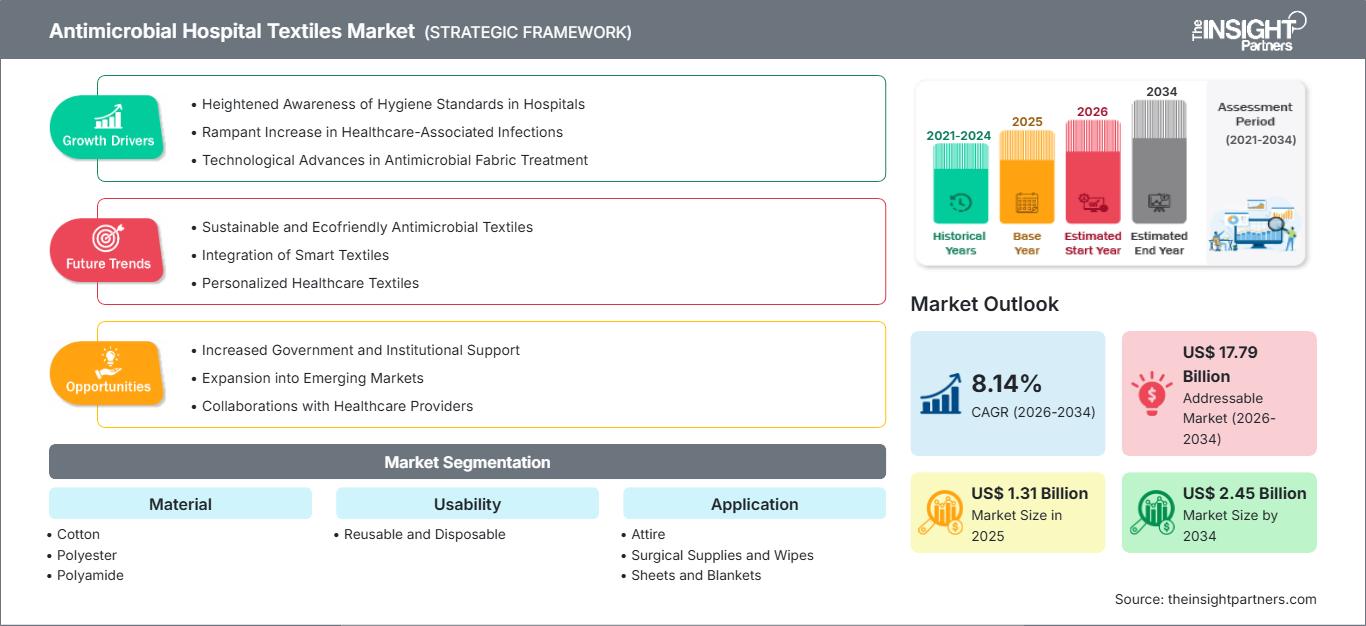
The Antimicrobial Hospital Textiles Market size is expected to reach US$ 2.45 Billion by 2034 from US$ 1.31 Billion in 2025. The market is estimated to record a CAGR of 8.14% from 2026 to 2034.
The antimicrobial hospital textiles market report is segmented by material (cotton, polyester, polyamide, and others). The market is segmented based on usability (reusable and disposable). The market is segmented based on application (attire, surgical supplies and wipes, sheets and blankets, and others). The market is segmented based on end use (general ward, surgical rooms, ICU, and others). The market size and forecast at global, regional, and country levels for all the key market segments are covered under the scope. The report offers the value in USD for the above analysis, segments, regions, and countries. The report covers market trends, as well as market dynamics such as drivers, restraints, and key opportunities. The report also covers industry landscape and competition analysis covering market concentration, heat map analysis, prominent players, and recent developments in the market.
Purpose of the Report
The report Antimicrobial Hospital Textiles Market by The Insight Partners aims to describe the present landscape and future growth, top driving factors, challenges, and opportunities. This will provide insights to various business stakeholders, such as:
- Technology Providers/Manufacturers: To understand the evolving market dynamics and know the potential growth opportunities, enabling them to make informed strategic decisions.
- Investors: To conduct a comprehensive trend analysis regarding the market growth rate, market financial projections, and opportunities that exist across the value chain.
- Regulatory bodies: To regulate policies and police activities in the market with the aim of minimizing abuse, preserving investor trust and confidence, and upholding the integrity and stability of the market.
Antimicrobial Hospital Textiles Market Segmentation Material
- Cotton
- Polyester
- Polyamide
Usability
- Reusable and Disposable
Application
- Attire
- Surgical Supplies and Wipes
- Sheets and Blankets
End Use
- General Ward
- Surgical Rooms
- ICU
Market Assessment and Insights
- Global market for Antimicrobial Hospital Textiles was valued at US$ 1.31 Billion in 2025
- Annual market size is expected to reach US$ 2.45 Billion by 2034
- Total addressable market (TAM) during 2026-2034 is projected to reach approximately US$ 17.79 Billion
- Market is anticipated to register a CAGR of 8.14% during the forecast period
- The United States represents a key market, supported by Heightened Awareness of Hygiene Standards in Hospitals, Rampant Increase in Healthcare-Associated Infections, Technological Advances in Antimicrobial Fabric Treatment, as well as evolving industry dynamics
- Market analysis covers North America, Europe, Asia-Pacific, South and Central America, Middle East and Africa, with growth evaluated across the forecast period
- Market opportunities such as Increased Government and Institutional Support, Expansion into Emerging Markets, Collaborations with Healthcare Providers are expected to influence market dynamics and addressable market
- Report profiles industry participants, including Milliken and Company, Trevira GmbH, Unitika Trading Co Ltd, Thai Acrylic Fiber Co Ltd, PurThread Technologies Inc, LifeThreads LLC, Sinterama, Smith and Nephew Plc, Herculite Inc, Microban International, while analyzing competitive strategies and innovation developments
-
Source: The Insight Partners' analysis based on proprietary research, government publications, company annual reports, investor presentations, industry databases, and expert interviews.
● REPORT CUSTOMIZATION
Tailor This Report To Align With Your Specific Business Requirements
This report can be customized to align precisely with your business objectives, scope, and target markets. Customization options include tailored segmentation, geography, competitive analysis, and strategic insights to support informed decision-making.
Customize This Report →WHAT YOU CAN ADJUST
- ● Segmentations
- ● Geography
- ● Competitive Analysis
- ● Language Preferences
Antimicrobial Hospital Textiles Market: Strategic Insights
-
Get Top Key Market Trends of this report.This FREE sample will include data analysis, ranging from market trends to estimates and forecasts.
Antimicrobial Hospital Textiles Market Growth Drivers
- Heightened Awareness of Hygiene Standards in Hospitals: It has also followed an increased awareness of hospital hygiene standards that have brought more emphasis toward the use of textiles that are treated with antimicrobial agents. Hospitals are becoming more attentive to hygiene protocols so as to provide safe environments to patients and health staff during and after surgeries or medical procedures. Hospital textiles include those used to prepare the bed, such as bed linen, curtains, surgical gowns, and drapes, and serve to provide a hygienic environment. Inhibition of bacterial growth in these textiles results in long-lasting cleanliness and contamination prevention.
- Rampant Increase in Healthcare-Associated Infections: It is an incredible impetus for increased antimicrobial hospital textiles market due to a fast-growing incidence of healthcare-associated infections (HAIs). Pneumonia, bloodstream infections, surgical site infections, and a few other infections typically referred to as HAIs severely impact patient outcomes and cost incurred by hospitals. Such textiles are being developed more and more for prevention of the transmission of bacteria and fungi in the hospitals and hence infections. This growing awareness and need for the reduction of infection in hospitals throughout the world is increasingly fueling the demand for such textiles.
- Technological Advances in Antimicrobial Fabric Treatment: The continuous technical evolution in antimicrobial fabric treatments has an impressive contribution to the market development. Manufacturers are coming out with new effective and fast-acting long-lasting antimicrobial agents, which would be incorporated in the hospital textiles. New such innovations include invention of silver ions treatments, copper-infused fabrics, and nanotechnology that are progressing the future market. The present innovations not only enhance performance in antimicrobial textiles but also improve comfort, durability, and resistance to wear and tear, making them more conducive for hospital environments.
Antimicrobial Hospital Textiles Market Future Trends
- Sustainable and Ecofriendly Antimicrobial Textiles: Sustainability has been becoming extremely important in healthcare sectors, these days. Antimicrobial hospital textiles are hypothesized to use biodegradable materials and use natural antimicrobial agents instead of synthetic chemicals. This will, thereby, contribute towards the world's holistic approach of going green and addressing the baseless ecological impact caused by the hospitals. The focus of manufacturers is expected to be on hygiene- and sustainability-meeting reusable, renewable resource-based textile products.
- Integration of Smart Textiles: Smart textiles, a term used for textiles that would sense environmental conditions or bodily states and accordingly respond, are one of the next trends in antimicrobial textiles application. These smart textiles, where sensors or other embedded technologies can be used, would serve in the hospitals for monitoring the patients' conditions or that of the associated environments. For instance, when fitted with sensors that scan and detect any bacteria or fungi, antimicrobial textiles could trigger some cleaning or antimicrobial response within an improved setting of infection control in hospitals.
- Personalized Healthcare Textiles: Personalized medicine and personalized healthcare are not new. Textiles are following in their footsteps. Hospitals and clinics are shifting attention from a one-size-fits-all model toward personalized approaches to care. It is the development of antimicrobial textiles for application to particular users. Antimicrobial textiles can be customized to patients' unique health characteristics, such as immune system vulnerability or particular infections, making it more effective and patient-centered.
Antimicrobial Hospital Textiles Market Opportunities
- Increased Government and Institutional Support: Governments and health organizations across the globe are putting in their share of a dollar toward infection control at the time of the post-COVID war. Hospitals and healthcare facilities are adopting antimicrobial textiles as part of their many different undertakings to create safer environments to prevent infection. This kind of institutional support creates a captive market for antimicrobial textiles, thereby opening up business opportunities for the manufacture of advanced, cost-effective products.
- Expansion into Emerging Markets: Growth opportunities found within markets such as Asia-Pacific, Latin America, and the Middle East. These markets are developing rapidly in healthcare infrastructure and growing extremely in terms of demand for advanced healthcare solutions. Antimicrobial hospital textiles arise as a vast opportunity for the manufacturers to put a foot in new terrains with growing awareness about infection control and hospital hygiene.
- Collaborations with Healthcare Providers: There is huge opportunity among healthcare-providing companies to collaborate with hospitals and their system integrators to develop innovative antimicrobial solutions that fit into hospital environments. Such innovation could see textiles such as antimicrobial with property formulation that could help fit end users, patients, and healthcare professionals into occupational lifestyles. The niche market for such companies will be that focusing on high-performance healthcare textiles.
Antimicrobial Hospital Textiles Market Report Scope
| Report Attribute | Details |
|---|---|
| Market size in 2025 | US$ 1.31 Billion |
| Market Size by 2034 | US$ 2.45 Billion |
| Global CAGR (2026 - 2034) | 8.14% |
| Historical Data | 2021-2024 |
| Forecast period | 2026-2034 |
| Segments Covered |
By Material
|
| Regions and Countries Covered |
North America
|
| Market leaders and key company profiles |
|
Antimicrobial Hospital Textiles Market Players Density: Understanding Its Impact on Business Dynamics
The Antimicrobial Hospital Textiles Market is growing rapidly, driven by increasing end-user demand due to factors such as evolving consumer preferences, technological advancements, and greater awareness of the product's benefits. As demand rises, businesses are expanding their offerings, innovating to meet consumer needs, and capitalizing on emerging trends, which further fuels market growth.
Key Selling Points
- Comprehensive Coverage: The report comprehensively covers the analysis of products, services, types, and end users of the Antimicrobial Hospital Textiles Market, providing a holistic landscape.
- Expert Analysis: The report is compiled based on the in-depth understanding of industry experts and analysts.
- Up-to-date Information: The report assures business relevance due to its coverage of recent information and data trends.
- Customization Options: This report can be customized to cater to specific client requirements and suit the business strategies aptly.
The research report on the Antimicrobial Hospital Textiles Market can, therefore, help spearhead the trail of decoding and understanding the industry scenario and growth prospects. Although there can be a few valid concerns, the overall benefits of this report tend to outweigh the disadvantages.
Frequently Asked Questions

- Comprehensive Market Sizing and Forecast Analysis
- Detailed Segmentation Analysis
- In-Depth Market Dynamics Assessment
- Regional and Country-Level Insights
- Competitive Landscape and Company Benchmarking
- Strategic Business Intelligence
Recent Reports
Testimonials

The Insight Partners' SCADA System Market report is comprehensive, with valuable insights on current trends and future forecasts. The team was highly professional, responsive, and supportive throughout. We are very satisfied and highly recommend their services.
RAN KEDEM Partner, Reali Technologies LTDs
I requested a report on a very specific software market and the team produced the report in a few days. The information was very relevant and well presented. I then requested some changes and additions to the report. The team was again very responsive and I got the final report in less than a week.
JEAN-HERVE JENN Chairman, Future Analytica
We worked with The Insight Partners for an important market study and forecast. They gave us clear insights into opportunities and risks, which helped shape our plans. Their research was easy to use and based on solid data. It helped us make smart, confident decisions. We highly recommend them.
PIYUSH NAGPAL Sr. Vice President, High Beam Global
The Insight Partners delivered insightful, well-structured market research with strong domain expertise. Their team was professional and responsive throughout. The user-friendly website made accessing industry reports seamless. We highly recommend them for reliable, high-quality research services
YUKIHIKO ADACHI CEO, Deep Blue, LLC.
This is the first time I have purchased a market report from The Insight Partners.While I was unsure at first, I visited their web site and felt more comfortable to take the risk and purchase a market report.I am completely satisfied with the quality of the report and customer service. I had several questions and comments with the initial report, but after a couple of dialogs over email with their analyst I believe I have a report that I can use as input to our strategic planning process.Thank you so much for taking the extra time and making this a positive experience.I will definitely recommend your service to others and you will be my first call when we need further market data.
JOHN SUZUKI President and Chief Executive Officer, Board Director, BK Technologies
I wish to appreciate your support and the professionalism you displayed in the course of attending to my request for information regarding to infectious disease IVD market in Nigeria. I appreciate your patience, your guidance, and the fact that you were willing to offer a discount, which eventually made it possible for us to close a deal. I look forward to engaging The Insight Partners in the future, all thanks to the impression you have created in me as a result of this first encounter.
DR CHIJIOKE ONYIA MANAGING DIRECTOR, PineCrest Healthcare Ltd.Reason to Buy
- Informed Decision-Making
- Understanding Market Dynamics
- Competitive Analysis
- Identifying Emerging Markets
- Customer Insights
- Market Forecasts
- Risk Mitigation
- Boosting Operational Efficiency
- Strategic Planning
- Investment Justification
- Tracking Industry Innovations
- Aligning with Regulatory Trends





 Get Free Sample for