
Leather for Railway Market Size and Growth 2031
Coverage: By Type (Genuine Leather and Artificial Leather [Polyurethane, Polyvinyl Chloride, and Others]), Application (Train Seats, Traction Bellows, Handle and Grip Bars, Cushions and Pillows, and Others), Train Type (Passenger Trains, Freight Trains, Mining Trains, and Others), and Geography
- Status : Published
- Report Code : TIPRE00040945
- Category : Chemicals and Materials
- No. of Pages : 365
- Available Report Formats :


- Last update date : July 03, 2025


2024 Market Size
US$ 1.68 Bn
Base year value
2031 Forecast
US$ 2.30 Bn
Projected by 2031
CAGR 2025-2031
4.6 %
Growth rate
Addressable Market
US$ 14.13 Bn
(2025-2031)
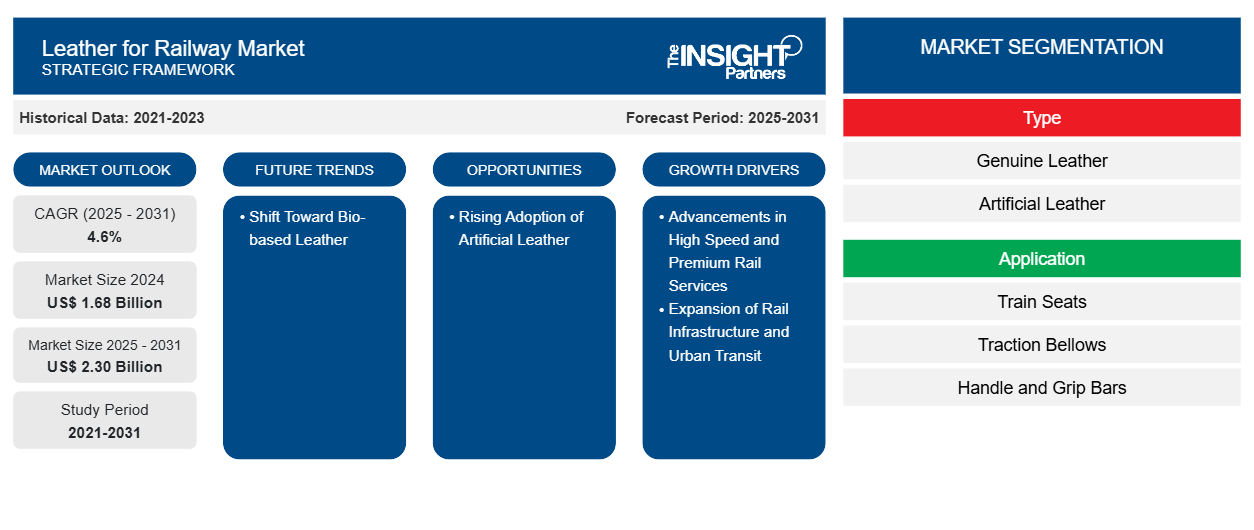
The leather for railway market is projected to reach US$ 2.30 billion by 2031 from US$ 1.68 billion in 2024. The market is expected to register a CAGR of 4.6% during 2025–2031. The shift toward bio-based leather is likely to bring new trends into the market during the forecast period.
Leather for Railway Market Analysis
Governments of different countries and private players are investing in rail modernization programs, including premium interior upgrades, creating long-term demand for leather. Leather is essential to make the interior of trains appealing and comfortable and to offer travelers a high level of convenience. Synthetic or artificial leather is composed of a fabric base, such as polyester, consisting of an intimate finish and texture of leather with dye, wax, polyurethane (PU), or polyvinyl chloride (PVC). Artificial leather possesses more advantageous properties than genuine leather. It can be coated with finishes and colors, allowing more design flexibility than genuine leather. These features make artificial leather ideal for railway applications, providing buyers with more efficient and sustainable solutions.
Leather for Railway Market Overview
The leather used in railway applications is made from either genuine or artificial leather. Genuine leather, also known as natural leather, is derived from the hides of cattle, goats, buffalo, or others, which is a by-product of the meat processing industry. Artificial leather, also known as synthetic leather, is made using polyvinyl chloride or polyurethane to mimic the properties and texture of natural leather. Genuine leather is breathable, allowing vapor and heat to dissipate, ensuring a comfortable seating experience for passengers during long journeys. This feature makes the material suitable for use in railway applications, such as train seats, traction bellows, handle and grip bars, cushions and pillows, and others. The surging veganism and rising concerns about animal cruelty are giving rise to an increased demand for artificial leather in railway applications, contributing to market growth.
Market Assessment and Insights
- Europe dominated the market with 34.5% share in 2024.
- Asia Pacific is poised to grow at a CAGR of 5% over the forecast period.
- United States market is projected to grow at a CAGR of 4.3% over the forecast period.
- By Type, the Genuine Leather segment accounted for the largest market share of 54.4% in 2024.
- By Application, the Train Seats segment is anticipated to witness the fastest growth, registering a CAGR of 4.8% over the forecast period
- By Train Type, the Passenger Trains segment accounted for the largest market share of 91.4% in 2024.
- The report profiles key industry players such as BASF SE, BOXMARK Leather GmbH & Co KG, Teijin Ltd, Toray Industries Inc, Covestro AG, San Fang Chemical Industrial Co Ltd, FILWEL Co., Ltd., Kuraray Co Ltd, Wickett-Craig, Super Tannery Ltd., while also analyzing key developments in novel ideas, disruptive products, and innovative services that could reshape the future market and reveal emerging themes across the industry.
Source: The Insight Partners' analysis based on proprietary research, government publications, company annual reports, investor presentations, industry databases, and expert interviews.
● REPORT CUSTOMIZATION
Tailor This Report To Align With Your Specific Business Requirements
This report can be customized to align precisely with your business objectives, scope, and target markets. Customization options include tailored segmentation, geography, competitive analysis, and strategic insights to support informed decision-making.
Customize This Report →WHAT YOU CAN ADJUST
- ● Segmentations
- ● Geography
- ● Competitive Analysis
- ● Language Preferences
Leather for Railway Market: Strategic Insights
-
Get Top Key Market Trends of this report.This FREE sample will include data analysis, ranging from market trends to estimates and forecasts.
Leather for Railway Market Drivers and Opportunities
Expansion of Rail Infrastructure and Urban Transit
Governments of developed and developing regions are investing in metro systems and regional train services to meet the rising demand for efficient mass public transportation. This growth directly impacts the demand for high-performance interior materials such as leather. As new trains are commissioned and older fleets are refurbished, the need for durable, comfortable, and aesthetically appealing materials becomes paramount. Leather consisting of premium look, long lifecycle, and ease of maintenance is well-suited for seating, headrests, armrests, and wall coverings in luxury and commuter trains. It offers a superior passenger experience while meeting stringent safety, fire-retardant, and hygiene standards required in public transport systems. China, India, and countries in the Middle East are expanding their urban rail networks. To modernize public transportation, Saudi Arabia has developed the Middle East's largest US$ 22 billion metro rail network for the public. Similarly, Europe and North America are modernizing their railway facilities by incorporating premium interiors to enhance customer satisfaction and compete with other modes of transport. These initiatives create opportunities for leather manufacturers and suppliers to provide compliant, sustainable, and customized leather solutions for railway interiors. The rising urbanization encourages a modal shift from road to rail, driving growth in metro and light rail transit projects. Thus, expanding rail infrastructure and urban transit propels the demand for leather in railway applications.
Rising Adoption of Artificial Leather
Synthetic or artificial leather is composed of a fabric base, such as polyester, consisting of an intimate finish and texture of leather with dye, wax, polyurethane (PU), or polyvinyl chloride (PVC). Artificial leather possesses more advantageous properties than genuine leather. While genuine leather is known for its durability, artificial leather has been proven to be equally or even more resistant to wear, water, and sunlight. It is easy to maintain and does not fade or crack as quickly as genuine leather when exposed to sunlight. Artificial leather can be coated with finishes and colors, allowing more design flexibility than genuine leather. These features make artificial leather ideal for railway applications, providing buyers with more efficient and sustainable solutions. It is cost-effective with efficient manufacturing processes, allowing railway operators to provide high-quality materials at more affordable prices for consumers and greater versatility. Genuine leather production involves high water usage and chemical tanning. Consumers increasingly favor synthetic leather variants as more eco-friendly options that reduce the carbon footprint.
Railway operators are shifting toward synthetic leather for interior applications and to contribute to a circular economy. In October 2024, Oriental Rail Infrastructure bagged a US$ 0.19 million order for Northeastern Railways (NER) in India. The project entails the manufacturing and supply of vinyl-coated upholstery fabric (artificial leather) for AC coaches (13,653 meters) and non-AC coaches (90,316 meters). The surging awareness, affordability of artificial leather, and sustainable production practices are expected to create future growth opportunities for the market.
Leather for Railway Market Report Segmentation Analysis
Key segments that contributed to the derivation of leather for railway market analysis are type, application, and train type.
- Based on type, the market is bifurcated into genuine leather and artificial leather. The artificial leather segment is segmented into polyurethane, polyvinyl chloride, and others. The artificial leather segment held a larger share of the market in 2024.
- By application, the leather for railway market is divided into train seats, traction bellows, handle and grip bars, cushions and pillows, and others. The train seats segment held the largest share of the market in 2024.
- Per train type, the market is segmented into passenger trains, freight trains, mining trains, and others. The passenger trains segment dominated the market in 2024.
Leather for Railway Market Share Analysis by Geography
The geographical scope of the leather for railway market is mainly divided into five regions: North America, Asia Pacific, Europe, the Middle East & Africa, and South & Central America.
Europe held a significant market share in 2024. The Europe leather for railway market is expanding, driven by increasing passenger traffic and a sustained emphasis on sustainable transportation solutions. According to Eurostat, in 2023, Europe's rail passenger transport surged to a record 429 billion passenger kilometers, marking an 11.2% increase compared to 2022. This growth underscores the surging demand for enhanced railway infrastructure and services across the region, positioning rail transport as a cornerstone of Europe's commitment to reducing carbon emissions and promoting greener mobility. The leather for railway market is closely intertwined with these developments, as leather continues to be a preferred material for premium interior applications. In railway vehicles, leather is primarily used in seating parts, wall coverings, and partitions, where the material's durability, ease of maintenance, and aesthetic appeal are highly valued. Investments driven by the European Union's Green Deal and rail network modernization initiatives fuel the refurbishment and development of new rolling stock, amplifying the market for high-quality interior materials. The Leather Working Group (LWG) and other sector-specific organizations actively collaborate with railway manufacturers to promote sustainable leather production practices and lifecycle management, ensuring that leather varieties offered by vendors meet the functional demands of the railway sector and align with Europe's stringent environmental goals. As passenger expectations evolve toward comfort, safety, and style, the leather market in Europe's railway sector is poised for sustained growth, supported by regulatory frameworks and increasing passenger volumes.
Leather for Railway Market Report Scope
| Report Attribute | Details |
|---|---|
| Market size in 2024 | US$ 1.68 Billion |
| Market Size by 2031 | US$ 2.30 Billion |
| Global CAGR (2025 - 2031) | 4.6% |
| Historical Data | 2021-2023 |
| Forecast period | 2025-2031 |
| Segments Covered |
By Type
|
| Regions and Countries Covered |
North America
|
| Market leaders and key company profiles |
|
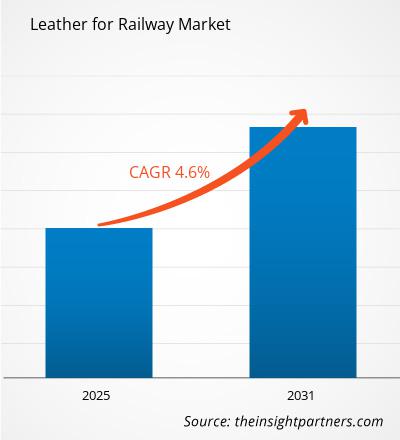
Leather for Railway Market Players Density: Understanding Its Impact on Business Dynamics
The Leather for Railway Market is growing rapidly, driven by increasing end-user demand due to factors such as evolving consumer preferences, technological advancements, and greater awareness of the product's benefits. As demand rises, businesses are expanding their offerings, innovating to meet consumer needs, and capitalizing on emerging trends, which further fuels market growth.
Leather for Railway Market News and Recent Developments
The leather for railway market is evaluated by gathering qualitative and quantitative data post primary and secondary research, which includes important corporate publications, association data, and databases. Key development in the leather for railway market is mentioned below:
- Covestro and Huafon Group reinforced their commitment to sustainability by signing a Letter of Intent (LoI) at the China International Import Expo (CIIE). This partnership aims to expand the use of low-carbon materials from the German materials manufacturer within Huafon's product portfolio, thereby advancing the circular economy. (Source: Covestro, News Letter, November 2024)
Leather for Railway Market Report Coverage and Deliverables
The " Leather for Railway Market Size and Forecast (2021–2031)" report provides a detailed analysis of the market covering below areas:
- Leather for railway market share and forecast at global, regional, and country levels for all the key market segments covered under the scope
- Leather for railway market trends, as well as market dynamics such as drivers, restraints, and key opportunities
- Detailed Porter's Five Forces and SWOT analysis
- Leather for railway market covering key market trends, global and regional framework, major players, regulations, and recent market developments
- Industry landscape and competition analysis covering market concentration, heat map analysis, prominent players, and recent developments for the leather for railway market
- Detailed company profiles
Frequently Asked Questions

- Comprehensive Market Sizing and Forecast Analysis
- Detailed Segmentation Analysis
- In-Depth Market Dynamics Assessment
- Regional and Country-Level Insights
- Competitive Landscape and Company Benchmarking
- Strategic Business Intelligence
Recent Reports
Testimonials

The Insight Partners' SCADA System Market report is comprehensive, with valuable insights on current trends and future forecasts. The team was highly professional, responsive, and supportive throughout. We are very satisfied and highly recommend their services.
RAN KEDEM Partner, Reali Technologies LTDs
I requested a report on a very specific software market and the team produced the report in a few days. The information was very relevant and well presented. I then requested some changes and additions to the report. The team was again very responsive and I got the final report in less than a week.
JEAN-HERVE JENN Chairman, Future Analytica
We worked with The Insight Partners for an important market study and forecast. They gave us clear insights into opportunities and risks, which helped shape our plans. Their research was easy to use and based on solid data. It helped us make smart, confident decisions. We highly recommend them.
PIYUSH NAGPAL Sr. Vice President, High Beam Global
The Insight Partners delivered insightful, well-structured market research with strong domain expertise. Their team was professional and responsive throughout. The user-friendly website made accessing industry reports seamless. We highly recommend them for reliable, high-quality research services
YUKIHIKO ADACHI CEO, Deep Blue, LLC.
This is the first time I have purchased a market report from The Insight Partners.While I was unsure at first, I visited their web site and felt more comfortable to take the risk and purchase a market report.I am completely satisfied with the quality of the report and customer service. I had several questions and comments with the initial report, but after a couple of dialogs over email with their analyst I believe I have a report that I can use as input to our strategic planning process.Thank you so much for taking the extra time and making this a positive experience.I will definitely recommend your service to others and you will be my first call when we need further market data.
JOHN SUZUKI President and Chief Executive Officer, Board Director, BK Technologies
I wish to appreciate your support and the professionalism you displayed in the course of attending to my request for information regarding to infectious disease IVD market in Nigeria. I appreciate your patience, your guidance, and the fact that you were willing to offer a discount, which eventually made it possible for us to close a deal. I look forward to engaging The Insight Partners in the future, all thanks to the impression you have created in me as a result of this first encounter.
DR CHIJIOKE ONYIA MANAGING DIRECTOR, PineCrest Healthcare Ltd.Reason to Buy
- Informed Decision-Making
- Understanding Market Dynamics
- Competitive Analysis
- Identifying Emerging Markets
- Customer Insights
- Market Forecasts
- Risk Mitigation
- Boosting Operational Efficiency
- Strategic Planning
- Investment Justification
- Tracking Industry Innovations
- Aligning with Regulatory Trends





 Get Free Sample for