
Apron Racks Market Size, Demand & Growth by 2034
Coverage: By Product Type (Wall-Mounted, Mobile); Application (Hospitals, Clinics, Laboratories, Others) , and Geography (North America, Europe, Asia Pacific, and South and Central America)
- Status : Data Released
- Report Code : TIPRE00018020
- Category : Consumer Goods
- No. of Pages : 150
- Available Report Formats :


- Last update date : October 30, 2026


2025 Market Size
US$ 269.99 Mn
Base year value
2034 Forecast
US$ 415.12 Mn
Projected by 2034
CAGR 2026-2034
4.90 %
Growth rate
Addressable Market
US$ 3,110.11 Mn
(2026-2034)
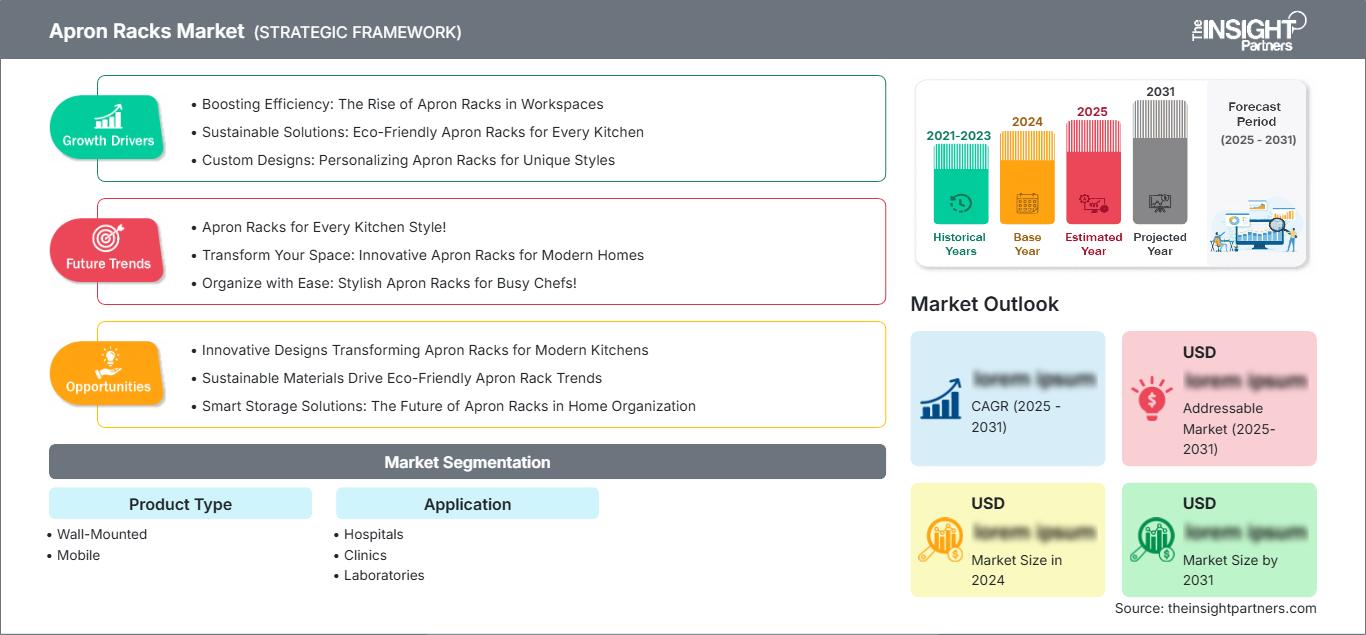
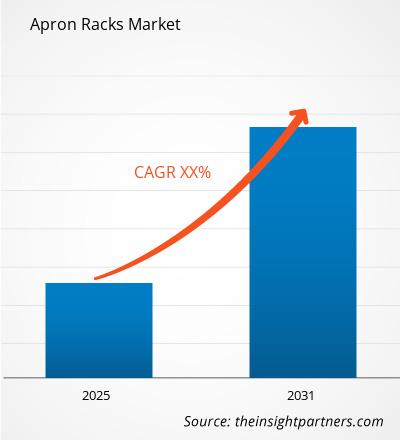
The apron racks market was valued at US$ 269.99 Million in 2025 and is projected to reach US$ 415.12 Million by 2034, expanding at a CAGR of 4.90% during 2026–2034. The market covers storage systems designed to organize, protect, and improve accessibility of radiation-protection aprons across healthcare environments. Demand is supported by increasing use of diagnostic and interventional imaging, greater attention to equipment maintenance, and facility-level requirements for orderly protective-garment storage.
North America represents a structurally mature demand center, supported by extensive diagnostic imaging infrastructure, established radiation-safety procedures, and replacement-oriented purchasing. The apron racks market size in the region is expected to expand at approximately 5.1–5.7% CAGR through 2034. Hospitals and imaging centers increasingly prioritize storage configurations that reduce garment folding, simplify inventory control, and support inspection routines while making efficient use of clinical-room space.
Apron Racks Market Assessment and Insights
- North America: North America is expected to account for approximately 34–38% share in 2025 and expand at a 5.1–5.7% CAGR between 2026–2034, supported by mature imaging infrastructure, replacement demand, and established radiation-protection practices.
- US: The US is expected to represent approximately 76–81% of North American demand in 2025, growing at a 5.0–5.6% CAGR as hospitals modernize imaging areas and standardize protective-equipment storage.
- Europe: Europe is projected to hold approximately 27–31% share in 2025 and grow at a 4.6–5.2% CAGR between 2026–2034, led by Germany, the UK, France, Italy, and Spain through imaging expansion and equipment lifecycle management.
- Asia Pacific: Asia Pacific is estimated at approximately 22–26% share in 2025 and is expected to grow at a 5.5–6.2% CAGR, with China, Japan, South Korea, India, and Australia supporting demand through healthcare infrastructure investment.
- Largest Segment: Wall-mounted systems are expected to hold approximately 57–62% market share in 2025 and grow at a 4.5–5.1% CAGR, reflecting space efficiency and installation simplicity.
- High Growth Segment: Mobile systems are expected to represent approximately 38–43% market share in 2025 and expand at a 5.5–6.2% CAGR, benefiting departments requiring flexible equipment positioning.
- Key companies analyzed in detail: INFAB Corporation, AliMed, LLC, Z&Z Medical, Inc., Phillips Safety Products, Inc., Wardray Premise Ltd, Xenolite, SFXray, Medicus Health, Scanflex Medical AB, ALVO Medical, AADCO Medical, and MAVIG GmbH.
Source: The Insight Partners' analysis based on proprietary research, government publications, company annual reports, investor presentations, industry databases, and expert interviews.
This evolution in the market has been from simple fixed hooks to specialized storage systems that focus on the distribution of weight, accessibility, washing, and conservation of the protective covering. This is reflected in the use of materials such as powder-coated steel, sturdy framing, tilted hooks, and wheels. INFAB provides a variety of these specialized storage solutions in both wall-mounted and wheeled versions of various hanger loads.
The apron racks market share is increasingly connected with the modernization of diagnostic departments and the broader professionalization of radiation-protection management. Facilities in emerging healthcare markets are moving toward standardized storage layouts as imaging capacity expands. Procurement decisions are also becoming more attentive to durability, floor-space utilization, cleaning requirements, and compatibility with different apron designs, creating opportunities for manufacturers that can combine practical ergonomics with lifecycle-oriented equipment management.
Apron Racks Market Report Scope
| Report Attribute | Details |
|---|---|
| Market size in 2025 | US$ 269.99 Million |
| Market Size by 2034 | US$ 415.12 Million |
| Global CAGR (2026 - 2034) | 4.90% |
| Historical Data | 2021-2024 |
| Forecast period | 2026-2034 |
Apron Racks Market Analysis
The apron racks market growth is closely associated with the installed base of X-ray, fluoroscopy, interventional radiology, and related imaging equipment. As protective garments remain essential in radiation-exposure environments, storage becomes an operational requirement rather than a peripheral purchase. WHO identifies hospitals and clinics as important elements of health systems, but the 2025 focus on healthcare facilities by WHO highlights the continued requirement of improved infrastructure, hygiene, waste disposal, and environmental services. Such conditions contribute to the need for better clinical storage.
Steel and hardware suppliers, fabrication and finishing companies, radiation protection equipment manufacturers, distributors, hospital equipment integrators, and procurement units of health care facilities are included in the supply chain. Manufacturers will compete on hanger capacity, mobility, resistance to corrosion, installation needs, and compatibility with lead and non-lead garments. The supply dynamics are stable as compared to imaging equipment due to the limited technological complexity of the product.
The apron racks market analysis indicates a fragmented competitive environment with specialized radiation-protection companies competing alongside broader medical-equipment suppliers. INFAB Corporation combines racks with aprons, cleaners, and tracking accessories, while AliMed, LLC links storage with its broader radiation-protection portfolio and digital inventory capabilities. Wardray Premise Ltd and SFXray maintain strong positions in radiation-protection equipment, giving them opportunities to bundle storage solutions with protective garments and related services.
Competitive differentiation increasingly depends on portfolio breadth, customization, distribution reach, and lifecycle support rather than complex technology alone. Companies can strengthen positioning by offering multiple hanger capacities, wall-mounted and mobile alternatives, accessory storage, and asset-management compatibility. The apron racks market Report also reflects an emerging preference for procurement packages that connect storage, garment inspection, cleaning, replacement, and documentation. This favors established suppliers with recurring relationships across radiology, cardiology, surgery, and diagnostic departments.
● REPORT CUSTOMIZATION
Tailor This Report To Align With Your Specific Business Requirements
This report can be customized to align precisely with your business objectives, scope, and target markets. Customization options include tailored segmentation, geography, competitive analysis, and strategic insights to support informed decision-making.
Customize This Report →WHAT YOU CAN ADJUST
- ● Segmentations
- ● Geography
- ● Competitive Analysis
- ● Language Preferences
Apron Racks Market: Strategic Insights
Regional Insights
North America apron racks market
North America is estimated to represent 34–38% of global demand in 2025 and is projected to expand at a 5.1–5.7% CAGR through 2034. The Apron Racks Market Forecast indicates that the region benefits from a large installed base of diagnostic imaging systems, established hospital procurement structures, and strong awareness of protective-garment handling. Replacement cycles also help generate demand since racks experience exposure to a lot of movement, cleaning, and loading. US health institutions make the majority of purchases in the region, whereas Canada also plays its part by means of modernizing hospitals and investing in diagnostic infrastructure. The developed procurement environment in the region prefers to purchase items that have proven their load-bearing, durability of surfaces, and easy installation. Another factor generating demand is increased focus on workflow optimization in highly loaded fluoroscopy and interventional departments, in which employees have fast access to protective garments.
Increasingly mobile solutions for procedure rooms and wall mounts in cases of constrained imaging rooms are preferred by manufacturers of radiation protection equipment in North America. Storage devices can be considered alongside garment inspection and inventory control programs, and infection prevention processes. Hence, the opportunity in the region goes further than unit replacement and lies in the area of storage improvements, along with imaging room renovation.
U.S. apron racks Market
The US represents approximately 76–81% of North American apron racks Market demand in 2025 and is expected to grow at a 5.0–5.6% CAGR through 2034. Its leading position reflects extensive diagnostic, interventional, surgical, and outpatient imaging activity. Increasingly, procurement is guided by ergonomic storage, longevity, visibility, and standardization within departments. The industry also stands to gain through existing vendors providing solutions in both stationary and portable varieties.
The application of this product tends to be most evident within hospitals and high-use imaging centers, where more than one garment can be stored near procedure rooms. Both AliMed and INFAB carry extensive lines of storage solutions, including aprons, hangers, racks, and accessories. Consumers are also evaluating if the storage solution helps to minimize creases and extra handling.
Europe apron racks Market
Europe is estimated to hold 27–31% share in 2025 and is forecast to expand at a 4.6–5.2% CAGR. Germany is the leading national market, followed by the UK, France, Italy, and Spain. Demand is supported by established radiology networks, hospital modernization, and attention to occupational radiation protection. Suppliers such as Wardray Premise Ltd, SFXray, and Scanflex Medical AB strengthen regional availability.
The UK apron racks Market benefits from structured healthcare procurement and continued investment in diagnostic capacity. Germany has a strong medical-technology manufacturing base and emphasizes standardized clinical equipment. France, Italy, and Spain provide additional demand through public and private hospital networks, diagnostic centers, and imaging-room upgrades. European buyers increasingly consider material durability, cleanability, space utilization, and compatibility with different protective garments when selecting racks. Cross-border distribution and certification requirements also encourage suppliers to maintain standardized product specifications.
APAC apron racks Market
APAC is estimated at 22–26% share in 2025 and is projected to grow at a 5.5–6.2% CAGR. China leads regional demand, followed by Japan, South Korea, India, and Australia. Expanding hospital capacity, diagnostic imaging penetration, and healthcare infrastructure investment support purchases.
China and India offer particularly strong long-term opportunities as hospitals modernize imaging departments and private diagnostic networks expand. Japan and South Korea emphasize advanced facility management, while Australia benefits from established clinical standards and replacement demand. Regional growth is reinforced by public healthcare investment and increasing adoption of organized radiation-protection practices. IATA reported Asia-Pacific air-cargo demand growth of 8.4% in 2025, illustrating strong regional trade connectivity that can support medical-equipment distribution.
Middle East & Africa apron racks Market
The Middle East and Africa apron racks Market demand is smaller but increasingly supported by hospital construction, diagnostic infrastructure, and healthcare modernization. Saudi Arabia leads regional activity, followed by the UAE and South Africa, with the remainder distributed across other Gulf and African markets. The region is expected to expand at approximately 4.8–5.5% CAGR.
Saudi Arabia and the UAE benefit from healthcare infrastructure programs and investment in specialized medical facilities. South Africa remains an important hub for advanced diagnostic services and regional equipment distribution. In the wider MEA market, suppliers increasingly address procurement requirements involving durability, mobility, easy maintenance, and installation flexibility. Infrastructure investment and diversification of healthcare systems create opportunities for standardized storage equipment alongside imaging-room and radiation-protection upgrades.
Segmentation Analysis
Product Type
Product Type segmentation distinguishes wall-mounted and mobile configurations. The segment is expected to expand at a 4.8–5.4% CAGR during 2026–2034 as facilities balance floor-space constraints with workflow flexibility. Product selection depends on room configuration, apron volume, department mobility requirements, and installation preferences. Durable steel construction, adequate hanger spacing, and compatibility with different protective garments remain important purchasing criteria.
- Wall-Mounted: Wall-mounted systems maintain a strong position where floor space is limited and storage can be located permanently near imaging rooms. They support orderly garment access and minimize movement around clinical work areas.
- Mobile: Mobile systems serve departments requiring flexible positioning, especially where protective garments must move between procedure rooms. Wheeled bases and multiple hanger arms support centralized storage and rapid redistribution.
Application
Application segmentation covers hospitals, clinics, and laboratories and is projected to grow at a 4.9–5.5% CAGR during 2026–2034. Hospitals remain the principal demand center because they operate multiple imaging and interventional departments. Clinics increasingly adopt dedicated storage as outpatient imaging expands, while laboratories purchase specialized systems where radiation-generating equipment requires controlled protective-equipment access.
- Hospitals: Hospitals represent the core application environment because radiology, cardiology, surgery, and interventional units may require several protective garments within a single facility. Centralized racks improve accessibility and organization.
- Clinics: Clinics favor compact solutions suited to smaller imaging rooms and limited storage footprints. Demand centers on simple installation, practical capacity, mobility, and easy cleaning.
- Laboratories: Laboratories require organized storage where imaging, testing, or research workflows involve radiation-protection garments. Compact systems can improve equipment accessibility while supporting controlled workspace layouts.
Opportunity Snapshot
| Application | Revenue Contribution (High/Medium/Low) | Trend Tag (MAX 2 words) | Adoption Stage (Emerging/Scaling/Mature) |
| Hospitals | High | Imaging Workflow | Mature |
| Clinics | Medium | Compact Storage | Scaling |
| Laboratories | Medium | Controlled Access | Scaling |
Apron Racks Market Growth Drivers and Impact Analysis
Expansion of Diagnostic and Interventional Imaging Capacity
Advances in diagnostic imaging and interventional procedures will result in increased demand for the amount of protective clothing that needs to be stored, accessed, inspected, and maintained. Facilities that add new fluoroscopy rooms, cath labs, surgical imaging stations, and radiology capabilities have a need for storage solutions capable of increasing garment usage without impacting workflow processes. The effect is greatest where multiple workers are using the same protective gear and where procedure rooms are in continuous operation. Custom-made racks minimize the need for homemade storage solutions through the use of hooks, shelves, and folds, which occupy more room and are harder to access. Increased usage of imaging over time may also lead to an increase in storage replacement needs due to repeated handling. This makes it advantageous for manufacturers when rack purchase is part of the imaging room setup, renovation, and equipment replacement.
Greater Focus on Protective-Garment Lifecycle Management
There has been an increasing focus in healthcare facilities on making the life of the radiation protection clothing longer through proper storage, testing, cleaning, and documentation. Proper hanging assists in reducing the formation of wrinkles and mechanical stresses, and proper arrangement of items may assist in scheduling inspections and item identification. Suppliers of the digital platforms for managing storage now provide systems that link identification and inspection of the items thus creating an ecosystem in which storage becomes an important part of the process. AliMed, for instance, is among the providers of digital inventory management along with radiation protection clothes and storage equipment. The implication is that there is a transition in buying priorities from mere storage capacity to storage effectiveness.
Demand for Space-Efficient and Flexible Clinical Storage
There is constant pressure on clinical facilities to make efficient use of costly floor space while ensuring safe navigation around the imaging equipment. Wall-mounted racks solve the problem of space-limited rooms through relocation of storage to the unused walls, whereas mobile units enable positioning of protective clothing at the point of procedure. This is especially applicable to hospitals running several imaging modalities in the same clinical area. Design considerations not only play a part in storage but also in workflow management. Those manufacturers who offer options for various hanger numbers, smaller sizes, wheels, sturdiness, and accessories will be able to cater to various facilities without the need to make alterations in room space. This opens up new opportunities in the marketplace, enabling manufacturers to sell their products to hospitals, ambulatory imaging centers, clinics, and laboratories. Purchasing decision-making has become more application-oriented now.
Apron Racks Market Future Trends
Digitally Connected Protective-Equipment Storage
Apron racks market trends are increasingly likely to converge with digital inventory management as healthcare providers seek visibility into protective-garment location, inspection status, cleaning history, and replacement needs. Rack storage for the future can include tags, QR codes, RFID capabilities, or scan-based processes without major changes in the actual rack design. However, the most promising area of development is going to be the combination of racks with garment management systems, rather than complex designs of the racks themselves. These storage solutions can assist departments in locating missing garments, decrease the need for paperwork, and plan inspections in multiple rooms. In addition, suppliers can use information about the process to perform analytics of the product's lifecycle and allow customers to detect any excess capacity or repeating replacements.
Modular Designs for Multi-Modal Imaging Departments
Modular storage systems, which are able to hold accessories of aprons, skirts, thyroid shields, gloves, and other components, will likely dominate future product innovation. Imaging departments are now tasked with the responsibility of handling multiple procedures, and this makes single-purpose storage less appealing because of its inflexibility. With modular arms, hook attachments, accessory adapters, and mobile bases, storage configurations may be altered without having to change the whole system. A flexible product design such as that would allow for phased purchase, whereby hospitals can add to the storage system as the number of imaging procedures increases. Manufacturers may start designing racks with attachments that can be added in order to retain the flexibility of distribution and keep production under control.
Apron Racks Market Opportunities
Bundled Procurement With Radiation-Protection Programs
Healthcare organizations tend to consider radiation protection as an overall operational program instead of a set of discrete items. This presents chances for vendors to bundle racks with protective clothing, hangers, cleaners, inspection service, tracking system, and replacement program. Bundling will help healthcare organizations to reduce the procurement process and to have the same specifications from many departments. Also, suppliers will get the chance to develop ongoing business by means of inspection and lifecycle service instead of selling one-off hardware. The vendors with the radiation-protection product range have advantages in that they know the types of garments, department processes, and compliance issues. The most commercially viable approaches could be a combination of a standardized storage system with a service contract and a digital inventory management system. This strategy will improve customer loyalty while helping hospitals to control their ownership costs and storage processes in dispersed hospitals.
Expansion Through Emerging Healthcare Infrastructure
Emerging healthcare markets offer an opportunity to introduce standardized storage solutions alongside new imaging departments, diagnostic centers, and hospital construction projects. New facilities can incorporate wall-mounted and mobile rack specifications during the design stage, avoiding later retrofits and improving workflow consistency from commissioning. Suppliers can work with medical-equipment distributors, architectural planners, radiation-shielding contractors, and imaging-system integrators to establish rack specifications within broader project packages. India, Southeast Asia, the Middle East, and selected African markets provide attractive targets because healthcare capacity is expanding while clinical infrastructure is becoming more standardized. Local manufacturing or regional assembly could further improve competitiveness by reducing freight costs and shortening delivery cycles. Suppliers that combine durable products with installation guidance, maintenance documentation, and adaptable configurations can strengthen their position in these developing procurement ecosystems.
Frequently Asked Questions

- Comprehensive Market Sizing and Forecast Analysis
- Detailed Segmentation Analysis
- In-Depth Market Dynamics Assessment
- Regional and Country-Level Insights
- Competitive Landscape and Company Benchmarking
- Strategic Business Intelligence
Recent Reports
Testimonials

The Insight Partners provided valuable market intelligence that supported our global go-to-market strategy. Their team was professional, responsive, and attentive to our feedback, providing thoughtful analysis and helpful methodological clarifications throughout the project.
Junmo Kim Chief Financial Officer (CFO), Enertech Co., Ltd.
The Insight Partners' SCADA System Market report is comprehensive, with valuable insights on current trends and future forecasts. The team was highly professional, responsive, and supportive throughout. We are very satisfied and highly recommend their services.
RAN KEDEM Partner, Reali Technologies LTDs
I requested a report on a very specific software market and the team produced the report in a few days. The information was very relevant and well presented. I then requested some changes and additions to the report. The team was again very responsive and I got the final report in less than a week.
JEAN-HERVE JENN Chairman, Future Analytica
We worked with The Insight Partners for an important market study and forecast. They gave us clear insights into opportunities and risks, which helped shape our plans. Their research was easy to use and based on solid data. It helped us make smart, confident decisions. We highly recommend them.
PIYUSH NAGPAL Sr. Vice President, High Beam Global
The Insight Partners delivered insightful, well-structured market research with strong domain expertise. Their team was professional and responsive throughout. The user-friendly website made accessing industry reports seamless. We highly recommend them for reliable, high-quality research services
YUKIHIKO ADACHI CEO, Deep Blue, LLC.
This is the first time I have purchased a market report from The Insight Partners.While I was unsure at first, I visited their web site and felt more comfortable to take the risk and purchase a market report.I am completely satisfied with the quality of the report and customer service. I had several questions and comments with the initial report, but after a couple of dialogs over email with their analyst I believe I have a report that I can use as input to our strategic planning process.Thank you so much for taking the extra time and making this a positive experience.I will definitely recommend your service to others and you will be my first call when we need further market data.
JOHN SUZUKI President and Chief Executive Officer, Board Director, BK Technologies
I wish to appreciate your support and the professionalism you displayed in the course of attending to my request for information regarding to infectious disease IVD market in Nigeria. I appreciate your patience, your guidance, and the fact that you were willing to offer a discount, which eventually made it possible for us to close a deal. I look forward to engaging The Insight Partners in the future, all thanks to the impression you have created in me as a result of this first encounter.
DR CHIJIOKE ONYIA MANAGING DIRECTOR, PineCrest Healthcare Ltd.Reason to Buy
- Informed Decision-Making
- Understanding Market Dynamics
- Competitive Analysis
- Identifying Emerging Markets
- Customer Insights
- Market Forecasts
- Risk Mitigation
- Boosting Operational Efficiency
- Strategic Planning
- Investment Justification
- Tracking Industry Innovations
- Aligning with Regulatory Trends





 Get Free Sample for