
Aqueous-Based Metal Cleaners Market Share, Size & Demand by 2034
Aqueous-Based Metal Cleaners Market Size and Forecasts (2021–2034), Global and Regional Share, Trends, and Growth Opportunity Analysis Report Coverage : by Nature (Alkaline, Acidic, Neutral); Technology (Ultrasonic, Rine, Immersion, Spray); End-Use Industry (Manufacturing, Automotive and Aerospace, Healthcare); and Geography (North America, Europe, Asia Pacific, and South and Central America)
- Status : Data Released
- Report Code : TIPRE00040450
- Category : Chemicals and Materials
- No. of Pages : 150
- Available Report Formats :


- Last update date : September 01, 2026


2025 Market Size
US$ 12.67 Bn
Base year value
2034 Forecast
US$ 19.24 Bn
Projected by 2034
CAGR 2026-2034
5.36 %
Growth rate
Addressable Market
US$ 149.40 Bn
(2026-2034)
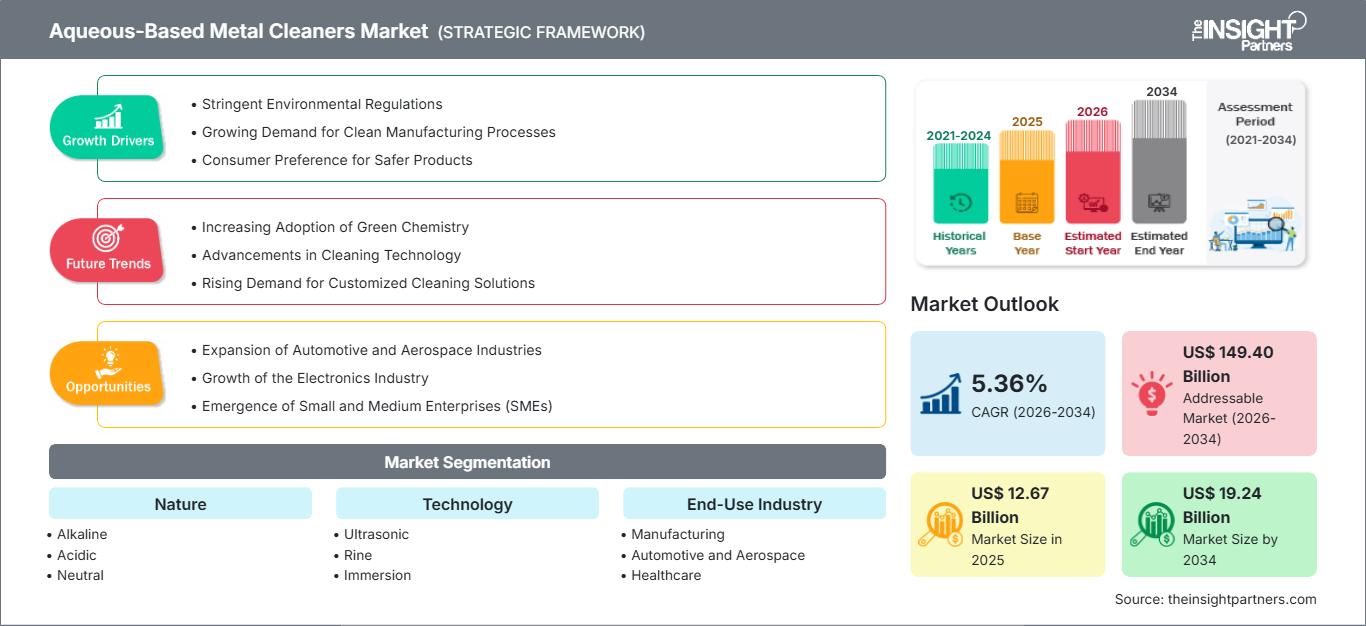
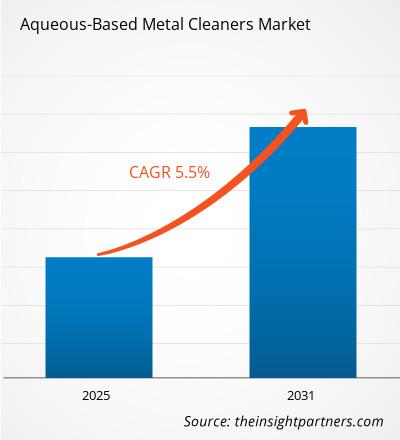
The Aqueous-based metal cleaners market size is expanding as manufacturers prioritize water-based surface preparation, lower-emission cleaning systems, and process efficiency across metal-intensive industries. The market is valued at US$ 12.67 Billion in 2025 and is projected to reach US$ 19.24 Billion by 2034, registering a 5.36% CAGR during 2026–2034. Demand is supported by industrial automation, precision manufacturing, stricter chemical-management requirements, and growing adoption of lower-impact cleaning chemistries.
North America remains strategically important as the aqueous-based metal cleaners market benefits from advanced automotive and aerospace production, semiconductor investments, and modernization of industrial maintenance operations. The regional market is expected to expand at a 4.8–5.4% CAGR during 2026–2034, supported by demand for low-foam formulations, automated cleaning equipment, and chemistries capable of reducing bath temperature, water consumption, and hazardous solvent exposure.
Aqueous-Based Metal Cleaners Market Assessment and Insights
- North America: North America is expected to account for a 25–29% Aqueous-based metal cleaners market share in 2025 and grow at a 4.8–5.4% CAGR between 2026–2034, supported by aerospace production, automotive manufacturing, semiconductor investment, and industrial cleaning modernization.
- US: The US is estimated to represent 20–24% of global revenue in 2025 and expand at a 4.9–5.5% CAGR during 2026–2034, supported by advanced manufacturing and aerospace applications.
- Europe: Europe is projected to hold a 22–26% share in 2025 and register a 4.3–5.0% CAGR between 2026–2034, with Germany, Italy, France, the UK, and Spain supporting demand through automotive, engineering, aerospace, and precision manufacturing.
- Asia Pacific: Asia Pacific is estimated to capture a 30–34% share in 2025 and grow at a 5.7–6.5% CAGR during 2026–2034, led by China, Japan, South Korea, and India through expanding manufacturing and electronics ecosystems.
- Largest Segment: Manufacturing holds a 46–50% market share in 2025 and is expected to grow at a 5.2–5.9% CAGR during 2026–2034, reflecting broad metal-processing demand.
- High Growth Segment: Ultrasonic represents a 21–25% market share in 2025 and is projected to grow at a 5.5–6.2% CAGR during 2026–2034, driven by precision cleaning requirements.
- Key companies analyzed in detail: BASF SE, Dow Inc., Stepan Company, Evonik Industries AG, Eastman Chemical Company, Nouryon B.V., Clariant AG, The Chemours Company, Indorama Ventures Public Company Limited, and Ashland Inc.
Source: The Insight Partners' analysis based on proprietary research, government publications, company annual reports, investor presentations, industry databases, and expert interviews.
There is a move away from the traditional degreasing with solvents to aqueous-based solutions that use surfactants, builders, sequestrants, corrosion inhibitors, and other additives. Cleaning chemicals used for spray and ultrasonic cleaning techniques are becoming more and more low-foaming, while alkaline and neutral cleaning agents can be used on different metals. Cleaners with predetermined bath life and stable performance are favored by automated systems.
In the next few years, spending will be directed towards concentrated formulations, low-temperature cleaning, reusability of process water, and compatibility of the chemicals with automated machines. Asia-Pacific is forecasted to see an expansion of capacities due to the trend towards localization of manufacturing, whereas Europe is going to focus on chemical compliance and efficient resource usage. North American producers can profit from reshoring in aerospace, automotive, electronics, and precision engineering.
Aqueous-Based Metal Cleaners Market Report Scope
| Report Attribute | Details |
|---|---|
| Market size in 2025 | US$ 12.67 Billion |
| Market Size by 2034 | US$ 19.24 Billion |
| Global CAGR (2026 - 2034) | 5.36% |
| Historical Data | 2021-2024 |
| Forecast period | 2026-2034 |
Aqueous-Based Metal Cleaners Market Analysis
Growth of the aqueous-based metal cleaners market is tied closely to demand from manufacturing operations that need to strip oils, grease, dirt particles, machine swarf, oxides, and processing fluids prior to coating, welding, plating, assembly, or inspection. The industry value chain starts with raw material suppliers (surfactants, solvents, builders, chelating agents, and inhibitors), continues with formulators, equipment manufacturers, distributors, and industrial customers. Thus, demand is tied to both consumption of chemicals and cleaning system capacity.
Supplier dynamics in the Aqueous-based metal cleaners market are driven by access to specialty surfactants, pH adjusters, sequestering agents, corrosion inhibitors, and other performance enhancing additives. Suppliers have been differentiating their products based on the type of substrate, contaminants to be stripped, water hardness, operating temperature, foaming tendency, and cleaning process used. Local supply and technical service are essential due to the requirement for formulation adjustment.
Metal cleaner in aqueous base presents a fragmented competition consisting of chemical companies and specialized formulation suppliers. BASF SE, Dow Inc., Stepan Company, Evonik Industries AG, Eastman Chemical Company, Nouryon B.V., Clariant AG, The Chemours Company, Indorama Ventures Public Company Limited, and Ashland Inc. compete by means of their surfactants, specialty chemicals, formulation materials, technical expertise, and specific solutions, not products.
According to the Aqueous-based metal cleaners market report, more investment is made into development of sustainable surfactants, low-temperature technologies, concentrates and highly pure cleaning chemistry. Genapol EP 2465 from Clariant exemplifies the transition into formulations that are suitable for use in sprayers, immersers and ultrasound equipment. BASF is increasing its production of high purity chemicals for wafer cleaning for semiconductors, which shows the importance of electronics in development of aqueous cleaning.
● REPORT CUSTOMIZATION
Tailor This Report To Align With Your Specific Business Requirements
This report can be customized to align precisely with your business objectives, scope, and target markets. Customization options include tailored segmentation, geography, competitive analysis, and strategic insights to support informed decision-making.
Customize This Report →WHAT YOU CAN ADJUST
- ● Segmentations
- ● Geography
- ● Competitive Analysis
- ● Language Preferences
Aqueous-Based Metal Cleaners Market: Strategic Insights
Regional Insights
North America Aqueous-based metal cleaners market
North America is estimated at a 25–29% Aqueous-based metal cleaners market share in 2025, with a 4.8–5.4% CAGR through 2034. The US dominates regional consumption because of its extensive automotive, aerospace, machinery, defense, and electronics manufacturing base. Canada contributes through transportation equipment, fabricated metals, and industrial maintenance, while Mexico supports regional demand through automotive assembly and component production.
The regional opportunity is now focused more on automated spraying and ultrasonic methods for repeatable cleaning and reduced manual labor. For aerospace and semiconductor companies, there is a need for strict surface cleanliness, whereas for automotives, there is an emphasis on throughput and consistent chemicals. Increased focus from regulatory agencies on the exposure of workers to various solvents and water treatment makes aqueous systems even more attractive.
U.S. Aqueous-based metal cleaners Market
The US represents approximately 80–84% of North America's 2025 market, equivalent to roughly 20–24% globally, and is expected to grow at a 4.9–5.5% CAGR. Demands for this market include use in automotive parts, aerospace structures, industrial machinery, electronics, and metal working. Some of the existing suppliers in this market include BASF SE, Dow Inc., Evonik Industries AG, and Ashland Inc.
Applications in the Aqueous-based metal cleaners market are increasingly inclined towards low-foam spray cleaners, ultrasonic cleaners, and products which can function at lower temperatures. There is an increase in demand for cleaners which are effective on aluminum, steel, and multicomponent metals among the automotive industry. Residue control and surface preparation are important in the aerospace industry while semiconductor investment represents another segment which requires higher purity.
Europe Aqueous-based metal cleaners Market
Europe is projected to hold a 22–26% share in 2025 and expand at a 4.3–5.0% CAGR, with Germany remaining the leading regional market. Key demand factors include environmental compliance, energy conservation, vehicle manufacturing, aircraft engineering, and industrial automation. Manufacturers are increasingly considering phosphate reduction, reduced temperatures, control of foam, and longevity of bath.
The United Kingdom, Germany, France, Italy, and Spain constitute key demand centers in Europe. Germany benefits from automotive and machinery manufacturing, while the United Kingdom benefits from aerospace engineering and military defense needs. France derives its demand from aerospace engineering and automotive manufacturing, Italy from machinery manufacturing and metal fabricating industries, and Spain from automotive component manufacturing.
APAC Aqueous-based metal cleaners Market
APAC is estimated to command a 30–34% Aqueous-based metal cleaners market in 2025 and grow at a 5.7–6.5% CAGR, making it the leading regional market. China leads, with Japan, South Korea, India, and Australia following. The development of manufacturing capacity, electronics manufacturing, automotive local manufacturing, and machinery investments all help drive consumption.
China accounts for the largest demand in the Aqueous-based metal cleaners market, with Japan and South Korea focusing on precise manufacturing and electronics. India is seeing gains from automotive and industrial manufacturing capacity, and Australia through machinery and resource equipment maintenance. Industrial policy measures that develop domestic manufacturing and semiconductor ecosystems bolster demand for surface cleaning chemistry solutions.
Middle East & Africa Aqueous-based metal cleaners Market
Middle East & Africa Aqueous-based metal cleaners market represents a smaller but developing market, with growth expected at approximately 4.5–5.2% CAGR. Demand from Saudi Arabia is driven by industrial diversification, oil and gas equipment, manufacturing, and infrastructure. The UAE is driven by aerospace, manufacturing, and logistics, whereas South Africa is driven by mining equipment, automotive, and general engineering equipment.
There are clear links between the regional opportunity and investments in industrial infrastructure and equipment for energy. Clean technology suppliers tend to focus on formulations that can be used in high-temperature environments and corrosive conditions and heavy oils. It is expected that Saudi Arabia will continue to drive the market due to the increasing number of localization programs.
Segmentation Analysis
Nature
Nature defines the chemical environment in which contaminants are removed and metal surfaces are protected. The segment is expected to grow at a 4.8–5.6% CAGR during 2026–2034 as users balance cleaning strength, substrate compatibility, corrosion control, wastewater requirements, and operating temperature.
- Alkaline: Alkaline cleaners maintain the largest position because they efficiently remove oils, grease, machining fluids, and particulate contamination from steel and many industrial components.
- Acidic: Acidic formulations are important for oxide, scale, and mineral-residue removal, particularly where surface preparation requires controlled etching or brightening before coating and finishing.
- Neutral: Neutral cleaners support sensitive substrates and precision applications where corrosion risk, residue control, and compatibility with mixed-metal assemblies are more important than aggressive contaminant removal.
Technology
Technology determines how chemical formulations interact with contaminated surfaces and directly influences throughput, water consumption, labor requirements, and cleaning uniformity. The technology segment is projected to register a 5.1–5.9% CAGR during 2026–2034, supported by automation and precision processing.
- Ultrasonic: Ultrasonic systems are gaining strategic importance for complex geometries because cavitation improves access to cavities, channels, threads, and intricate components while maintaining repeatable cleaning performance.
- Rine: Rine systems remain important where post-cleaning removal of chemical residues is essential, particularly in multistage manufacturing lines requiring controlled surface quality before downstream processing.
- Immersion: Immersion systems provide practical batch processing for fabricated components and industrial parts, with demand supported by flexible production environments and applications requiring extended chemical contact.
- Spray: Spray technology supports high-throughput continuous production and automated lines, particularly where manufacturers prioritize short cycle times, controlled chemical delivery, and consistent coverage across large component volumes.
End-Use Industry
End-use demand is closely connected to metal-processing intensity, contamination levels, surface-quality requirements, and production automation. The segment is expected to grow at a 5.0–5.8% CAGR during 2026–2034, with manufacturing maintaining the broadest consumption base.
- Manufacturing: Manufacturing represents the broadest application base because machinery, fabricated components, tools, and assemblies require cleaning before coating, welding, plating, assembly, or inspection.
- Automotive and Aerospace: Automotive and aerospace users require highly controlled cleaning because residues can compromise coatings, bonding, welding, corrosion protection, and component reliability.
- Healthcare: Healthcare demand centers on precision metal components, surgical instruments, equipment parts, and manufacturing environments where residue control, material compatibility, and repeatable cleaning processes are essential.
Opportunity Snapshot
| End-Use Industry | Revenue Contribution | Trend Tag | Adoption Stage |
|---|---|---|---|
| Manufacturing | High | Process Automation | Mature |
| Automotive and Aerospace | High | Precision Cleaning | Scaling |
| Healthcare | Medium | Sterile Processing | Scaling |
Aqueous-Based Metal Cleaners Market Growth Drivers and Impact Analysis
Expansion of automated precision manufacturing
There is an increase in the need for cleaners with reliable performance in each manufacturing cycle due to automation. Automated spraying, dipping and ultrasonic cleaning operations require regulated foaming, consistent concentration, effective rinsing and compatibility with sensors and dosing machinery. With increased robotic and inline inspection operations in factories, cleaning will be an integral process operation rather than a maintenance activity. This shifts the focus in the purchase decision from the simple ability of the cleaner to remove contaminants to bath stability and reduced cycle time. Formulators that offer technical expertise on formulations and compatibility of their products will secure more lucrative contracts. The consequences of this shift are highly applicable in automotive components, aerospace parts, electronics and machines where substandard cleaning will cause problems in coating, bonding, plating or inspection.
Lower-temperature processing and resource efficiency
The efficiency of water usage and energy are being viewed as tangible operating objectives in terms of industrial cleaning activities. Traditional high-temperature cleaning activities may lead to an increased amount of energy utilization and cause degradation of chemicals faster and result in higher demands in terms of wastewater treatment facilities. As a consequence, formulators are working on the development of new chemistries, which will be capable of cleaning at low temperatures and at low concentrations. The commercial importance of this trend is not limited to just selling cleaners since the overall cost of the process is analyzed by the consumer, including water treatment, heating, rinsing, and waste treatment. The potential benefit from this approach is particularly applicable for automotive and metal processors, as these industries have high production rates.
Regulatory pressure on hazardous cleaning chemistries
Chemical management rules are influencing the economics of industrial cleaning by adding stricter focus on hazardous substances, emissions, occupational exposure and waste water discharges. While rules vary from jurisdiction to jurisdiction, there is an increasing trend towards development of compositions that will have less of the volatile solvents, easy handling and improved environmental profile while preserving the performance of the cleaning agents. This favors the aqueous systems that can include biodegradable surfactants, phosphates limited builders and properly selected corrosion inhibitors. This influence does not affect all industries in the same way because the aqueous systems may produce waste waters that need processing especially when cleaning heavy oils, metals or production residues. Therefore, clients evaluate not only the chemistry but the whole system of cleaning.
Aqueous-Based Metal Cleaners Market Future Trends
Low-foam multifunctional formulations
The aqueous-based metal cleaners market trends will undoubtedly include multifunctional formulations with low foam that will be able to function in a variety of different cleaning techniques. The new formulations will incorporate wetting, degreasing, emulsifying, corrosion protection, and rinsing capabilities all in one formula. This way, the formulation will become less complex to use when there are multiple cleaning steps involved and will be more compatible with automation equipment such as spray and ultrasonic ones. It is also expected that the formulation will be capable of functioning in a wider range of hardness of water and at a lower temperature. In particular, the multifunctional formulae will become especially critical for companies producing the mixed-metal assemblies due to their need for more than one formula.
Digital bath management and predictive cleaning
Digitalization is expected to transform industrial cleaning from periodic chemical replacement toward continuously monitored process management. Sensors can increasingly measure concentration, conductivity, temperature, contamination loading, and other operating parameters, enabling dosing systems to maintain target chemistry conditions. Predictive approaches can reduce unnecessary bath dumping and identify deviations before cleaning quality deteriorates. The technology is particularly attractive for high-throughput automotive, aerospace, and precision manufacturing operations where unplanned cleaning failures can disrupt production. Chemical suppliers may increasingly bundle formulations with monitoring protocols, dosing equipment, technical service, and data analytics rather than selling chemistry independently. This model can improve customer retention while creating recurring revenue opportunities around process optimization. The longer-term direction is toward closed-loop cleaning systems in which chemistry consumption, water use, energy demand, and cleaning performance are monitored simultaneously.
Aqueous-Based Metal Cleaners Market Opportunities
Premium formulations for electronics and precision components
The aqueous-based metal cleaners market Forecasts indicate an opportunity to develop premium chemistries for electronics, semiconductor equipment, precision machinery, and advanced components. These applications place greater emphasis on ionic contamination, residue control, surface compatibility, and particle removal than conventional industrial degreasing. Suppliers can target this opportunity through ultra-low-residue formulations, high-purity raw materials, controlled foaming characteristics, and specialized rinsing protocols. Semiconductor manufacturing is particularly attractive because new fabrication capacity requires localized supplies of high-purity process chemicals and cleaning materials. Partnerships with equipment manufacturers and component producers can shorten qualification cycles by validating chemistry within specific cleaning systems. Companies that establish application laboratories near semiconductor and electronics clusters can also improve technical responsiveness. This approach can support higher margins than commodity industrial cleaning while strengthening long-term customer relationships.
Integrated low-resource cleaning systems
A second opportunity lies in integrated cleaning packages that combine chemistry, equipment compatibility, bath monitoring, and wastewater-management recommendations. Industrial customers increasingly assess cleaning processes through total operating cost rather than purchase price alone. Suppliers can therefore differentiate by demonstrating lower chemical consumption, reduced heating demand, longer bath life, and smaller wastewater loads. Such systems are particularly relevant to automotive and aerospace plants operating large multistage lines, where small improvements in individual stages can create meaningful aggregate savings. Equipment partnerships can expand the opportunity by embedding formulation specifications into automated dosing and cleaning programs. Suppliers may also develop concentrated products designed for optimized transport and on-site dilution. The resulting model shifts competition toward measurable process economics, technical support, and lifecycle performance rather than solely toward the price per kilogram of cleaner.
Recent Developments
- October 15, 2025: Nouryon launched sustainable cleaning-ingredient technologies. Nouryon announced new ingredient solutions for laundry, dishwashing, and surface-cleaning applications at the SEPAWA Congress. The portfolio emphasized cleaning performance alongside more sustainably sourced and produced ingredients, supporting the broader shift toward lower-impact aqueous cleaning formulations and specialty surfactant systems.
- March 10, 2025: Evonik Industries AG entered into exclusive US distribution agreement for cleaning solutions. Evonik entered an exclusive agreement with Cleveland-based Sea-Land Chemical Company to distribute its cleaning solutions portfolio in the US. The agreement strengthens Evonik’s access to the North American cleaning-chemicals market and expands the regional distribution reach of specialty ingredients used in cleaning formulations, supporting broader demand for performance-oriented aqueous cleaning systems.
Frequently Asked Questions

- Comprehensive Market Sizing and Forecast Analysis
- Detailed Segmentation Analysis
- In-Depth Market Dynamics Assessment
- Regional and Country-Level Insights
- Competitive Landscape and Company Benchmarking
- Strategic Business Intelligence
Recent Reports
Testimonials

The Insight Partners' SCADA System Market report is comprehensive, with valuable insights on current trends and future forecasts. The team was highly professional, responsive, and supportive throughout. We are very satisfied and highly recommend their services.
RAN KEDEM Partner, Reali Technologies LTDs
I requested a report on a very specific software market and the team produced the report in a few days. The information was very relevant and well presented. I then requested some changes and additions to the report. The team was again very responsive and I got the final report in less than a week.
JEAN-HERVE JENN Chairman, Future Analytica
We worked with The Insight Partners for an important market study and forecast. They gave us clear insights into opportunities and risks, which helped shape our plans. Their research was easy to use and based on solid data. It helped us make smart, confident decisions. We highly recommend them.
PIYUSH NAGPAL Sr. Vice President, High Beam Global
The Insight Partners delivered insightful, well-structured market research with strong domain expertise. Their team was professional and responsive throughout. The user-friendly website made accessing industry reports seamless. We highly recommend them for reliable, high-quality research services
YUKIHIKO ADACHI CEO, Deep Blue, LLC.
This is the first time I have purchased a market report from The Insight Partners.While I was unsure at first, I visited their web site and felt more comfortable to take the risk and purchase a market report.I am completely satisfied with the quality of the report and customer service. I had several questions and comments with the initial report, but after a couple of dialogs over email with their analyst I believe I have a report that I can use as input to our strategic planning process.Thank you so much for taking the extra time and making this a positive experience.I will definitely recommend your service to others and you will be my first call when we need further market data.
JOHN SUZUKI President and Chief Executive Officer, Board Director, BK Technologies
I wish to appreciate your support and the professionalism you displayed in the course of attending to my request for information regarding to infectious disease IVD market in Nigeria. I appreciate your patience, your guidance, and the fact that you were willing to offer a discount, which eventually made it possible for us to close a deal. I look forward to engaging The Insight Partners in the future, all thanks to the impression you have created in me as a result of this first encounter.
DR CHIJIOKE ONYIA MANAGING DIRECTOR, PineCrest Healthcare Ltd.Reason to Buy
- Informed Decision-Making
- Understanding Market Dynamics
- Competitive Analysis
- Identifying Emerging Markets
- Customer Insights
- Market Forecasts
- Risk Mitigation
- Boosting Operational Efficiency
- Strategic Planning
- Investment Justification
- Tracking Industry Innovations
- Aligning with Regulatory Trends





 Get Free Sample for