
Area Sensors Market Demand, Share & Growth by 2034
Coverage: By Type (General Purpose Area Sensor, Cross-beam Area Sensor); Application (Object Detection, Picking Systems, Positioning and Examination, Personnel Safety, Equipment Protection, Others) , and Geography (North America, Europe, Asia Pacific, and South and Central America)
- Status : Data Released
- Report Code : TIPRE00021258
- Category : Electronics and Semiconductor
- No. of Pages : 150
- Available Report Formats :


- Last update date : July 20, 2026


2025 Market Size
US$ 4.41 Bn
Base year value
2034 Forecast
US$ 8.23 Bn
Projected by 2034
CAGR 2026-2034
7.17 %
Growth rate
Addressable Market
US$ 57.01 Bn
(2026-2034)
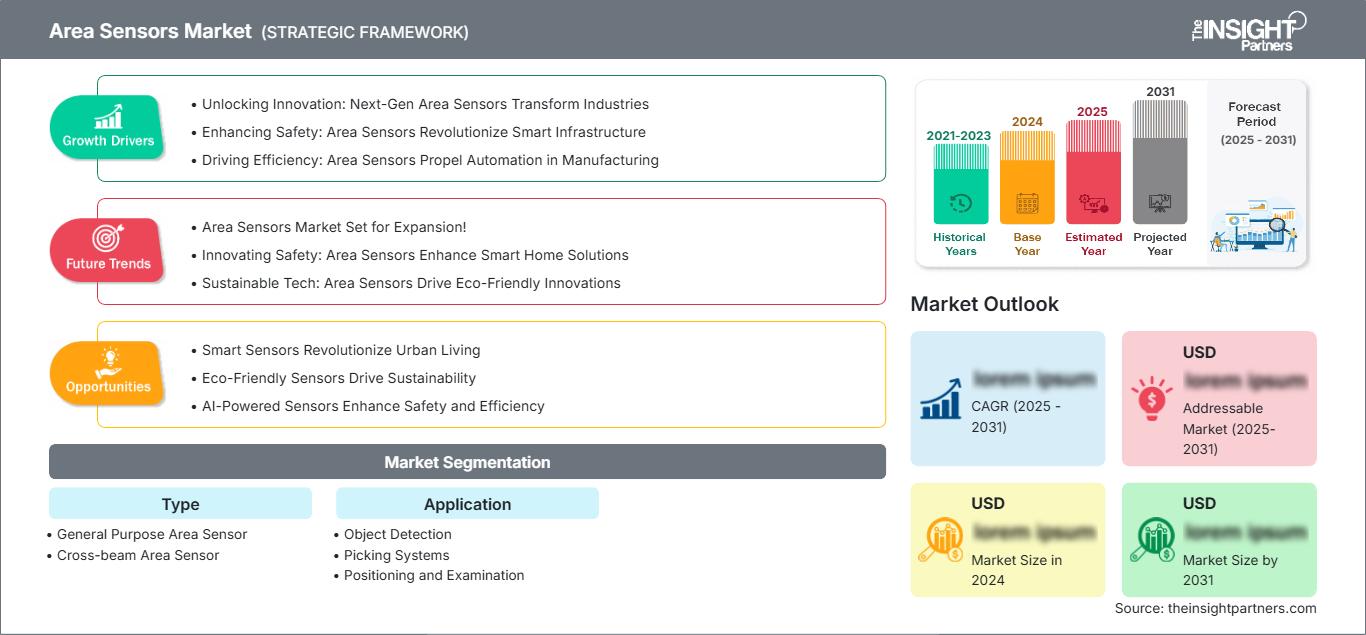
The Area Sensors market was valued at US$ 4.41 Billion in 2025 and is projected to reach US$ 8.23 Billion by 2034, registering a CAGR of 7.17% during 2026–2034. Demand is supported by wider adoption of non-contact object detection, light-grid monitoring, personnel safety, and equipment protection across automated factories, warehouses, packaging lines, electronics production, and machine-building environments.
North America remains a high-value adoption base as manufacturers prioritize machine safeguarding, productivity, and sensor-enabled quality assurance. The Area Sensors Market size in the region is expected to expand at a CAGR of 6.4–7.3% during 2026–2034, driven by warehouse automation, OSHA-aligned safety investments, robotics adoption, and rising use of IO-Link-enabled light grids in material handling and packaging applications.
Area Sensors Market Assessment and Insights
- North America: Held 28–32% share in 2025 and is projected to grow at a CAGR of 6.4–7.3% during 2026–2034, supported by factory modernization, safety retrofits, and high automation density.
- US: Represented 82–86% of North American revenue in 2025 and is forecast to expand at a CAGR of 6.5–7.4% during 2026–2034, driven by logistics automation and machine safety upgrades.
- Europe: Accounted for 25–29% share in 2025 and is expected to grow at a CAGR of 5.9–6.8% during 2026–2034, led by Germany, the UK, France, Italy, and Spain through machinery safety and industrial automation investment.
- Asia Pacific: Held 34–38% share in 2025 and is projected to register a CAGR of 8.0–9.1% during 2026–2034, led by China, Japan, South Korea, India, and Australia through electronics, automotive, and intralogistics automation.
- Largest Segment: General Purpose Area Sensor held 61–65% market share in 2025 and is expected to grow at a CAGR of 6.6–7.5% during 2026–2034, reflecting broad object detection use.
- High Growth Segment: Cross-beam Area Sensor represented 35–39% market share in 2025 and is forecast to grow at a CAGR of 8.1–9.4% during 2026–2034, supported by irregular-object detection needs.
- Key companies analyzed in detail: Autonics Corporation, Cess Automation, Datalogic S.p.A., Delta Electronics, Inc., KEYENCE CORPORATION, OMRON Corporation, Orbital Mekatronik Systems Pvt. Ltd., Panasonic Corporation of North America, Pepperl+Fuchs SE, XECRO GmbH.
Source: The Insight Partners' analysis based on proprietary research, government publications, company annual reports, investor presentations, industry databases, and expert interviews.
Area Sensors have evolved from simple through-beam light screens into compact automation devices that support object detection, height verification, counting, picking confirmation, and machine guarding. Production dynamics are shifting toward slim housings, improved optical alignment, IO-Link diagnostics, and cross-beam detection geometries that reduce blind zones. Suppliers are also improving ambient-light immunity and contamination monitoring to keep sensing performance stable in dusty, reflective, and high-throughput production environments, contributing to the growth of the Area Sensors Market share across industrial automation applications.
Forward demand will be shaped by e-commerce warehouses, electronics assembly, automotive component production, pharmaceutical packaging, and food processing lines that need reliable non-contact verification. Emerging geographies are adopting Area Sensors as automation moves beyond large factories into mid-sized plants. Regulatory emphasis on machine safety, fewer manual interventions, and measurable uptime will keep investment focused on sensor networks that protect people while improving line throughput.
Area Sensors Market Report Scope
| Report Attribute | Details |
|---|---|
| Market size in 2025 | US$ 4.41 Billion |
| Market Size by 2034 | US$ 8.23 Billion |
| Global CAGR (2026 - 2034) | 7.17% |
| Historical Data | 2021-2024 |
| Forecast period | 2026-2034 |
Area Sensors Market Analysis
Demand is rising as manufacturers replace manual inspection and single-point sensors with wider detection fields that monitor moving objects across conveyor openings, racks, robotic cells, and operator access zones. The Area Sensors growth profile is reinforced by productivity pressure, labor constraints, and the need to reduce stoppages caused by mis-picks, jams, missing parts, or unsafe access. Adoption is strongest where fast cycle times require continuous, repeatable sensing.
The ecosystem includes optical component suppliers, sensor manufacturers, automation distributors, machine builders, system integrators, PLC vendors, and end users. Supply dynamics increasingly depend on infrared emitters, receivers, ASICs, industrial connectors, rugged housings, and firmware diagnostics. Area Sensors suppliers are prioritizing easy alignment, longer sensing distance, compact profiles, IP-rated construction, and digital interfaces because customers want fast commissioning and reduced maintenance across multi-shift production assets, according to findings highlighted in the Area Sensors Market report.
Competitive intensity in the Area Sensors analysis reflects a mix of global automation leaders and specialized sensing companies. KEYENCE CORPORATION, OMRON Corporation, Pepperl+Fuchs SE, Datalogic S.p.A., Autonics Corporation, Delta Electronics, Inc., Panasonic Corporation of North America, and XECRO GmbH compete on sensing reliability, portfolio breadth, diagnostics, and engineering support. Cess Automation and Orbital Mekatronik Systems Pvt. Ltd. strengthen regional reach through integration and application-led supply.
Investment is moving toward cross-beam optics, contamination self-diagnosis, IO-Link status reporting, and compact plastic or aluminum bodies that suit constrained machinery. Vendors with broad photoelectric portfolios can bundle area sensing with safety relays, controllers, vision systems, and barcode readers. Strategic positioning, therefore, depends on lifecycle support, short delivery cycles, application engineering, and the ability to serve OEMs that standardize sensing across machine platforms.
● REPORT CUSTOMIZATION
Tailor This Report To Align With Your Specific Business Requirements
This report can be customized to align precisely with your business objectives, scope, and target markets. Customization options include tailored segmentation, geography, competitive analysis, and strategic insights to support informed decision-making.
Customize This Report →WHAT YOU CAN ADJUST
- ● Segmentations
- ● Geography
- ● Competitive Analysis
- ● Language Preferences
Area Sensors Market: Strategic Insights
Regional Insights
North America Area Sensors Market
North America accounted for 28–32% of Area Sensors share in 2025 and is projected to grow at a CAGR of 6.4–7.3% during 2026–2034. Demand is supported by automated warehouses, packaging lines, automotive component plants, and machine-safety upgrades where area detection reduces stoppages and protects operators near moving equipment.
Regional buyers prefer rugged, easily commissioned systems with strong diagnostics, because unplanned downtime carries high labor and fulfillment costs. General-purpose units lead volume, while cross-beam systems gain traction in irregular-object detection and picking confirmation. Area Sensors also benefit from the growing deployment of autonomous material handling, carton sortation, and automated storage systems.
U.S. Area Sensors Market
The U.S. represented 82–86% of North American revenue in 2025 and is expected to expand at a CAGR of 6.5–7.4% during 2026–2034. Large distribution centers, food processing plants, electronics manufacturers, and automotive suppliers use light grids to verify objects, guide pick-to-light workflows, and protect equipment openings. These demand trends are expected to support a positive Area Sensors Market forecast, driven by continued investments in industrial automation, warehouse modernization, and machine safety technologies.
Company presence is strong through KEYENCE CORPORATION, OMRON Corporation, Autonics Corporation, Pepperl+Fuchs SE, Datalogic S.p.A., Delta Electronics, Inc., and Panasonic Corporation of North America. Application trends favor object detection, equipment protection, and picking systems, especially where warehouses and plants need stable detection despite reflective packaging, dust, and variable product sizes.
Europe Area Sensors Market
Europe held 25–29% share in 2025 and is forecast to grow at a CAGR of 5.9–6.8% during 2026–2034. Germany leads because of its machine-building base, automotive suppliers, and preference for engineered automation reliability. The UK emphasizes warehouse automation and packaging safety, while France supports food, pharmaceutical, and consumer goods applications. These developments reflect key Area Sensors Market trends, including increased adoption of intelligent sensing technologies, machine safety solutions, and automation systems across diverse industrial sectors.
Italy and Spain contribute through packaging machinery, metalworking, logistics, and industrial modernization programs. European demand is shaped by safety expectations, CE machinery compliance, energy-efficient operations, and a mature distributor network. Pepperl+Fuchs SE, Datalogic S.p.A., OMRON Corporation, KEYENCE CORPORATION, and XECRO GmbH are prominent across plant-level sensing, light grids, and application engineering.
APAC Area Sensors Market
Asia Pacific accounted for 34–38% share in 2025 and is projected to grow at a CAGR of 8.0–9.1% during 2026–2034. China leads through electronics, batteries, packaging, and logistics automation, while Japan and South Korea support high-precision manufacturing and sensor innovation. These factors position the region as a major growth engine for the Area Sensors Market, supported by expanding industrial automation, smart manufacturing investments, and rising demand for advanced sensing technologies across key production sectors.
India and Australia are scaling adoption through warehouse modernization, automotive parts production, food processing, and safety upgrades. Policy support for electronics manufacturing, industrial corridors, and smart logistics increases Area Sensors demand. Autonics Corporation, KEYENCE CORPORATION, OMRON Corporation, Delta Electronics, Inc., and Orbital Mekatronik Systems Pvt. Ltd. have strong relevance across regional applications.
Middle East & Africa Area Sensors Market
The Middle East & Africa market is projected to grow at a CAGR of 5.4–6.5% during 2026–2034. Saudi Arabia leads adoption through logistics parks, packaging plants, mining support operations, and industrial diversification. The UAE follows with automated warehousing, ports, and food distribution investment. These developments are contributing to the expansion of the Area Sensors Market, supported by increasing automation initiatives, industrial modernization programs, and growing investments in logistics and manufacturing infrastructure across the region.
South Africa remains the most developed Sub-Saharan market because of manufacturing, mining, automotive assembly, and food processing activity. The rest of MEA adoption is gradual but improving as machine builders and distributors introduce compact sensing solutions. Equipment protection and personnel safety remain the most resilient use cases in the region.
Segmentation Analysis
Type
Type is projected to grow at a CAGR of 7.0–8.2% during 2026–2034. The Area Sensors Market scope is widening as users select between general-purpose detection and cross-beam configurations that minimize non-detection zones. Buying decisions depend on object shape, installation space, ambient light, sensing distance, and the need to detect small or irregular items on moving lines.
- General Purpose Area Sensor remains the volume leader because it offers economical multi-beam detection for conveyors, entry points, part presence, and general automation tasks where standard object profiles are common.
- Cross-beam Area Sensor is strategically important where three-point or crossed-beam detection improves reliability for small, thin, angled, or irregular objects that may pass between parallel optical axes.
Application
Application is forecast to grow at a CAGR of 7.2–8.5% during 2026–2034. Within the Area Sensors Market, adoption spans object detection, picking systems, positioning and examination, personnel safety, and equipment protection. Application demand is strongest where a wider sensing field reduces human error, confirms product flow, enables safer access control, and protects machinery from jams or accidental entry.
- Object Detection is a core use case because multi-beam coverage identifies passing cartons, parts, trays, and packages more reliably than single-point detection in dynamic production settings.
- Picking Systems use area sensing to confirm operator hand movement, reduce picking errors, and support fast fulfillment workflows in warehouses, electronics assembly, and kitting lines.
- Positioning and Examination applications benefit from detection fields that verify height, alignment, profile, and object presence before downstream processing or robotic handling begins.
- Personnel Safety remains essential in guarding hazardous zones, machine openings, and automated cells where fast detection supports safe interruption of motion or access.
- Equipment Protection uses area detection to prevent jams, collisions, overloads, and misfeeds, reducing maintenance costs and improving uptime in conveyors and automated machinery.
Opportunity Snapshot
| Segment Name | Revenue Contribution | Trend Tag | Adoption Stage |
| Object Detection | High | Conveyor Flow | Mature |
| Picking Systems | High | Pick Assist | Scaling |
| Positioning and Examination | Medium | Profile Check | Scaling |
| Personnel Safety | High | Machine Guarding | Mature |
| Equipment Protection | Medium | Jam Prevention | Scaling |
Area Sensors Market Growth Drivers and Impact Analysis
Automation density increasing need for wide-field detection
A higher level of automation density is a structural influence because plants and distribution centers are installing more conveyors, robots, automated storage, and fast-packaging lines that need a reliable object presence detection over a larger space. Area Sensors decrease the necessity for human supervision and allow machines to respond better to situations when there is no product, misalignment, or unpredictable movement. This effect is the most visible in logistics, electronics, and consumer goods manufacturing since small disruptions may interfere with order fulfillment and further processing. With the constant desire to improve facilities' operations, sensing areas become an integrated part of machines rather than an additional one.
Machine safety requirements supporting personnel protection adoption
Safety-oriented investment is rising due to the risk posed by automated machinery that presents hazards of pinch points, moving gates, robots, transfer, and conveyor hazards. The Area Sensors help provide non-contact protection and the presence detection capability that enables the machines to either slow down or come to a stop if there is any danger of personnel entry. The result is a safer operation with the benefit of quicker restart than with physical barriers in certain processes. It has manifested itself in the need for dependable light grids, safety curtain devices, diagnostics capabilities, and controller compatibility.
Picking and intralogistics systems requiring error-proof sensing
Demand for picking systems will be one of the key drivers as warehouses, assembly lines, and kitting centers work to minimize errors while not slowing down employees. With the help of Area Sensors, hand presence can be detected, items picked up, objects moving around, and bins opened — thus providing an efficient means of error proofing. Such effects include less wrong picks, greater accuracy of the inventory, and better compatibility with warehouse management or manufacturing execution systems. In terms of hardware and its mounting possibilities, it will definitely be a good idea to offer something compact with visible indicators.
Area Sensors Market Future Trends
IO-Link diagnostics becoming standard in smart sensing networks
The Area Sensors trends are showing an increased tendency for digitally-connected light grids that provide the information on alignment, contamination, signal intensity, object height, and operational state to controllers or maintenance systems. IO-Link technology and others like it would allow for transitioning to condition-based maintenance in order to reduce the time spent on analyzing intermittent issues, thus allowing moving from reactive problem solving to proactive solutions. At the same time, this development is important in terms of standardization and commissioning, since the parameter settings can be transferred from machine to machine and even recovered after replacement.
Cross-beam configurations improving detection of irregular objects
The need for cross-beam sensing will increase with the use of production lines dealing with small, thin, dark, clear, or oddly shaped objects. Parallel beams may create spaces through which thin objects can pass without being sensed, but crossed beam paths enhance resolution over the area. Future product developments will be aimed at overcoming errors caused by environmental light, reflections from packages, dust, and vibrations. Such a need is especially applicable in industries like electronics, packaging, pharmaceuticals, and automatic sorting, where a lack of detection causes wastage and disruption of operations.
Area Sensors Market Opportunities
Modular sensing packages for warehouse automation OEMs
The automation of warehouses provides a definite opportunity for vendors that offer modular packages for conveyors, automated storage, picking stations, sorters, and robot manipulators. According to the forecasts by Area Sensors, there will be continuous demand for sensors in those cases when high throughput is needed, and manual errors have to be minimized. Differences will be possible by offering pre-engineered mounting solutions, fast-connect cables, status lights, and guides for popular PLC platforms. The best program for such sensors will include winning original equipment manufacturers, since standard packages of sensors can be duplicated.
Safety retrofit demand in mid-sized industrial facilities
There is significant potential in mid-sized manufacturing since most of the machines in such companies tend to be old with poor diagnostics and protection systems. Area Sensors will help fix the safety concerns without having to replace all machines. The product offering needs to focus on smaller sizes, easy wiring, distributor education, and templates for various applications, including presses, conveyors, doors, cutting, and material handling. This is best achieved using financing from automation partners or safety improvement initiatives. The market is ripe wherever there is a demand for quick risk reduction and compliance.
Recent Developments
- April 2026: Murata Manufacturing Co., Ltd has commenced mass production of its MRMS166R and MRMS168R anisotropic magnetoresistance (AMR) sensors for healthcare, wearable, and IoT devices. The MRMS166R is the first AMR sensor to combine an average current consumption of 20 nA with operation from a 1.2 V supply, enabling extended battery life in coin cell-powered systems. The devices are solid-state magnetic sensors used for switching applications. They detect the presence or absence of a magnetic field and generate an output signal that system logic uses to control functions such as transitions between active and sleep modes. This enables contactless switching without mechanical components, improving reliability and supporting sealed, miniaturized designs.
- October 2025: STMicroelectronics (NYSE: STM), a global semiconductor leader serving customers across the spectrum of electronics applications, introduces a new family of 5MP CMOS image sensors: VD1943, VB1943, VD5943, and VB5943. These advanced ST BrightSense sensors are designed to accelerate the development of innovative vision applications across industries, including advanced industrial automation with enhanced machine and robotic vision, next-generation security, including biometric identification and traffic management, and smart retail applications such as inventory management and automated checkout. A longtime leader in optical sensing technology for consumer applications, ST continues to expand its offering for new applications with its industry-leading design, 3D stacking expertise, and high-volume manufacturing for market-leading performance.
- February 2023: Delta has added two new area sensors - AS-E and AS-T - to its portfolio. The powerful AS-E and AS-T models each sense a bigger part between the sensor lines, allowing them to detect and register products, ingredients and components. An example could be to identify an item falling from a conveyor belt or being moved to an incorrect destination while being transported. This reduces losses and helps to minimize material wastage and transportation of wrong items. Both the standard AS-E area sensor and its more robust counterpart AS-T for outdoor use, support comprehensive no-dead-zone detection within their working area. They are ideally suited for a diverse range of deployment scenarios in industrial applications.
Frequently Asked Questions

- Comprehensive Market Sizing and Forecast Analysis
- Detailed Segmentation Analysis
- In-Depth Market Dynamics Assessment
- Regional and Country-Level Insights
- Competitive Landscape and Company Benchmarking
- Strategic Business Intelligence
Recent Reports
Testimonials

The Insight Partners provided valuable market intelligence that supported our global go-to-market strategy. Their team was professional, responsive, and attentive to our feedback, providing thoughtful analysis and helpful methodological clarifications throughout the project.
Junmo Kim Chief Financial Officer (CFO), Enertech Co., Ltd.
The Insight Partners' SCADA System Market report is comprehensive, with valuable insights on current trends and future forecasts. The team was highly professional, responsive, and supportive throughout. We are very satisfied and highly recommend their services.
RAN KEDEM Partner, Reali Technologies LTDs
I requested a report on a very specific software market and the team produced the report in a few days. The information was very relevant and well presented. I then requested some changes and additions to the report. The team was again very responsive and I got the final report in less than a week.
JEAN-HERVE JENN Chairman, Future Analytica
We worked with The Insight Partners for an important market study and forecast. They gave us clear insights into opportunities and risks, which helped shape our plans. Their research was easy to use and based on solid data. It helped us make smart, confident decisions. We highly recommend them.
PIYUSH NAGPAL Sr. Vice President, High Beam Global
The Insight Partners delivered insightful, well-structured market research with strong domain expertise. Their team was professional and responsive throughout. The user-friendly website made accessing industry reports seamless. We highly recommend them for reliable, high-quality research services
YUKIHIKO ADACHI CEO, Deep Blue, LLC.
This is the first time I have purchased a market report from The Insight Partners.While I was unsure at first, I visited their web site and felt more comfortable to take the risk and purchase a market report.I am completely satisfied with the quality of the report and customer service. I had several questions and comments with the initial report, but after a couple of dialogs over email with their analyst I believe I have a report that I can use as input to our strategic planning process.Thank you so much for taking the extra time and making this a positive experience.I will definitely recommend your service to others and you will be my first call when we need further market data.
JOHN SUZUKI President and Chief Executive Officer, Board Director, BK Technologies
I wish to appreciate your support and the professionalism you displayed in the course of attending to my request for information regarding to infectious disease IVD market in Nigeria. I appreciate your patience, your guidance, and the fact that you were willing to offer a discount, which eventually made it possible for us to close a deal. I look forward to engaging The Insight Partners in the future, all thanks to the impression you have created in me as a result of this first encounter.
DR CHIJIOKE ONYIA MANAGING DIRECTOR, PineCrest Healthcare Ltd.Reason to Buy
- Informed Decision-Making
- Understanding Market Dynamics
- Competitive Analysis
- Identifying Emerging Markets
- Customer Insights
- Market Forecasts
- Risk Mitigation
- Boosting Operational Efficiency
- Strategic Planning
- Investment Justification
- Tracking Industry Innovations
- Aligning with Regulatory Trends





 Get Free Sample for