
Armored Personnel Carrier Market Share, Demand & Growth by 2034
Coverage: By Type (Tracked, Wheeled); Number of Occupant (Less than 10, 10 to 15, More than 15); Range (200 - 400 Km, 400 - 600 Km, Above 600 Km) , and Geography (North America, Europe, Asia Pacific, and South and Central America)
- Status : Data Released
- Report Code : TIPRE00028590
- Category : Aerospace and Defense
- No. of Pages : 150
- Available Report Formats :


- Last update date : November 03, 2026


2025 Market Size
US$ 5.33 Bn
Base year value
2034 Forecast
US$ 9.86 Bn
Projected by 2034
CAGR 2026-2034
7.07 %
Growth rate
Addressable Market
US$ 68.56 Bn
(2026-2034)
The armored personnel carrier market was valued at US$ 5.33 Billion in 2025 and is projected to reach US$ 9.86 Billion by 2034, expanding at a CAGR of 7.07% during 2026–2034. Growth is supported by military modernization, replacement of aging troop transport fleets, higher requirements for protected mobility, and increasing emphasis on survivability, modularity, and interoperability. Procurement programs are also shifting toward platforms that combine mobility, protection, communications, and mission-system integration within common vehicle architectures.
North America remains an important demand center, supported by sustained modernization of mechanized formations, replacement cycles, and requirements for highly survivable tactical mobility. The armored personnel carrier market size is also influenced by rising demand for networked platforms, expeditionary mobility, and vehicles that can accommodate evolving protection and mission equipment. North American procurement is expected to expand at a defensible ~5% CAGR through 2034 as modernization programs increasingly prioritize common platforms, digital integration, and fleet sustainment.
Armored Personnel Carrier Market Assessment and Insights
Regional Outlook
- North America: ~31% of the global market in 2025 | ~5% CAGR through 2034. Market position: North America maintains the largest regional position, supported by established armored vehicle fleets, defense modernization programs, replacement demand, advanced survivability requirements, and sustained investment in mechanized and expeditionary land forces.
- US: ~82% of North American market revenue in 2025 | ~5% CAGR through 2034. Market position: The US dominates North American demand because of its large armored fleet, modernization priorities, overseas operational requirements, and extensive industrial ecosystem supporting tactical vehicles, protection systems, communications, and sustainment.
- Europe: ~28% of the global market in 2025 | ~7% CAGR through 2034. Market position: Europe is a mature but rapidly modernizing market, with Germany, the UK, France, Italy, and Spain supporting fleet replacement, NATO interoperability, local production, and increased investment in protected mobility and mechanized formations.
- Asia Pacific: ~29% of the global market in 2025 | ~10% CAGR through 2034. Market position: Asia Pacific is the fastest-growing major region, driven by modernization in China, India, Japan, South Korea, and Australia, greater indigenous production, border-security requirements, and increasing emphasis on protected mobility.
Segment Outlook
- Wheeled: ~65% Share in 2025 | ~6% CAGR through 2034. Market position: Wheeled platforms lead because they provide high road mobility, comparatively efficient operating costs, strategic deployability, and adaptable configurations for troop transport, command, reconnaissance, medical evacuation, and other missions.
- Tracked: ~35% Share in 2025 | ~8% CAGR through 2034. Market position: Tracked platforms represent the high-growth segment as militaries seek greater cross-country mobility, protection, and battlefield endurance for mechanized formations operating in demanding terrain and alongside heavily protected combat systems.
Competitive Coverage
ARTEC GmbH, Patria, General Dynamics European Land Systems, Mahindra Emirates Vehicle Armouring FZ LLC, Military Industrial Company LLC, Otokar Otomotiv ve Savunma Sanayi A.Ş., NIMR Automotive, Tata Motors, Hanwha Corporation, Textron Systems, BAE Systems, Rheinmetall
Methodology
The Insight Partners follows Data Collection & Secondary Research, Primary Research, Data Analysis, and Data Triangulation & Final Review to validate market estimates and insights.
Source: The Insight Partners' analysis based on proprietary research, government publications, company annual reports, investor presentations, industry databases, and expert interviews.
The armored personnel carrier market has developed from basic standard vehicles for transporting troops to protected mobility systems designed to provide platforms for communication, reconnaissance, command, medical evacuation, electronics, and weapons systems. Advances in materials used for armoring, the design of the vehicle, the suspension system, the power management system, situational awareness, and digital communication are changing the criteria for platforms. Manufacturing of the products is shifting towards common platform families and regional manufacturing, which enables defense ministries to standardize their fleets according to the specific needs of their country.
In the future, purchasing will increase in Europe, Asia Pacific, the Middle East, and selected developing defense nations. Local manufacturing and technology transfer have become critical as governments pursue supply chain resilience and sovereign capability. Interoperability and readiness, as well as lifecycle considerations, have become key aspects for the regulatory and procurement environment. This makes it favorable for suppliers able to integrate platform engineering with local industrial cooperation, maintenance, upgrading, and mission-systems integration.
Armored Personnel Carrier Market Report Scope
| Report Attribute | Details |
|---|---|
| Market size in 2025 | US$ 5.33 Billion |
| Market Size by 2034 | US$ 9.86 Billion |
| Global CAGR (2026 - 2034) | 7.07% |
| Historical Data | 2021-2024 |
| Forecast period | 2026-2034 |
Armored Personnel Carrier Market Analysis
The main drivers of demand are the modernization of mechanized forces, the need to replace old platforms, and the necessity to transport people under increasing threats on the battlefield. Today, protection, mobility, payload, endurance, connectivity, and system interoperability with allied forces are being considered as one capability and not just a set of features of the vehicle itself. This means that the value chain goes from the suppliers of armor and engines to the producers of vehicles, turrets and communication systems, sensors, local assembly plants, and long-term service providers.
The supply side dynamics is becoming more distributed geographically as well. While European programs tend to develop multinational procurement and technology transfer programs, buyers in Asia and the Middle East usually prefer to concentrate on local assembly programs. For this reason, the armored personnel carrier market is not only affected by vehicle sales but also by maintenance, spare parts, upgrading services, training, and even the capability to produce regionally.
Competition is moving towards platform commonality, survivability, mobility, and localization. Patria has expanded the international presence of its 6x6 family of vehicles via the multinational CAVS project. In addition, ARTEC GmbH and Rheinmetall will continue benefiting from European customer demand for their Boxer-derived systems. General Dynamics European Land Systems is positioning itself through the Piranha series and other wheeled platforms. Meanwhile, BAE Systems is growing its CV90 platform production and upgrades. Thus, platforms with an established multinational user base are likely to be ahead if the customer emphasizes interoperability and supply security.
According to the armored personnel carrier market report, investment is being directed towards production growth and industrial collaboration. Patria has increased manufacturing capabilities and technology transfer. In addition, Otokar has sought to localize production of certain products in Romania. At the same time, Tata Motors and Tata Advanced Systems are part of India’s wider local land system industry. Furthermore, regional manufacturers like NIMR Automotive and Mahindra Emirates Vehicle Armouring meet demand in the Middle East region. Thus, the competition environment includes global platform providers and regional manufacturers competing through customization, localization, lifecycle support, and exports.
● REPORT CUSTOMIZATION
Tailor This Report To Align With Your Specific Business Requirements
This report can be customized to align precisely with your business objectives, scope, and target markets. Customization options include tailored segmentation, geography, competitive analysis, and strategic insights to support informed decision-making.
Customize This Report →WHAT YOU CAN ADJUST
- ● Segmentations
- ● Geography
- ● Competitive Analysis
- ● Language Preferences
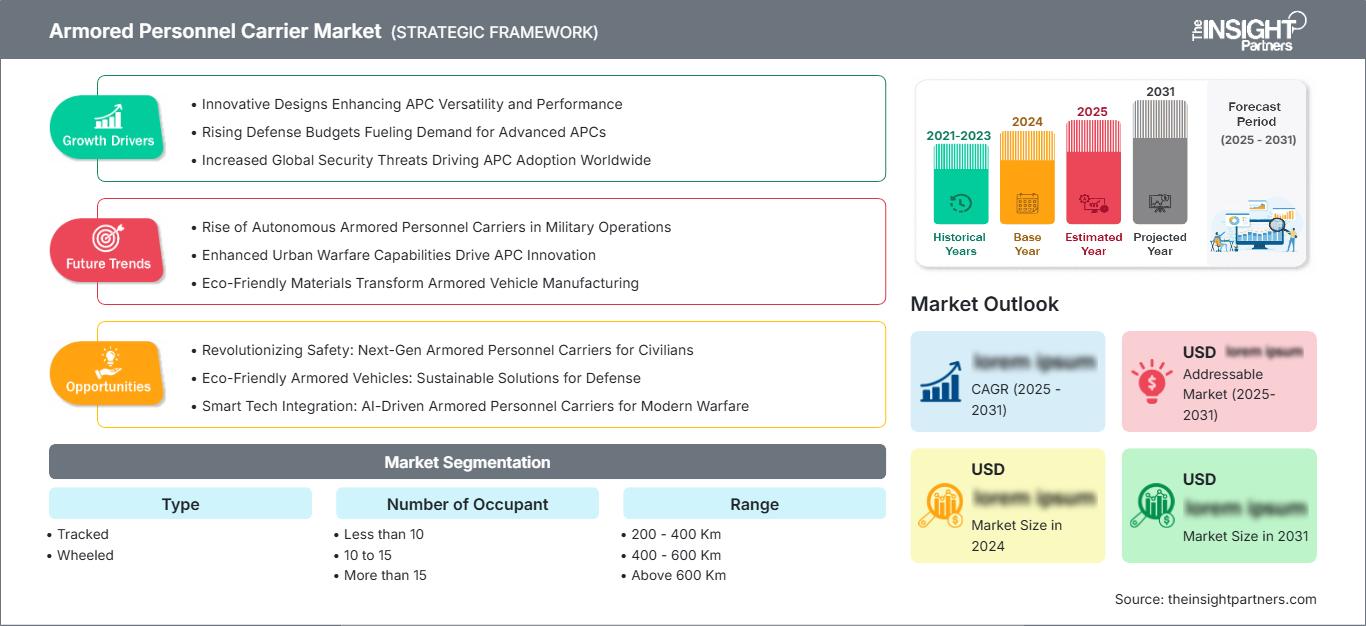
Armored Personnel Carrier Market: Strategic Insights
Regional Insights
North America armored personnel carrier market
The North American armored personnel carrier market share in 2025 stood at ~31%, and the region is forecast to grow at ~5% CAGR until 2034. It enjoys a substantial fleet, well-developed defense industrial base, and further modernization of its protected mobility vehicles. The main drivers behind demand include the need for replacements, increasing survivability, networked command abilities, and the ability to form deployable formations. The U.S. serves as the primary consumer of the products under analysis, whereas Canada acts as the source of demand due to modernization and interoperability requirements.
The procurement process in North America is favorable toward platforms which are capable of accepting upgrades regarding armor protection, communication equipment, sensors, remote weapon stations, and mission systems without complete reprocuring of the vehicles. Therefore, sustainability plays an essential role during procurement. Programs of North American countries impact allied demand since interoperability and similar standards make partner nations procure the same platforms and subsystems.
U.S. armored personnel carrier market
The US accounted for ~82% of North American market revenue in 2025 and will see growth at ~5% CAGR till 2034. This is owing to the size of the US Army and Marine Corps, presence of mechanized forces, need to deploy worldwide and investment into protected mobility. Survivability, mobility, digital connectivity, modular design, and interoperability within larger battle formations become key procurement criteria.
The US is also driven by an extensive industrial base which includes vehicle OEMs, armor manufacturers, electronics firms and sustainment contractors. Companies such as Textron Systems, BAE Systems, and General Dynamics among others have involvement in related land system products. Usage goes beyond conventional soldier transport vehicles and extends to command, reconnaissance, medevac, combat support and specialized protected vehicles.
Europe armored personnel carrier market
Europe represented ~28% of the global market in 2025 and is expected to expand at ~7% CAGR through 2034. Germany is the leading country in Europe, supported by major land-force modernization, industrial investment, and procurement programs involving wheeled and tracked platforms. The UK is strengthening protected mobility and sovereign manufacturing capabilities, while France and Italy continue modernization of mechanized fleets. Spain is also advancing land-force capabilities and industrial participation in European vehicle programs.
Procurement activities by Germany are significant since they facilitate scaling up of production, developing technologies, and localization of suppliers within the region. Procurement activities in the UK emphasize domestic capabilities along with interoperability among NATO members. Demand from France and Italy pertains to protected and networked vehicles that can operate with ease. Spain requires upgrading of its fleet along with domestic industrial involvement. Within Europe, multilateral procurement minimizes duplication and promotes similar vehicle architectures. Such an environment is favorable for vehicle manufacturers that offer technology transfer, localization, and sustainment of vehicles.
APAC armored personnel carrier market
APAC constituted approximately 29% of the total armored personnel carrier market share in 2025 and is estimated to register a CAGR of approximately 10%, being the fastest growing of all the regional markets. Leading APAC nation is China, whereas other nations such as India, Japan, South Korea and Australia are making investments towards developing their mobility solutions and protected capabilities. APAC demand would be driven by need for securing borders, modernization of existing fleet and development of vehicles suitable for various terrains and environments.
Indigenous manufacturing is being encouraged by India, whereas interoperability and mobility solutions would be developed by Japan, South Korea and Australia. Industrial localization is becoming one of the key factors when considering procurement.
Middle East & Africa armored personnel carrier market
Middle East and Africa demand is projected to expand at ~8% CAGR through 2034. Saudi Arabia is a leading country in the Middle East & Africa region where evidence of sustained defense modernization and domestic industrial development supports continued protected mobility requirements. The UAE also maintains significant demand for advanced tactical vehicles, while South Africa contributes specialized engineering and regional defense manufacturing capabilities.
Procurement priorities vary from border security and internal security to conventional land-force modernization. In the Gulf, defense investment and industrial localization encourage suppliers to establish regional assembly, maintenance, and technology partnerships. Across Africa, vehicle requirements are strongly influenced by operational mobility, protection against mines and improvised threats, peacekeeping missions, and infrastructure constraints. These conditions favor adaptable platforms that combine protection with practical mobility and manageable lifecycle costs.
Segmentation Analysis
Type
Type segment in the armored personnel carrier market represents a central procurement decision because militaries balance tactical mobility, protection, operating cost, terrain performance, and deployment requirements when selecting protected troop carriers. Wheeled platforms generally provide efficient road mobility and easier strategic movement, while tracked architectures support demanding cross-country operations. The tracked segment is projected to expand at ~8% CAGR through 2034 as mechanized forces prioritize battlefield mobility and survivability.
- Tracked: Tracked platforms are suited to heavily contested environments where cross-country mobility, obstacle negotiation, and battlefield endurance are priorities. Their integration with mechanized formations supports missions requiring close coordination with heavily protected combat vehicles.
- Wheeled: Wheeled platforms benefit from strong road mobility, lower logistical complexity, and flexible deployment. They are widely adaptable to troop transport, command, reconnaissance, medical, and combat-support missions across diverse operating environments.
Number of Occupant
Number of Occupant segment in the armored personnel carrier market influences vehicle architecture, internal volume, protection requirements, mission equipment, and tactical employment. Customers select capacity according to squad structure, mission configuration, and the balance between personnel carriage and onboard systems. Larger internal volumes can support specialized configurations, whereas compact designs can prioritize mobility and tactical flexibility in constrained operating environments. Procurement increasingly considers modular interiors that can be reconfigured as mission requirements change.
- Less than 10: Compact personnel configurations support command, reconnaissance, liaison, security, and specialized missions where reduced crew and passenger capacity allows greater flexibility for equipment integration and tactical maneuver.
- 10 to 15: This capacity range aligns closely with common protected troop transport requirements. It balances personnel movement with internal space for communications, equipment, protection systems, and mission-specific configurations.
- More than 15: Higher-capacity vehicles are relevant where maximizing protected personnel movement is a central requirement. They can improve transport efficiency for larger formations but require careful balancing of weight, protection, power, and maneuverability.
Range
Range determines operational endurance and influences vehicle suitability for long-distance deployments, dispersed operations, border security, and extended tactical missions. Buyers increasingly evaluate range alongside fuel efficiency, powertrain performance, payload, terrain capability, and logistical support. Vehicles with greater endurance can reduce dependence on forward refueling infrastructure and provide additional operational flexibility, particularly in geographically extensive theaters and environments where logistics are exposed to disruption.
- 200 - 400 Km: This range is suitable for missions supported by established logistics networks and regular refueling opportunities. It can meet tactical mobility requirements where operational routes remain comparatively close to support infrastructure.
- 400 - 600 Km: This range provides a stronger balance between tactical endurance and vehicle weight. It is relevant for formations conducting dispersed operations while retaining practical access to established logistics support.
- Above 600 Km: Extended-range platforms support long-distance movement, border missions, expeditionary operations, and environments where refueling infrastructure may be limited. Higher endurance can improve operational flexibility and reduce logistical interruptions.
Opportunity Snapshot
| Type | Revenue Contribution | Trend Tag | Adoption Stage |
|---|---|---|---|
| Tracked | Medium | Cross-Country Mobility | Scaling |
| Wheeled | High | Strategic Mobility | Mature |
Armored Personnel Carrier Market Growth Drivers and Impact Analysis
Modernization of aging mechanized vehicle fleets
A major growth driver is the replacement of aging protected mobility fleets whose original architectures were not designed for contemporary battlefield requirements. Older platforms often face limitations in digital connectivity, armor integration, power generation, sensor compatibility, and maintainability. Modern replacement programs therefore involve more than one-for-one vehicle substitution. Defense ministries are seeking platforms that can accommodate future upgrades while reducing lifecycle complexity through common components and modular mission systems. This raises the value of vehicle families capable of supporting multiple configurations from a shared chassis. The impact is particularly significant in Europe and Asia Pacific, where modernization programs are being combined with industrial participation and localized production. Fleet replacement consequently generates both initial vehicle demand and recurring opportunities for upgrades, sustainment, training, and component supply.
Greater emphasis on protected mobility and battlefield survivability
The operational requirement to transport personnel while reducing exposure to mines, improvised explosive devices, ballistic threats, and indirect attack is increasing demand for integrated protection. Modern armored vehicles increasingly combine ballistic protection with mine resistance, modular armor, improved suspension, situational awareness, and active protection or countermeasure technologies. These requirements influence vehicle weight, powertrain design, internal volume, and payload, making engineering integration a critical competitive factor. Buyers are also placing greater emphasis on mobility after protection is added, because heavier platforms can lose tactical flexibility if power and suspension systems are not upgraded accordingly. The market impact is a shift toward modular architectures that allow customers to tailor protection levels without redesigning the complete platform, creating additional demand for armor packages, electronic systems, mission equipment, and lifecycle engineering.
Multinational procurement and industrial localization
Multinational procurement is improving production scale while industrial localization is helping governments strengthen domestic defense supply chains. European programs demonstrate how common vehicle architectures can be adopted by multiple armed forces while allowing national assembly, component production, maintenance, and technology transfer. Similar approaches are emerging in other regions where customers seek local manufacturing capacity and greater control over sustainment. This structure benefits established platform developers because a successful reference fleet can lead to additional orders from partner nations. It also creates opportunities for regional manufacturers, engineering firms, and component suppliers. The commercial impact extends beyond vehicle sales because localized programs generate long-term demand for training, spare parts, repair facilities, upgrades, and fleet-management services. Suppliers that can combine exportable platforms with credible industrial participation are therefore positioned to capture broader program value.
Armored Personnel Carrier Market Future Trends
Modular digital architectures will become standard procurement criteria
Future platforms in the armored personnel carrier market trends are expected to place greater emphasis on modular digital architectures that allow sensors, communications, electronic systems, remote weapon stations, and mission equipment to be upgraded without extensive redesign. This trend reflects the shortening technology cycle for battlefield electronics and the need to integrate new capabilities throughout a vehicle's service life. Open and adaptable architectures can reduce upgrade disruption while supporting interoperability among allied forces. Vehicle manufacturers are therefore likely to compete increasingly on software integration, power availability, data connectivity, and the ability to support third-party mission systems. For buyers, this approach can extend platform relevance and reduce the risk of premature obsolescence. The resulting procurement model favors vehicles designed as upgradeable systems rather than fixed configurations with limited future growth capacity.
Localized production will reshape international vehicle programs
International customers in the armored personnel carrier market forecast are increasingly seeking production arrangements that include local assembly, technology transfer, regional maintenance, and domestic supplier participation. This trend is likely to accelerate as governments place greater emphasis on supply-chain resilience and sovereign defense capability. Instead of importing complete vehicles throughout a program, manufacturers may establish regional production lines or transfer selected manufacturing activities to domestic partners. Such arrangements can also support export opportunities from the recipient country when regulatory and industrial conditions permit. For vehicle suppliers, localization can increase program complexity but also strengthen long-term customer relationships and improve access to follow-on orders. By 2034, the most competitive international programs are likely to combine proven vehicle designs with flexible industrial models capable of adapting production and sustainment responsibilities to customer requirements.
Armored Personnel Carrier Market Opportunities
Regional manufacturing partnerships in high-growth markets
High-growth markets in Asia Pacific and the Middle East provide opportunities for manufacturers to establish regional production and sustainment partnerships. Customers in these markets increasingly value local industrial participation alongside vehicle capability, particularly where defense procurement is connected to broader national manufacturing strategies. A partnership model can include localized assembly, component sourcing, maintenance facilities, training, and engineering support. This approach can reduce delivery friction and strengthen lifecycle relationships while allowing the original equipment manufacturer to retain platform-level technology and integration responsibility. Companies with scalable vehicle families can use the same architecture across several customers while adapting armor, communications, weapons, and internal layouts to national requirements. The commercial opportunity therefore extends beyond initial procurement into recurring support and modernization revenues.
Lifecycle modernization and fleet sustainment services
Large installed fleets create opportunities for suppliers that can provide modernization packages rather than relying exclusively on new vehicle sales. Aging platforms can often be extended through powertrain upgrades, improved protection, digital communications, sensor integration, suspension improvements, and new mission equipment. Sustainment programs also provide a lower-risk entry point for suppliers seeking long-term relationships with defense ministries. As militaries standardize vehicle families, demand for common spare parts, diagnostic tools, training, depot maintenance, and fleet-management systems can increase. Companies that combine vehicle manufacturing with engineering and lifecycle support can capture a greater portion of program expenditure. This opportunity is especially relevant in mature markets where replacement budgets compete with readiness requirements and where governments seek to maximize the operational life of existing fleets.
Frequently Asked Questions

- Comprehensive Market Sizing and Forecast Analysis
- Detailed Segmentation Analysis
- In-Depth Market Dynamics Assessment
- Regional and Country-Level Insights
- Competitive Landscape and Company Benchmarking
- Strategic Business Intelligence
Recent Reports
Testimonials

The Insight Partners provided valuable market intelligence that supported our global go-to-market strategy. Their team was professional, responsive, and attentive to our feedback, providing thoughtful analysis and helpful methodological clarifications throughout the project.
Junmo Kim Chief Financial Officer (CFO), Enertech Co., Ltd.
The Insight Partners' SCADA System Market report is comprehensive, with valuable insights on current trends and future forecasts. The team was highly professional, responsive, and supportive throughout. We are very satisfied and highly recommend their services.
RAN KEDEM Partner, Reali Technologies LTDs
I requested a report on a very specific software market and the team produced the report in a few days. The information was very relevant and well presented. I then requested some changes and additions to the report. The team was again very responsive and I got the final report in less than a week.
JEAN-HERVE JENN Chairman, Future Analytica
We worked with The Insight Partners for an important market study and forecast. They gave us clear insights into opportunities and risks, which helped shape our plans. Their research was easy to use and based on solid data. It helped us make smart, confident decisions. We highly recommend them.
PIYUSH NAGPAL Sr. Vice President, High Beam Global
The Insight Partners delivered insightful, well-structured market research with strong domain expertise. Their team was professional and responsive throughout. The user-friendly website made accessing industry reports seamless. We highly recommend them for reliable, high-quality research services
YUKIHIKO ADACHI CEO, Deep Blue, LLC.
This is the first time I have purchased a market report from The Insight Partners.While I was unsure at first, I visited their web site and felt more comfortable to take the risk and purchase a market report.I am completely satisfied with the quality of the report and customer service. I had several questions and comments with the initial report, but after a couple of dialogs over email with their analyst I believe I have a report that I can use as input to our strategic planning process.Thank you so much for taking the extra time and making this a positive experience.I will definitely recommend your service to others and you will be my first call when we need further market data.
JOHN SUZUKI President and Chief Executive Officer, Board Director, BK Technologies
I wish to appreciate your support and the professionalism you displayed in the course of attending to my request for information regarding to infectious disease IVD market in Nigeria. I appreciate your patience, your guidance, and the fact that you were willing to offer a discount, which eventually made it possible for us to close a deal. I look forward to engaging The Insight Partners in the future, all thanks to the impression you have created in me as a result of this first encounter.
DR CHIJIOKE ONYIA MANAGING DIRECTOR, PineCrest Healthcare Ltd.Reason to Buy
- Informed Decision-Making
- Understanding Market Dynamics
- Competitive Analysis
- Identifying Emerging Markets
- Customer Insights
- Market Forecasts
- Risk Mitigation
- Boosting Operational Efficiency
- Strategic Planning
- Investment Justification
- Tracking Industry Innovations
- Aligning with Regulatory Trends





 Get Free Sample for