
Aroma Chemicals Market Trends, Size & Forecast by 2034
Coverage: By Chemical Type (Terpenes, Benzonoids, Musk chemicals, Others); Applications (Soap and Detergents, Cosmetics and Toiletries, Fine Fragrances, Household Products, Food and Beverage, Other Applications) , and Geography (North America, Europe, Asia Pacific, and South and Central America)
- Status : Data Released
- Report Code : TIPRE00005617
- Category : Chemicals and Materials
- No. of Pages : 150
- Available Report Formats :


- Last update date : September 01, 2026


2025 Market Size
US$ 6.77 Bn
Base year value
2034 Forecast
US$ 10.64 Bn
Projected by 2034
CAGR 2026-2034
5.16 %
Growth rate
Addressable Market
US$ 79.02 Bn
(2026-2034)
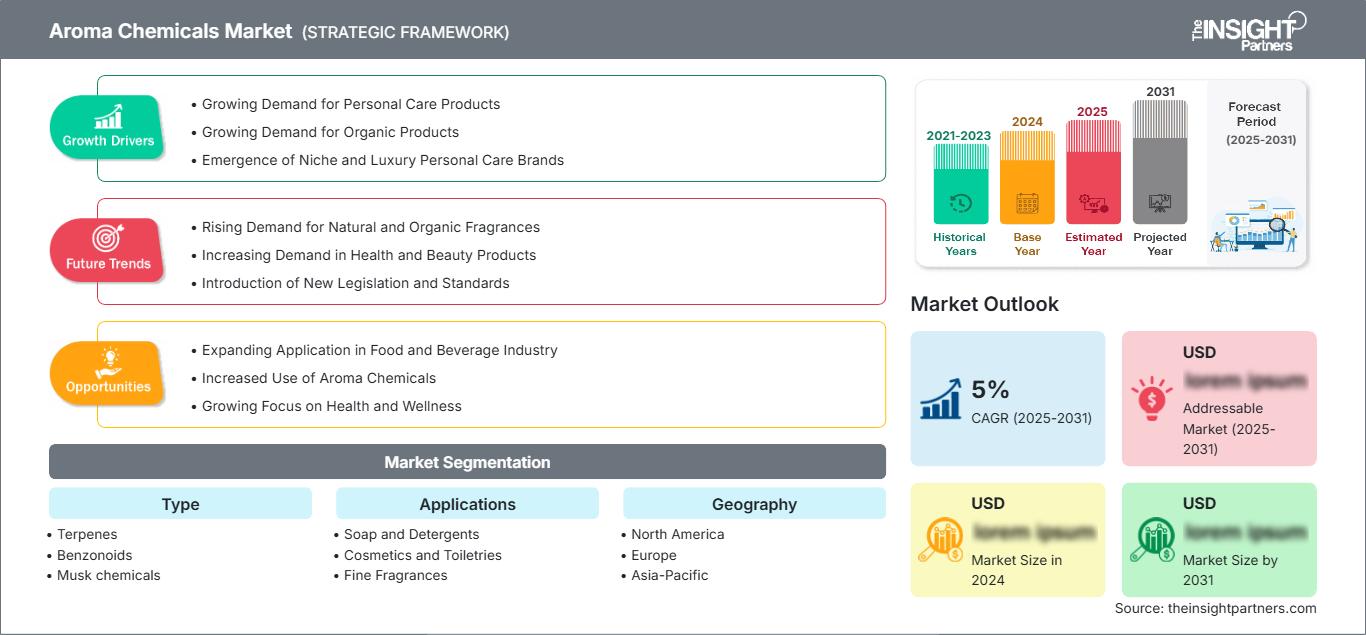
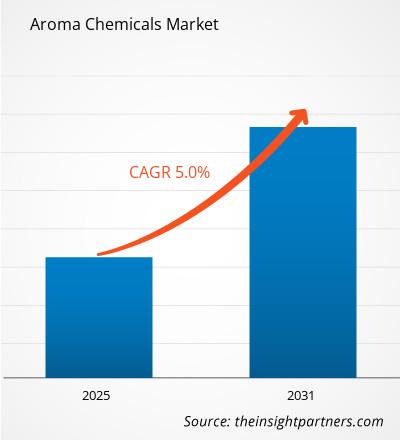
The aroma chemicals market size was valued at US$ 6.77 Billion in 2025 and is projected to reach US$ 10.64 Billion by 2034, expanding at a CAGR of 5.16% during 2026–2034. Growth is supported by sustained consumption of fragrance ingredients across personal care, home care, fine fragrances, and food and beverage products, alongside continued investment in specialty molecules, natural-identical ingredients, and formulation technologies that improve performance, regulatory suitability, and sustainability.
North America remains an important demand center, with the aroma chemicals market share expected to expand at an estimated CAGR of 4.4–5.0% during 2026–2034. Premium personal care, household fragrance, and fine fragrance applications are supporting demand, while regulatory scrutiny of sensitizers and volatile ingredients is encouraging suppliers to develop safer molecules, renewable feedstocks, biodegradable ingredients, and more efficient fragrance delivery systems.
Aroma Chemicals Market Assessment and Insights
- North America: The region is estimated to account for a 23–27% share in 2025 and expand at a CAGR of 4.4–5.0% during 2026–2034, supported by premium personal care, home care, and fine fragrance consumption.
- US: The US represents approximately 18–21% of global demand in 2025 and is projected to grow at a CAGR of 4.3–4.9% through 2034, led by household and personal-care formulations.
- Europe: Europe holds an estimated 27–31% share in 2025 and is expected to grow at 4.0–4.6% CAGR through 2034. Germany, France, Italy, Spain, and the UK remain important fragrance manufacturing and consumption centers.
- Asia Pacific: Asia Pacific accounts for approximately 31–35% share in 2025 and is expected to register 5.8–6.5% CAGR through 2034, with China, India, Japan, South Korea, and Southeast Asian markets driving consumption.
- Largest Segment: Terpenes represent an estimated 35–39% market share in 2025 and are expected to expand at a 4.8–5.4% CAGR through 2034, supported by broad fragrance and flavor applications.
- High Growth Segment: Cosmetics and Toiletries is estimated to hold 22–26% share in 2025 and grow at 5.7–6.4% CAGR through 2034, driven by premiumization and functional fragrance demand.
- Key companies analyzed in detail: BASF SE, dsm-firmenich AG, International Flavors & Fragrances Inc., Givaudan SA, Kao Corporation, Robertet SA, Solvay SA, Symrise AG, Takasago International Corporation, and MANE.
Source: The Insight Partners' analysis based on proprietary research, government publications, company annual reports, investor presentations, industry databases, and expert interviews.
Market players have moved away from volume-based product offerings to differentiated products that emphasize sensory performance, safety, sustainability, and regulation. In addition, companies are using petrochemistry, biotechnology, fermentation, extraction, and renewable raw materials. Supply chains are getting more integrated, with large fragrance players building applications laboratories and new ingredients that can help shorten formulation cycles and enhance their customer co-creation capabilities.
Over the forecast period, suppliers will be focused on the development of renewable carbon, biodegradable, natural origin, and controlled release ingredients. The emerging Asian market will receive investments in capacity as well as applications because of increasing consumption in the personal and home care segments. Europe regulations will keep on dictating the choice of molecules worldwide, whereas North America and Asia formulators are evaluating their ingredients based on lifecycle, safety, performance, and sourcing besides price.
Aroma Chemicals Market Report Scope
| Report Attribute | Details |
|---|---|
| Market size in 2025 | US$ 6.77 Billion |
| Market Size by 2034 | US$ 10.64 Billion |
| Global CAGR (2026 - 2034) | 5.16% |
| Historical Data | 2021-2024 |
| Forecast period | 2026-2034 |
Aroma Chemicals Market Analysis
The aroma chemicals market growth is linked to rising consumption of fragranced consumer products and the increasing complexity of formulations. The value chain begins with petrochemical, bio-based, or agricultural feedstocks, followed by chemical synthesis, fermentation, extraction, purification, quality testing, and formulation. Fragrance houses then blend individual molecules into finished compositions for manufacturers of soaps, detergents, cosmetics, toiletries, household products, fine fragrances, and selected food applications.
There are significant differences in the dynamics of supplies for different molecules. Being commodity-type products, terpenes and musks are more vulnerable to the volatility of feedstock and energy prices, while specialty molecules have better opportunities to be priced higher due to special olfactory characteristics, regulatory profile, and high performance in applications. Hence, manufacturers have to be flexible and combine large-volume production with small-scale specialty production campaigns. Vertical integration, long-term contracts with suppliers, regional storage, and multi-location manufacturing become key elements in order to minimize supply disruptions and raw materials volatility.
Aroma Chemicals Market Report identifies the competitive environment with integrated chemical companies, aroma ingredients specialists and diversified fragrance companies. Competition from BASF SE is provided by chemical manufacturing capacity and specialty aroma ingredients; competition from Givaudan SA, DSM-Firmenich AG, and International Flavors & Fragrances Inc. – by integration of ingredients with formulating and application developing. Symrise AG and Takasago International Corporation are also positioned with respect to integrated fragrance development and ingredient portfolios.
Investment strategies are focused now on differentiating molecules, naturals, biotechnology, and sustainability. The position of Robertet SA is based on natural ingredients, Kao Corporation operates in chemicals and consumer segments, Solvay SA has specialty chemical background, and MANE combines integrated fragrances and naturals. Competitiveness of the players is increasingly built on regulatory competence, intellectual property rights, feedstock security, application developments, and commercialization of new molecules.
● REPORT CUSTOMIZATION
Tailor This Report To Align With Your Specific Business Requirements
This report can be customized to align precisely with your business objectives, scope, and target markets. Customization options include tailored segmentation, geography, competitive analysis, and strategic insights to support informed decision-making.
Customize This Report →WHAT YOU CAN ADJUST
- ● Segmentations
- ● Geography
- ● Competitive Analysis
- ● Language Preferences
Aroma Chemicals Market: Strategic Insights
Regional Insights
North America aroma chemicals market
North America is estimated to represent 23–27% of the aroma chemicals market in 2025 and is projected to grow at a 4.4–5.0% CAGR through 2034. The US dominates regional consumption because of its large personal-care, home-care, cleaning-product, and fragrance industries. Canada contributes through cosmetics, household products, and specialty ingredient distribution. Demand is increasingly influenced by consumer preference for longer-lasting and differentiated fragrances.
The regional supply chain consists of global ingredient producers, perfumeries, distributors, and formulators. The need for regulatory reform due to fragrance allergies, ingredient disclosure, and environmental impact encourages reformulations towards safe and sustainable chemical compounds. Premiumization also facilitates higher-quality ingredients in cosmetics and luxury fragrances. Mexico represents another production facility for consumer goods targeting North America. Thus, regional growth will continue at a consistent pace through product innovation, not through volume growth.
U.S. aroma chemicals Market
The US represents approximately 75–79% of North America's aroma chemicals market in 2025 and is projected to expand at a 4.3–4.9% CAGR through 2034. The market benefits from extensive consumption of laundry products, personal care, deodorants, cosmetics, air fresheners, and premium fragrances. Large fragrance and chemical companies maintain technical, commercial, and application-development capabilities across the country.
Applications are evolving into those involving high-performance materials which will have the capability of imparting persistence, masking of odors, sensory distinction, and stability in formulations. Fragrances in household items are critical due to the widespread application of fragrances in conveying freshness and cleanness. Cosmetic and toiletry formulations are increasingly becoming more demanding of molecules which will be compatible with the sensitive skin positioning of the products.
Europe aroma chemicals Market
Europe accounts for an estimated 27–31% share of the aroma chemicals market in 2025 and is expected to grow at a 4.0–4.6% CAGR through 2034. France is the leading regional fragrance center, supported by Grasse, while Germany, the UK, Italy, and Spain provide substantial chemical, formulation, cosmetics, and consumer-product demand.
There is continued demand for personal care products, home care products, and fine fragrances within the UK; allergens and sustainability are now being assessed by more suppliers. Germany has great capabilities with respect to chemicals and formulation. France continues to be critical when it comes to fine fragrances and innovation in natural ingredients. Meanwhile, Italy and Spain are key for cosmetics/personal care products/fragrance manufacture. European legislation is very influential strategically, driving better molecules, ingredient assessment, renewable feedstocks, and biodegradables.
APAC aroma chemicals Market
APAC is estimated to hold 31–35% of the aroma chemicals market in 2025 and is projected to expand at a 5.8–6.5% CAGR through 2034. China is dominant in terms of regional consumption and production of fragrances, trailed by Japan, India, South Korea, and Australia. Increased personal-care usage, coupled with growth of fragrance brands domestically, drives the demand.
China and India offer the best volume opportunity due to a large population of consumers, coupled with the growth of cosmetics industries. Japan and South Korea concentrate on offering premium fragrances with advanced performance sensory features, while Australia focuses on specialty personal-care and natural-product offerings. The regional manufacturers are developing their local formulation abilities and sourcing options. Industrialization, cosmetics production, urbanization, and higher consumer spending are expected to drive aroma ingredients demand.
Middle East & Africa aroma chemicals Market
The Middle East and Africa represents a smaller but expanding demand base, supported by Saudi Arabia, the UAE, South Africa, and other regional markets. The region is expected to register approximately 4.8–5.5% CAGR through 2034, with the UAE and Saudi Arabia leading premium fragrance consumption and commercial development.
The availability of energy will help the chemical business economics in certain markets in the Gulf region, whereas investment in infrastructure and retail developments increase the availability of personal care and household products. The fragrances culture in Saudi Arabia opens doors for fragrances components and perfume compositions and long-lasting fragrances. The UAE is a vital country in terms of distribution and luxury fragrances. South Africa is still a major regional market for personal care and household products.
Segmentation Analysis
Type
The aroma chemicals market scope by type encompasses Terpenes, Benzonoids, Musk chemicals, and Others. Type-level demand is influenced by olfactive performance, raw-material availability, regulatory status, production economics, and application compatibility. Terpenes remain the largest category because of their broad use, while specialty molecules gain importance where formulators require distinctive sensory profiles, improved stability, or specific regulatory characteristics. The type segment is expected to grow at a 4.5–5.6% CAGR during 2026–2034.
- Terpenes: Terpenes maintain broad adoption across fragrance and flavor formulations because they provide citrus, woody, floral, and fresh olfactive effects. Their strategic importance also supports development of renewable and bio-based alternatives.
- Benzonoids: Benzonoids serve as important building blocks for floral, balsamic, vanilla, and sweet fragrance profiles. Demand is supported by their formulation versatility across personal care, fine fragrance, and household applications.
- Musk chemicals: Musk chemicals provide persistence, diffusion, and substantive character in fragrance formulations. Synthetic musks remain strategically important because consistent performance and controlled odor profiles are difficult to replicate across many product categories.
Applications
Applications include Soap and Detergents, Cosmetics and Toiletries, Fine Fragrances, Household Products, Food and Beverage, and Others. Application demand depends on fragrance intensity, product format, consumer preferences, regulatory constraints, and performance requirements. Cosmetics and toiletries are expected to remain among the fastest-expanding applications, while soaps and detergents provide substantial recurring consumption. The applications segment is expected to grow at a 5.0–5.8% CAGR during 2026–2034.
- Soap and Detergents: Fragrance ingredients are used to create freshness and cleanliness cues in laundry and cleansing products. Demand increasingly favors ingredients that withstand washing, storage, and repeated exposure while maintaining recognizable scent profiles.
- Cosmetics and Toiletries: Cosmetics and toiletries require differentiated sensory profiles across skincare, haircare, deodorants, and bathing products. Premiumization and product innovation encourage demand for specialty molecules with safety and performance advantages.
- Fine Fragrances: Fine fragrances require complex combinations of top, middle, and base notes, increasing the need for high-purity specialty molecules. Ingredient innovation supports longer-lasting, distinctive, and increasingly personalized fragrance compositions.
- Household Products: Air fresheners, surface cleaners, dishwashing products, and other household formats use aroma ingredients to mask undesirable odors and communicate freshness. Controlled-release and malodor-management technologies are becoming increasingly relevant.
- Food and Beverage: Aroma ingredients contribute to flavor and sensory formulation in selected food and beverage applications. Regulatory requirements, purity specifications, and permitted-use frameworks strongly influence ingredient selection and commercialization.
Opportunity Snapshot
| Application | Revenue Contribution | Trend Tag | Adoption Stage |
|---|---|---|---|
| Soap and Detergents | High | Freshness Performance | Mature |
| Cosmetics and Toiletries | High | Premium Scent | Scaling |
| Fine Fragrances | Medium | Luxury Fragrance | Scaling |
| Household Products | Medium | Odor Control | Scaling |
| Food and Beverage | Medium | Natural Profiles | Mature |
| Others | Low | Specialty Uses | Emerging |
Aroma Chemicals Market Growth Drivers and Impact Analysis
Rising consumption of fragranced personal-care products
Increasing penetration of cosmetics, toiletries, deodorants, shampoos, skincare, and bath products expands the addressable base for aroma ingredients. Consumers increasingly use fragrance as a product-selection attribute, encouraging manufacturers to differentiate products through recognizable, premium, and longer-lasting scent profiles. The effect is particularly significant in emerging markets where rising disposable incomes support broader adoption of personal-care products. Manufacturers are responding by introducing localized fragrance concepts and premium variants rather than relying solely on mass-market formulations. This shifts purchasing toward specialty aroma molecules capable of delivering specific sensory characteristics at controlled concentrations. Ingredient suppliers benefit because higher formulation complexity increases the number of molecules and intermediates required per finished fragrance system, supporting both volume consumption and value growth across specialty aroma chemical portfolios.
Expansion of premium and functional household fragrance applications
Household products increasingly use fragrance not only to mask chemical or cleaning odors but also to create sensory differentiation. Laundry detergents, fabric conditioners, dishwashing products, surface cleaners, air fresheners, and home-care concentrates increasingly incorporate persistent fragrance systems. This development raises demand for molecules capable of surviving challenging formulation environments, washing processes, and storage conditions. Functional fragrance technologies can command greater value because suppliers must demonstrate measurable performance rather than simply provide an odor profile. The resulting shift encourages investment in high-performance aroma molecules, encapsulation-compatible ingredients, and malodor-management systems. Suppliers that can combine olfactive performance with stability, regulatory compliance, and cost efficiency are better positioned to secure long-term formulation programs with multinational consumer-product manufacturers.
Regulatory pressure accelerating safer and sustainable molecule development
Regulatory scrutiny of fragrance ingredients is increasing the importance of toxicological assessment, allergen management, biodegradability, renewable carbon content, and environmental persistence. Rather than treating compliance as a downstream formulation issue, producers are increasingly incorporating safety and environmental screening into molecule development. This approach can shorten commercialization risks by identifying unsuitable candidates before large-scale investment. Sustainable chemistry is also becoming commercially relevant as consumer-product companies establish environmental targets across their supply chains. Consequently, aroma chemical manufacturers are evaluating fermentation, biotechnology, renewable feedstocks, improved catalytic routes, and lower-energy processes. The impact extends beyond individual products because successful molecules can become platform ingredients across multiple fragrance applications, creating opportunities for suppliers to replace legacy materials while maintaining acceptable sensory performance and manufacturing economics.
Aroma Chemicals Market Future Trends
AI-assisted molecule discovery and fragrance formulation
The aroma chemicals market trends are increasingly shaped by artificial intelligence, computational chemistry, sensory databases, and digital formulation tools. Over the coming years, suppliers are likely to use AI to screen molecular structures, predict odor characteristics, identify regulatory risks, and optimize formulations before laboratory synthesis. This can reduce the number of experimental iterations required during ingredient development. AI may also help perfumers identify alternatives for restricted or discontinued molecules by mapping sensory similarities and formulation compatibility. Integration with consumer data could enable fragrance houses to design region-specific profiles more efficiently. The strongest commercial impact is likely to emerge where digital discovery is combined with laboratory validation, because aroma performance remains dependent on concentration, interactions, matrix effects, stability, and human sensory evaluation rather than molecular prediction alone.
Biotechnology expands renewable aroma ingredient portfolios
Biotechnology is expected to move from a niche sourcing route toward a broader platform for producing selected aroma molecules and natural-identical ingredients. Fermentation can provide access to molecules whose conventional production depends on petroleum-derived intermediates, seasonal crops, or geographically concentrated agricultural resources. Advances in metabolic engineering may improve yields and reduce the number of processing steps required. Commercial adoption will depend on achieving competitive economics, reliable feedstock availability, regulatory acceptance, and consistent sensory quality. Suppliers with fermentation expertise can also use biotechnology to create differentiated molecules that are difficult to manufacture economically through conventional synthesis. Over time, this approach should broaden the range of renewable ingredients available to perfumers and formulators while strengthening supply resilience for selected high-value aroma materials.
Aroma Chemicals Market Opportunities
Investment in renewable and biodegradable fragrance molecules
The aroma chemicals market Forecasts indicate an opportunity for manufacturers to allocate capital toward molecules that combine strong olfactive performance with renewable carbon, biodegradability, and favorable toxicological profiles. Such investments can address simultaneous requirements from regulators, consumer-product companies, and fragrance formulators. Priority areas include citrus alternatives, floral molecules, musk substitutes, and specialty ingredients produced through fermentation or renewable feedstocks. Commercial success will require more than sustainability claims because formulators must maintain sensory quality, stability, dosage efficiency, and cost competitiveness. Suppliers can improve returns by designing platform molecules that serve several applications instead of products limited to one fragrance category. Partnerships with biotechnology firms, feedstock producers, universities, and downstream fragrance houses can further reduce development risk and accelerate scale-up.
Localized production and application centers in emerging markets
Emerging markets provide opportunities for suppliers to establish regional application laboratories, technical centers, and selected manufacturing capacity close to growing customer bases. Localized infrastructure can reduce formulation-development timelines and allow fragrance houses to adapt aroma profiles to regional consumer preferences. India, China, Southeast Asia, and the Middle East are particularly relevant because cosmetics, personal care, household products, and fine fragrances are developing at different rates across these markets. Regional technical centers can also improve supply resilience by reducing dependence on distant inventories. Investment strategies should prioritize capabilities that combine analytical testing, sensory evaluation, formulation support, regulatory expertise, and customer co-creation. This model can create deeper customer relationships while improving the commercial conversion of newly developed aroma ingredients.
Recent Developments
- June 24, 2026: BASF SE launched Micadelva, a citrus fragrance ingredient developed as a non-allergenic alternative to orange terpenes. The product contains 80% renewable carbon and is readily biodegradable. BASF also introduced a Safe-by-Design concept intended to support fragrance ingredient development amid changing regulatory requirements.
- May 28, 2026: International Flavors & Fragrances Inc. inaugurated the Domaine des Naturels LMR experimental field in Grasse, France. The facility supports research and development of natural ingredients for perfumery, cosmetics, and flavors, strengthening capabilities in agricultural research, natural ingredient development, and end-to-end stewardship.
Frequently Asked Questions

- Comprehensive Market Sizing and Forecast Analysis
- Detailed Segmentation Analysis
- In-Depth Market Dynamics Assessment
- Regional and Country-Level Insights
- Competitive Landscape and Company Benchmarking
- Strategic Business Intelligence
Recent Reports
Testimonials

The Insight Partners' SCADA System Market report is comprehensive, with valuable insights on current trends and future forecasts. The team was highly professional, responsive, and supportive throughout. We are very satisfied and highly recommend their services.
RAN KEDEM Partner, Reali Technologies LTDs
I requested a report on a very specific software market and the team produced the report in a few days. The information was very relevant and well presented. I then requested some changes and additions to the report. The team was again very responsive and I got the final report in less than a week.
JEAN-HERVE JENN Chairman, Future Analytica
We worked with The Insight Partners for an important market study and forecast. They gave us clear insights into opportunities and risks, which helped shape our plans. Their research was easy to use and based on solid data. It helped us make smart, confident decisions. We highly recommend them.
PIYUSH NAGPAL Sr. Vice President, High Beam Global
The Insight Partners delivered insightful, well-structured market research with strong domain expertise. Their team was professional and responsive throughout. The user-friendly website made accessing industry reports seamless. We highly recommend them for reliable, high-quality research services
YUKIHIKO ADACHI CEO, Deep Blue, LLC.
This is the first time I have purchased a market report from The Insight Partners.While I was unsure at first, I visited their web site and felt more comfortable to take the risk and purchase a market report.I am completely satisfied with the quality of the report and customer service. I had several questions and comments with the initial report, but after a couple of dialogs over email with their analyst I believe I have a report that I can use as input to our strategic planning process.Thank you so much for taking the extra time and making this a positive experience.I will definitely recommend your service to others and you will be my first call when we need further market data.
JOHN SUZUKI President and Chief Executive Officer, Board Director, BK Technologies
I wish to appreciate your support and the professionalism you displayed in the course of attending to my request for information regarding to infectious disease IVD market in Nigeria. I appreciate your patience, your guidance, and the fact that you were willing to offer a discount, which eventually made it possible for us to close a deal. I look forward to engaging The Insight Partners in the future, all thanks to the impression you have created in me as a result of this first encounter.
DR CHIJIOKE ONYIA MANAGING DIRECTOR, PineCrest Healthcare Ltd.Reason to Buy
- Informed Decision-Making
- Understanding Market Dynamics
- Competitive Analysis
- Identifying Emerging Markets
- Customer Insights
- Market Forecasts
- Risk Mitigation
- Boosting Operational Efficiency
- Strategic Planning
- Investment Justification
- Tracking Industry Innovations
- Aligning with Regulatory Trends





 Get Free Sample for