
Articulating Paper Forceps Market Trends, Share & Demand by 2034
Coverage: By Type (Straight Articulating Paper Forceps, Curved Articulating Paper Forceps); End Type (Single Ended, Double Ended); End User (Hospitals, Specialty Dental Clinics, Others) , and Geography (North America, Europe, Asia Pacific, and South and Central America)
- Status : Data Released
- Report Code : TIPRE00008168
- Category : Chemicals and Materials
- No. of Pages : 150
- Available Report Formats :


- Last update date : September 01, 2026


2025 Market Size
US$ 135.83 Mn
Base year value
2034 Forecast
US$ 191.98 Mn
Projected by 2034
CAGR 2026-2034
3.92 %
Growth rate
Addressable Market
US$ 1,488.92 Mn
(2026-2034)
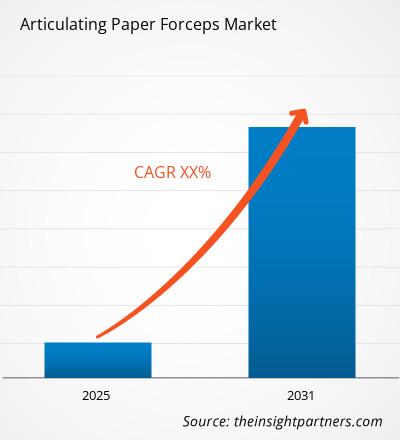
The articulating paper forceps market is positioned within the broader dental hand-instrument ecosystem, supporting occlusal assessment during restorative, prosthodontic, orthodontic, and implant-related procedures. The market is valued at US$ 135.83 Million in 2025 and is projected to reach US$ 191.98 Million by 2034, expanding at a 3.92% CAGR from 2026 to 2034. Demand is shaped by recurring instrument replacement, procedural standardization, and increasing emphasis on precise occlusal adjustment.
North America remains a structurally important market, supported by established dental infrastructure, high utilization of restorative procedures, and replacement demand for reusable stainless-steel instruments. The articulating paper forceps market size in the region is expected to expand at an estimated 4.2–4.7% CAGR between 2026 and 2034, with specialty dental clinics increasingly influencing procurement through clinician-led instrument preferences and standardized treatment protocols.
Articulating Paper Forceps Market Assessment and Insights
- North America: North America represented an estimated 35–39% articulating paper forceps market share in 2025 and is projected to grow at a 4.2–4.7% CAGR between 2026–2034, supported by established dental practices, instrument replacement cycles, and demand for precision occlusal procedures.
- US: The US accounted for approximately 78–82% of North America's 2025 market and is expected to expand at a 4.1–4.6% CAGR between 2026–2034, supported by specialty dentistry and organized procurement.
- Europe: Europe held approximately 28–32% share in 2025 and is projected to grow at a 3.5–4.0% CAGR between 2026–2034, with Germany, the UK, France, Italy, and Spain providing established demand.
- Asia Pacific: Asia Pacific represented approximately 22–26% share in 2025 and is expected to grow at a 4.5–5.0% CAGR between 2026–2034, led by China, Japan, India, and South Korea as dental infrastructure expands.
- Largest Segment: Straight Articulating Paper Forceps represented an estimated 58–62% market share in 2025 and is expected to grow at a 3.7–4.0% CAGR between 2026–2034, reflecting broad procedural applicability.
- High Growth Segment: Specialty Dental Clinics represented approximately 39–43% share in 2025 and is projected to grow at a 4.5–5.0% CAGR between 2026–2034, supported by specialist restorative and prosthodontic workflows.
- Key companies analyzed in detail: Johnson & Johnson; Hu-Friedy Mfg. Co., LLC; Premier Dental Products Company; Darby Dental Supply, LLC; ProDentUSA; Henry Schein, Inc.; Integra LifeSciences Corporation; New Surgical Instruments Co.; Maxill, Inc.; Smile Surgical Ireland Limited; Peter Brasseler Holdings, LLC; Dr. Jean Bausch GmbH & Co. KG; Sklar Surgical Instruments.
Source: The Insight Partners' analysis based on proprietary research, government publications, company annual reports, investor presentations, industry databases, and expert interviews.
The articulating paper forceps market size growth has occurred through small increments rather than by revolutionary innovation. Properties such as stainless steel construction, teeth or grooves in the working ends, ergonomics, autoclavability, and better grip continue to be important attributes of products within this market. Differentiation between instruments is increasingly achieved through tip design, balance, finish, and adaptability to use with thin articulating films and papers.
Going forward, articulating paper forceps market growth is expected to take place through the exploitation of emerging dental markets, especially India, China, Southeast Asia, and some countries in Latin America where new private dental clinics are opening and dental laboratories are becoming better incorporated into clinical practice. Infection control, quality management, ergonomic requirements, and procurement will become increasingly relevant criteria for choosing instruments.
Articulating Paper Forceps Market Report Scope
| Report Attribute | Details |
|---|---|
| Market size in 2025 | US$ 135.83 Million |
| Market Size by 2034 | US$ 191.98 Million |
| Global CAGR (2026 - 2034) | 3.92% |
| Historical Data | 2021-2024 |
| Forecast period | 2026-2034 |
Articulating Paper Forceps Market Analysis
The articulating paper forceps market forecast indicates that growth in demand is highly associated with restorative dentistry, prosthodontics, crown and bridge work, implants supported restoration, and occlusal adjustments. Therefore, the growth of this market will be directly related to the number of procedures where controlled application of the occlusal marking materials is required. The supply chain ranges from producers of stainless steel, forgings for precision instruments to instrument manufacturers, sterilizers, distributors, dental distributors, clinics, and hospitals.
The competitive dynamics within the articulating paper forceps market are quite fragmented since the technology behind the production is rather mature, and the goods could be manufactured in various precision instruments clusters. Competitive dynamics in the industry include competition in such criteria as material, tolerances, finish, handle design, tip design, sterilization capabilities, and distribution capabilities. Moreover, there is a constant need for replacement purchase of goods.
The competitive environment consists of global dental companies, specialized instrument makers, and dental distributors with private label offerings. Johnson & Johnson and Integra LifeSciences Corporation offer exposure to medical devices, while Hu-Friedy Mfg. Co., LLC and Peter Brasseler Holdings, LLC have greater exposure to dental instruments. Dr. Jean Bausch GmbH & Co. KG is important for occlusal evaluations due to its product range consisting of articulating material and related instruments.
Competitive positioning is now driven by the breadth of offerings, not just forceps. Henry Schein, Inc. takes advantage of its scale in distribution, whereas Premier Dental Products Company, Darby Dental Supply, LLC, ProDentUSA, Maxill, Inc., and Sklar Surgical Instruments compete through dental and surgical product offerings. The areas of investment include production consistency, offering more items in the catalog, online ordering, training of clinicians, and working with distributors.
● REPORT CUSTOMIZATION
Tailor This Report To Align With Your Specific Business Requirements
This report can be customized to align precisely with your business objectives, scope, and target markets. Customization options include tailored segmentation, geography, competitive analysis, and strategic insights to support informed decision-making.
Customize This Report →WHAT YOU CAN ADJUST
- ● Segmentations
- ● Geography
- ● Competitive Analysis
- ● Language Preferences
Articulating Paper Forceps Market: Strategic Insights
Regional Insights
North America articulating paper forceps market
North America accounted for an estimated 35–39% articulating paper forceps market in 2025, with regional growth projected at 4.2–4.7% CAGR through 2034. US leads the region in terms of demand owing to high number of installations of dental practices, higher restorative procedures, and distribution network. Contribution from Canada comes in through private dental practices, specialists, and institutions.
The region enjoys the advantage of already existing protocols for infections and regular change of reusable hand pieces. Practices that deal with prosthodontics, restorative dentistry, and implantology contribute significantly and relatively steady demand for accessories used in occlusion analysis. Purchase by distributors is an important factor, even if bigger dental practices prefer standardization of their products.
U.S. articulating paper forceps Market
The US represented approximately 78–82% of North America's 2025 demand and is projected to grow at a 4.1–4.6% CAGR through 2034. Demand is distributed across general dental offices, specialty practices, hospitals, dental schools, and dental service organizations. Hu-Friedy Mfg. Co., LLC, Henry Schein, Inc., Peter Brasseler Holdings, LLC, and other established suppliers maintain significant distribution exposure.
Applications requiring use are the highest in cases where clinicians regularly assess occlusal contact after restorative treatment. Applications that require regular use include prosthodontics, implant prosthetics, crown adjustments, and complicated restorative work. Purchasing by dental service organizations may be additionally influenced through standardization of instrument specifications in affiliated clinics. The factors now considered in product choice include ergonomics, autoclavability, corrosion resistance, tip design, and thin articulating film compatibility, along with cost considerations.
Europe articulating paper forceps Market
Europe represented approximately 28–32% share in 2025 and is expected to grow at a 3.5–4.0% CAGR through 2034. Germany leads due to the presence of dental instruments manufacturing skills and a sound restorative and prosthodontic foundation. The United Kingdom also sustains its demand through private practices and specialty centers.
Germany’s market receives a boost from the presence of dental instrument skills as well as laboratory-clinic connections. France, Italy, and Spain contribute more demand through private dentistry and specialist treatment centers. In Europe, reusable surgical instruments made of stainless steel retain significance since clinics consider sterilization and durability when making their purchases. Traceability and documentation of medical devices affect procurement, while manufacturers with good distribution networks can cater to fragmented national dental markets.
APAC articulating paper forceps Market
APAC held an estimated 22–26% share in 2025 and is projected to grow at a 4.5–5.0% CAGR through 2034. The largest market comes from China followed by Japan, South Korea, India, and Australia. Expansion in private dental facility construction, urbanization, dental training, and specialist care contributes to growing instrument demand.
China and India offer the best prospects for growth due to rising numbers of clinics and access to dental services. The maturity of specialist market with greater importance for precision instruments is seen in Japan and South Korea. Australia gains from high dental standards and structured procurement processes. Growing instrument demand is fueled by domestic production, improved distribution channels, and organized clinical procedures.
Middle East & Africa articulating paper forceps Market
Middle East and Africa demand remains smaller but is expected to expand at approximately 3.0–3.5% CAGR through 2034. Saudi Arabia and the UAE are the leading demand generators in the region, due to healthcare investments, private dental clinics, and specialist care centers. South Africa is the key demand market in Africa, with the existing dental service providers.
The Gulf nations offer chances on the back of healthcare infrastructure and medical tourism, whereas South Africa gains on the back of established private dental clinics. Rest-of-MEA demand continues to be fragmented and price-sensitive. Important purchasing criteria include distributors, availability of instruments, and their longevity since clinics prefer to buy reusable instruments.
Segmentation Analysis
Type
The Type segment is projected to expand at approximately 3.8–4.1% CAGR from 2026–2034. Product selection depends primarily on clinical access, operator preference, and the geometry of the occlusal area being assessed. Straight designs offer broad applicability, while curved designs support access around posterior and difficult-to-reach surfaces.
- Straight Articulating Paper Forceps: These instruments maintain broad adoption because their simple geometry supports routine placement and removal of articulating paper. Their familiar handling characteristics make them suitable for general restorative procedures.
- Curved Articulating Paper Forceps: Curved configurations support access to posterior areas and anatomically constrained locations. Their geometry can improve maneuverability during occlusal assessment where a straight instrument offers limited working access.
End Type
The End Type segment is expected to grow at approximately 3.6–4.0% CAGR from 2026–2034. Configuration influences how clinicians manipulate marking material and position it over occlusal surfaces. Selection is generally driven by procedural preference, accessibility, and desired handling characteristics.
- Single Ended: Single-ended instruments provide straightforward handling and are widely suited to routine occlusal marking. Their uncomplicated construction can support easy sterilization, storage, and replacement within standard dental instrument sets.
- Double Ended: Double-ended instruments provide two working configurations within one instrument, potentially improving tray efficiency. They can be useful for practices seeking multiple functional geometries without maintaining separate instruments for every procedure.
End User
The End User segment is projected to expand at approximately 4.0–4.4% CAGR from 2026–2034. Demand is supported by recurring occlusal assessment procedures, instrument replacement, and greater specialization within dental care. Specialty clinics are positioned for stronger growth because restorative and prosthodontic procedures require frequent precision assessment.
- Hospitals: Hospitals purchase instruments through structured procurement systems and require products compatible with sterilization and infection-control protocols. Demand is supported by dental departments, oral surgery services, and multidisciplinary restorative care.
- Specialty Dental Clinics: Specialty clinics generate recurring demand through prosthodontic, restorative, implant, and orthodontic procedures. Clinician preference for precise handling and ergonomic instrumentation can influence product selection and replacement patterns.
Opportunity Snapshot
| End User | Revenue Contribution (High/Medium/Low) | Trend Tag | Adoption Stage |
|---|---|---|---|
| Hospitals | Medium | Institutional Procurement | Mature |
| Specialty Dental Clinics | High | Specialist Restorations | Scaling |
Articulating Paper Forceps Market Growth Drivers and Impact Analysis
Expansion of restorative and prosthodontic procedures
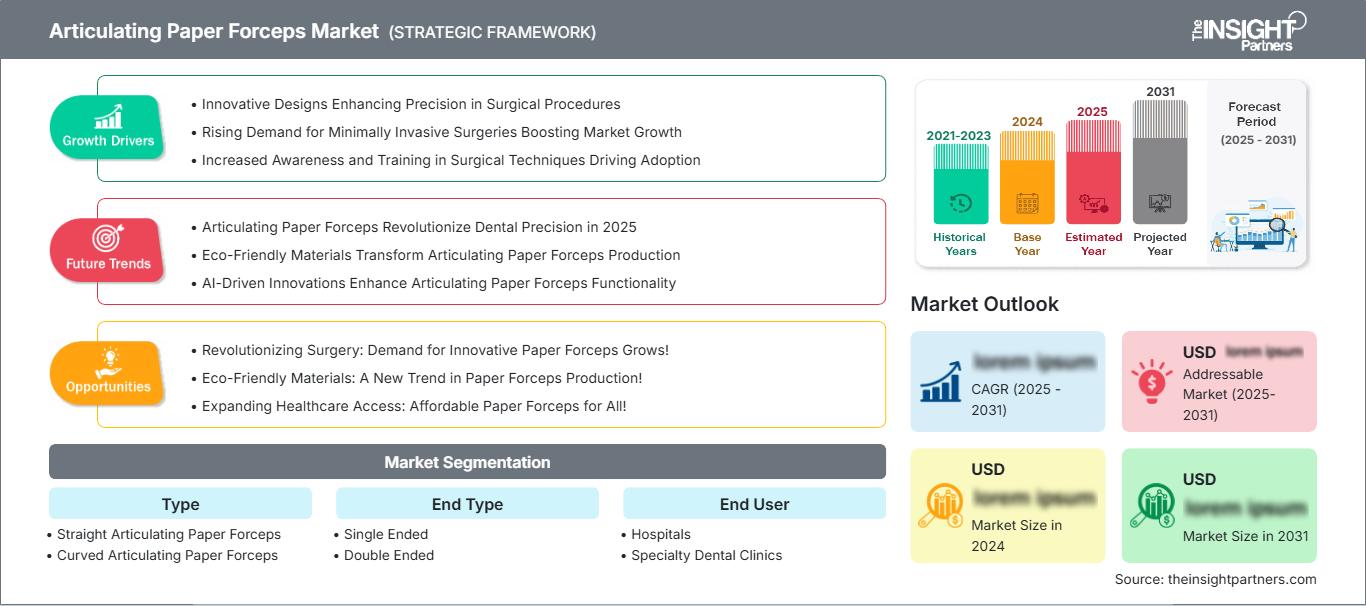
Growth in restorative and prosthodontic dentistry directly supports demand for instruments used to position articulating materials during occlusal adjustment. It is essential for clinicians to detect early contact areas and ensure that there is proper occlusion during crown restorations, bridges, implants, veneers, and complicated fillings. As restorative procedures become more and more standardized, dental practices will need reliable tools that can be sterilized repeatedly and easily fit into existing dental trays. Market opportunities are significant in specialty clinics because occlusal verification becomes an integral part of the completion of the procedure. Forceps manufacturers can take advantage of this procedural dependency by designing forceps in different geometries along with articulating papers/films.
Increasing emphasis on infection control and instrument reprocessing
Dentists are becoming more interested in the verification of their cleaning, sterilization, storing, and managing techniques. Stainless steel forceps that are reusable are attractive options in cases where there is a central reprocessing process since such instruments can withstand several reprocessing cycles as long as they are well-maintained. The above consideration will make manufacturers focus on making these devices resistant to corrosion, surface treatment, joint design, and compatibility with current sterilization methods. The business implications are more than just sales because most clinicians are taking into account the entire lifecycle of an instrument when deciding what to buy. Those which can retain their functionality even after many cycles are more preferred among professionals, especially in hospitals and clinics.
Growth of organized dental practices and specialist clinic networks
The expansion of organized dental practices and specialty clinic networks is changing procurement behavior. Independent dentists often select instruments individually, whereas larger groups increasingly standardize preferred brands, specifications, and purchasing channels across multiple locations. This creates opportunities for manufacturers and distributors that can provide consistent product quality, reliable inventory, and centralized ordering. The effect is particularly relevant for articulating instruments because practices can standardize straight and curved configurations across restorative workflows. Group purchasing also increases the importance of distributor coverage, private-label options, and product documentation. Suppliers that demonstrate dependable delivery and consistent manufacturing tolerances can gain repeat orders even in a mature product category. Over time, procurement consolidation may reduce fragmented purchasing while increasing the importance of framework agreements and multi-location supply relationships.
Articulating Paper Forceps Market Future Trends
Integration of occlusal assessment with digital workflows
The articulating paper forceps market trends show that dental dentistry will increasingly complement, rather than immediately replace, conventional articulating materials and hand instruments. Intraoral scanning, digital bite analysis, CAD/CAM restoration, and computerized occlusal assessment are becoming more interconnected, creating hybrid workflows in which physical marking remains useful for clinical confirmation. Suppliers are likely to position forceps as components of broader occlusal assessment systems rather than isolated instruments. Future product development may emphasize compatibility with thinner films, specialized papers, and procedures requiring precise positioning around digitally manufactured restorations. Manufacturers could also use digital education platforms to demonstrate correct handling and workflow integration. This trend should favor companies with broad dental portfolios because they can connect manual instruments with digital diagnostics, restorative materials, and clinical education, creating more comprehensive procurement propositions.
Ergonomic specialization of reusable hand instruments
Instrument ergonomics will become a stronger differentiation factor as dentists perform increasingly specialized procedures and seek to minimize hand fatigue. Forceps manufacturers can refine handle dimensions, surface textures, spring characteristics, tip alignment, and working angles without fundamentally changing the instrument's core function. Curved designs may receive additional attention for posterior access, while straight models can be optimized for rapid routine manipulation. Customization by clinician preference could also become more common through expanded product ranges rather than individualized manufacturing. Over the forecast period, manufacturers with established precision-forging and finishing capabilities are likely to compete through incremental ergonomic improvements, durability, and consistency. Product education will remain important because the benefits of ergonomic design are closely tied to handling technique and clinical procedure.
Articulating Paper Forceps Market Opportunities
Premium instruments for specialist restorative workflows
Specialty dental clinics offer an opportunity to develop higher-value instruments designed specifically for restorative, prosthodontic, and implant workflows. Suppliers can differentiate through refined tip geometries, balanced handles, corrosion-resistant materials, and compatibility with thin articulating films. Instead of competing solely on unit price, manufacturers can position premium instruments around precision, durability, and lifecycle performance. Bundled kits containing complementary occlusal assessment instruments could further increase average transaction values. Specialist education and clinician demonstrations can support adoption because purchasing decisions in these settings are strongly influenced by workflow efficiency and user experience. Expansion into specialist clinics in Asia Pacific and the Middle East could be particularly attractive where private dentistry is developing rapidly. Partnerships with distributors and dental education organizations can improve market access without requiring extensive direct sales infrastructure.
Localized manufacturing and distribution in emerging markets
Emerging dental markets provide opportunities for manufacturers to combine localized production with stronger distribution coverage. India, China, Southeast Asia, and selected Middle Eastern markets contain expanding private clinic networks where price sensitivity remains significant but demand for standardized stainless-steel instruments is increasing. Localized sourcing can reduce lead times, lower logistics costs, and support region-specific packaging or catalog requirements. Companies can also establish distributor partnerships with dental dealers that already serve laboratories, clinics, and hospitals. Product portfolios should maintain internationally recognized quality characteristics while offering different price tiers for independent practices and organized clinic groups. A dual-channel strategy combining premium imported instruments with competitively priced locally manufactured products could broaden market coverage. This approach can improve accessibility while preserving opportunities for premiumization as clinic sophistication increases.
Recent Developments
- April 22, 2026: HuFriedyGroup announced a partnership with Seattle Study Club focused on advancing dental education and clinical excellence. The collaboration is relevant to the dental hand-instrument market because professional education and clinician training can influence instrument selection, procedural standardization, and adoption of new instrumentation across restorative and specialty practices.
- February 4, 2026: PWR Air introduced at Chicago Midwinter Meeting. HuFriedyGroup formally introduced PWR Air at the 2026 Chicago Midwinter Meeting, accompanied by hands-on demonstrations and a mobile air-polishing experience. The launch illustrates the company's strategy of combining physical dental instruments, procedural equipment, clinical education, and workflow-oriented solutions within a broader dental-care portfolio.
Frequently Asked Questions

- Comprehensive Market Sizing and Forecast Analysis
- Detailed Segmentation Analysis
- In-Depth Market Dynamics Assessment
- Regional and Country-Level Insights
- Competitive Landscape and Company Benchmarking
- Strategic Business Intelligence
Recent Reports
Testimonials

The Insight Partners' SCADA System Market report is comprehensive, with valuable insights on current trends and future forecasts. The team was highly professional, responsive, and supportive throughout. We are very satisfied and highly recommend their services.
RAN KEDEM Partner, Reali Technologies LTDs
I requested a report on a very specific software market and the team produced the report in a few days. The information was very relevant and well presented. I then requested some changes and additions to the report. The team was again very responsive and I got the final report in less than a week.
JEAN-HERVE JENN Chairman, Future Analytica
We worked with The Insight Partners for an important market study and forecast. They gave us clear insights into opportunities and risks, which helped shape our plans. Their research was easy to use and based on solid data. It helped us make smart, confident decisions. We highly recommend them.
PIYUSH NAGPAL Sr. Vice President, High Beam Global
The Insight Partners delivered insightful, well-structured market research with strong domain expertise. Their team was professional and responsive throughout. The user-friendly website made accessing industry reports seamless. We highly recommend them for reliable, high-quality research services
YUKIHIKO ADACHI CEO, Deep Blue, LLC.
This is the first time I have purchased a market report from The Insight Partners.While I was unsure at first, I visited their web site and felt more comfortable to take the risk and purchase a market report.I am completely satisfied with the quality of the report and customer service. I had several questions and comments with the initial report, but after a couple of dialogs over email with their analyst I believe I have a report that I can use as input to our strategic planning process.Thank you so much for taking the extra time and making this a positive experience.I will definitely recommend your service to others and you will be my first call when we need further market data.
JOHN SUZUKI President and Chief Executive Officer, Board Director, BK Technologies
I wish to appreciate your support and the professionalism you displayed in the course of attending to my request for information regarding to infectious disease IVD market in Nigeria. I appreciate your patience, your guidance, and the fact that you were willing to offer a discount, which eventually made it possible for us to close a deal. I look forward to engaging The Insight Partners in the future, all thanks to the impression you have created in me as a result of this first encounter.
DR CHIJIOKE ONYIA MANAGING DIRECTOR, PineCrest Healthcare Ltd.Reason to Buy
- Informed Decision-Making
- Understanding Market Dynamics
- Competitive Analysis
- Identifying Emerging Markets
- Customer Insights
- Market Forecasts
- Risk Mitigation
- Boosting Operational Efficiency
- Strategic Planning
- Investment Justification
- Tracking Industry Innovations
- Aligning with Regulatory Trends





 Get Free Sample for