
Asia Pacific Home Healthcare Market Analysis and Forecast by Size, Share, Growth, Trends 2031
Asia Pacific Home Healthcare Market Size and Forecast (2021–2031), Regional Share, Trend, and Growth Opportunity Analysis Report Coverage: By Services (Skilled Nursing Care, Physical Therapy, Rehabilitation Therapy, Speech Therapy, and Others), Type (Therapeutic, Diagnostic, and Mobility Assist), and Indication (Cancer, Respiratory Diseases, Mobility Disorders, Cardiovascular Disorders, Wound Care, Diabetes, and Other)
Historic Data: 2021-2023 | Base Year: 2024 | Forecast Period: 2025-2031- Status : Published
- Report Code : TIPRE00023452
- Category : Life Sciences
- No. of Pages : 144
- Available Report Formats :




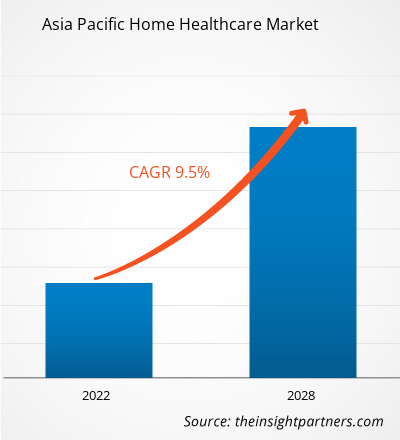
The Asia Pacific home healthcare market size is expected to reach US$ 1,26,380.08 million by 2031 from US$ 66,852.60 million in 2024. The market is estimated to record a CAGR of 9.5% from 2024 to 2031.
Executive Summary and Asia Pacific Home Healthcare Market Analysis:
The Asia Pacific Home Healthcare Market is growing rapidly due to several key factors. First, the increasing number of chronic disorders like diabetes, heart diseases, and respiratory issues has raised the demand for home healthcare services. Patients are looking for easy and affordable care options outside traditional hospitals. Second, the region has experienced a rise in product approvals for new medical devices and remote monitoring technologies. These products improve the quality and accessibility of home healthcare solutions. In addition, many local and international companies are entering and expanding in the market, which has intensified competition and sparked innovation, further fuelling market growth. Furthermore, several countries in the Asia Pacific region are investing significantly in their healthcare infrastructure. Both governments and private sectors are putting money into improving healthcare access and affordability. They are focusing on decentralized care models like home healthcare. These investments aim to meet the growing healthcare needs of aging populations and patients with chronic diseases. As a result, home healthcare is becoming an increasingly important part of the regional healthcare system in the coming years.
Customize This Report To Suit Your Requirement
Get FREE CUSTOMIZATIONAsia Pacific Home Healthcare Market: Strategic Insights

-
Get Top Key Market Trends of this report.This FREE sample will include data analysis, ranging from market trends to estimates and forecasts.
Asia Pacific Home Healthcare Market Segmentation Analysis:
Key segments that contributed to the derivation of the Asia Pacific home healthcare market analysis are services, type, and indication.
- By services, the Asia Pacific home healthcare market is segmented into skilled nursing care, physical therapy, rehabilitation therapy, speech therapy, and others. The skilled nursing care segment held the largest share of the market in 2024.
- By type, the Asia Pacific home healthcare market is segmented into therapeutic, diagnostic, and mobility assist. The therapeutic segment held the largest share of the market in 2024.
- By indication, the Asia Pacific home healthcare market is segmented into cancer, respiratory diseases, mobility disorders, cardiovascular disorders, wound care, diabetes, and other. The respiratory diseases segment held the largest share of the market in 2024.
Asia Pacific Home Healthcare Market Report Scope
| Report Attribute | Details |
|---|---|
| Market size in 2024 | US$ 66,852.60 Million |
| Market Size by 2031 | US$ 1,26,380.08 Million |
| CAGR (2024 - 2031) | 9.5% |
| Historical Data | 2021-2023 |
| Forecast period | 2025-2031 |
| Segments Covered |
By Services
|
| Regions and Countries Covered |
Asia Pacific
|
| Market leaders and key company profiles |
|
Asia Pacific Home Healthcare Market Players Density: Understanding Its Impact on Business Dynamics
The Asia Pacific Home Healthcare Market is growing rapidly, driven by increasing end-user demand due to factors such as evolving consumer preferences, technological advancements, and greater awareness of the product's benefits. As demand rises, businesses are expanding their offerings, innovating to meet consumer needs, and capitalizing on emerging trends, which further fuels market growth.
Asia Pacific Home Healthcare Market Outlook
With the global population aging, governments across the globe are acknowledging the significance of delivering comprehensive healthcare services to senior citizens, which include care within the home. This awareness is leading to various initiatives and programs focused on enhancing the quality of life for older adults and encouraging healthy aging. For instance, in India, grants are available for the establishment of houses that provide elderly individuals with food, lodging, healthcare, and entertainment options through the Scheme of Integrated Programme for Older Persons (IPSrC). Government initiatives, such as the "National Programme for the Health Care of the Elderly" (NPHCE) since 2010, prioritize the provision of primary, secondary, and tertiary healthcare facilities for people over 60. The scope of this program has been extended to geriatric primary and secondary care services, such as lab, physiotherapy, IPD, and OPD, across 713 health districts in India. Also, China has prioritized the development of home- and community-based care services (HCBS) under its 14th Five-Year Plan (2021-2025). The central government has launched pilot HCBS programs in various cities, providing subsidies and grants to localities for building home-care infrastructure, adapting housing for older people, and expanding the availability of home nursing and rehabilitative services. Additionally, the “Internet Plus Nursing Service” initiative allows hospitals and platforms to offer home visits for the elderly, post-surgical patients, and other groups in need, combining digital coordination with in-home care. Such initiatives benefit the well-being of seniors and increase the demand for home healthcare services.
Asia Pacific Home Healthcare Market Country Insights
Based on country, the Asia Pacific home healthcare market comprises Australia, China, India, Japan, South Korea, and the Rest of Asia Pacific. Japan held the largest share in 2024.
The Japanese home healthcare market — including medical devices, services, and other products for home use is expected to grow at a significant rate. Japan is one of the most rapidly aging countries. A report from the National Institute of Population and Social Security Research (IPSS) in April 2023 projected that by 2025, ~8 million baby boomers born between 1947 and 1949 will be over 75 years old in Japan, representing 17.5% of the total population. By 2040, approximately 35% of the population will be aged 65 or more. With the increasing aging population, the risk of chronic diseases is also increasing. For instance, as per the OECD (Organisation for Economic Co-operation and Development), CVDs are among the top contributors to the disease burden, accounting for over 20% of the total medical expenditure. Japan has one of the best insurances for home healthcare patients in Asia. There are 16 types of home healthcare services approved for reimbursement in National Health Insurance. The wide range of services included in coverage includes short and long-term nursing home stays, home renovation, home healthcare support services, purchase or rental of homecare equipment and rehabilitation support services. Japan's government programs are promoting the expansion of IT in healthcare through increased health record access and home healthcare quality, such as My Hospital Everywhere and Seamless Cooperation. The government has established a certification program for nurses to diagnose and treat basic illnesses by visiting patients' homes, hence reducing the costs of doctor visits.
Asia Pacific Home Healthcare Market Company Profiles
Some of the key players operating in the market include Enhabit Home Health & Hospice, Apollo HomeCare, Cura Mexico, Koninklijke Philips NV, LHC Group Inc, BAYADA Home Health Care, Mears Group Plc, Abbott Care, Amedisys Inc, Kindred Healthcare LLC, and CenterWell Home Healths, among others. These players are adopting various strategies such as expansion, product innovation, and mergers and acquisitions to provide innovative products to their consumers and increase their market share.
Asia Pacific Home Healthcare Market Research Methodology :
The following methodology has been followed for the collection and analysis of data presented in this report:
-
Secondary Research
The research process begins with comprehensive secondary research, utilizing both internal and external sources to gather qualitative and quantitative data for each market. Commonly referenced secondary research sources include, but are not limited to:
- Company websites, annual reports, financial statements, broker analyses, and investor presentations.
- Industry trade journals and other relevant publications.
- Government documents, statistical databases, and market reports.
- News articles, press releases, and webcasts specific to companies operating in the market.
Note: All financial data included in the Company Profiles section has been standardized to USD. For companies reporting in other currencies, figures have been converted to USD using the relevant exchange rates for the corresponding year.
-
Primary Research
The Insight Partners’ conducts a significant number of primary interviews each year with industry stakeholders and experts to validate its data analysis and gain valuable insights. These research interviews are designed to:
- Validate and refine findings from secondary research.
- Enhance the expertise and market understanding of the analysis team.
- Gain insights into market size, trends, growth patterns, competitive dynamics, and future prospects.
Primary research is conducted via email interactions and telephone interviews, encompassing various markets, categories, segments, and sub-segments across different regions. Participants typically include:
- Industry stakeholders: Vice Presidents, business development managers, market intelligence managers, and national sales managers
- External experts: Valuation specialists, research analysts, and key opinion leaders with industry-specific expertise

- Historical Analysis (2 Years), Base Year, Forecast (7 Years) with CAGR
- PEST and SWOT Analysis
- Market Size Value / Volume - Regional, Country
- Industry and Competitive Landscape
- Excel Dataset
Recent Reports
Testimonials

The Insight Partners' SCADA System Market report is comprehensive, with valuable insights on current trends and future forecasts. The team was highly professional, responsive, and supportive throughout. We are very satisfied and highly recommend their services.
RAN KEDEM Partner, Reali Technologies LTDs
I requested a report on a very specific software market and the team produced the report in a few days. The information was very relevant and well presented. I then requested some changes and additions to the report. The team was again very responsive and I got the final report in less than a week.
JEAN-HERVE JENN Chairman, Future Analytica
We worked with The Insight Partners for an important market study and forecast. They gave us clear insights into opportunities and risks, which helped shape our plans. Their research was easy to use and based on solid data. It helped us make smart, confident decisions. We highly recommend them.
PIYUSH NAGPAL Sr. Vice President, High Beam Global
The Insight Partners delivered insightful, well-structured market research with strong domain expertise. Their team was professional and responsive throughout. The user-friendly website made accessing industry reports seamless. We highly recommend them for reliable, high-quality research services
YUKIHIKO ADACHI CEO, Deep Blue, LLC.
This is the first time I have purchased a market report from The Insight Partners.While I was unsure at first, I visited their web site and felt more comfortable to take the risk and purchase a market report.I am completely satisfied with the quality of the report and customer service. I had several questions and comments with the initial report, but after a couple of dialogs over email with their analyst I believe I have a report that I can use as input to our strategic planning process.Thank you so much for taking the extra time and making this a positive experience.I will definitely recommend your service to others and you will be my first call when we need further market data.
JOHN SUZUKI President and Chief Executive Officer, Board Director, BK Technologies
I wish to appreciate your support and the professionalism you displayed in the course of attending to my request for information regarding to infectious disease IVD market in Nigeria. I appreciate your patience, your guidance, and the fact that you were willing to offer a discount, which eventually made it possible for us to close a deal. I look forward to engaging The Insight Partners in the future, all thanks to the impression you have created in me as a result of this first encounter.
DR CHIJIOKE ONYIA MANAGING DIRECTOR, PineCrest Healthcare Ltd.Reason to Buy
- Informed Decision-Making
- Understanding Market Dynamics
- Competitive Analysis
- Identifying Emerging Markets
- Customer Insights
- Market Forecasts
- Risk Mitigation
- Boosting Operational Efficiency
- Strategic Planning
- Investment Justification
- Tracking Industry Innovations
- Aligning with Regulatory Trends
Unlock Exclusive Report Discounts
Enquire Now




 Get Free Sample For