
Asia Pacific Hospital at Home Market Analysis and Forecast by Size, Share, Growth, Trends 2034
Coverage: By Component (Equipment and Devices and Software and Services), Service Type (Acute Care at Home, Chronic Disease Management at Home, Post Acute or Transitional Care, Palliative Care and Hospice Care, and Rehabilitation Services), Delivery Mode (Remote Monitoring and Telehealth, In-person Home Visits, and Hybrid Models), Patient Demographic (Adult Patients and Pediatric Patients), Indication (Cardiovascular Conditions, Respiratory Diseases, Orthopedic and Post-Surgical Recovery, Infectious Diseases, Neurological Rehabilitation, and Others), and Care Provider (Hospitals and Health Systems, Home Health Agencies, Primary Care or Physician Groups, and Private HaH Providers)
- Status : Published
- Report Code : TIPRE00043601
- Category : Life Sciences
- No. of Pages : 208
- Available Report Formats :


- Last update date : June 25, 2026


2025 Market Size
US$ 8,253.7 Mn
Base year value
2034 Forecast
US$ 16,825.9 Mn
Projected by 2034
CAGR 2026-2034
8.3 %
Growth rate
Addressable Market
US$ 113,030.98 Mn
(2026-2034)
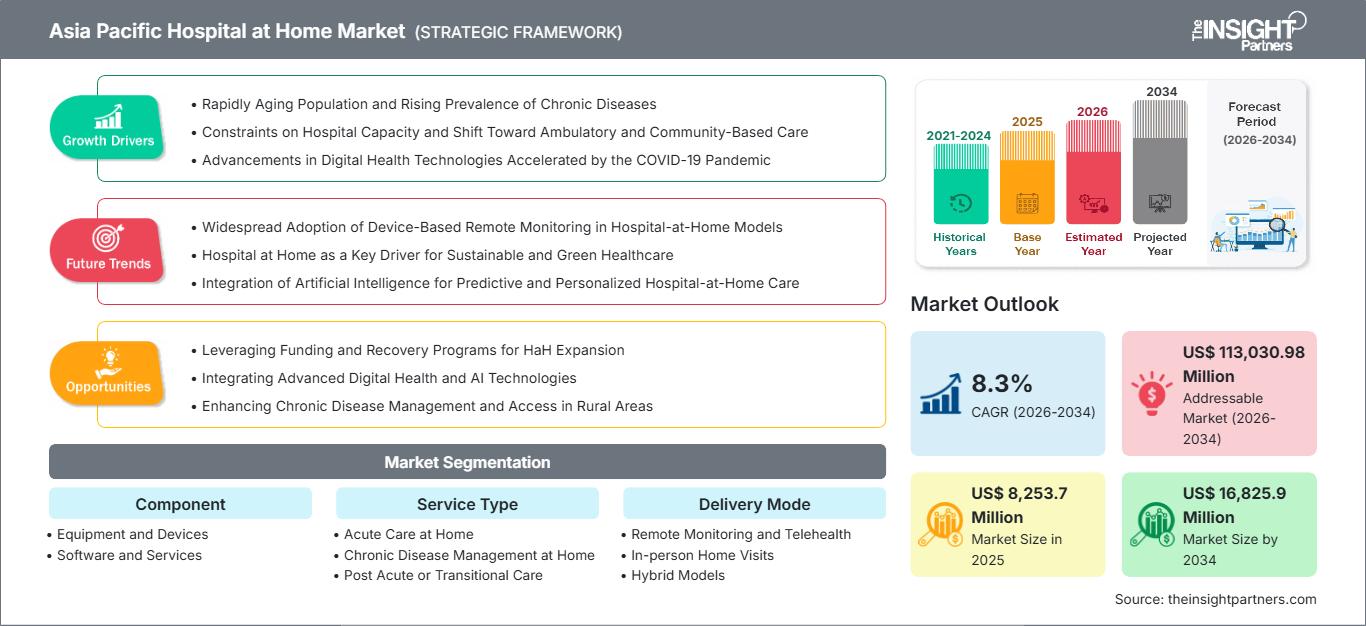
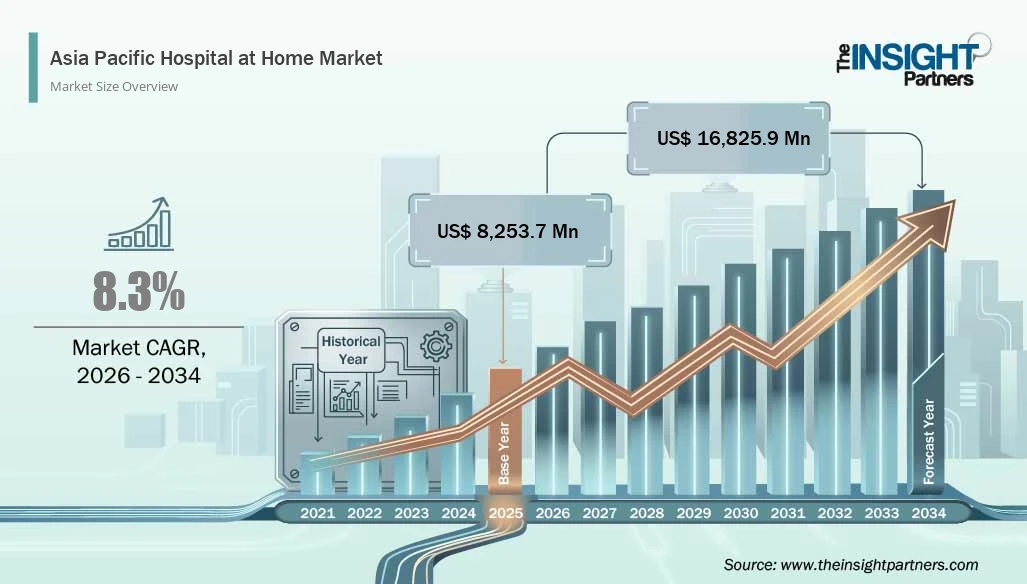
The Asia Pacific Hospital at Home Market size is expected to reach US$ 16,825.9 Million by 2034 from US$ 8,253.7 Million in 2025. The market is estimated to record a CAGR of 8.3% from 2026 to 2034.
Executive Summary and Asia Pacific Hospital at Home Market Analysis:
The Asia Pacific hospital at home market is segmented into China, Japan, India, Australia, South Korea, Rest of Asia Pacific. Hospital at Home (HaH) models-often referred to as Hospital in the Home (HITH), virtual wards, or virtual hospitals-are gaining traction amid rapid aging demographics, urban-rural healthcare disparities, and digital health advancements. However, adoption remains more fragmented and is still emerging compared to that in developed economies. Australia leads with established state-funded HITH programs-such as in New South Wales and Victoria-where services deliver acute care (e.g., for infections, respiratory conditions) at home using multidisciplinary teams, remote monitoring, and telehealth. Queensland's virtual COVID-19 HITH service scaled to over 3,240 admissions, reducing readmission risks through virtual technology.
Victoria launched a six-month virtual hospital pilot in 2025 to support over 250 patients, easing ward pressures. In other countries such as Singapore and Japan, pilots integrate RPM and AI for chronic-acute transitions, while India and China explore community-based models to address hospital overloads. Benefits include cost-effectiveness, lower infection risks, and improved access in remote areas, with evidence from Australian reviews showing reduced hospital stays and better outcomes. Adoption is accelerating due to high smartphone penetration enabling telehealth, government initiatives for aging populations (e.g., Japan's community care focus), and post-pandemic emphasis on decentralized care. Overall, Asia Pacific shows strong growth potential through digital shifts and preventive care integration.
● REPORT CUSTOMIZATION
Tailor This Report To Align With Your Specific Business Requirements
This report can be customized to align precisely with your business objectives, scope, and target markets. Customization options include tailored segmentation, geography, competitive analysis, and strategic insights to support informed decision-making.
Customize This Report →WHAT YOU CAN ADJUST
- ● Segmentations
- ● Geography
- ● Competitive Analysis
- ● Language Preferences
Asia Pacific Hospital at Home Market: Strategic Insights
-
Get Top Key Market Trends of this report.This FREE sample will include data analysis, ranging from market trends to estimates and forecasts.
Asia Pacific Hospital at Home Market Segmentation Analysis:
- By Component, the Asia Pacific Hospital at Home Market is segmented into Equipment and Devices and Software and Services. The Software and Services segment dominated the market in 2025.
- By Service Type, the Asia Pacific Hospital at Home Market is segmented into Acute Care at Home, Chronic Disease Management at Home, Post Acute or Transitional Care, Palliative Care and Hospice Care, and Rehabilitation Services. The Palliative Care and Hospice Care segment dominated the market in 2025.
- By Delivery Mode, the Asia Pacific Hospital at Home Market is segmented into Remote Monitoring and Telehealth, In-person Home Visits, and Hybrid Models. The Remote Monitoring and Telehealth segment dominated the market in 2025.
- By Patient Demographic, the Asia Pacific Hospital at Home Market is segmented into Adult Patients and Pediatric Patients. The Adult Patients segment dominated the market in 2025.
- By Indication, the Asia Pacific Hospital at Home Market is segmented into Cardiovascular Conditions, Respiratory Diseases, Orthopedic and Post-Surgical Recovery, Infectious Diseases, Neurological Rehabilitation, and Others. The Neurological Rehabilitation segment dominated the market in 2025.
- By Care Provider, the Asia Pacific Hospital at Home Market is segmented into Hospitals and Health Systems, Home Health Agencies, Primary Care or Physician Groups, and Private HaH Providers. The Hospitals and Health Systems segment dominated the market in 2025.
Asia Pacific Hospital at Home Market Report Scope
| Report Attribute | Details |
|---|---|
| Market size in 2025 | US$ 8,253.7 Million |
| Market Size by 2034 | US$ 16,825.9 Million |
| CAGR (2026 - 2034) | 8.3% |
| Historical Data | 2021-2024 |
| Forecast period | 2026-2034 |
| Segments Covered |
By Component
|
| Regions and Countries Covered |
Asia Pacific
|
| Market leaders and key company profiles |
|
Asia Pacific Hospital at Home Market Players Density: Understanding Its Impact on Business Dynamics
The Asia Pacific Hospital at Home Market is growing rapidly, driven by increasing end-user demand due to factors such as evolving consumer preferences, technological advancements, and greater awareness of the product's benefits. As demand rises, businesses are expanding their offerings, innovating to meet consumer needs, and capitalizing on emerging trends, which further fuels market growth.
Asia Pacific Hospital at Home Market Outlook
The Hospital at Home (HaH) model-delivering acute inpatient-level care in patients' homes through remote monitoring, telehealth, in-home visits, and diagnostics-offers substantial opportunities for market expansion in 2026. This approach reduces costs by 20-30%, improves patient satisfaction and outcomes, lowers readmissions, and addresses hospital capacity issues, particularly for conditions such as heart failure, infections, and pneumonia. The Acute Hospital Care at Home (AHCaH) waiver program-launched by CMS in 2020-remains the cornerstone, reimbursing at inpatient Medicare rates and enabling over 400 hospitals across 39 states to participate.
Additional funding avenues support HaH expansion. The Rural Health Transformation Program allocates US$ 50 billion over five years (US$ 10 billion annually starting in 2026), with states receiving awards ranging from US$147 million to US$281 million in the first year. These funds aim to modernize rural care, including implementing innovative models such as HaH to improve access in underserved areas. The MAHA ELEVATE Model-launching in September 2026-offers US$ 100 million for cooperative agreements testing lifestyle interventions complementary to acute care, potentially integrable with HaH for chronic disease management. Providers should monitor Senate action on H.R. 4313, apply for rural funding through state plans, and prepare evidence-based proposals for MAHA opportunities to scale HaH sustainably while navigating potential Medicaid pressures.
Asia Pacific Hospital at Home Market Country Insights
By country, the Asia Pacific Hospital at Home Market is segmented into China, Japan, India, Australia, South Korea, and the Rest of APAC. China held the largest share in 2025.
In China, the Hospital at Home (HaH) model is advancing through technology-driven pilots that extend hospital-level care to patients' homes, particularly for chronic and subacute conditions amid an aging population and resource pressures. A prominent example is the Smart Home Ward (SHW) program at Guangdong Second Provincial General Hospital. This 5G-powered initiative leverages the Internet of Things (IoT), artificial intelligence (AI), and cloud computing for remote monitoring, telemedicine consultations, ward rounds, and rehabilitation. It supports early-supported discharge and admission avoidance for conditions such as cardiovascular diseases (e.g., heart failure, acute coronary syndrome), stroke, Parkinson's disease, and Alzheimer's, with interdisciplinary teams overseeing care via wearable sensors, smart devices (e.g., intelligent mattresses, watches for fall detection), and real-time data transmission to hospital systems.
Features include pretraining wards for patient education, personalized rehab (e.g., AR/VR cognitive therapy), and environmental adaptations for safety. Policy reforms have significantly increased institutions offering HaH services, increasing bed numbers and access. Benefits include improved treatment adherence, patient autonomy, reduced hospital burden, and equivalent care quality with fewer in-person visits, enhancing convenience for home recovery. These efforts demonstrate HaH's potential to integrate acute monitoring with home-based support, particularly for chronic management in urban settings.
Asia Pacific Hospital at Home Market Company Profiles
Some of the key players operating in the market include B Braun SE, Medtronic Plc, Air Liquide, Huma Therapeutics Limited, Doccla, LNA-Santé, Inhealthcare, Spirit Health Group Ltd, RIBERA SALUD, and Capio Sverige AB.
These players are adopting various strategies such as expansion, product innovation, and mergers and acquisitions to provide innovative products to their consumers and increase their market share.
Asia Pacific Hospital at Home Market Research Methodology
The following methodology has been followed for the collection and analysis of data presented in this report:
Secondary Research
The research process begins with comprehensive secondary research, utilizing internal and external sources to gather qualitative and quantitative data for each market. Commonly referenced secondary research sources include, but are not limited to:
- Company websites, annual reports, financial statements, broker analyses, and investor presentations
- Industry trade journals and other relevant publications
- Government documents, statistical databases, and market reports
- News articles, press releases, and webcasts specific to companies operating in the market
Note: All financial data included in the Company Profiles section has been standardized to US$. For companies reporting in other currencies, figures have been converted to US$ using the relevant exchange rates for the corresponding year.
Primary Research
The Insight Partners conducts a significant number of primary interviews each year with industry stakeholders and experts to validate its data analysis and gain valuable insights. These research interviews are designed to:
- Validate and refine findings from secondary research
- Enhance the expertise and market understanding of the analysis team
- Gain insights into market size, trends, growth patterns, competitive dynamics, and future prospects
Primary research is conducted via email interactions and telephone interviews, encompassing various markets, categories, segments, and sub-segments across different regions. Participants typically include:
- Industry stakeholders: Vice Presidents, Business Development Managers, Market Intelligence Managers, and National Sales Managers
- External experts: Valuation specialists, research analysts, and key opinion leaders with industry-specific expertise

- Comprehensive Market Sizing and Forecast Analysis
- Detailed Segmentation Analysis
- In-Depth Market Dynamics Assessment
- Regional and Country-Level Insights
- Competitive Landscape and Company Benchmarking
- Strategic Business Intelligence
Recent Reports
Testimonials

The Insight Partners' SCADA System Market report is comprehensive, with valuable insights on current trends and future forecasts. The team was highly professional, responsive, and supportive throughout. We are very satisfied and highly recommend their services.
RAN KEDEM Partner, Reali Technologies LTDs
I requested a report on a very specific software market and the team produced the report in a few days. The information was very relevant and well presented. I then requested some changes and additions to the report. The team was again very responsive and I got the final report in less than a week.
JEAN-HERVE JENN Chairman, Future Analytica
We worked with The Insight Partners for an important market study and forecast. They gave us clear insights into opportunities and risks, which helped shape our plans. Their research was easy to use and based on solid data. It helped us make smart, confident decisions. We highly recommend them.
PIYUSH NAGPAL Sr. Vice President, High Beam Global
The Insight Partners delivered insightful, well-structured market research with strong domain expertise. Their team was professional and responsive throughout. The user-friendly website made accessing industry reports seamless. We highly recommend them for reliable, high-quality research services
YUKIHIKO ADACHI CEO, Deep Blue, LLC.
This is the first time I have purchased a market report from The Insight Partners.While I was unsure at first, I visited their web site and felt more comfortable to take the risk and purchase a market report.I am completely satisfied with the quality of the report and customer service. I had several questions and comments with the initial report, but after a couple of dialogs over email with their analyst I believe I have a report that I can use as input to our strategic planning process.Thank you so much for taking the extra time and making this a positive experience.I will definitely recommend your service to others and you will be my first call when we need further market data.
JOHN SUZUKI President and Chief Executive Officer, Board Director, BK Technologies
I wish to appreciate your support and the professionalism you displayed in the course of attending to my request for information regarding to infectious disease IVD market in Nigeria. I appreciate your patience, your guidance, and the fact that you were willing to offer a discount, which eventually made it possible for us to close a deal. I look forward to engaging The Insight Partners in the future, all thanks to the impression you have created in me as a result of this first encounter.
DR CHIJIOKE ONYIA MANAGING DIRECTOR, PineCrest Healthcare Ltd.Reason to Buy
- Informed Decision-Making
- Understanding Market Dynamics
- Competitive Analysis
- Identifying Emerging Markets
- Customer Insights
- Market Forecasts
- Risk Mitigation
- Boosting Operational Efficiency
- Strategic Planning
- Investment Justification
- Tracking Industry Innovations
- Aligning with Regulatory Trends





 Get Free Sample for