
Asia Pacific Lubricants Market Trends, Share & Demand by 2034
Coverage: By Base Oil (Mineral Oil, Synthetic Oil, and Bio-based Oil), By Type (Hydraulic Fluids, Engine Oils, Driveline Lubricants, Metalworking Fluids, Grease, Process Oils, Coolants, Transformer Oils, and Others), and By End-use Industry (Automotive (Passenger Cars, Light Commercial Vehicles, Heavy Commercial Vehicles, and Others), Building and Construction, Power Generation, Mining and Metallurgy, Food Processing, Oil and Gas, Marine, Aviation, and Others)
- Status : Published
- Report Code : TIPRE00027232
- Category : Chemicals and Materials
- No. of Pages : 321
- Available Report Formats :


- Last update date : September 10, 2026


2025 Market Size
US$ 50.43 Bn
Base year value
2034 Forecast
US$ 81.24 Bn
Projected by 2034
CAGR 2026-2034
5.4 %
Growth rate
Addressable Market
US$ 595.84 Bn
(2026-2034)
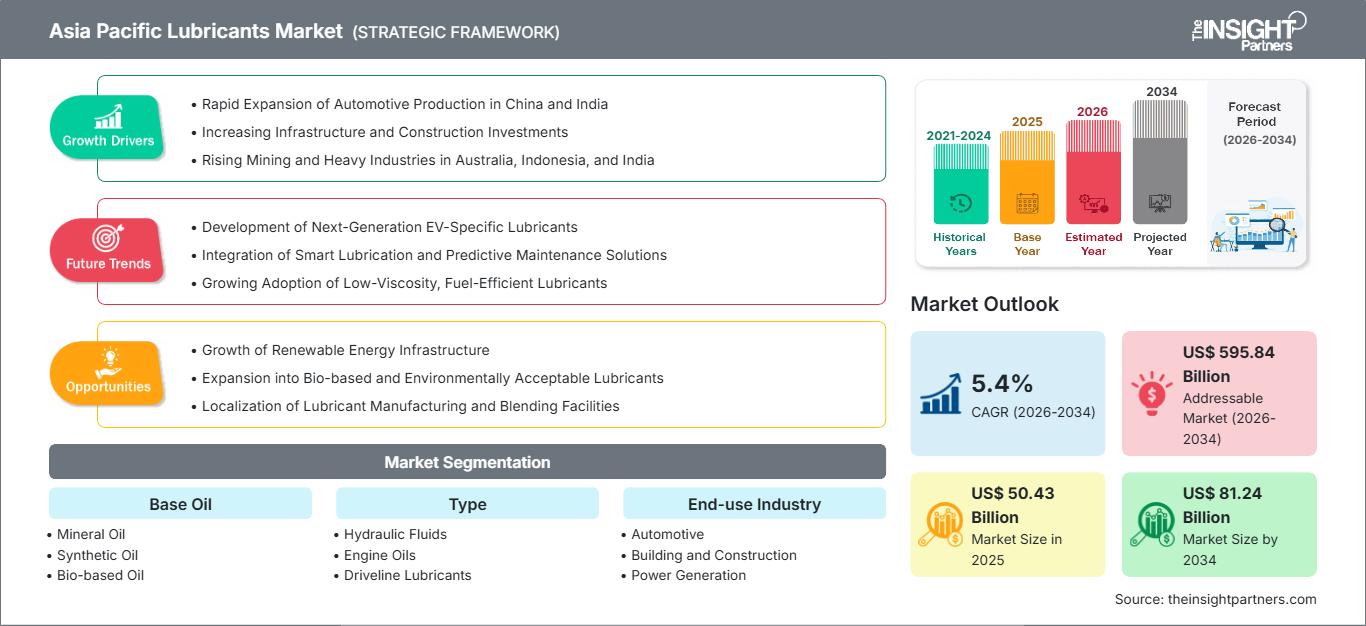
The Asia Pacific Lubricants market size was US$ 50.43 Billion in 2025 and is projected to reach US$ 81.24 Billion by 2034, registering a CAGR of 5.4% during 2026–2034. Expansion is supported by automotive production, vehicle parc growth, manufacturing activity, construction equipment, mining operations, power generation, marine transportation, and industrial machinery. Fuel-efficiency requirements, equipment reliability, longer service intervals, OEM specifications, and the transition toward application-specific lubricant formulations increasingly influence demand.
Rising industrialization and transportation activity are strengthening demand across China, India, Japan, South Korea, and Southeast Asia. The Asia Pacific Lubricants Market size is shaped by vehicle ownership, manufacturing investment, infrastructure development, equipment utilization, and energy-sector expansion. Premiumization is becoming increasingly important as customers seek lower friction, longer drain intervals, improved thermal stability, and reduced maintenance costs across automotive and industrial applications.
Asia Pacific Lubricants Market Assessment and Insights
- Asia Pacific: Asia Pacific accounted for a significant share of lubricant demand in 2025 and is projected to grow at a 5.4% CAGR, led by China, India, Japan, and South Korea.
- Largest Segment: Automotive represented an estimated 53.0% market share in 2025 and is projected to grow at a 5.5% CAGR during 2026–2034, maintaining its leading end-use position.
- High Growth Segment: Bio-based Oil represented approximately 7.6% of base-oil demand in 2025 and is projected to grow at a 6.0% CAGR through 2034, supported by rising demand for biodegradable lubricants, environmental compliance, and sustainable industrial applications.
- Key companies analyzed in detail: BP p.l.c., Chevron Corporation, ENEOS Holdings, Inc., Exxon Mobil Corporation, FUCHS SE, TotalEnergies SE, Idemitsu Kosan Co., Ltd., Shell plc, China Petroleum & Chemical Corporation, Hindustan Petroleum Corporation Limited, Hyrax Oil Sdn Bhd, Petron Corporation, PT Pertamina (Persero), S-OIL CORPORATION, and SK Enmove Co., Ltd.
Source: The Insight Partners' analysis based on proprietary research, government publications, company annual reports, investor presentations, industry databases, and expert interviews.
The evolution of Asia Pacific Lubricants reflects a transition from volume-oriented consumption toward higher-performance formulations. Automotive manufacturers increasingly specify lower-viscosity and longer-drain products, while industrial users emphasize wear protection, thermal stability, cleanliness, and energy efficiency. Production dynamics are also changing as refiners and lubricant manufacturers expand regional blending capabilities, improve supply-chain resilience, and develop formulations tailored to vehicle, machinery, mining, power, and manufacturing applications.
The forward outlook remains strongest across India, China, and Southeast Asia, where manufacturing, transportation, construction, energy infrastructure, and equipment utilization continue expanding. Electrification will alter the product mix rather than eliminate lubrication requirements, creating demand for thermal-management fluids, e-drive lubricants, specialty greases, and other advanced formulations. Investments in local manufacturing, OEM approvals, technical laboratories, and regional distribution networks are expected to strengthen competitive positioning through 2034.
Asia Pacific Lubricants Market Report Scope
| Report Attribute | Details |
|---|---|
| Market size in 2025 | US$ 50.43 Billion |
| Market Size by 2034 | US$ 81.24 Billion |
| CAGR (2026 - 2034) | 5.4% |
| Historical Data | 2021-2024 |
| Forecast period | 2026-2034 |
Asia Pacific Lubricants Market Analysis
Asia Pacific Lubricants Market growth is supported by expanding automotive fleets, industrial machinery, construction equipment, mining assets, manufacturing plants, and power infrastructure. The value chain includes base-oil production, additive manufacturing, formulation, blending, packaging, distribution, OEM channels, workshops, industrial distributors, and direct procurement. Integrated refiners benefit from supply security, while specialist formulators compete through product performance, technical expertise, and application-specific solutions. China, India, Japan, and South Korea offer significant production and blending capabilities, while Southeast Asia is increasingly serving as an important manufacturing and distribution hub. Supply conditions remain influenced by crude prices, base-oil availability, refinery utilization, additive costs, freight, and inventory levels. These factors make localized production increasingly important for suppliers serving large automotive and industrial customers.
The competitive landscape combines global integrated energy companies, national oil companies, specialist lubricant manufacturers, and regional suppliers. Shell plc, BP p.l.c., Exxon Mobil Corporation, Chevron Corporation, TotalEnergies SE, FUCHS SE, and Idemitsu Kosan Co., Ltd. compete through OEM approvals, technical services, premium formulations, and distribution reach. China Petroleum & Chemical Corporation, Hindustan Petroleum Corporation Limited, PT Pertamina (Persero), Petron Corporation, S-OIL CORPORATION, and SK Enmove Co., Ltd. strengthen regional positions through refining, base oils, blending, and domestic distribution. Investment is increasingly directed toward localized manufacturing and higher-value products. Exxon Mobil Corporation's India investment, for example, includes a lubricant plant designed for 159,000 kiloliters of finished lubricants annually, supporting automotive and industrial applications.
The Asia Pacific Lubricants Market analysis indicates that competitive differentiation increasingly depends on formulation technology, OEM qualification, supply reliability, and technical support. Premium synthetic products allow suppliers to address applications where extended drain intervals, fuel efficiency, oxidation stability, and equipment protection justify higher prices. Industrial customers are increasingly evaluating lubricant suppliers based on total maintenance economics rather than purchase price alone. This favors companies capable of providing condition-monitoring support, product optimization, inventory management, and application engineering.
Investment strategies are also shifting toward electrification-related fluids and specialized industrial applications. SK Enmove is developing thermal management solutions for electric-vehicle batteries, while established lubricant producers are expanding their portfolios to include e-drive fluids, battery cooling, dielectric fluids, and advanced greases. This creates a competitive pathway beyond conventional engine oils and industrial lubricants. Suppliers with established base-oil technology, additive relationships, formulation laboratories, and regional customer networks are positioned to adapt their portfolios as equipment architectures change.
● REPORT CUSTOMIZATION
Tailor This Report To Align With Your Specific Business Requirements
This report can be customized to align precisely with your business objectives, scope, and target markets. Customization options include tailored segmentation, geography, competitive analysis, and strategic insights to support informed decision-making.
Customize This Report →WHAT YOU CAN ADJUST
- ● Segmentations
- ● Geography
- ● Competitive Analysis
- ● Language Preferences
Asia Pacific Lubricants Market: Strategic Insights
Regional Insights
APAC Asia Pacific Lubricants Market
APAC accounted for a significant share of lubricant demand in 2025 and is projected to grow at a 5.4% CAGR through 2034. China remains the leading country, followed by India, Japan, South Korea, and Australia. Manufacturing, automotive production, construction, mining, power generation, and infrastructure development provide a broad foundation for demand.
China benefits from its extensive industrial and automotive base, while India is supported by manufacturing, infrastructure, and commercial mobility. Japan and South Korea emphasize advanced formulations and high-specification applications, while Australia benefits strongly from mining and heavy equipment. Regional industrial policy, infrastructure investment, vehicle production, and energy expansion continue to support lubricant requirements. Electrification is adding thermal-management and specialized fluid opportunities.
Segmentation Analysis
Base Oil
The Asia Pacific Lubricants Market scope across base oils reflects differences in viscosity requirements, thermal stability, oxidation resistance, operating conditions, environmental considerations, and formulation economics. Mineral oil remains important due to its availability and cost position, while synthetic and bio-based oils are gaining relevance in premium and environmentally sensitive applications.
- Mineral Oil: Mineral oil remains the principal volume foundation due to established refining infrastructure, broad availability, cost advantages, and extensive use in automotive servicing, industrial equipment, construction machinery, and general-purpose lubrication.
- Synthetic Oil: Synthetic oil is increasingly important in applications requiring lower viscosity, thermal stability, extended drain intervals, fuel efficiency, oxidation resistance, and compliance with demanding OEM performance specifications.
- Bio-based Oil: Bio-based oil is increasingly relevant where biodegradability, renewable sourcing, environmental sensitivity, spill-risk management, and sustainability considerations influence industrial lubricant procurement.
Type
Product types address distinct mechanical, thermal, electrical, and processing requirements across transportation and industry. Engine oils continue to see significant demand due to the installed vehicle fleet, while hydraulic fluids, greases, metalworking fluids, transformer oils, and coolants benefit from industrial modernization.
- Hydraulic Fluids: Hydraulic fluids support construction, mining, manufacturing, agriculture, and material-handling equipment where pressure control, wear protection, cleanliness, and contamination management influence machinery reliability.
- Engine Oils: Engine oils remain central to automotive maintenance, with requirements shaped by vehicle parc size, OEM specifications, fuel efficiency, emissions requirements, and extended service intervals.
- Driveline Lubricants: Driveline lubricants support transmissions, axles, differentials, and gears, and their formulation requirements are evolving alongside hybrid and electric drivetrain architectures.
- Metalworking Fluids: Metalworking fluids support machining, cutting, forming, and grinding operations by controlling heat, friction, corrosion, surface quality, and tool wear.
- Grease: Grease supports bearings, joints, electric motors, industrial machinery, and heavy equipment where localized lubrication and resistance to pressure, water, and temperature are important.
- Process Oils: Process oils support rubber, plastics, chemicals, and manufacturing operations by influencing processing behavior, material characteristics, surface properties, and production consistency.
- Coolants: Coolants provide thermal management across engines, industrial machinery, batteries, and other systems where heat transfer, corrosion control, and material compatibility are important.
- Transformer Oils: Transformer oils provide electrical insulation and heat dissipation, with demand supported by grid expansion, renewable integration, and replacement of aging electrical equipment.
- Others: Other lubricant types serve specialized applications that require formulations tailored to specific equipment, operating environments, processing requirements, or performance characteristics.
End-use Industry
End-use industries determine lubricant requirements through equipment design, operating loads, service conditions, maintenance schedules, regulatory considerations, and performance specifications. Automotive remains the largest demand base, while construction, power generation, mining, food processing, oil and gas, marine, and aviation create specialized opportunities.
- Automotive: Automotive remains the principal end-use application, covering passenger and commercial vehicles, OEM factory fill, aftermarket servicing, driveline systems, greases, coolants, and emerging thermal-management requirements.
- Passenger Cars: Passenger cars generate recurring engine oil and driveline demand, while hybridization and electrification gradually change viscosity, thermal, and component-lubrication requirements.
- Light Commercial Vehicles: Light commercial vehicles require durable engine, driveline, and chassis components, as well as grease products, because intensive delivery schedules and high utilization increase maintenance requirements.
- Heavy Commercial Vehicles: Heavy commercial vehicles require high-performance engine oils, driveline lubricants, greases, and coolants because freight operations expose powertrains and components to sustained loads.
- Others: Other automotive applications require specialized lubricants across vehicle configurations and operating environments outside the principal passenger and commercial vehicle categories.
- Building and Construction: Construction equipment requires hydraulic fluids, engine oils, greases, and driveline products that can withstand dust, heavy loads, temperature fluctuations, and intermittent operating cycles.
- Power Generation: Power generation creates demand for turbine oils, transformer oils, hydraulic fluids, compressor products, and specialty lubricants across conventional and renewable assets.
- Mining and Metallurgy: Mining and metallurgy consume heavy-duty lubricants for haul trucks, crushers, mills, conveyors, hydraulic systems, drilling equipment, and high-load processing machinery.
- Food Processing: Food processing requires specialty lubricants designed around incidental-contact controls, contamination prevention, hygiene, corrosion protection, and reliable operation of processing equipment.
- Oil and Gas: Oil and gas operations require lubricants for compressors, pumps, turbines, drilling systems, valves, and processing equipment operating under demanding pressure and temperature conditions.
- Marine: Marine applications require engine oils, cylinder lubricants, greases, hydraulic fluids, and specialty products designed for corrosion resistance and long operating cycles.
- Aviation: Aviation requires highly controlled lubricant formulations for engines, turbines, bearings, landing systems, and auxiliary equipment, with stringent qualification and performance requirements.
- Others: Other end-use industries create specialized lubricant requirements across equipment and processes with distinct operating conditions and performance specifications.
Opportunity Snapshot
| End-use Industry | Revenue Contribution | Trend Tag | Adoption Stage |
| Automotive | High | Fleet Service | Mature |
| Passenger Cars | High | Hybrid Fluids | Scaling |
| Light Commercial Vehicles | Medium | Fleet Efficiency | Scaling |
| Heavy Commercial Vehicles | High | Long Drain | Scaling |
| Others | Low | Specialty Mobility | Emerging |
| Building and Construction | Medium | Hydraulic Efficiency | Scaling |
| Power Generation | Medium | Grid Reliability | Scaling |
| Mining and Metallurgy | Medium | Heavy Duty | Scaling |
| Food Processing | Low | Food Grade | Scaling |
| Oil and Gas | Medium | Asset Reliability | Mature |
| Marine | Medium | Low Emission | Scaling |
| Aviation | Low | Turbine Protection | Mature |
| Others | Low | Specialty Fluids | Emerging |
Asia Pacific Lubricants Market Growth Drivers and Impact Analysis
Increase the Manufacturing and Infrastructure Equipment Base
Industrialization in China, India, and Southeast Asia is increasing the number of machines that need regular greasing. Hydraulic fluids and greases, construction equipment and material handling, mining machines, steel plants, power plants, and metalworking fluids are all used in manufacturing plants. Roads, railways, ports, industrial parks, and energy projects are further bolstered by infrastructure investment, enhancing equipment utilization. The increased use of machines means a greater need for premium formulations to control wear, contamination, corrosion, and thermal stress. Customers are now assessing the performance of lubricants in terms of equipment uptime and maintenance economics. Suppliers can increase their periodic sales to industrial accounts by offering condition monitoring, technical, and application services. This means that lubricant performance is becoming a more quantifiable factor in efficient operations and asset reliability in the manufacturing and infrastructure economies of Asia.
Increasing Demand for Vehicle Manufacturing and Business Mobility
The automotive manufacturing ecosystem supports lubricant consumption via OEM factory fill, dealerships, workshops, vehicle fleet maintenance, and aftermarket channels in Asia. The demand for passenger cars, light commercial vehicles, and heavy trucks comes from China, India, Japan, South Korea, Thailand, and Indonesia. Commercial mobility is especially significant, as it involves greater use of the engine, transmission, axles, grease, and cooling system. Tighter efficiency specifications are driving down viscosity and the use of synthetic products. The electrification transition is changing the product mix rather than eliminating the need for lubrication; it is driving demand for thermal fluids, e-drive fluids, greases, and specialized fluids. Qualification, formulation testing, technical support, and application engineering are more critical when purchasing because manufacturers define the formulation to fit a particular vehicle architecture and OEM service requirements.
Expansion of Energy, Mining, and Electrical Infrastructure
The expansion of power generation, transmission networks, renewable installations, mining projects, and energy-processing facilities provides sustainable industrial lubrication needs. Products are designed to endure harsh conditions and long hours, such as those in turbines, transformers, compressors, pumps, conveyors, crushers, drilling rigs, and heavy transport vehicles. The International Energy Agency (IEA) stated that 80% of the world's electricity demand growth in 2025 is expected to come from emerging market and developing economies, with China accounting for 58% of the growth. This expansion is for the extra demand for industrial machinery, electrical equipment, and maintenance fluids. Dust, vibration, temperature, and load stress are among the most prominent industrial environmental factors in the mining industry, especially in Australia, Indonesia, India, and China. Other specialized lubricants, such as transformer oils, greases, hydraulic products, and electrical equipment-specific lubricants, can also be used in grid modernization.
Asia Pacific Lubricants Market Future Trends
Shift Toward Low-Viscosity and Energy-Efficient Formulations
Asia Pacific Lubricants Market trends are being shaped by the growing demand for low-viscosity lubricants that minimize friction without sacrificing wear protection, oxidation resistance, cleanliness, or component durability. OEMs are becoming more demanding in their efficiency requirements and are pushing for lubricants that will aid fuel savings and extend service life. Those in the industrial community are putting these rules into practice for hydraulic systems, compressors, gears, and other equipment that use energy, thereby impacting operating costs. These applications can be formulated with synthetic base oils and advanced additive systems. This trend is likely to be significant in China, Japan, South Korea, and India, where automotive and industrial manufacturers are increasingly specifying high performance. In the future, viscosity, additive chemistry, drain interval, equipment condition, and overall operating cost will likely be viewed as interconnected performance factors in procurement.
Expansion of Thermal Management Fluids Beyond Conventional Lubrication
Specialized thermal-management fluids are being used in new applications, such as electrification, battery storage, data centers, and high-density computing. These products require the ability to be electrically insulated, to have good heat transfer, to be compatible with the materials they come into contact with, to be low viscosity, and to perform satisfactorily under long operating cycles. Asia is poised to benefit from having battery makers, electronics manufacturers, auto makers, and data-center investment all within its grasp. The traditional lubricant suppliers have the base-oil expertise, additive knowledge, formulation expertise, and an industry customer base to address new applications. The demand is projected to extend beyond vehicle batteries to include immersion cooling for servers and energy-storage devices as well. Suppliers who have demonstrated their ability to supply the correct fluid for the given application and can do so using their own application engineering skills can become strategic partners in industrial fluid procurement and technology partnerships as thermal loads grow.
Asia Pacific Lubricants Market Opportunities
Localized Premium Lubricant Manufacturing in India and Southeast Asia
As India and Southeast Asia expand automotive manufacturing, industrial capacity, infrastructure, and commercial transportation, localized manufacturing is an attractive investment opportunity. Regional plants offer several significant advantages: reduced import exposure, faster replenishment times, greater inventory responsiveness, and better formulation suited to local operating conditions. High-end synthetic products, hydraulic fluids, greases, and specialty formulations can attract higher-value sales in markets where efficiency and equipment reliability are paramount. In the case of Exxon Mobil, the Maharashtra project will proceed in this localization trajectory, producing 159,000 kilolitres of finished lubricants per year. Flexible blending capacity, quality labs, OEM approval, additive handling, packaging, and regional distribution should be priorities for investment. This infrastructure can give suppliers greater control over supply continuity and enable quicker formulation changes for regional automotive and industrial customers.
Specialty Fluids for Electrification and Digital Infrastructure
Asia Pacific Lubricants Market Forecasts indicate that the market is expected to grow in thermal management, e-drive lubrication, battery cooling, dielectric fluids, specialized greases, and immersion cooling. The battery industry, electronics manufacturing, automotive and vehicle assembly, data centers, and industrial equipment are all located in Asia, creating a large market segment for special fluid technologies. Suppliers can consolidate their strength by cooperating with vehicle OEMs, battery manufacturers, data center operators, and equipment manufacturers. Investment should be directed to the development of high-purity formulations, the performance of the dielectric, thermal stability, contamination control, material compatibility, and regional-scale production. Applications possess a higher level of technical differentiation than traditional products due to the direct link between fluid performance and performance of temperature control, equipment efficiency, safety, operating reliability, and component longevity. The qualification abilities are, therefore, going to be a key competitive obstacle.
Recent Developments
- July 2026: Shell plc completed the sale of Jiffy Lube International and Premium Velocity Auto quick-lube operations to Monomoy Capital Partners, supporting its portfolio optimization strategy while maintaining focus on core energy and lubricants businesses.
- June 2026: Chevron progressed development of next-generation heavy-duty engine oils aligned with upcoming API PC-12 standards to support advanced diesel engines, stricter emission requirements, improved fuel efficiency, and equipment durability.
- May 2026: ENEOS Holdings Inc. acquired Chevron's downstream fuels and lubricants marketing businesses across Southeast Asia and Australia for US$2.17 billion, strengthening its regional fuels and lubricants presence.
Frequently Asked Questions

- Comprehensive Market Sizing and Forecast Analysis
- Detailed Segmentation Analysis
- In-Depth Market Dynamics Assessment
- Regional and Country-Level Insights
- Competitive Landscape and Company Benchmarking
- Strategic Business Intelligence
Recent Reports
Testimonials

The Insight Partners' SCADA System Market report is comprehensive, with valuable insights on current trends and future forecasts. The team was highly professional, responsive, and supportive throughout. We are very satisfied and highly recommend their services.
RAN KEDEM Partner, Reali Technologies LTDs
I requested a report on a very specific software market and the team produced the report in a few days. The information was very relevant and well presented. I then requested some changes and additions to the report. The team was again very responsive and I got the final report in less than a week.
JEAN-HERVE JENN Chairman, Future Analytica
We worked with The Insight Partners for an important market study and forecast. They gave us clear insights into opportunities and risks, which helped shape our plans. Their research was easy to use and based on solid data. It helped us make smart, confident decisions. We highly recommend them.
PIYUSH NAGPAL Sr. Vice President, High Beam Global
The Insight Partners delivered insightful, well-structured market research with strong domain expertise. Their team was professional and responsive throughout. The user-friendly website made accessing industry reports seamless. We highly recommend them for reliable, high-quality research services
YUKIHIKO ADACHI CEO, Deep Blue, LLC.
This is the first time I have purchased a market report from The Insight Partners.While I was unsure at first, I visited their web site and felt more comfortable to take the risk and purchase a market report.I am completely satisfied with the quality of the report and customer service. I had several questions and comments with the initial report, but after a couple of dialogs over email with their analyst I believe I have a report that I can use as input to our strategic planning process.Thank you so much for taking the extra time and making this a positive experience.I will definitely recommend your service to others and you will be my first call when we need further market data.
JOHN SUZUKI President and Chief Executive Officer, Board Director, BK Technologies
I wish to appreciate your support and the professionalism you displayed in the course of attending to my request for information regarding to infectious disease IVD market in Nigeria. I appreciate your patience, your guidance, and the fact that you were willing to offer a discount, which eventually made it possible for us to close a deal. I look forward to engaging The Insight Partners in the future, all thanks to the impression you have created in me as a result of this first encounter.
DR CHIJIOKE ONYIA MANAGING DIRECTOR, PineCrest Healthcare Ltd.Reason to Buy
- Informed Decision-Making
- Understanding Market Dynamics
- Competitive Analysis
- Identifying Emerging Markets
- Customer Insights
- Market Forecasts
- Risk Mitigation
- Boosting Operational Efficiency
- Strategic Planning
- Investment Justification
- Tracking Industry Innovations
- Aligning with Regulatory Trends





 Get Free Sample for