
Assembly Fastening Tool Market Size, Trends & Growth by 2034
Coverage: by Product (Corded, Cordless); Tool Type (Right-angle Tools, Inline Tools, Pistol Grip Tools, Others); End User (Aerospace and Defense, Heavy Equipment, Automotive, Semiconductors and Electronics, Healthcare, Others) , and Geography (North America, Europe, Asia Pacific, and South and Central America)
- Status : Data Released
- Report Code : TIPRE00011348
- Category : Electronics and Semiconductor
- No. of Pages : 150
- Available Report Formats :


- Last update date : July 17, 2026


2025 Market Size
US$ 9.93 Bn
Base year value
2034 Forecast
US$ 14.41 Bn
Projected by 2034
CAGR 2026-2034
4.23 %
Growth rate
Addressable Market
US$ 110.57 Bn
(2026-2034)
The Assembly Fastening Tool Market was valued at US$ 9.93 Billion in 2025 and is projected to reach US$ 14.41 Billion by 2034, registering a CAGR of 4.23% from 2026 to 2034. Demand is anchored in precision assembly, torque traceability, and production-line reliability across aerospace and defense, heavy equipment, automotive, semiconductors and electronics, and healthcare manufacturing environments.
North America remains a structurally important region, with an estimated 2026–2034 CAGR range of 3.8–4.3% supported by reshoring of critical manufacturing, aircraft build-rate recovery, and higher adoption of connected torque tools. The Assembly Fastening Tool Market size in the region is further influenced by automotive platform electrification, semiconductor packaging investments, and strict quality documentation requirements in regulated production.
Assembly Fastening Tool Market Assessment and Insights
- North America held a 30–33% share in 2025 and is expected to grow at a 3.8–4.3% CAGR between 2026–2034, supported by aerospace, defense, and automotive retooling programs.
- US accounted for 78–82% of North America in 2025 and is projected to expand at a 3.9–4.4% CAGR through 2034.
- Europe represented 24–27% share in 2025 and is forecast to grow at a 3.6–4.1% CAGR, led by Germany, the UK, France, Italy, and Spain.
- Asia Pacific captured 34–37% share in 2025 and is projected to advance at a 4.7–5.2% CAGR, led by China, Japan, South Korea, and India.
- Largest Segment: Cordless products held 55–58% Market share in 2025 and are expected to grow at a 4.5–5.0% CAGR through 2034.
- High Growth Segment: Healthcare end users held 6–8% share in 2025 and are forecast to expand at a 5.2–5.8% CAGR through 2034.
- Key companies analyzed in detail: Apex Tool Group, LLC; Atlas Copco AB; Estic Corporation; Koki Holdings Co., Ltd.; Hilti Corporation; Makita Corporation; Panasonic Holdings Corporation; Robert Bosch GmbH; Stanley Black & Decker, Inc.; Trane Technologies plc.
Source: The Insight Partners' analysis based on proprietary research, government publications, company annual reports, investor presentations, industry databases, and expert interviews.
Manufacturing plants are shifting their focus from traditional pneumatic fastening systems to electric, battery-operated, and computer-controlled systems due to the increasing complexity of manufactured products. This is evident in the assembly of car batteries, aircraft interiors, medical equipment, and electronic assemblies, where repeatability, ergonomics, and traceability help reduce warranty liability. The Assembly Fastening Tool Market is also benefiting from robotic cell systems, modular fastening stations, and controller-based torque history.
Future demand will depend on factory investments made in India, Mexico, Southeast Asia, and Eastern Europe, where localized manufacturing is generating new assembly capability. Government scrutiny over safety, quality, and device validation in aircraft increases the need for calibrated fastening solutions. Suppliers having software, services, battery technology, and application engineering skills can benefit from both replacement and greenfield demand.
Assembly Fastening Tool Market Report Scope
| Report Attribute | Details |
|---|---|
| Market size in 2025 | US$ 9.93 Billion |
| Market Size by 2034 | US$ 14.41 Billion |
| Global CAGR (2026 - 2034) | 4.23% |
| Historical Data | 2021-2024 |
| Forecast period | 2026-2034 |
Assembly Fastening Tool Market Analysis
The Assembly Fastening Tool Market growth depends on the presence of manufacturing plants, where precision fastening is critical to ensuring safety, warranty costs, and overall assembly-line efficiency. The rise in demand for electric vehicles is driving an increase in the number of fastening points for batteries and thermal management systems, while aerospace projects require torque documentation for quality assurance.
Along the supply chain, demand extends beyond the fastener to include batteries, controllers, sockets, calibration services, software, and plant integration. Motor parts, lithium-ion batteries, sensors, and gear assembly continue to affect the market supply dynamics. Those suppliers who can provide availability along with service certification will be better positioned than others.
The Assembly Fastening Tool Market analysis focuses on application engineering rather than tool procurement. The companies that have excelled in the industrial application category include Atlas Copco AB, Apex Tool Group, LLC, Estic Corporation, and Stanley Black & Decker, Inc. Those in cordless and professional tool applications are Makita Corporation, Robert Bosch GmbH, Hilti Corporation, and Panasonic Holdings Corporation.
Funds are being invested in intelligent torque control, battery connectivity, lightweighting of the housing, and service analysis. Koki Holdings Co., Ltd. and Trane Technologies plc expand their scope with professional tools and experience in industrial applications. The strategy for success is becoming increasingly dependent on lifecycle management, operator training, and digital assembly verification, particularly when the plant connects fastening data to MESs.
● REPORT CUSTOMIZATION
Tailor This Report To Align With Your Specific Business Requirements
This report can be customized to align precisely with your business objectives, scope, and target markets. Customization options include tailored segmentation, geography, competitive analysis, and strategic insights to support informed decision-making.
Customize This Report →WHAT YOU CAN ADJUST
- ● Segmentations
- ● Geography
- ● Competitive Analysis
- ● Language Preferences
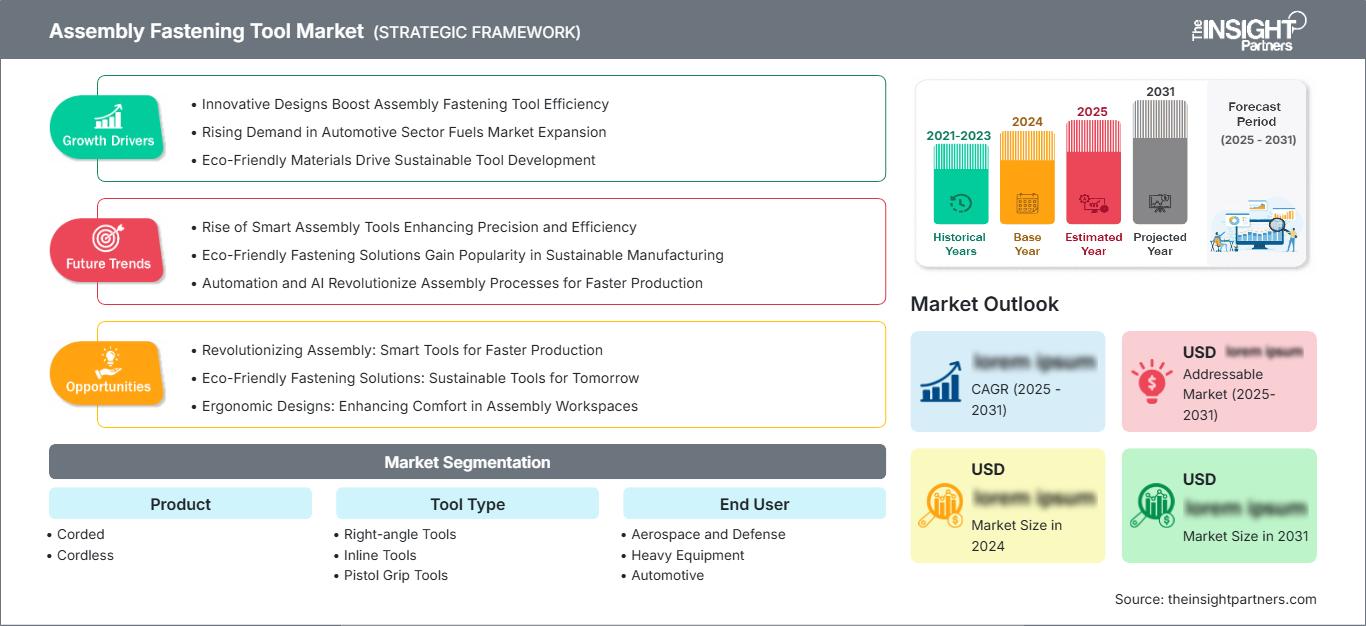
Assembly Fastening Tool Market: Strategic Insights
Regional Insights
North America Assembly Fastening Tool Market
North America accounted for a 30–33% Assembly Fastening Tool Market share in 2025 and is projected to grow at a 3.8–4.3% CAGR from 2026 to 2034. Aerospace build-rate normalization, defense procurement, electric vehicle retooling, and semiconductor packaging capacity support fastening demand across the US, Canada, and Mexico.
In this area, tracing-tightening tools are favored due to the need for productivity gains required for audits, labor cost issues, and reshoring efforts. The increasing importance of right-angle and inline tools, which are linked, is evident in their use in battery packs, airline seats, heating, ventilation, air conditioning, and medical devices.
U.S. Assembly Fastening Tool Market
The US represented 78–82% of North America demand in 2025 and is expected to grow at a 3.9–4.4% CAGR through 2034. Automotive battery plants, aerospace suppliers, medical device manufacturers, and electronics assembly facilities are increasing purchases of torque-controlled, cordless, and data-enabled tools for validated production environments.
Presence in the company is wide, including Atlas Copco AB, Apex Tool Group, LLC, Stanley Black & Decker, Inc., Robert Bosch GmbH, and Makita Corporation. Trends in applications will include ergonomic pistol-grip tools for general assembly, right-angle tools with small batteries, and inline tools for electronics fastening applications.
Europe Assembly Fastening Tool Market
Europe held a 24–27% share in 2025 and is forecast to grow at a 3.6–4.1% CAGR. German customers have the lead due to demand for automotive, machinery, and electronics assembly. The UK benefits from aerospace and defense assembly, where documented torque control becomes part of the supplier qualification and maintenance criteria.
Requirements for French, Italian, and Spanish markets are aerospace and defense assemblies, rail assemblies, medical equipment, and machinery manufacturing. Europeans appreciate high energy efficiency, silent operation, and compliance with safety regulations. Connected fastening systems can help achieve digitalization of EU manufacturing plants; hence, companies will be able to avoid rework and provide process capability documentation.
APAC Assembly Fastening Tool Market
APAC accounted for 34–37% share in 2025 and is projected to grow at a 4.7–5.2% CAGR, making it the fastest regional engine. In terms of size, China leads, while Japan and South Korea drive demand for precise fasteners used in electronics, robotics, automotive, and battery manufacturing.
India and Australia are making contributions through the production of industrial machinery, defense localization, healthcare devices, and infrastructure-related manufacturing. Government policies related to electronics, electric vehicles, and aircraft manufacturing chains are increasing the need for calibration in fastening tools.
Middle East & Africa Assembly Fastening Tool Market
Middle East & Africa is projected to grow at a 3.4–3.9% CAGR from 2026 to 2034, with Saudi Arabia leading demand. UAE industrial diversification, automotive manufacturing in South Africa, and energy infrastructure investments are driving the procurement of heavy-duty fastening systems for manufacturing and maintenance applications.
The demand in the rest of MEA is largely project-driven, relating to utilities, logistics infrastructure, and oilfield equipment services. In most cases, buyers emphasize durability, after-sales service, and tool availability over connectivity features. Yet industrial zones are increasingly using torque-controlled tools that require quality documentation.
Segmentation Analysis
Product
The Product segment is expected to grow at a 4.2–4.7% CAGR from 2026 to 2034. The Assembly Fastening Tool Market scope is expanding as companies balance continuous corded use with cordless fastening tool use. Improvements in battery technology, brushless motors, and reduced tool weight will influence buyer decision-making.
- Corded Tools: Continue to be significant in stationary applications, high-duty-cycle situations, and cases where power availability is more important than portability.
- Cordless Tools: Become dominant in portable assembly and maintenance applications, as they make station changes fast and easy without any cable management issues.
Tool Type
The Tool Type segment is projected to expand at a 4.0–4.5% CAGR from 2026 to 2034. Application-based tools have become the norm, with geometry, accessibility, torque range, and operator position playing crucial roles in purchasing decision-making. The connected controls are leading to the inclusion of right-angle, inline, and pistol-grip tools into the quality management process.
- Right-angle Tools: Used for tight assemblies like power trains, battery pack assembly, aircraft interior, and machinery frames due to limited joint accessibility and the need for torque consistency.
- Inline Tools: Used in precise assembly applications like electronic products, medical devices, and other small parts where axial alignment, torque consistency, and compact workstation compatibility are essential.
- Pistol Grip Tools: Used in general assembly because of ease of operation, speed, and balanced ergonomics for medium torque applications.
End User
The End User segment is forecast to grow at a 4.3–4.8% CAGR from 2026 to 2034. Demand varies by quality risk, assembly complexity, and production volume. Aerospace, defense, automotive, semiconductors, electronics, heavy equipment, and healthcare users increasingly require tools that combine fastening accuracy with documentation, calibration, and service continuity.
- Aerospace and Defense: The user needs traceable fasteners for applications such as safety-critical assemblies, cabinetry, missiles, and repair activities, where audit-capable torque documentation and tool calibration are required.
- Heavy Equipment: Manufacturers rely on rugged fastening tools for use in frames, hydraulics, engines, and attachments, prioritizing durability, accessibility, and torque consistency in demanding manufacturing conditions.
- Automotive: Remains a major demand base as electric vehicles, battery enclosures, chassis modules, and powertrain platforms require faster fastening, quality data, and flexible tooling.
- Semiconductors and Electronics: The manufacturer focuses on low-torque, clean, workstation-friendly, and repeatable fasteners for use in devices, enclosures, circuit boards, and manufacturing equipment assembly.
- Healthcare: High-growth user group as medical devices, diagnostic equipment, and surgical systems demand controlled fastening, contamination-sensitive handling, and validated assembly documentation.
Opportunity Snapshot
| End User | Revenue Contribution | Trend Tag | Adoption Stage |
| Aerospace and Defense | High | Torque Traceability | Scaling |
| Heavy Equipment | Medium | Rugged Assembly | Mature |
| Automotive | High | EV Platforms | Scaling |
| Semiconductors and Electronics | Medium | Micro Fastening | Scaling |
| Healthcare | Low | Validated Devices | Emerging |
Assembly Fastening Tool Market Growth Drivers and Impact Analysis
Rising Need for Traceable Torque Quality
Manufacturing teams are moving away from manual or simple power tools towards those that log information regarding torque, angle, who did it, and at which station. This trend is most notable in aerospace, electric cars, medical equipment, and electronics, where a single mistake during the fastening process can be costly and even lead to compliance concerns. The Assembly Fastening Tools market has thus benefited from consumers' view of traceability as a process control measure rather than an upgrade to their tools.
Electrification of Automotive and Industrial Platforms
The components of electric vehicles, battery energy systems, and industrial equipment with electric drive must be mounted on lightweight frames, sealed containers, busbars, thermal units, and electronic boxes. This equipment requires torque control, minimal vibration, and clear documentation. The need for angled, linear, and cordless fasteners arises from the need for such capabilities. In plants adopting mixed production lines, fastening systems are needed to reduce the changeover period. Fastener suppliers that integrate tools with controllers and application support can increase profits.
Labor Productivity and Ergonomic Safety Priorities
The use of lightweight equipment, proper grip mechanisms, torque reaction arms, and battery-powered tools illustrates how manufacturers have addressed problems such as labor shortages, work-related injuries, and productivity goals through improved technology. Improved ergonomic design reduces operator fatigue and ensures cycle consistency during mass production assembly tasks. The Market Effect occurs when the operator completes many assemblies per day, as in auto interiors assembly, appliance assembly, electronics casing assembly, and medical device assembly.
Assembly Fastening Tool Market Future Trends
AI-Enabled Error Proofing at the Workstation
Assembly Fastening Tool Market trends indicate a shift towards assembly fastening tools that serve functions beyond tightening joints. Future technology will be able to analyze torque curves, correlate fastener performance with defect curves, and notify the supervisor of any deviation in joint performance. This ability may eliminate the need for destructive testing and manual inspection of the assembly in controlled manufacturing. Moreover, vision systems and electronic work instructions will help select the right fastening sequence.
Battery Platform Standardization Across Plants
For major companies, battery systems are supposed to be standardized on the following: fasteners, drills, cutters, and maintenance devices to reduce inventory challenges. Common chargers, interchangeable batteries, and fleet-monitoring software will help minimize downtime and facilitate easier procurement. This trend will give an edge to manufacturers with extensive cordless product lines and industrial battery systems. With the development of safety measures for handling lithium-ion batteries, purchasing decisions will be based on thermal management, charging cycles, and services.
Assembly Fastening Tool Market Opportunities
Localized Manufacturing Hubs in Emerging Economies
Assembly Fastening Tool Market Forecasts indicate a strong opportunity in nations building up their production capabilities for cars, electronics, aircraft, and medicine. India, Mexico, Vietnam, and Eastern European nations are attracting supplier park investments, with new production lines requiring standardized fastening solutions from the outset. Tool makers may succeed by providing application audits, training, calibration services, and financing packages. Service centers based locally will play a crucial role, since greenfield operations focus more on uptime than on the lowest initial cost.
Healthcare and Precision Device Assembly
The medical industry represents a compelling market due to the need for fasteners that are not torque-sensitive, contamination-free, and validated. Customers in this sector require inline tools, bit engagement control, and documentation that enables product validation. Suppliers can compete in this industry based on contamination-sensitive technology, calibration services, and quality management system-compliant documentation. Even though the financial impact is lower than in the automotive sector, margins are positive because healthcare manufacturers require process assurance and regulatory compliance.
Recent Developments
- March 2026: Atlas Copco introduced the XB cordless assembly tool range for smart manufacturing, featuring the XCB (mechanical clutch) and XTB (torque transducer) nut runners. The all-electric tools provide cordless mobility, digital torque control, angle monitoring, OK/NOK feedback, and ergonomic design to improve assembly precision, productivity, and support Industry 4.0 manufacturing.
- June 2026: New fastening technologies highlighted advances in smart, connected assembly systems, including intelligent cordless fastening tools, transducer-based torque control, and automated error-proofing features that improve manufacturing flexibility, traceability, throughput, and quality across modern production lines.
- July 2026: Bosch Power Tools India expanded its 18V cordless product portfolio with new professional-grade tools designed to enhance productivity, precision, and user safety for industrial and construction applications, reinforcing its commitment to connected, battery-powered solutions for modern manufacturing and job sites.
Frequently Asked Questions

- Comprehensive Market Sizing and Forecast Analysis
- Detailed Segmentation Analysis
- In-Depth Market Dynamics Assessment
- Regional and Country-Level Insights
- Competitive Landscape and Company Benchmarking
- Strategic Business Intelligence
Recent Reports
Testimonials

The Insight Partners' SCADA System Market report is comprehensive, with valuable insights on current trends and future forecasts. The team was highly professional, responsive, and supportive throughout. We are very satisfied and highly recommend their services.
RAN KEDEM Partner, Reali Technologies LTDs
I requested a report on a very specific software market and the team produced the report in a few days. The information was very relevant and well presented. I then requested some changes and additions to the report. The team was again very responsive and I got the final report in less than a week.
JEAN-HERVE JENN Chairman, Future Analytica
We worked with The Insight Partners for an important market study and forecast. They gave us clear insights into opportunities and risks, which helped shape our plans. Their research was easy to use and based on solid data. It helped us make smart, confident decisions. We highly recommend them.
PIYUSH NAGPAL Sr. Vice President, High Beam Global
The Insight Partners delivered insightful, well-structured market research with strong domain expertise. Their team was professional and responsive throughout. The user-friendly website made accessing industry reports seamless. We highly recommend them for reliable, high-quality research services
YUKIHIKO ADACHI CEO, Deep Blue, LLC.
This is the first time I have purchased a market report from The Insight Partners.While I was unsure at first, I visited their web site and felt more comfortable to take the risk and purchase a market report.I am completely satisfied with the quality of the report and customer service. I had several questions and comments with the initial report, but after a couple of dialogs over email with their analyst I believe I have a report that I can use as input to our strategic planning process.Thank you so much for taking the extra time and making this a positive experience.I will definitely recommend your service to others and you will be my first call when we need further market data.
JOHN SUZUKI President and Chief Executive Officer, Board Director, BK Technologies
I wish to appreciate your support and the professionalism you displayed in the course of attending to my request for information regarding to infectious disease IVD market in Nigeria. I appreciate your patience, your guidance, and the fact that you were willing to offer a discount, which eventually made it possible for us to close a deal. I look forward to engaging The Insight Partners in the future, all thanks to the impression you have created in me as a result of this first encounter.
DR CHIJIOKE ONYIA MANAGING DIRECTOR, PineCrest Healthcare Ltd.Reason to Buy
- Informed Decision-Making
- Understanding Market Dynamics
- Competitive Analysis
- Identifying Emerging Markets
- Customer Insights
- Market Forecasts
- Risk Mitigation
- Boosting Operational Efficiency
- Strategic Planning
- Investment Justification
- Tracking Industry Innovations
- Aligning with Regulatory Trends





 Get Free Sample for