
Attack Helicopter Market Trends, Share & Demand by 2034
Coverage: By MTOW (Below 8 metric ton, Above 8 metric ton); End-User (Air Force, Naval Force, Land Force) , and Geography (North America, Europe, Asia Pacific, and South and Central America)
- Status : Data Released
- Report Code : TIPRE00021929
- Category : Aerospace and Defense
- No. of Pages : 150
- Available Report Formats :


- Last update date : November 03, 2026


2025 Market Size
US$ 10.92 Bn
Base year value
2034 Forecast
US$ 16.99 Bn
Projected by 2034
CAGR 2026-2034
5.03 %
Growth rate
Addressable Market
US$ 126.62 Bn
(2026-2034)
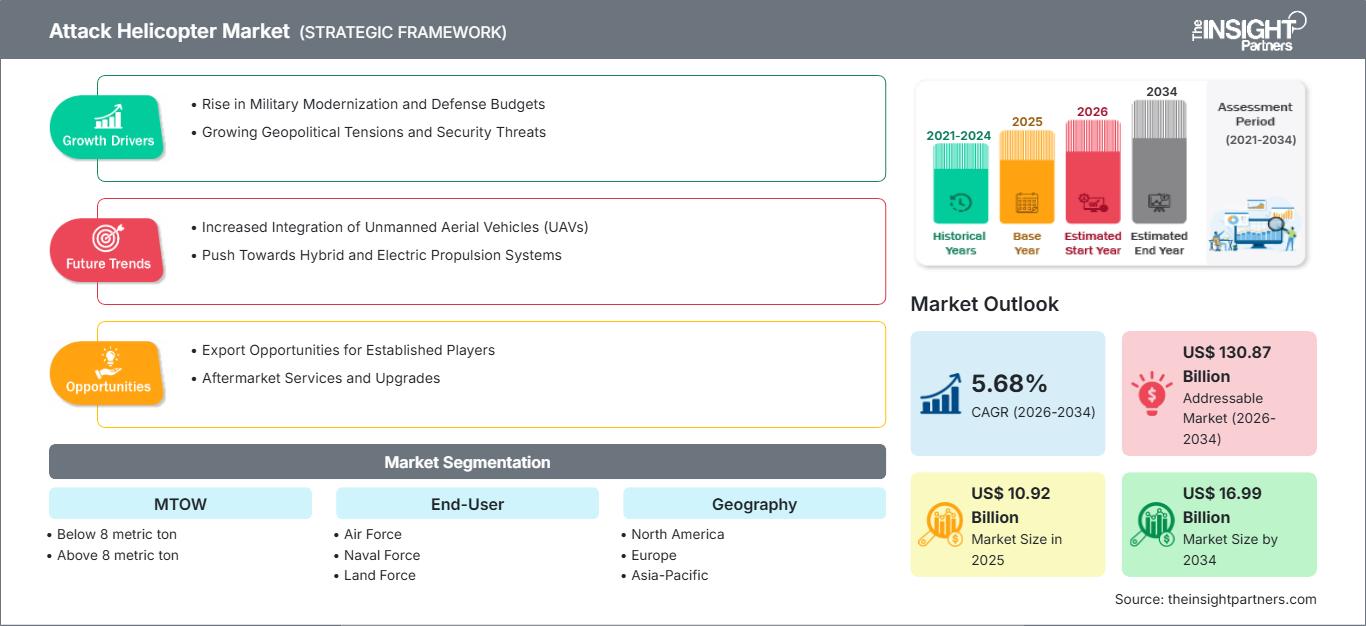
The attack helicopter market was valued at US$ 10.92 Billion in 2025 and is projected to reach US$ 16.99 Billion by 2034, registering a CAGR of 5.03% during 2026–2034. Demand is supported by military fleet modernization, replacement of aging rotorcraft, expansion of indigenous defense manufacturing, and integration of advanced sensors, precision weapons, digital mission systems, and survivability technologies. Procurement programs increasingly emphasize interoperability, mission flexibility, and compatibility with networked battlefield architectures.
Across North America, the attack helicopter market size is supported by sustained fleet sustainment, modernization of established combat platforms, and investment in mission-system upgrades. The region is expected to register a ~4% CAGR through 2034, reflecting the maturity of its installed fleet and the continued requirement for replacement, remanufacturing, training, weapons integration, and digital capability enhancements.
Attack Helicopter Market Assessment and Insights
Regional Outlook
- North America: ~36% of the global market in 2025 | ~4% CAGR through 2034. Market position: North America holds the leading regional position because of its large installed combat-helicopter fleet, established defense-industrial base, recurring modernization programs, and sustained demand for Apache-class platforms and associated mission systems.
- US: ~80% of North American market revenue in 2025 | ~4% CAGR through 2034. Market position: The US represents the dominant country market within North America, supported by Army aviation modernization, Apache procurement and remanufacturing, extensive training infrastructure, and continued investment in sensors, communications, weapons, and survivability systems.
- Europe: ~25% of the global market in 2025 | ~4% CAGR through 2034. Market position: Europe represents a mature but modernizing market, led by France, Germany, Italy, Spain, and the UK, where fleet replacement, NATO interoperability, indigenous production, and upgrades to combat rotorcraft are sustaining demand.
- Asia Pacific: ~28% of the global market in 2025 | ~7% CAGR through 2034. Market position: Asia Pacific is the fastest-growing region, supported by fleet expansion, border-security requirements, indigenous aerospace programs, modernization of legacy rotorcraft, and rising procurement by China, India, Japan, South Korea, and Australia.
Segment Outlook
- Above 8 metric ton: ~72% Share in 2025 | ~5% CAGR through 2034. Market position: Above 8 metric ton platforms lead because they accommodate larger weapon loads, advanced sensors, greater endurance, and integrated survivability systems. Their role in high-intensity operations supports sustained procurement and modernization demand.
- Naval Force: ~15% Share in 2025 | ~7% CAGR through 2034. Market position: Naval Force represents a high-growth application area as maritime forces expand shipborne aviation, littoral surveillance, anti-surface capabilities, and expeditionary operations requiring compact but heavily equipped rotary-wing combat platforms.
Competitive Coverage
Airbus S.A.S., Bell Textron Inc., Boeing, Denel Aerostructures, Hindustan Aeronautics Limited, Lockheed Martin Corporation, Leonardo S.p.A., MD Helicopters, Inc., Robinson Helicopter Company, Rostec
Methodology
The Insight Partners follows Data Collection & Secondary Research, Primary Research, Data Analysis, and Data Triangulation & Final Review to validate market estimates and insights.
Source: The Insight Partners' analysis based on proprietary research, government publications, company annual reports, investor presentations, industry databases, and expert interviews.
There has been a shift in the attack helicopter market from purely mechanical weapon systems to digitally-enabled combat systems which integrate electro-optic sensors, radars, guided ammunition, electronic warfare, communications security and mission computers. Modular construction techniques which permit upgrades without the replacement of the entire airframe are now common in production operations. Service life extension and interoperability with unmanned vehicles, as well as with land forces and command and control systems, are some of the benefits of this practice, and hence modernization programs generate demand for both new constructions and remanufacturing operations.
Going forward, there will be an expansion of acquisitions into developing defense markets where nations aim to develop their aviation capabilities in addition to gaining more sovereignty over maintenance, upgrade and logistics activities. Asia Pacific looks to have a strong growth opportunity ahead and European programs are putting the focus on collaborative development and interoperability. Furthermore, regulatory and defense planning considerations are increasingly favoring systems capable of operating in challenging electromagnetic environments and working together with unmanned vehicles. This is prompting manufacturers to invest in open architecture solutions, modular avionics and digital engineering, among others.
Attack Helicopter Market Report Scope
| Report Attribute | Details |
|---|---|
| Market size in 2025 | US$ 10.92 Billion |
| Market Size by 2034 | US$ 16.99 Billion |
| Global CAGR (2026 - 2034) | 5.03% |
| Historical Data | 2021-2024 |
| Forecast period | 2026-2034 |
Attack Helicopter Market Analysis
The attack helicopter market demand is born from the requirement for rapid-response fire support, targeting with armor, reconnaissance on the field of battle, escorting operations, and teamwork with infantrymen. The value chain encompasses airframe development, engine manufacture, sensor design, avionics development, weapon system design, communications systems, training, maintenance, and midlife modifications. Buying is done not only with regard to acquisition costs but also lifecycle capabilities. Hence, those companies that already have airframes in place, support capability, upgrading options, and access to mission system technology would benefit. The supplier side is additionally affected by long certification times, government buying process, specialized production, and aerospace components.
In the attack helicopter market report, differentiation is increasingly based on sensor fusion, survivability, networking capabilities, precision engagements, and integration with unmanned aircraft systems. The firm Boeing has an installed base of Apache helicopters, and engages in production and remanufacturing of the same. Meanwhile, Airbus S.A.S. and Leonardo S.p.A. are developing European combat helicopters. Lockheed Martin Corporation provides the mission systems and rotorcraft technology, while Bell Textron Inc., Hindustan Aeronautics Limited, MD Helicopters, Inc., Denel Aerostructures, Robinson Helicopter Company, and Rostec operate within their respective regional aerospace ecosystems. The investments are therefore flowing into platform upgrades, digital engineering, local participation, and sustainment.
● REPORT CUSTOMIZATION
Tailor This Report To Align With Your Specific Business Requirements
This report can be customized to align precisely with your business objectives, scope, and target markets. Customization options include tailored segmentation, geography, competitive analysis, and strategic insights to support informed decision-making.
Customize This Report →WHAT YOU CAN ADJUST
- ● Segmentations
- ● Geography
- ● Competitive Analysis
- ● Language Preferences
Attack Helicopter Market: Strategic Insights
Regional Insights
North America Attack Helicopter Market
The North American region retains the title of largest regional market, making up ~36% of the global market revenues in 2025 and growing at a ~4% CAGR until 2034. The United States makes up the majority of regional demand because of the large number of military rotorcraft that are currently operated there, training capacity, and modernization needs.
A small share of regional demand is also made up by Canada, which is driven not by the same heavy attack helicopter demands, but by general defense aircraft modernization. In the case of the US, the Apache ecosystem offered by Boeing highlights the importance of continuous production, remanufacturing, training, and support through the lifecycle. Increasingly, the regional market is being driven by increased drone integration, digital communications, advanced targeting, and electronic warfare capabilities. This creates opportunities for mission systems providers on a repetitive basis, despite low growth in airframe acquisitions.
U.S. Attack Helicopter Market
The USA was responsible for ~80% of North American attack helicopter market share in 2025 and is projected to grow at a ~4% CAGR until 2034. This position stems from the size of US Army aviation, the ongoing AH-64 upgrade program, and the presence of extensive maintenance, training, weapon, and mission system suppliers. Boeing delivered 19 new AH-64 Apaches and remanufactured 42 helicopters in 2025.
The emphasis on networked operations, survivability, range and engagement, and interoperability with unmanned systems is becoming more prevalent. As noted in 2026, there are more than 1,300 Apaches serving in the world’s militaries, with a Boeing contract in 2025 covering 106 new-build AH-64E aircraft showing continued interest in the system from abroad through US-based production facilities.
Europe Attack Helicopter Market
The region accounted for approximately 25% of the total attack helicopter market share in 2025 and expected to grow at a CAGR of about 4% until 2034. France is the largest country within Europe owing to the size of its combat-helicopter fleet and the requirement of its modernization. Other countries in Europe having large military aviation fleets are Germany, the UK, Italy, and Spain. Increasing demand for attack helicopters in Europe will be driven by the factors like NATO interoperability requirements, modernization needs, and high-intensity operations requirements.
Germany will continue with the modernization of its rotary-wing assets while the UK continues with its Apache fleet modernization program. France and Spain both are supporting the Tiger Mark III modernization program that provides avionics, armament, communication, and teaming capability for combat helicopters. As per Airbus, this program is aimed at ensuring the operational relevance of Tigers in the future high-intensity battlefield. Similarly, Italy has been improving its combat-rotorcraft capability through Leonardo AW249 program while Spain's overall defense helicopter acquisition program contributes toward the modernization of its armed forces.
APAC Attack Helicopter Market
In 2025, APAC is estimated to account for ~28% of the global attack helicopter market revenue and is the fastest-growing regional market, with a ~7% CAGR up to 2034. India is the key country in Asia Pacific due to indigenous aerospace manufacturing, modernization, and needs related to various terrains and border security. China, Japan, South Korea, and Australia are adding to regional demand through fleet modernization and capability expansion.
The manufacturing of helicopters domestically in India will ensure their involvement in the domestic supply chain, while Japan and South Korea are working on improving their advanced military aviation technology, and Australia is working on interoperability with their allies and rotorcrafts. The procurement trend in the region is that of integration of sensors, precise guided weapons, communication, and survivability.
Middle East & Africa Attack Helicopter Market
The Middle East and Africa market is projected to expand at a ~5% CAGR through 2034, supported by defense modernization, fleet replacement, border-security requirements, and investment in airpower capabilities. Saudi Arabia is the leading country in the Middle East and Africa region where attack-helicopter procurement and sustainment requirements are supported by substantial defense investment and operational requirements across expansive territories.
The UAE has a technologically sophisticated military aviation environment, and South Africa participates through existing aerospace and defense capacities. In the broader region, users place a premium on reliability in the harsh and challenging environment, sensor effectiveness, precision strike, and life cycle support. The development of infrastructure and local maintenance is becoming increasingly important as users look to increase aircraft availability and reduce reliance on foreign maintenance services.
Segmentation Analysis
MTOW
MTOW is an important segmentation dimension because aircraft weight determines payload capacity, endurance, propulsion requirements, armor integration, and the amount of mission equipment that can be carried. The category is strongly influenced by mission intensity and buyer requirements, with heavier platforms generally favored for sustained combat missions requiring substantial weapons and sensor payloads. Within this main segment, the Above 8 metric ton sub-segment is expected to register a ~5% CAGR through 2034 as militaries prioritize heavily equipped platforms with greater mission persistence.
- Below 8 metric ton: Lighter attack helicopters address missions where lower operating burden, maneuverability, and deployment flexibility are prioritized. They can support reconnaissance, armed escort, rapid response, and operations where infrastructure or transport constraints limit the use of heavier aircraft.
- Above 8 metric ton: Heavier platforms support larger weapon loads, stronger protection, advanced sensors, and greater endurance. Their suitability for high-intensity combat and complex mission-system integration sustains demand among militaries seeking concentrated battlefield effects.
End-User
End-user requirements determine procurement priorities, operational configuration, training needs, and sustainment models across military aviation organizations. Land forces remain the principal demand center because attack helicopters are closely associated with ground-force support, armored-target engagement, and battlefield reconnaissance. Air and naval forces add specialized requirements involving expeditionary operations and maritime environments. Within this main segment, the Naval Force sub-segment is expected to register a ~7% CAGR through 2034 as maritime forces expand shipborne aviation and littoral combat capabilities.
- Air Force: Air forces employ attack helicopters where rapid-response combat aviation, specialized strike support, and integration with broader airpower systems are required. Procurement decisions emphasize interoperability, mission availability, sensor performance, and coordination with fixed-wing assets.
- Naval Force: Naval users require compact combat helicopters capable of operating from ships and supporting maritime security, littoral operations, and expeditionary missions. Demand is strengthened by greater emphasis on shipborne aviation and distributed maritime operations.
- Land Force: Land forces constitute the core user base because attack helicopters provide responsive fire support and reconnaissance close to ground formations. Requirements center on survivability, precision engagement, endurance, communications, and rapid deployment.
Opportunity Snapshot
| End Users | Revenue Contribution | Trend Tag | Adoption Stage |
| Air Force | Medium | Air Integration | Mature |
| Naval Force | Low | Maritime Combat | Scaling |
| Land Force | High | Ground Support | Mature |
Attack Helicopter Market Growth Drivers and Impact Analysis
Modernization of Aging Military Rotorcraft Fleets
Aging attack-helicopter fleets are creating sustained demand for replacement aircraft, remanufacturing, avionics upgrades, weapons integration, and structural refurbishment. Many operators are balancing the cost of extending proven platforms against the operational advantages of acquiring newer systems. Modernization can provide improved sensors, communications, targeting, survivability, and digital mission capabilities without requiring a completely new support ecosystem. This dynamic benefits manufacturers with established platforms because existing fleets create recurring opportunities for upgrades and lifecycle services. It also supports suppliers of engines, avionics, electronic warfare systems, training equipment, and precision weapons. The result is a market structure in which new-build procurement and aftermarket modernization reinforce each other rather than operating as completely separate demand channels.
Expansion of Indigenous Defense Aerospace Capabilities
Governments are increasingly seeking domestic capability to design, produce, maintain, and upgrade military helicopters. Localization reduces exposure to foreign supply disruptions while strengthening industrial capacity, technical employment, and sovereign maintenance capability. For the market, this creates opportunities for partnerships involving technology transfer, component manufacturing, assembly, engineering services, and local depot maintenance. India provides a prominent example of the broader localization trend, while European programs increasingly emphasize multinational industrial cooperation. Suppliers able to establish regional production or sustainment relationships can improve access to government procurement programs and reduce lifecycle dependence on distant support infrastructure. Indigenous capability therefore influences not only aircraft acquisition but also the distribution of value across the broader aerospace supply chain.
Integration of Networked Sensors and Precision Weapons
Attack helicopters are increasingly being evaluated as connected battlefield nodes rather than standalone weapons platforms. Advanced electro-optical systems, digital communications, targeting technologies, electronic warfare equipment, and precision weapons allow crews to operate with greater information and coordinate with other assets. This shift raises the technology content of each aircraft and increases demand for software, mission computers, secure communications, and sensor integration. It also encourages manufacturers to adopt modular architectures that can accommodate future upgrades. For operators, the ability to integrate new capabilities progressively can extend platform relevance and reduce the need for frequent complete fleet replacement. This supports recurring investment throughout the aircraft lifecycle and increases the strategic importance of systems integration expertise.
Attack Helicopter Market Future Trends
Greater Adoption of Crewed-Uncrewed Teaming
Future attack helicopter operations are expected to place greater emphasis on cooperation between crewed rotorcraft and uncrewed systems. Helicopters can use drones for reconnaissance, target identification, communications extension, and selected high-risk tasks while maintaining the human crew in a more protected position. Airbus is already incorporating crewed-uncrewed teaming concepts into its military helicopter modernization activities, while Leonardo's newer combat-helicopter development emphasizes connectivity and digital integration. This evolution could change aircraft requirements by increasing demand for open mission architectures, autonomous control interfaces, secure data links, and high-capacity processing. Suppliers that design platforms around interoperable digital ecosystems will be better positioned to support incremental capability additions through 2034.
Shift Toward Modular and Upgradeable Combat Architectures
Future platforms are likely to rely increasingly on modular avionics, open architectures, and scalable mission systems. The objective is to allow operators to insert new sensors, communications equipment, electronic warfare functions, and weapons without extensive redesign of the core aircraft. Such architectures can shorten upgrade cycles and reduce the disruption associated with major fleet modernization programs. Airbus's Tiger Mark III program illustrates this direction through new digital avionics, communications capacity, and scalable systems, while Leonardo's AW249 emphasizes an open architecture designed for continued capability growth. The attack helicopter market trend will increase the importance of software engineering, systems integration, cybersecurity, and modular hardware suppliers alongside traditional airframe manufacturers.
Attack Helicopter Market Opportunities
Localized Sustainment and Lifecycle Support Networks
Localized sustainment represents a significant commercial opportunity because operators increasingly seek faster maintenance turnaround, greater fleet availability, and stronger domestic technical capability. Suppliers can expand beyond aircraft sales by establishing regional maintenance centers, training programs, component repair capacity, simulation infrastructure, and engineering support. Boeing's 2026 agreements with Polish industry for Apache maintenance and training illustrate how procurement programs can generate long-term industrial participation beyond initial aircraft delivery. Similar models can be applied in other markets where governments require technology transfer and sovereign support capabilities. Companies that combine platform expertise with lifecycle services can build recurring revenue opportunities while helping customers reduce dependence on overseas maintenance infrastructure.
Regional Production Partnerships in High-Growth Markets
High-growth markets offer opportunities in the attack helicopter market forecast for manufacturers to combine international platforms with local production, assembly, component sourcing, and engineering partnerships. Asia Pacific is particularly relevant because governments are increasing defense-industrial autonomy while modernizing military aviation fleets. Partnerships can address procurement requirements while allowing customers to develop domestic capabilities in aerospace manufacturing and maintenance. For suppliers, localization can strengthen eligibility for government programs, improve long-term customer relationships, and create regional export potential. The opportunity extends beyond complete aircraft to engines, avionics, structures, weapons integration, training, and support equipment. Companies with adaptable industrial models can therefore participate in market expansion without relying solely on direct aircraft exports.
Frequently Asked Questions

- Comprehensive Market Sizing and Forecast Analysis
- Detailed Segmentation Analysis
- In-Depth Market Dynamics Assessment
- Regional and Country-Level Insights
- Competitive Landscape and Company Benchmarking
- Strategic Business Intelligence
Recent Reports
Testimonials

The Insight Partners provided valuable market intelligence that supported our global go-to-market strategy. Their team was professional, responsive, and attentive to our feedback, providing thoughtful analysis and helpful methodological clarifications throughout the project.
Junmo Kim Chief Financial Officer (CFO), Enertech Co., Ltd.
The Insight Partners' SCADA System Market report is comprehensive, with valuable insights on current trends and future forecasts. The team was highly professional, responsive, and supportive throughout. We are very satisfied and highly recommend their services.
RAN KEDEM Partner, Reali Technologies LTDs
I requested a report on a very specific software market and the team produced the report in a few days. The information was very relevant and well presented. I then requested some changes and additions to the report. The team was again very responsive and I got the final report in less than a week.
JEAN-HERVE JENN Chairman, Future Analytica
We worked with The Insight Partners for an important market study and forecast. They gave us clear insights into opportunities and risks, which helped shape our plans. Their research was easy to use and based on solid data. It helped us make smart, confident decisions. We highly recommend them.
PIYUSH NAGPAL Sr. Vice President, High Beam Global
The Insight Partners delivered insightful, well-structured market research with strong domain expertise. Their team was professional and responsive throughout. The user-friendly website made accessing industry reports seamless. We highly recommend them for reliable, high-quality research services
YUKIHIKO ADACHI CEO, Deep Blue, LLC.
This is the first time I have purchased a market report from The Insight Partners.While I was unsure at first, I visited their web site and felt more comfortable to take the risk and purchase a market report.I am completely satisfied with the quality of the report and customer service. I had several questions and comments with the initial report, but after a couple of dialogs over email with their analyst I believe I have a report that I can use as input to our strategic planning process.Thank you so much for taking the extra time and making this a positive experience.I will definitely recommend your service to others and you will be my first call when we need further market data.
JOHN SUZUKI President and Chief Executive Officer, Board Director, BK Technologies
I wish to appreciate your support and the professionalism you displayed in the course of attending to my request for information regarding to infectious disease IVD market in Nigeria. I appreciate your patience, your guidance, and the fact that you were willing to offer a discount, which eventually made it possible for us to close a deal. I look forward to engaging The Insight Partners in the future, all thanks to the impression you have created in me as a result of this first encounter.
DR CHIJIOKE ONYIA MANAGING DIRECTOR, PineCrest Healthcare Ltd.Reason to Buy
- Informed Decision-Making
- Understanding Market Dynamics
- Competitive Analysis
- Identifying Emerging Markets
- Customer Insights
- Market Forecasts
- Risk Mitigation
- Boosting Operational Efficiency
- Strategic Planning
- Investment Justification
- Tracking Industry Innovations
- Aligning with Regulatory Trends





 Get Free Sample for