
Automotive Camless Engine Market Size, Growth & Trends by 2034
Coverage: By Engine Type (Gasoline Engine, Diesel Engine); Vehicle Type (Passenger Cars, Commercial Vehicle) , and Geography (North America, Europe, Asia Pacific, and South and Central America)
- Status : Data Released
- Report Code : TIPRE00021959
- Category : Automotive and Transportation
- No. of Pages : 150
- Available Report Formats :


- Last update date : August 27, 2026


2025 Market Size
US$ 35.44 Bn
Base year value
2034 Forecast
US$ 115.20 Bn
Projected by 2034
CAGR 2026-2034
13.99 %
Growth rate
Addressable Market
US$ 649.54 Bn
(2026-2034)
The automotive camless engine market is projected to grow from US$ 35.44 billion in 2025 to US$ 115.20 billion by 2034, registering a CAGR of 13.99% during 2026–2034. Growth in this sector correlates with ongoing efforts in the automotive industry to achieve better combustion efficiency, reduced mechanical losses, and improved emissions performance in internal combustion engine and hybrid powertrain architectures.
North America continues to be a significant region for technology verification, as original equipment manufacturers (OEMs) and powertrain providers test new technologies, such as advanced valve actuation, in gasoline, diesel, and hybrid powertrains. The automotive camless engine market size in North America is influenced by fuel economy concerns, high-performance vehicles, and electronic combustion control systems.
Automotive Camless Engine Market Assessment and Insights
- North America: Estimated at 24–28% share in 2025 and growing at a CAGR of 12–14% during 2026–2034, supported by advanced powertrain engineering and hybrid platform investment.
- US: Estimated to represent 72–76% of North America in 2025 and grow at a CAGR of 12–13.5%, driven by technology testing, performance vehicles, and supplier programs.
- Europe: Estimated at 27–31% share in 2025 and growing at a CAGR of 12–14%, led by Germany, the UK, France, Italy, and Spain through emissions regulation and engine efficiency programs.
- Asia Pacific: Estimated at 34–38% share in 2025 and growing at a CAGR of 14–16%, led by China, Japan, South Korea, and India because of large vehicle output and hybridization initiatives.
- Largest Segment: Gasoline Engine is estimated at 58–62% share in 2025 and growing at a CAGR of 12–14%, supported by passenger car penetration and compatibility with variable valve strategies.
- High Growth Segment: Commercial Vehicle is estimated at 30–34% share in 2025 and growing at a CAGR of 14–16%, supported by fuel saving potential in fleets and diesel efficiency needs.
- Key companies analyzed in detail: Freevalve AB, Linamar Corporation, Musashi Seimitsu Industry Co., Ltd., BorgWarner Inc., Nemak, S.A.B. de C.V., Parker-Hannifin Corporation, ElringKlinger AG, Qoros Auto Co., Ltd., thyssenkrupp AG, Camcon Automotive Ltd., and Koenigsegg Automotive AB.
Source: The Insight Partners' analysis based on proprietary research, government publications, company annual reports, investor presentations, industry databases, and expert interviews.
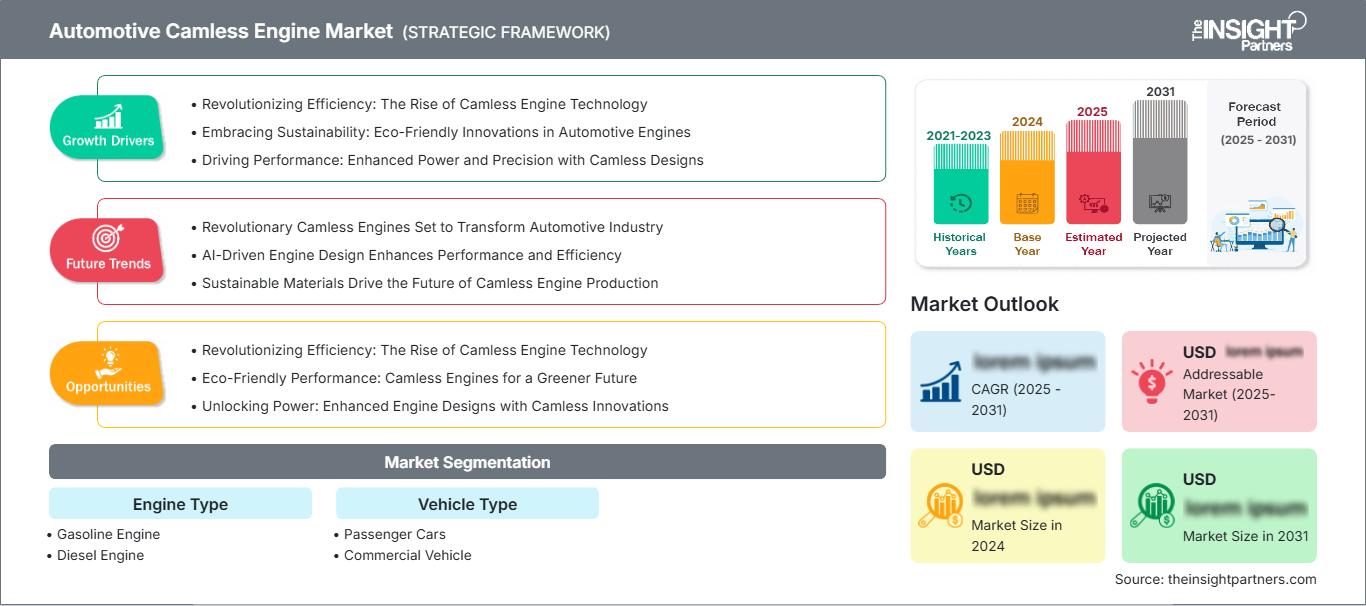
The market has transitioned from experimental, fully variable valve-actuation technology to a dedicated powertrain path that emphasizes the optimization of combustion control. Freevalve AB and Koenigsegg Automotive AB remain at the cutting edge in demonstrating the technical capabilities of independent valve control, while more general suppliers study actuator needs, seal requirements, durability considerations, and control system requirements. Future market growth for camless engine systems in the automotive industry will require transforming prototypes into a cost-effective manufacturing process that meets warranty and emissions standards. Rising interest in cleaner and more efficient combustion engine technology motivates the development of variable valve actuation systems.
The future adoption of this technology will be seen in hybrid powertrains, high-performance gasoline engines, range extenders, and select commercial vehicles. New regions will offer long-term prospects as stricter emissions legislation is introduced, without immediately phasing out combustion systems. Investment will center around electronic control units, robust valve actuators, and a small form that delivers software that delivers across-the-board fuel economy improvements under all operating conditions. Other application possibilities might arise in the search for regulatory compliance while improving fuel economy and drivability.
Automotive Camless Engine Market Report Scope
| Report Attribute | Details |
|---|---|
| Market size in 2025 | US$ 35.44 Billion |
| Market Size by 2034 | US$ 115.20 Billion |
| Global CAGR (2026 - 2034) | 13.99% |
| Historical Data | 2021-2024 |
| Forecast period | 2026-2034 |
Automotive Camless Engine Market Analysis
The demand is influenced by regulatory factors related to efficiency, combustion tuning, and a drive to minimize friction losses caused by conventional valvetrain components. According to market analysis, a fully variable valve control mechanism could offer benefits such as improved torque responsiveness, better cold-start performance, and load-specific tuning of the combustion process. With camless technology, there are no limitations associated with camshaft mechanics, resulting in improved efficiency and reduced emissions. As a result, the technology is becoming an attractive option for car manufacturers developing next-generation internal combustion engines and hybrids.
However, supplier capability is driven by reliable actuation mechanisms, cost, noise, and compatibility with current control systems. The commercial use of the technology is predicated on components that can reliably perform throughout the engine's entire lifecycle under harsh thermal and mechanical loads.
In terms of competitive positioning, one group includes specialized innovators, and the other diversified component suppliers. Freevalve AB, Camcon Automotive Ltd., and Koenigsegg Automotive AB will be helpful in technology demonstration, while BorgWarner Inc., Linamar Corporation, Musashi Seimitsu Industry Co., Ltd., Parker-Hannifin Corporation, ElringKlinger AG, Nemak, S.A.B. de C.V., and thyssenkrupp AG will be useful in manufacturing, materials, actuation, and engine-system technologies associated with further commercialization of camless engines. Knowledge of powertrain engineering and precision manufacturing will help them develop scalable solutions for use by automotive companies.
Furthermore, market prospects will depend on the overall transition towards emission-friendly internal combustion technologies and hybrids. Camless engine technology enables optimization of individual cylinder air-fuel ratios, valve timing, and fuel injection across different driving conditions. Further research will continue to focus on improving actuator reliability, energy efficiency, and software calibration. It is likely that partnerships between original equipment manufacturers and technology providers will accelerate commercialization. The most promising market opportunities might arise in luxury cars, performance engines, hybrids, and selected commercial vehicles.
● REPORT CUSTOMIZATION
Tailor This Report To Align With Your Specific Business Requirements
This report can be customized to align precisely with your business objectives, scope, and target markets. Customization options include tailored segmentation, geography, competitive analysis, and strategic insights to support informed decision-making.
Customize This Report →WHAT YOU CAN ADJUST
- ● Segmentations
- ● Geography
- ● Competitive Analysis
- ● Language Preferences
Automotive Camless Engine Market: Strategic Insights
Regional Insights
North America automotive camless engine market
North America is estimated to hold 24–28% automotive camless engine market share in 2025 and grow at a CAGR of 12–14% during 2026–2034. The region benefits from high engineering intensity, performance vehicle programs, and supplier expertise in electronically controlled powertrain systems.
US demand is influenced by hybrid powertrain development, pickup and performance vehicle efficiency targets, and regulatory pressure to lower fleet emissions. Commercial vehicle operators also create a pathway for adoption where fuel savings can justify higher component cost over longer operating cycles.
U.S. automotive camless engine Market
The US is estimated to account for 72–76% of North America in 2025 and grow at a CAGR of 12–13.5% during 2026–2034. The country’s demand is tied to technology testing, advanced combustion research, and interest in extending efficient internal combustion platforms.
Automotive camless engine systems are most relevant in applications where higher cost can be balanced by measurable performance or fuel economy benefits. Passenger cars, light trucks, hybrid range extenders, and selected commercial vehicles represent the most practical early adoption areas.
Europe automotive camless engine Market
Europe is estimated to hold 27–31% share in 2025 and grow at a CAGR of 12–14% during 2026–2034. Germany leads regional development because of its engine engineering base, premium vehicle platforms, and supplier depth across valvetrain, materials, and control systems.
The UK, France, Italy, and Spain support adoption through emissions compliance, hybridization, and commercial vehicle efficiency programs. Europe’s regulatory environment encourages technologies that reduce cold-start emissions and optimize combustion, even as electrification gradually reshapes new vehicle development priorities.
APAC automotive camless engine Market
APAC is estimated to account for 34–38% share in 2025 and grow at a CAGR of 14–16% during 2026–2034. China leads because of scale, hybrid development, and local supplier participation in advanced powertrain programs.
Japan and South Korea contribute through precision engine engineering, while India and Australia support long-term demand through fuel economy needs and commercial vehicle modernization. Regional growth depends on cost reduction and successful localization of actuator and control technologies.
Middle East & Africa automotive camless engine Market
The Middle East & Africa is expected to grow at a CAGR of 10–12% during 2026–2034. Saudi Arabia and the UAE lead regional interest through premium vehicles, logistics fleets, and energy-linked transport modernization.
South Africa and the Rest of MEA provide selective demand from commercial vehicles and aftermarket efficiency upgrades. Adoption remains limited by cost, but durability gains and reduced fuel consumption can support niche deployment in high-utilization fleets.
Segmentation Analysis
Engine Type
According to the Automotive Camless Engine Market Report, the Engine Type segment is expected to grow at a CAGR of 13–15% during 2026–2034. The market scope across engine types is led by gasoline platforms because variable valve control improves combustion flexibility, enhances fuel efficiency, and supports stricter emissions compliance. Diesel applications are also gaining relevance where fuel economy, high torque output, and advanced emissions management remain critical. Growing investments in electronically controlled valve actuation technologies are expected to further strengthen adoption across both engine categories, particularly in hybrid, performance-oriented, and next-generation internal combustion vehicle platforms.
- Gasoline Engine: Gasoline engines dominate early adoption because passenger cars, performance vehicles, and hybrid platforms can use precise valve timing to improve torque, efficiency, and cold-start emissions.
- Diesel Engine: Diesel engines offer long-term potential in commercial applications where precise valve actuation can support fuel savings, exhaust management, and better load-specific combustion control.
Vehicle Type
Vehicle Type is expected to grow at a CAGR of 13–15% during 2026–2034. Passenger cars represent the largest deployment base, while commercial vehicles provide higher-value use cases where fuel savings, duty-cycle optimization, and engine durability can justify advanced electronically controlled valve systems.
- Passenger Cars: Passenger cars lead adoption because automakers can pair camless systems with hybridization, downsizing, and premium performance engines to balance efficiency and drivability.
- Commercial Vehicle: Commercial vehicles are strategically important because high mileage, fuel cost sensitivity, and diesel efficiency requirements can improve the payback case for advanced valve actuation.
Opportunity Snapshot
| Vehicle Type | Revenue Contribution | Trend Tag | Adoption Stage |
| Passenger Cars | High | Hybrid Efficiency | Scaling |
| Commercial Vehicle | Medium | Fleet Savings | Emerging |
Automotive Camless Engine Market Growth Drivers and Impact Analysis
Need for higher combustion efficiency
Automakers are under pressure to extract more efficiency from combustion engines while reducing emissions and maintaining drivability. Camless valve actuation allows intake and exhaust events to be adjusted independently, helping engines operate closer to optimum combustion conditions across load ranges. This can reduce pumping losses, improve transient response, and support downsized turbocharged engines. The impact is strongest in hybrid platforms, where engines operate in defined efficiency zones and electronically controlled valve timing can complement electrified torque support.
Tightening emissions and fuel economy rules
Global emissions standards are still working to make vehicles use more efficient combustion processes, even as fully electric vehicles come along at a slower pace. Camless engines may improve cold-start emissions, exhaust gas control, and combustion efficiency by modifying valve operation. In this case, the manufacturer gains another option to comply with regulations without switching to internal combustion engines right away. The aspect will be particularly important in areas with many hybrid cars and trucks that rely on poor-quality fu
Hybrid powertrain and range-extender development
A hybrid vehicle provides a feasible pathway for camless engines, as combustion engines can be tailored to specific operating windows. The use of electronically controlled valve actuation will enable efficient operation, lower emissions, and smooth shifting of power between electric and engine operation for range-extender and hybrid engines. Companies that integrate the actuator, sensor, control system, and software calibration will have a leg up in meeting OEMs' demands for efficient combustion engines.
Automotive Camless Engine Market Future Trends
Software-defined combustion control
Automotive camless engine market trends suggest the possibility of software-defined combustion, in which valve actuation, fuel injection, boosting, and hybrid power management are coordinated into a single package. Such software-defined combustion could potentially allow for over-the-air tuning, fuel-specific efficiencies, and rapid adaptation to fuel varieties such as gasoline, ethanol blends, and synthetic fuel. The trend will benefit those who can blend mechanical longevity with software and data validation.
Compact actuator integration
Future designs will emphasize compact, quieter, and lower-power valve actuators that can fit within existing engine packaging constraints. Integration will move beyond concept engines toward modular actuator assemblies, standardized control interfaces, and validated durability cycles. If suppliers reduce cost and complexity, camless architecture can shift from niche performance demonstrations toward hybrid passenger cars and high-utilization commercial applications where measurable fuel savings support procurement decisions.
Automotive Camless Engine Market Opportunities
Cost-optimized hybrid engine modules
Automotive camless engine market Forecasts indicate an opportunity in hybrid engine modules designed for defined operating cycles. Suppliers can target compact gasoline engines used in plug-in hybrids and range extenders, where precise valve actuation improves efficiency without requiring broad full-load operation. A modular approach can reduce calibration complexity and support repeatable integration across vehicle programs. Partnerships among actuator developers, engine manufacturers, and control software providers will be essential for lowering cost and accelerating validation.
Fleet-focused diesel efficiency upgrades
Commercial fleets provide a selective but meaningful opportunity because fuel economy improvements can translate into measurable operating savings. Heavy-duty and light commercial vehicles also face pressure to reduce emissions while maintaining payload, range, and uptime. Camless valve control could support better low-speed torque, exhaust temperature management, and duty-cycle efficiency. Adoption will depend on rugged actuator design, serviceability, warranty confidence, and evidence that lifecycle savings offset higher upfront system cost.
Frequently Asked Questions

- Comprehensive Market Sizing and Forecast Analysis
- Detailed Segmentation Analysis
- In-Depth Market Dynamics Assessment
- Regional and Country-Level Insights
- Competitive Landscape and Company Benchmarking
- Strategic Business Intelligence
Recent Reports
Testimonials

The Insight Partners' SCADA System Market report is comprehensive, with valuable insights on current trends and future forecasts. The team was highly professional, responsive, and supportive throughout. We are very satisfied and highly recommend their services.
RAN KEDEM Partner, Reali Technologies LTDs
I requested a report on a very specific software market and the team produced the report in a few days. The information was very relevant and well presented. I then requested some changes and additions to the report. The team was again very responsive and I got the final report in less than a week.
JEAN-HERVE JENN Chairman, Future Analytica
We worked with The Insight Partners for an important market study and forecast. They gave us clear insights into opportunities and risks, which helped shape our plans. Their research was easy to use and based on solid data. It helped us make smart, confident decisions. We highly recommend them.
PIYUSH NAGPAL Sr. Vice President, High Beam Global
The Insight Partners delivered insightful, well-structured market research with strong domain expertise. Their team was professional and responsive throughout. The user-friendly website made accessing industry reports seamless. We highly recommend them for reliable, high-quality research services
YUKIHIKO ADACHI CEO, Deep Blue, LLC.
This is the first time I have purchased a market report from The Insight Partners.While I was unsure at first, I visited their web site and felt more comfortable to take the risk and purchase a market report.I am completely satisfied with the quality of the report and customer service. I had several questions and comments with the initial report, but after a couple of dialogs over email with their analyst I believe I have a report that I can use as input to our strategic planning process.Thank you so much for taking the extra time and making this a positive experience.I will definitely recommend your service to others and you will be my first call when we need further market data.
JOHN SUZUKI President and Chief Executive Officer, Board Director, BK Technologies
I wish to appreciate your support and the professionalism you displayed in the course of attending to my request for information regarding to infectious disease IVD market in Nigeria. I appreciate your patience, your guidance, and the fact that you were willing to offer a discount, which eventually made it possible for us to close a deal. I look forward to engaging The Insight Partners in the future, all thanks to the impression you have created in me as a result of this first encounter.
DR CHIJIOKE ONYIA MANAGING DIRECTOR, PineCrest Healthcare Ltd.Reason to Buy
- Informed Decision-Making
- Understanding Market Dynamics
- Competitive Analysis
- Identifying Emerging Markets
- Customer Insights
- Market Forecasts
- Risk Mitigation
- Boosting Operational Efficiency
- Strategic Planning
- Investment Justification
- Tracking Industry Innovations
- Aligning with Regulatory Trends





 Get Free Sample for