
Automotive Communication Technology Market Growth, Size, Share, Trends, and Forecast till 2034
Coverage: By Bus Module (Local Interconnect Network (LIN), Controller Area Network (CAN), FlexRay, Media-Oriented Systems Transport (MOST), Ethernet); Application (Powertrain, Body Control and Comfort, Infotainment & Communication, and Safety & ADAS); Vehicle Class (Economy, Mid-Size, Luxury), and Geography (North America, Europe, Asia Pacific, and South and Central America)
- Status : Data Released
- Report Code : TIPRE00003396
- Category : Technology, Media and Telecommunications
- No. of Pages : 150
- Available Report Formats :


- Last update date : August 12, 2026


2025 Market Size
US$ 21.19 Bn
Base year value
2034 Forecast
US$ 78.12 Bn
Projected by 2034
CAGR 2026-2034
15.6 %
Growth rate
Addressable Market
US$ 421.85 Bn
(2026-2034)
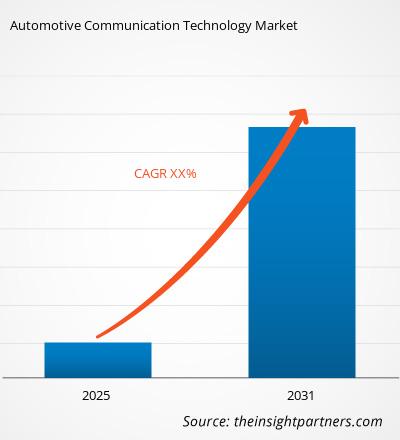
The automotive communication technology market was valued at US$ 21.19 Billion in 2025 and is projected to reach US$ 78.12 Billion by 2034, registering a CAGR of 15.6 % from 2026 to 2034. Growth is being shaped by connected vehicles, software-defined platforms, electronic control unit consolidation, electrification, and rising demand for high-speed data transfer across powertrain, body, infotainment, communication, safety, and ADAS domains.
The North America automotive communication technology market size is expected to expand at a CAGR of 13.8–14.6% from 2026 to 2034, supported by software-defined vehicle investment, premium vehicle electronics content, and demand for secure in-vehicle networking. OEMs are shifting from distributed electronic control units toward domain and zonal architectures that require reliable Ethernet, CAN FD, and gateway connectivity.
Automotive Communication Technology Market Assessment and Insights
- North America: Accounted for an estimated 24–27% share in 2025 and is expected to grow at a CAGR between 13.8–14.6% during 2026–2034, supported by connected vehicle programs and software-defined architecture migration.
- US: Represented about 77–81% of North America demand in 2025 and is projected to grow at a CAGR between 13.7–14.5% during 2026–2034.
- Europe: Held an estimated 25–28% share in 2025 and is likely to expand at a CAGR between 14.0–14.8%, led by Germany, the UK, France, Italy, and Spain.
- Asia Pacific: Led with an estimated 38–42% share in 2025 and is expected to grow at a CAGR between 16.4–17.2%, driven by China, Japan, South Korea, India, and Australia.
- Largest Segment: Controller Area Network estimated 34–38% market share in 2025 and a CAGR between 13.2–14.0% during 2026–2034.
- High Growth Segment: Ethernet estimated 17–21% share in 2025 and a CAGR between 20.5–21.8% during 2026–2034.
- Key companies analyzed in detail: Broadcom Inc., Continental AG, Infineon Technologies AG, Intel Corporation, Analog Devices, Inc., Melexis NV, Microchip Technology Inc., onsemi, Elmos Semiconductor SE, and Renesas Electronics Corporation.
Source: The Insight Partners' analysis based on proprietary research, government publications, company annual reports, investor presentations, industry databases, and expert interviews.
Technology evolution in the automotive communication technology market has moved from single-domain bus systems toward layered architectures where LIN, CAN, FlexRay, MOST, and Ethernet coexist. CAN remains widely deployed for control traffic, LIN supports low-cost comfort functions, and Ethernet is becoming the high-bandwidth backbone for cameras, gateways, diagnostics, cybersecurity, and over-the-air updates. Production dynamics are influenced by rising ECU counts, wiring-harness complexity, and automaker efforts to reduce latency while improving scalability.
Forward momentum will be strongest in connected, electric, and premium vehicle platforms where software features depend on dependable data routing. Automotive Communication Technology Market forecast projections indicate that emerging geographies are adopting more electronic content per vehicle, while mature markets continue investing in validation, cybersecurity, and zonal computing architectures. Regulatory emphasis on safety, data protection, and functional reliability is expected to increase demand for qualified semiconductors, transceivers, switches, and embedded communication software.
Automotive Communication Technology Market Report Scope
| Report Attribute | Details |
|---|---|
| Market size in 2025 | US$ 21.19 Billion |
| Market Size by 2034 | US$ 78.12 Billion |
| Global CAGR (2026 - 2034) | 15.6% |
| Historical Data | 2021-2024 |
| Forecast period | 2026-2034 |
Automotive Communication Technology Market Analysis
The Automotive communication technology market growth is being driven by software-defined vehicles, ADAS expansion, digital cockpit upgrades, and electrified powertrains that generate higher data traffic inside the vehicle. Modern vehicles need deterministic networks for their safety functions and high-bandwidth connectivity for cameras, radars, infotainment, and cloud-based systems. These result in a need for gateways, switches, microcontrollers, PHY transceivers, protocol stacks, and cybersecurity components.
Such an eco-system comprises semiconductor companies, Tier 1 electronic companies, network software companies, OEM electrical architecture companies, validation companies, and tool chain companies. Supply dynamics are shaped by automotive-grade qualification, long product life cycles, functional safety compliance, and the need for stable sourcing. Automotive communication technology market analysis shows that suppliers able to connect legacy CAN and LIN domains with Ethernet backbones can capture value during architecture transitions.
Competition is intensifying due to the alignment of semiconductor firms and automotive electronic suppliers toward zone computing and centralized computing. Broadcom Inc., Infineon Technologies AG, Microchip Technology Inc., onsemi, Analog Devices, Inc., and Renesas Electronics Corporation are competing in the physical layer, microcontroller, interface, and connectivity segments. Continental AG is integrating communications hardware into its vehicle electronics platform, whereas Intel Corporation supports computationally demanding software-defined vehicle needs.
Investment trends emphasize automotive Ethernet, CAN FD, secure gateways, time-sensitive networking, and software abstraction. The Automotive Communication Technology Market is witnessing increased strategic activity, highlighted by Infineon Technologies AG's completed acquisition of Marvell’s automotive Ethernet business in 2025, which added PHY, switch, and bridge capabilities. Strategic positioning increasingly depends on bandwidth scalability, electromagnetic compatibility, cybersecurity support, and close relationships with OEMs redesigning electrical and electronic architectures.
● REPORT CUSTOMIZATION
Tailor This Report To Align With Your Specific Business Requirements
This report can be customized to align precisely with your business objectives, scope, and target markets. Customization options include tailored segmentation, geography, competitive analysis, and strategic insights to support informed decision-making.
Customize This Report →WHAT YOU CAN ADJUST
- ● Segmentations
- ● Geography
- ● Competitive Analysis
- ● Language Preferences
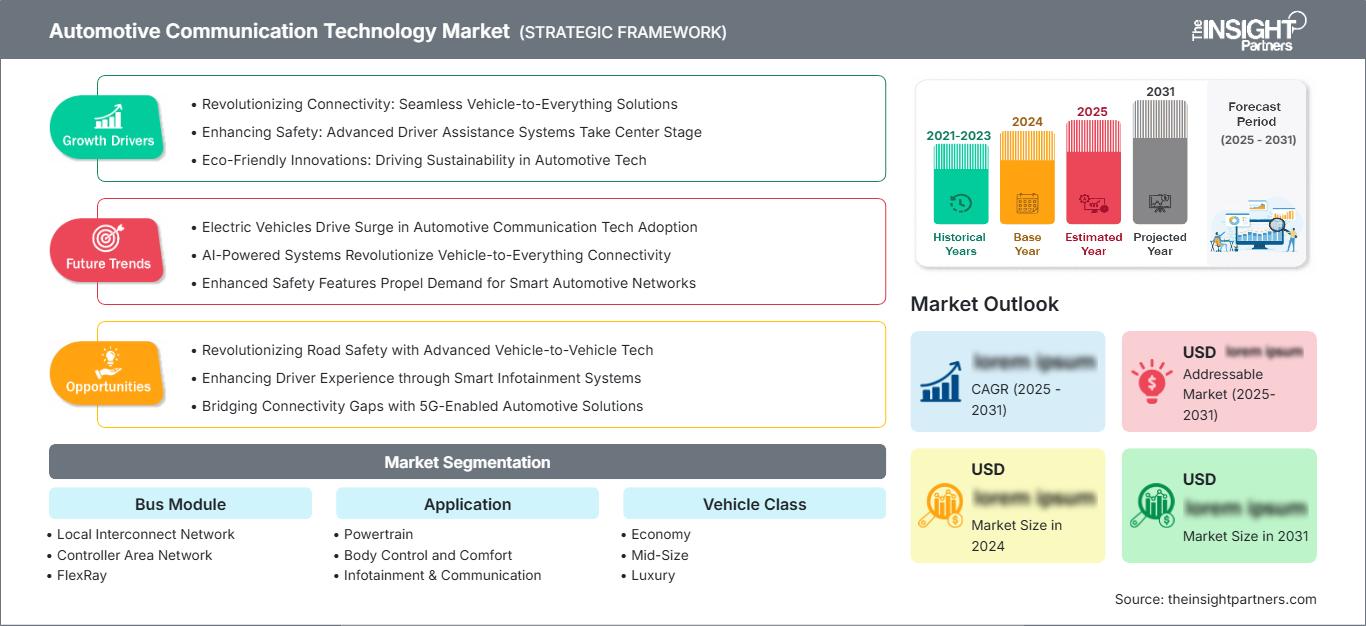
Automotive Communication Technology Market: Strategic Insights
Regional Insights
North America automotive communication technology market
North America held an estimated 24–27% automotive communication technology market share in 2025 and is forecast to expand at a 13.8–14.6% CAGR during 2026–2034. Demand is supported by connected SUVs, pickup platforms, electric vehicles, fleet telematics, and software-defined vehicle programs that need dependable high-speed communication inside the vehicle.
Regional suppliers and OEM engineering teams are prioritizing Ethernet gateways, CAN FD migration, secure diagnostics, and over-the-air readiness. The US anchors development because of semiconductor design capability, autonomous mobility testing, cloud partnerships, and premium vehicle electronics demand. Canada and Mexico follow platform decisions linked to integrated North American manufacturing.
U.S. automotive communication technology Market
The US represented an estimated 77–81% of North American demand in 2025 and is expected to grow at a CAGR of 13.7–14.5% through 2034. The Automotive Communication Technology Market in the country is driven by connected vehicle software adoption, electric pickup launches, ADAS sensor fusion requirements, and the expansion of digital cockpit architectures that depend on low-latency data movement and high-bandwidth communication networks.
Broadcom Inc., Intel Corporation, Microchip Technology Inc., onsemi, and Analog Devices, Inc. are some examples of companies that provide the ecosystem with their solutions for semiconductors, connectivity, embedded computing, and interfaces. The highest application demand is observed in infotainment and communications, safety and ADAS, and powertrain control applications.
Europe automotive communication technology market
Europe accounted for an estimated 25–28% share in 2025 and is projected to grow at a 14.0–14.8% CAGR during 2026–2034. Germany is in the lead due to the development of Ethernet backbones, gateway aggregation, and zoning architecture by premium OEMs and Tier 1s for software-defined vehicles.
The UK has connected mobility engineering and technology use in its fleets, whereas France, Italy, and Spain make contributions in the form of vehicle manufacturing, light commercial vehicle platforms, and electronics safety systems. Key focus areas for Europe include cybersecurity, functional safety, emissions-related power train control, and software standards enabling cross-domain communications.
APAC automotive communication technology Market
APAC held the leading 38–42% share in 2025 and is expected to grow at a 16.4–17.2% CAGR during 2026–2034. China leads due to electric vehicle scale, local semiconductor development, smart cockpit adoption, and fast software-defined vehicle deployment.
Japan and South Korea add advanced electronics engineering, while India expands through connected vehicle penetration and cost-sensitive CAN, LIN, and Ethernet integration. Australia contributes through safety-focused imports and fleet connectivity. Industrial policy, EV localization, and ADAS adoption make APAC the largest deployment base.
Middle East & Africa automotive communication technology Market
The Middle East and Africa are projected to grow at a 12.6–13.4% CAGR during 2026–2034. Saudi Arabia is the leading country, supported by premium vehicle imports, logistics modernization, smart mobility initiatives, and infrastructure-linked fleet digitization.
The UAE contributes through connected transport programs and high-end vehicle demand, while South Africa adds aftermarket diagnostics, vehicle assembly, and electronics service opportunities. The rest of MEA adoption remains uneven, but commercial fleets and urban mobility projects should increase communication module demand.
Segmentation Analysis
Bus Module
Bus Module is expected to grow at a CAGR of 15.1–15.9% during 2026–2034. Automotive communication technology market scope in this segment is shaped by cost, determinism, bandwidth, safety, and migration paths from distributed ECUs toward domain and zonal controllers.
- Local Interconnect Network remains important for low-cost comfort and body functions such as windows, mirrors, lighting, seat adjustment, and HVAC actuators, where simple communication and low wiring cost matter.
- Controller Area Network continues as the dominant control network because it supports robust real-time communication across powertrain, chassis, body, diagnostics, and safety-related electronic control units.
- FlexRay serves selected deterministic and legacy safety-critical applications where dual-channel redundancy and predictable timing were designed into braking, steering, or chassis control architectures.
- Media-Oriented Systems Transport retains relevance in some infotainment and multimedia platforms, although automakers are gradually migrating high-bandwidth content toward Ethernet-based architectures.
- Ethernet is the fastest-growing module because it supports high-bandwidth ADAS data, zonal gateways, over-the-air updates, centralized compute, diagnostics, and IP-based software-defined vehicle services.
Application
Application is forecast to grow at a CAGR of 15.3–16.1% during 2026–2034. Demand varies by function because the powertrain requires reliability, body control needs cost efficiency, infotainment needs bandwidth, and safety and ADAS require deterministic low-latency communication.
- Powertrain relies on robust networks for engine, transmission, battery management, thermal systems, and electrified propulsion controls, where timing accuracy and fault tolerance are critical.
- Body Control and Comfort uses LIN and CAN to connect doors, lighting, climate, seats, mirrors, and access systems with emphasis on cost, reliability, and scalable module integration.
- Infotainment & Communication needs higher bandwidth for displays, audio, navigation, connectivity, diagnostics, and data-rich cockpit functions that increasingly depend on Ethernet and centralized compute.
- Safety & ADAS requires fast and secure data transfer between sensors, domain controllers, braking, steering, and vehicle motion systems to support driver assistance and automated functions.
Vehicle Class
Vehicle Class is projected to grow at a CAGR of 15.0–15.8% during 2026–2034. Economy vehicles prioritize cost-optimized networks, mid-size models scale connected features, and luxury vehicles introduce high-speed architectures before wider mass-market adoption.
- Economy vehicles rely on LIN and CAN for essential electronics, diagnostics, and safety features, with selective Ethernet adoption as low-cost connected functions become standard.
- Mid-Size vehicles generate high volume because consumers expect digital cockpit, ADAS, connected services, and comfort features without luxury pricing, making balanced bus architecture important.
- Luxury vehicles lead the adoption of Ethernet, centralized gateways, software updates, advanced infotainment, and sensor-rich safety functions that later cascade into broader vehicle classes.
Opportunity Snapshot
| Applicatione | Revenue Contribution | Trend Tag | Adoption Stage |
| Powertrain | High | Control Reliability | Mature |
| Body Control and Comfort | Medium | Low-Cost Nodes | Mature |
| Infotainment & Communication | High | Cockpit Data | Scaling |
| Safety & ADAS | High | Sensor Fusion | Scaling |
Automotive Communication Technology Market Growth Drivers and Impact Analysis
Software-Defined Vehicle Architecture Migration
Reimagining electrical and electronic architectures to enable updates, validation, and scaling of software applications post-launch is now becoming a necessity in the auto industry. This development creates an increasing need for higher bandwidth internal backbone, secure gateways, and reliable communication between the zones, domain controllers, and sensors. The effect is strategic since the selection of communication technology will determine the platform rather than being just an engineering option at the component level. Companies providing Ethernet, CAN FD, time-sensitive networking, and cybersecurity technology will have more content in each car.
Rising ADAS and Digital Cockpit Data Traffic
The ADAS systems and digital cockpits create high data volumes from cameras, radars, displays, navigation systems, audio systems, connectivity solutions, and driver monitoring applications. The legacy bus cannot transmit all the data at high resolution effectively; hence, the auto manufacturers integrate CAN and LIN control buses with Ethernet backbone connections. This trend increases the need for switches, PHY transceivers, gateways, and embedded processors that can handle latency, safety, and electromagnetic compliance considerations. The market impact will be higher for premium cars, electric vehicles, and midsize segments where customers demand connected interfaces and safety solutions.
Electrification and Zonal Wiring Optimization
Communication in electric vehicles drives architectural design since battery management, cooling, charging, power electronics, and service applications necessitate communication. Zonal wiring enables less wiring mass and input/output consolidation, which helps in achieving efficiencies and ease of manufacturing. Communication modules facilitate communication between sensors and actuators and the central compute along secure and scalable communication channels. Implications include increased use of semiconductors, increased demand for automotive networks, and integration of microcontroller and Ethernet offerings.
Automotive Communication Technology Market Future Trends
Automotive Ethernet as the Vehicle Data Backbone
Automotive communication technology market trends are shifting toward Ethernet as the backbone for software-defined vehicles, ADAS, diagnostics, and over-the-air services. Future vehicles will use Ethernet switches, PHYs, bridges, and time-sensitive networking to connect zonal controllers and high-performance computing. CAN and LIN will remain for cost-efficient local control, but Ethernet will carry higher-volume data. Standardization work by AUTOSAR and OPEN Alliance should support interoperability, cybersecurity, and supplier qualification across global vehicle programs.
Secure Gateway and Software Abstraction Layers
Future communication architectures will place more value on gateways that separate hardware changes from software functions. Middleware, standardized interfaces, and secure routing will help OEMs update features without redesigning every electronic control unit. Cybersecurity, diagnostics, and functional safety requirements will shape purchasing decisions. Suppliers that combine silicon, software stacks, and validation tools can reduce integration risk. This trend should increase demand for scalable platforms rather than isolated communication chips.
Automotive Communication Technology Market Opportunities
Integrated Ethernet and Microcontroller Platforms
Integrated Ethernet and microcontroller platforms offer a clear opportunity as OEMs seek simpler sourcing for zonal and domain architectures. Automotive communication technology Forecasts indicate that combining real-time control, switching, PHY interfaces, security, and software support can reduce validation burden. Suppliers can target vehicle zones, smart sensors, gateways, and edge compute nodes with reference designs. This approach is attractive because automakers want fewer integration points, predictable safety documentation, and scalable hardware families that can serve economy, mid-size, and luxury platforms.
Emerging Market Connected Vehicle Localization
Emerging markets offer opportunities for localized communication modules that balance cost and connectivity. India, Southeast Asia, Latin America, and parts of MEA are moving from basic electronics toward connected infotainment, diagnostics, fleet telematics, and ADAS readiness. Suppliers can design CAN, LIN, and entry Ethernet solutions for regional price points while meeting automotive-grade reliability. Local assembly, technical support, and repair ecosystem training can improve adoption. This opportunity is action-oriented because OEMs need scalable networks before advanced software features can expand.
Frequently Asked Questions

- Comprehensive Market Sizing and Forecast Analysis
- Detailed Segmentation Analysis
- In-Depth Market Dynamics Assessment
- Regional and Country-Level Insights
- Competitive Landscape and Company Benchmarking
- Strategic Business Intelligence
Recent Reports
Testimonials

The Insight Partners' SCADA System Market report is comprehensive, with valuable insights on current trends and future forecasts. The team was highly professional, responsive, and supportive throughout. We are very satisfied and highly recommend their services.
RAN KEDEM Partner, Reali Technologies LTDs
I requested a report on a very specific software market and the team produced the report in a few days. The information was very relevant and well presented. I then requested some changes and additions to the report. The team was again very responsive and I got the final report in less than a week.
JEAN-HERVE JENN Chairman, Future Analytica
We worked with The Insight Partners for an important market study and forecast. They gave us clear insights into opportunities and risks, which helped shape our plans. Their research was easy to use and based on solid data. It helped us make smart, confident decisions. We highly recommend them.
PIYUSH NAGPAL Sr. Vice President, High Beam Global
The Insight Partners delivered insightful, well-structured market research with strong domain expertise. Their team was professional and responsive throughout. The user-friendly website made accessing industry reports seamless. We highly recommend them for reliable, high-quality research services
YUKIHIKO ADACHI CEO, Deep Blue, LLC.
This is the first time I have purchased a market report from The Insight Partners.While I was unsure at first, I visited their web site and felt more comfortable to take the risk and purchase a market report.I am completely satisfied with the quality of the report and customer service. I had several questions and comments with the initial report, but after a couple of dialogs over email with their analyst I believe I have a report that I can use as input to our strategic planning process.Thank you so much for taking the extra time and making this a positive experience.I will definitely recommend your service to others and you will be my first call when we need further market data.
JOHN SUZUKI President and Chief Executive Officer, Board Director, BK Technologies
I wish to appreciate your support and the professionalism you displayed in the course of attending to my request for information regarding to infectious disease IVD market in Nigeria. I appreciate your patience, your guidance, and the fact that you were willing to offer a discount, which eventually made it possible for us to close a deal. I look forward to engaging The Insight Partners in the future, all thanks to the impression you have created in me as a result of this first encounter.
DR CHIJIOKE ONYIA MANAGING DIRECTOR, PineCrest Healthcare Ltd.Reason to Buy
- Informed Decision-Making
- Understanding Market Dynamics
- Competitive Analysis
- Identifying Emerging Markets
- Customer Insights
- Market Forecasts
- Risk Mitigation
- Boosting Operational Efficiency
- Strategic Planning
- Investment Justification
- Tracking Industry Innovations
- Aligning with Regulatory Trends





 Get Free Sample for