
Automotive Composite Market Growth, Trends & Demand by 2034
Coverage: By Fiber Type (Carbon Fiber Composites, Glass Fiber Composites, and Others), Type (Thermoset and Thermoplastic), and Vehicle Type (Passenger Cars, Commercial Vehicles, and Two Wheelers)
- Status : Published
- Report Code : TIPRE00002782
- Category : Chemicals and Materials
- No. of Pages : 235
- Available Report Formats :


- Last update date : June 02, 2026


2025 Market Size
US$ 29.13 Bn
Base year value
2034 Forecast
US$ 71.21 Bn
Projected by 2034
CAGR 2026-2034
10.4 %
Growth rate
Addressable Market
US$ 444.13 Bn
(2026-2034)
The automotive composite market size is projected to reach US$ 71.21 billion by 2034 from US$ 29.13 billion in 2025. The market is expected to register a CAGR of 10.4% during 2026–2034.
Automotive Composite Market Analysis
The automotive composite market is driven by the rising demand for lightweight, high-strength, and fuel-efficient vehicle components across passenger cars, commercial vehicles, and electric vehicles due to stringent emission regulations, improving performance requirements, and sustainability goals. The use of composites is becoming popular for body panels, interior components, chassis parts, battery enclosures, and reinforcements, due to their high strength-to-weight ratio and corrosion resistance.
There is a trend toward electric mobility and hybrid vehicles, which drives greater uptake as manufacturers aim to lower vehicle weight and improve driving range. Advanced mobility, motorsport engineering, and next-generation vehicle platforms are additional areas where investment is growing, helping to support growth. Improvements in resin systems, thermoplastic composites, and automated production methods—such as resin transfer molding and high-pressure compression molding—are contributing to the reduction of production time and cost. Ongoing progress in recycling technology and bio-composites is also helping to promote recycling as a necessary part of sustainability efforts.
Automotive Composite Market Overview
Automotive composites are designed by reinforcing fibers (glass, carbon fiber, natural fibers) with polymer matrices to create lightweight, durable, and high-performance structural and semi-structural components. They have a high tensile strength, impact resistance, thermal stability, design freedom, and are excellent alternatives to steel and aluminum. Thermoplastic composites are being used to improve cycle times, while recycled and bio-based materials are increasingly being adopted in the industry. In addition, automated production processes such as automated fiber placement and robotic molding systems are becoming more widely implemented.
A drive for vehicle electrification and increasingly stringent emission regulations is driving the substitution of metal components with composites. In electric vehicles, weight reduction has a direct impact on battery efficiency. Passenger vehicles are the dominant application segment, and premium mobility solutions and electric vehicles are the fastest-growing segments. Europe and North America are the most advanced regions for the use of advanced composites because of the presence of big OEMs and regulatory measures. Asia Pacific is expected to be the fastest-growing region with growing automotive production, EV adoption, and industrial manufacturing capabilities.
Market Assessment and Insights
- Asia Pacific dominated the market with 44.1% share in 2025.
- Asia Pacific is poised to grow at a CAGR of 11.3% over the forecast period.
- United States market is projected to grow at a CAGR of 10.5% over the forecast period.
- By Fiber Type, the Glass Fiber Composites segment accounted for the largest market share of 76.9% in 2025.
- By Type, the Thermoplastic segment is anticipated to witness the fastest growth, registering a CAGR of 11.1% over the forecast period
- By Vehicle Type, the Passenger Cars segment accounted for the largest market share of 67.6% in 2025.
- The report profiles key industry players such as SGL Carbon SE, Teijin Ltd, Hexcel Corp, Toray Industries Inc, Solvay SA, DuPont de Nemours Inc, Mitsubishi Chemical Group Corp, Hexion Inc, Gurit Holding AG, Atlas Fibre, while also analyzing key developments in novel ideas, disruptive products, and innovative services that could reshape the future market and reveal emerging themes across the industry.
Source: The Insight Partners' analysis based on proprietary research, government publications, company annual reports, investor presentations, industry databases, and expert interviews.
● REPORT CUSTOMIZATION
Tailor This Report To Align With Your Specific Business Requirements
This report can be customized to align precisely with your business objectives, scope, and target markets. Customization options include tailored segmentation, geography, competitive analysis, and strategic insights to support informed decision-making.
Customize This Report →WHAT YOU CAN ADJUST
- ● Segmentations
- ● Geography
- ● Competitive Analysis
- ● Language Preferences
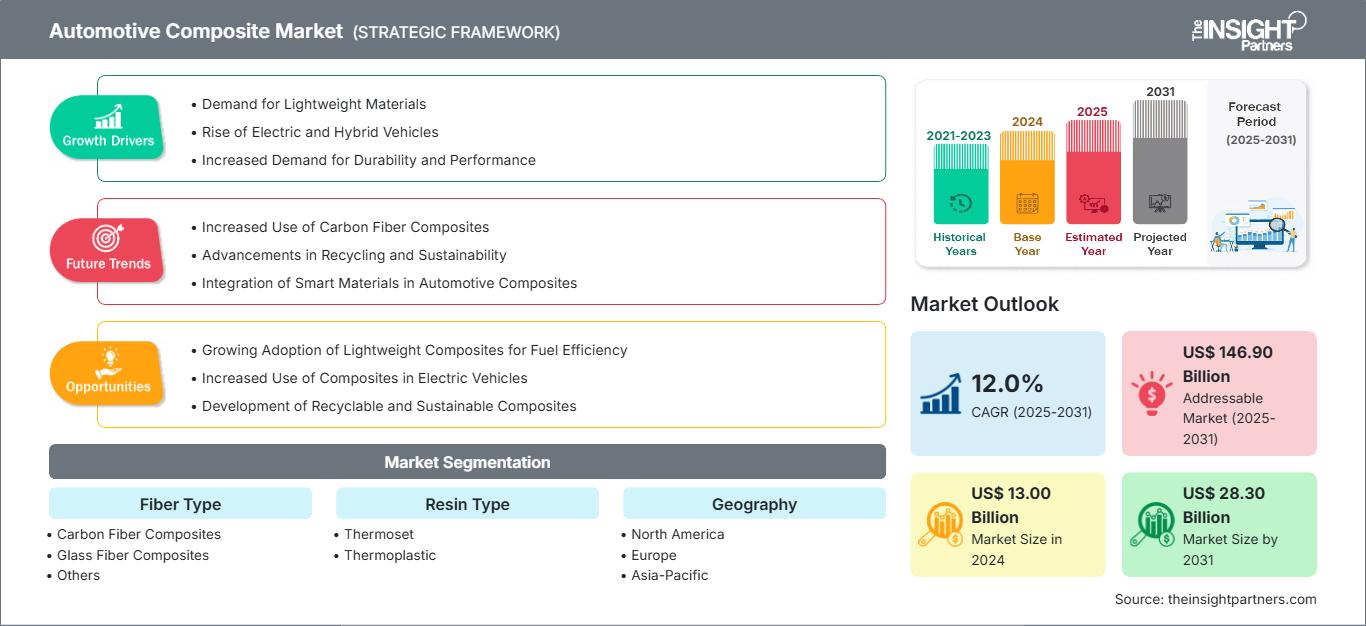
Automotive Composite Market: Strategic Insights
-
Get Top Key Market Trends of this report.This FREE sample will include data analysis, ranging from market trends to estimates and forecasts.
Automotive Composite Market Drivers and Opportunities
Market Drivers:
- Rising Demand for Lightweight and Fuel-Efficient Vehicles: The automotive composites market is primarily expected to expand due to the rising use of lightweight materials in passenger cars, commercial vehicles, and electric vehicles, where manufacturers are striving to meet more stringent fuel efficiency, performance, and emission reduction standards.
- Growing Adoption in Electric Vehicles and Advanced Mobility: Rapid growth in electric vehicles, hybrid vehicles, and autonomous mobility platforms is boosting the use of composites in battery enclosures, structural parts, and interior components to enhance range, safety, and energy efficiency.
- Increasing Focus on Emission Regulations and Sustainability Targets: Automotive OEMs are also shifting from metals to composites due to the stringent global emission norms and sustainability programs.
Market Opportunities:
- Expansion of Electric Mobility and Lightweight Vehicle Platforms: Advanced composite materials are well-suited to the ongoing transition toward electric mobility, shared mobility, and next-generation vehicle architectures, enabling structural and functional applications in vehicles.
- Demand in Commercial Vehicles and High-Performance Automobiles: The use of composites in trucks, buses, and performance vehicles continues to grow, creating new opportunities to enhance durability, load efficiency, and overall vehicle lifecycle performance.
- Advancements in Cost-Effective Manufacturing and Recycling Technologies: New thermoplastic composite technologies, automated manufacturing processes, and recycled fiber technologies are improving the viability of automotive composites for mass-market vehicle production by reducing costs and increasing scalability.
Automotive Composite Market Report Segmentation Analysis
The automotive composite market is divided into different segments to give a clearer view of its growth potential and the latest trends. Below is the standard segmentation approach used in industry reports:
By Fiber Type:
- Carbon Fiber Composites: The automotive composites market is propelled by the demand for lightweight and high-strength carbon fiber composites for EVs and high-end cars. It enhances efficiency, range, and structural performance, and it is growing with increased EV uptake, despite its high cost.
- Glass Fiber Composites: Glass fiber composites account for the largest market share and are favored because they are inexpensive, strong, and widely used in structural components, interior parts, and body panels across all types of vehicles.
- Others: The "Others" segment comprises natural and hybrid fibers, driven by the growing demand for sustainability, and is primarily used in non-structural and interior applications in the automotive industry.
By Type:
- Thermoset
- Thermoplastic
By Vehicle Type:
- Passenger Cars
- Commercial Vehicles
- Two Wheelers and Others
By Geography:
- North America
- Europe
- Asia Pacific
- Middle East & Africa
- South & Central America
Automotive Composite Market Report Scope
| Report Attribute | Details |
|---|---|
| Market size in 2025 | US$ 29.13 Billion |
| Market Size by 2034 | US$ 71.21 Billion |
| Global CAGR (2026 - 2034) | 10.4% |
| Historical Data | 2021-2024 |
| Forecast period | 2026-2034 |
| Segments Covered |
By Fiber Type
|
| Regions and Countries Covered |
North America
|
| Market leaders and key company profiles |
|
Automotive Composite Market Players Density: Understanding Its Impact on Business Dynamics
The Automotive Composite Market is growing rapidly, driven by increasing end-user demand due to factors such as evolving consumer preferences, technological advancements, and greater awareness of the product's benefits. As demand rises, businesses are expanding their offerings, innovating to meet consumer needs, and capitalizing on emerging trends, which further fuels market growth.
Automotive Composite Market Share Analysis by Geography
Growing automotive production and expanding electric vehicle manufacturing are driving the automotive composites market across North America, Europe, Asia Pacific, Latin America, the Middle East, and Africa. Demand for lightweight, durable, and fuel-efficient materials, along with stricter emission standards and the shift toward electric mobility, is further boosting the adoption of automotive composites in passenger, performance, and commercial vehicles.
The automotive composite market growth differs in each region due to the rate of economic development and consumer preferences. Below is a summary of market share and trends by region:
1. North America
- Market Share: Holds a significant share of the automotive composites market
- Key Drivers:
- High demand for lightweight and fuel-efficient materials from automotive, EV, and commercial vehicle manufacturers
- The increasing adoption of strict emissions and fuel economy standards is causing material substitution.
- Advanced research and development, and a strong automotive production base.
- Trends: Growing adoption of carbon fiber composites, recycled materials, and lightweight electric vehicle components.
2. Europe
- Market Share: Accounts for a significant share of the automotive composite market.
- Key Drivers:
- Stringent CO₂ emission regulations are encouraging the use of lightweight materials in vehicles.
- High concentration of automotive manufacturers and premium vehicle production.
- Trends: Increasing emphasis on using recyclable composite materials and the adoption of the circular economy in automotive manufacturing.
3. Asia Pacific
- Market Share: The largest and fastest-growing market
- Key Drivers:
- Rapid growth in automotive manufacturing and EV adoption
- Rising vehicle demand and a strong industrial base.
- Government investments in clean mobility and industrial development.
- Trends: High demand for cost-competitive composites, growth of automotive manufacturing capacity.
4. Middle East and Africa
- Market Share: A steadily growing market with strong long-term potential
- Key Drivers:
- Rapid growth in vehicle assembly and infrastructure investments
- Increasing focus on economic diversification and industrial development
- Expansion of the mobility and transportation modernization sector.
- Trends: Gradually progressing toward adoption in the transport and infrastructure sectors.
5. South and Central America
- Market Share: An emerging market with growing potential
- Key Drivers:
- Growth in manufacturing and transportation of automobiles.
- High costs of gasoline-powered cars
- Improved awareness of the benefits of lightweight materials.
- Trends: Automotive composites are increasingly used in vehicles and mobility applications.
High Market Density and Competition
Competition is intense due to the presence of established players such as Gurit Holding AG, Hexcel Corp, and Mitsubishi Chemical Group Corp.
This high level of competition urges companies to stand out by:
- Providing lightweight, high-strength, durable materials to enhance fuel economy, safety, and performance in passenger cars, commercial vehicles, and electric vehicles.
- Ensuring consistent quality and material performance using advanced manufacturing technologies, automated processes, and rigorous testing standards.
- Implementing eco-friendly, sustainable, and economical production systems such as recycled composites, bio-based materials, and energy-efficient production lines.
Opportunities and Strategic Moves
- Create innovative composite solutions for electric vehicles, structural automotive components, and next-generation lightweight vehicle platforms.
- Establish collaboration with automotive OEMs, EV suppliers, and Tier-1 suppliers to foster innovation.
- Invest in automation, recycling technologies, and efficient supply chains while aligning with regulatory and sustainability requirements to support faster global adoption.
Major companies operating in the automotive composite market are:
- Gurit Holding AG
- Hexcel Corp
- Mitsubishi Chemical Group Corp
- SGL Carbon SE
- Solvay SA
- Teijin Ltd
- DuPont de Nemours Inc
- Toray Industries Inc
- Atlas Fibre
- Hexion Inc
Disclaimer: The companies listed above are not ranked in any particular order.
Other companies analyzed during research:
- Elaghmore Advisor LLP
- Plasan Carbon Composites
- Jushi Group
- Röchling Group
- Owens Corning
Automotive Composite Market News and Recent Developments
- Hexcel and FIDAMC Join Forces to Shape the Future of Composite Materials.: In March 2025, FIDAMC, a leading research and technology center in composite manufacturing, and Hexcel, a global leader in composite materials production, announced a strategic partnership to drive innovation, research, and the future development of advanced composite materials.
- Hexcel Corporation Plans to Divest Its Operations in Austria.: In October 2024, Hexcel Corporation is planning to divest its operations in Neumarkt, Austria, where it has been producing composite materials since 1947. The company focuses on glass and carbon fiber-reinforced materials and serves various markets, including wind energy and automotive. In order to refocus its industrial business on preferred carbon fiber applications, Hexcel is exploring strategic options for its Austrian operations and seeking a successor for the plant.
Automotive Composite Market Report Coverage and Deliverables
The " Automotive Composite Market Size and Forecast (2021–2034)" report provides a detailed analysis of the market covering the following areas:
- Automotive composite market size and forecast at global, regional, and country levels for all segments covered under the scope
- Automotive composite market trends, as well as dynamics such as drivers, restraints, and key opportunities
- Detailed Porter's five forces analysis and SWOT analysis
- Automotive composite market analysis covering market trends, global and regional framework, major players, regulations, and recent developments.
- Industry landscape and competition analysis covering market concentration, heat map analysis, prominent players, and recent developments for the automotive composite market
- Detailed company profiles
Frequently Asked Questions

- Comprehensive Market Sizing and Forecast Analysis
- Detailed Segmentation Analysis
- In-Depth Market Dynamics Assessment
- Regional and Country-Level Insights
- Competitive Landscape and Company Benchmarking
- Strategic Business Intelligence
Recent Reports
Testimonials

The Insight Partners provided valuable market intelligence that supported our global go-to-market strategy. Their team was professional, responsive, and attentive to our feedback, providing thoughtful analysis and helpful methodological clarifications throughout the project.
Junmo Kim Chief Financial Officer (CFO), Enertech Co., Ltd.
The Insight Partners' SCADA System Market report is comprehensive, with valuable insights on current trends and future forecasts. The team was highly professional, responsive, and supportive throughout. We are very satisfied and highly recommend their services.
RAN KEDEM Partner, Reali Technologies LTDs
I requested a report on a very specific software market and the team produced the report in a few days. The information was very relevant and well presented. I then requested some changes and additions to the report. The team was again very responsive and I got the final report in less than a week.
JEAN-HERVE JENN Chairman, Future Analytica
We worked with The Insight Partners for an important market study and forecast. They gave us clear insights into opportunities and risks, which helped shape our plans. Their research was easy to use and based on solid data. It helped us make smart, confident decisions. We highly recommend them.
PIYUSH NAGPAL Sr. Vice President, High Beam Global
The Insight Partners delivered insightful, well-structured market research with strong domain expertise. Their team was professional and responsive throughout. The user-friendly website made accessing industry reports seamless. We highly recommend them for reliable, high-quality research services
YUKIHIKO ADACHI CEO, Deep Blue, LLC.
This is the first time I have purchased a market report from The Insight Partners.While I was unsure at first, I visited their web site and felt more comfortable to take the risk and purchase a market report.I am completely satisfied with the quality of the report and customer service. I had several questions and comments with the initial report, but after a couple of dialogs over email with their analyst I believe I have a report that I can use as input to our strategic planning process.Thank you so much for taking the extra time and making this a positive experience.I will definitely recommend your service to others and you will be my first call when we need further market data.
JOHN SUZUKI President and Chief Executive Officer, Board Director, BK Technologies
I wish to appreciate your support and the professionalism you displayed in the course of attending to my request for information regarding to infectious disease IVD market in Nigeria. I appreciate your patience, your guidance, and the fact that you were willing to offer a discount, which eventually made it possible for us to close a deal. I look forward to engaging The Insight Partners in the future, all thanks to the impression you have created in me as a result of this first encounter.
DR CHIJIOKE ONYIA MANAGING DIRECTOR, PineCrest Healthcare Ltd.Reason to Buy
- Informed Decision-Making
- Understanding Market Dynamics
- Competitive Analysis
- Identifying Emerging Markets
- Customer Insights
- Market Forecasts
- Risk Mitigation
- Boosting Operational Efficiency
- Strategic Planning
- Investment Justification
- Tracking Industry Innovations
- Aligning with Regulatory Trends





 Get Free Sample for